
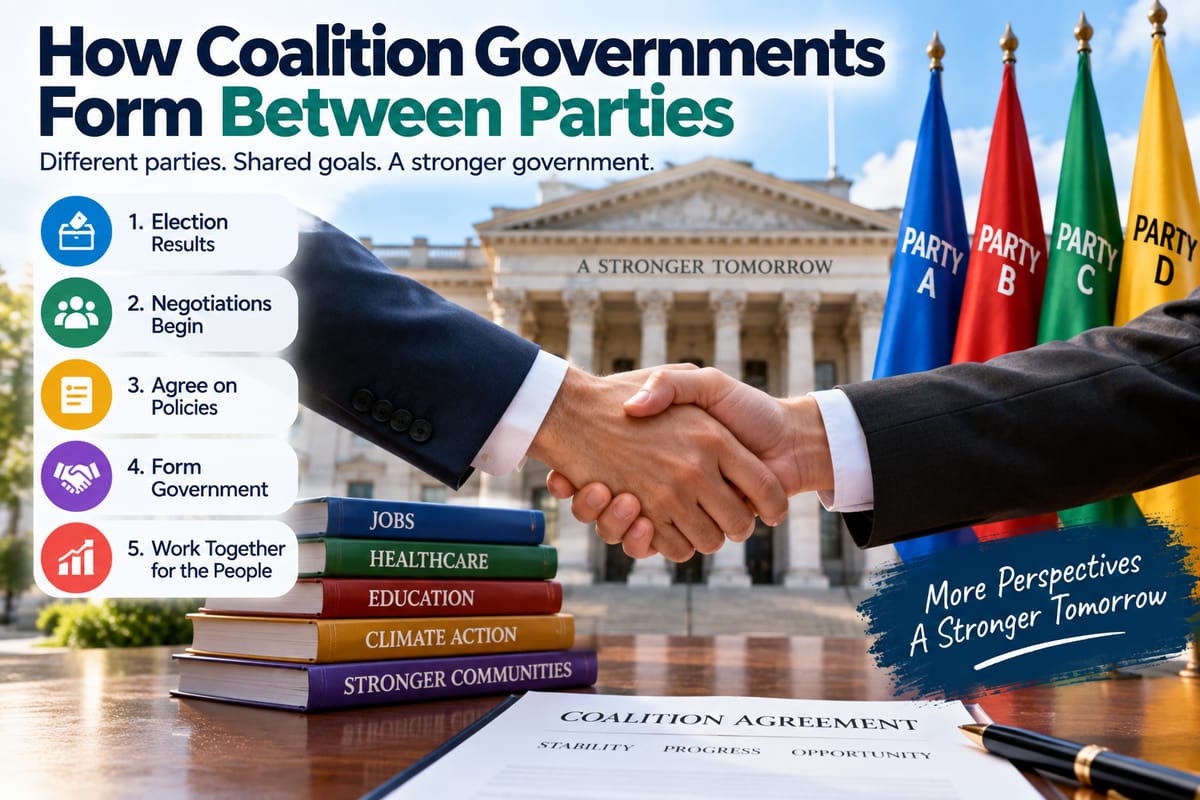
How Coalition Governments Form Between Parties
Elections do not always produce a single political party with enough seats to govern alone. In systems where several parties win representation in parliament, forming a government can require negotiation between parties with different priorities, platforms and constituencies.
The result can be a coalition government, in which two or more political parties agree to work together to form and sustain a government.
Coalition governments are particularly common in parliamentary systems with multiparty legislatures. In these systems, the government generally needs the support of parliament to take office and remain in power.
The process of forming a coalition can involve negotiations over policy priorities, the government program, ministerial positions, legislative support and procedures for resolving disagreements.
Understanding how these negotiations work helps explain what happens after an election when no party has a parliamentary majority.
What Is a Coalition Government?
A coalition government is a government formed by two or more political parties that agree to cooperate in governing.
Instead of one party controlling the government independently, participating parties share political responsibility and work together to maintain sufficient parliamentary support.
Coalitions can take different forms. Some involve parties that are relatively close ideologically, while others bring together parties with significant policy differences.
The exact rules vary by country because constitutions, electoral laws, parliamentary procedures and political traditions differ.
For a broader explanation of how different governments are structured, The Complete Guide to Political Systems provides useful background on parliamentary, presidential and other political arrangements.
Why Do Coalition Governments Form?
The most common reason is that no single party controls enough seats to govern independently.
Imagine a parliament with 100 seats where:
- Party A wins 42 seats
- Party B wins 31 seats
- Party C wins 17 seats
- Party D wins 10 seats
Party A has more seats than any other party but does not have a majority of 51 seats.
If Party A wants to form a government that can reliably command parliamentary support, it may need to negotiate with another party.
Party A and Party C together would hold 59 seats, creating a parliamentary majority.
This is a simplified example, but it illustrates why election results can lead directly to coalition negotiations.
International IDEA notes that the complexity of government formation depends substantially on the party system. Where one party regularly wins an overall majority, formation can be relatively straightforward; where multiple parties compete for parliamentary seats, negotiations become more important.
The Role of Political Parties
Political parties are central to coalition formation because they organize elected representatives around shared political programs and legislative strategies.
In parliamentary systems, parties can help determine who will form the government and who will serve in the executive.
International IDEA describes political parties as important institutional actors in government selection, including situations where the leader of a majority party or coalition becomes prime minister.
Learning how parties differ in their organization, ideology and electoral role can make coalition negotiations easier to understand. The Complete Guide to Political Parties and Party Systems explores those structures in greater detail.
Step 1: Election Results Determine the Starting Point
Coalition formation generally begins after election results establish the distribution of parliamentary seats.
The number of seats won by each party determines its bargaining position, although seat totals are not the only factor.
A relatively small party may become important if larger parties need its support to reach a majority.
For example, a party holding 10 seats in a 100-seat legislature could become particularly significant if two larger parties hold 45 and 45 seats respectively.
The smaller party could potentially provide the additional support needed by one of the larger parties to reach a majority.
This is sometimes described as a kingmaker position, although the practical influence of a smaller party depends on the country’s constitutional rules and the willingness of other parties to cooperate with it.
Step 2: Parties Assess Their Options
After an election, party leaders and their negotiating teams typically examine the available governing arrangements.
Depending on the parliamentary numbers, possible arrangements may include:
- A single-party majority government
- A formal coalition
- A minority government supported by other parties
- A confidence-and-supply arrangement
- A broader parliamentary agreement
- A temporary governing arrangement while negotiations continue
The available options depend heavily on the country’s constitutional and parliamentary rules.
In some systems, a government can take office without having a majority of seats if it can demonstrate that it is capable of obtaining sufficient parliamentary support.
Step 3: Parties Begin Negotiations
Coalition negotiations can involve several rounds of discussions.
Political parties may negotiate over:
- Government policy
- Economic priorities
- Legislative programs
- Ministerial positions
- Budget priorities
- Parliamentary procedures
- Foreign policy
- Administrative responsibilities
- Dispute-resolution mechanisms
- The length and scope of the agreement
The objective is to identify enough common ground for the parties to govern together.
These negotiations can happen formally through designated negotiating teams or informally through party leaders and parliamentary representatives.
Step 4: Parties Identify Common Ground
Coalition partners do not necessarily agree on every issue.
Instead, they generally need sufficient agreement on the issues that will form the government’s governing program.
For example, two parties might disagree about taxation but agree on:
- Infrastructure investment
- Education spending
- Certain administrative reforms
- Regional development
- Parliamentary procedures
Negotiators can use areas of agreement to construct a shared governing program.
This process can involve compromises in which each party accepts some policies it would not have pursued independently in exchange for progress on other priorities.
Step 5: A Coalition Agreement May Be Negotiated
Once parties identify potential areas of cooperation, they may produce a formal coalition agreement or government program.
Such an agreement can describe the policies and priorities that participating parties intend to pursue together.
Coalition agreements can vary enormously in length and detail.
Some may provide broad principles, while others establish detailed commitments covering taxation, spending, legislation, administrative reforms and government procedures.
The OECD notes that coalition agreements in several parliamentary countries can set out the political and economic agenda of the government for the period in which the coalition governs.
What Is a Coalition Agreement?
A coalition agreement is essentially a negotiated framework for cooperation between political parties.
It can answer questions such as:
- What policies will the government prioritize?
- Which issues require agreement between coalition partners?
- How will disagreements be handled?
- Which party receives particular ministerial responsibilities?
- How will legislation be coordinated?
- What budgetary priorities will be pursued?
The agreement can provide a common reference point for the coalition after negotiations end.
However, its legal status varies by country. A political coalition agreement may be a political commitment rather than a constitutional or statutory document.
Step 6: Parties Negotiate Cabinet Positions
Coalition formation can also involve negotiations over ministerial positions.
If multiple parties enter government, they may divide cabinet responsibilities among themselves.
For example, one party might receive responsibility for finance while another receives responsibility for education or infrastructure.
The precise method depends on the country’s constitutional arrangements and political conventions.
Ministerial appointments can be politically significant because they determine which individuals and parties oversee government departments.
However, the distribution of ministries is usually connected to the broader coalition agreement rather than being an isolated negotiation.
Step 7: A Prime Minister or Head of Government Is Selected
The next stage depends on the country’s constitutional system.
In some parliamentary systems, the leader of the party or coalition capable of commanding parliamentary support becomes prime minister.
In other systems, the head of state has a formal role in appointing or nominating a potential head of government.
Parliament may then confirm or elect that person, depending on the constitutional rules.
The OECD describes several models, including systems in which parliamentary negotiations lead to an informal agreement before a formal appointment by the head of state.
Step 8: Parliament May Need to Approve or Support the Government
Some countries require an explicit parliamentary vote of investiture or confidence before a government can fully take office.
Others allow a government to take office provided that it does not face an immediate parliamentary majority against it.
These differences are important because they determine how coalition negotiations translate into an actual government.
International IDEA emphasizes that parliamentary government formation mechanisms differ between constitutional systems and can include formal parliamentary votes, appointments and other procedures.
Majority Coalitions and Minority Governments
Not every coalition government has to contain more than half of all parliamentary seats.
A majority coalition consists of parties whose combined seats give them a parliamentary majority.
A minority government has fewer than half of the seats but remains in office because it can obtain enough support from other parties to survive parliamentary votes.
A minority government may negotiate with opposition parties on individual bills rather than giving those parties permanent cabinet positions.
This distinction is important because parliamentary support and cabinet membership are not necessarily the same thing.
Confidence-and-Supply Agreements
One arrangement between parties is known as a confidence-and-supply agreement.
Under this type of arrangement, a smaller party or group may agree to support the government on key confidence votes and budget or supply legislation without formally joining the cabinet.
This can give a government enough parliamentary support to operate while allowing the supporting party to remain outside the executive.
The exact meaning and operation of such agreements varies between political systems.
Why Smaller Parties Can Matter
Coalition negotiations can give smaller parties significant influence when larger parties cannot reach a majority without them.
Suppose a parliament has:
- Party A: 46 seats
- Party B: 38 seats
- Party C: 9 seats
- Party D: 7 seats
Party A is the largest party but has no majority.
If Party A and Party C agree to govern together, they reach 55 seats.
Alternatively, Party B could negotiate with Party C and Party D to reach 54 seats.
The smaller parties may therefore have meaningful negotiating leverage despite holding fewer seats individually.
This does not mean that smaller parties always control coalition negotiations. Their influence depends on the alternatives available to larger parties and the compatibility of their policy positions.
How Policy Differences Are Managed
Coalition partners often have different electoral platforms.
That creates a practical challenge: the government needs a coherent program even though its members represent different parties.
Negotiators may resolve disagreements through compromise.
For example, if one party favors higher public spending and another favors stricter budget control, the coalition agreement might establish spending priorities alongside fiscal limits.
Some disagreements may be left outside the coalition’s agreed program, allowing individual parties to maintain their own positions on issues that are not considered essential to government cooperation.
Party Discipline Matters
Coalition governments depend not only on agreements between party leaders but also on cooperation among legislators.
Party discipline can be important because governments need sufficient parliamentary votes to pass legislation and maintain confidence.
International IDEA notes that party discipline can be integral to maintaining a coherent government program and securing parliamentary support for legislation and budgets.
Coalition partners therefore need mechanisms for coordinating their members in parliament.
What Happens When Coalition Partners Disagree?
Disagreements are normal in coalition governments.
The important question is how those disagreements are managed.
A coalition agreement may establish procedures for resolving disputes.
Potential mechanisms can include:
- Meetings between party leaders
- Cabinet committees
- Coalition coordination committees
- Negotiations between ministers
- Parliamentary party discussions
- Formal dispute-resolution procedures
The objective is to prevent individual disagreements from automatically becoming government-wide crises.
However, some disputes may involve issues so central to a party’s identity or electoral platform that compromise becomes difficult.
What Can Cause a Coalition to Collapse?
A coalition can break down for several reasons.
These may include:
- Major policy disagreements
- Budget disputes
- Leadership conflicts
- Loss of parliamentary support
- Withdrawal of a coalition partner
- Disagreement over a major legislative proposal
- Internal divisions within a coalition party
- A confidence vote being lost
The consequences depend on the constitutional system.
A government may be replaced by another coalition, continue as a minority government or trigger an election if no alternative government can command parliamentary support and the relevant constitutional procedures require a new vote.
How Coalition Governments Affect Lawmaking
Coalition governments can influence the legislative process because legislation often needs support from multiple parties.
Before a bill is introduced or voted on, coalition parties may negotiate its contents.
This can produce legislation that reflects compromises between the participating parties.
At the same time, disagreement can make legislation more difficult to pass.
The effectiveness of a coalition therefore depends partly on whether its members can maintain sufficient agreement to support the government’s legislative program.
Coalition Governments and Political Representation
Coalition governments can bring multiple political parties into the executive.
This can mean that voters who supported different parties are represented within the governing arrangement.
The degree of representation depends on the electoral system, parliamentary seat distribution and coalition negotiations.
The broader relationship between elections, legislatures, parties and government is explored in How Political Representation Works in Legislatures and Governments.
Coalitions can therefore be understood partly as a mechanism for translating a fragmented parliamentary result into a functioning government.
Why Electoral Systems Matter
The electoral system can influence how frequently coalition governments form.
Systems that produce proportional representation often allow multiple parties to win parliamentary seats.
When several parties gain meaningful representation, a single party may be less likely to hold a majority.
By contrast, electoral systems that strongly reward the largest party can make single-party majorities more common, although this is not guaranteed.
The OECD notes that electoral-system design affects the balance between proportional representation and majoritarian outcomes, with more inclusive systems potentially encouraging multiparty representation and coalition governments.
Coalition Governments in Parliamentary Systems
Coalition governments are particularly associated with parliamentary systems because the executive depends on legislative support.
In a parliamentary system, the government generally needs parliament’s confidence to remain in office.
This creates an institutional connection between election results, party representation and government formation.
When no party has enough seats to govern alone, coalition negotiations can become an essential part of the process.
This differs from presidential systems, where the president is separately elected and can form an executive even when the president’s party does not control a legislative majority.
Coalition Governments Are Not All the Same
There is no single model of coalition government.
Two countries may both have coalition governments while using very different constitutional procedures.
Differences can involve:
- How the prime minister is appointed
- Whether parliament votes on the government
- How cabinet ministers are selected
- Whether coalition agreements are formally recognized
- How confidence votes work
- How governments can be removed
- Whether early elections are possible
- How parties are represented in parliament
For this reason, understanding the specific constitutional system of a country is essential when analyzing its coalition process.
Coalition Government and Democratic Government
Coalition governments operate within broader democratic institutions.
Democratic government involves mechanisms through which citizens participate in choosing representatives and political parties, while institutions establish how those representatives exercise public authority.
The How Democratic Governments Work and Why They Matter provides broader context for understanding elections, representation, institutions and accountability.
Coalition formation is one stage in this larger process.
Voters choose representatives, representatives form parliamentary groups, parties negotiate governing arrangements and the resulting government remains accountable through the institutions established by the country’s constitution and laws.
A Simple Example of Coalition Formation
Consider a fictional parliament with 120 seats.
The election produces:
| Party | Seats |
|---|---|
| Party A | 50 |
| Party B | 34 |
| Party C | 21 |
| Party D | 15 |
A majority requires 61 seats.
Party A is the largest party but cannot govern alone.
Several possibilities exist:
- A + B = 84 seats
- A + C = 71 seats
- A + D = 65 seats
- B + C + D = 70 seats
The parties must determine which combinations are politically and programmatically workable under the country’s rules.
They may compare policy priorities, negotiate a governing program and decide how responsibilities will be shared.
The election therefore produces the parliamentary numbers, but the coalition negotiations determine which combination can translate those numbers into a government.
What Happens After a Coalition Is Formed?
Coalition formation is not the end of the process.
Once the government takes office, coalition partners must continue coordinating their policies and parliamentary actions.
They may establish regular meetings between party leaders, ministers and parliamentary representatives.
The government must also manage ordinary responsibilities such as:
- Preparing budgets
- Introducing legislation
- Managing government departments
- Responding to emergencies
- Implementing policies
- Maintaining parliamentary support
A coalition agreement provides a framework, but continued political cooperation is necessary to keep the government functioning.
The Role of Compromise
Compromise is often an unavoidable part of coalition politics.
A party entering a coalition may not receive everything it sought during an election campaign.
Instead, it negotiates with potential partners to identify policies that can be jointly supported.
The resulting government program can therefore differ from the individual manifestos of all participating parties.
This is one reason coalition formation can take time. Parties need to determine not only whether they can share government but also what governing together will actually mean.
Coalition Negotiations and Public Accountability
Coalition negotiations can raise questions about transparency and accountability.
Citizens may want to know which parties agreed to which policies and what commitments were made during the formation process.
The degree of public disclosure varies between countries.
Some coalition agreements are published in detail, while other negotiations may involve private discussions before a final agreement is announced.
Once a government is operating, however, coalition parties remain subject to the normal parliamentary and electoral forms of accountability established by their political system.
The Broader Significance of Coalition Formation
Coalition governments demonstrate how election results can produce governing arrangements that are more complicated than simply identifying the party with the most votes.
A party can finish first without winning enough parliamentary seats to govern alone.
Several parties may then negotiate over policies, leadership, cabinet positions and parliamentary support.
The final government emerges from a combination of electoral results, constitutional rules, party negotiations and parliamentary arithmetic.
For citizens trying to understand what happens after a fragmented election, the central idea is relatively simple: when no party can command the necessary parliamentary support alone, parties may negotiate with one another to create a government capable of securing that support and governing under the country’s constitutional rules.




2 Comments
Micle harison
June 7, 2019Lorem ipsum dolor sit amet, usu ut perfecto postulant deterruisset, libris causae volutpat at est, ius id modus laoreet urbanitas. Mel ei delenit dolores.
John Doe
June 7, 2019Some consultants are employed indirectly by the client via a consultancy staffing company.