
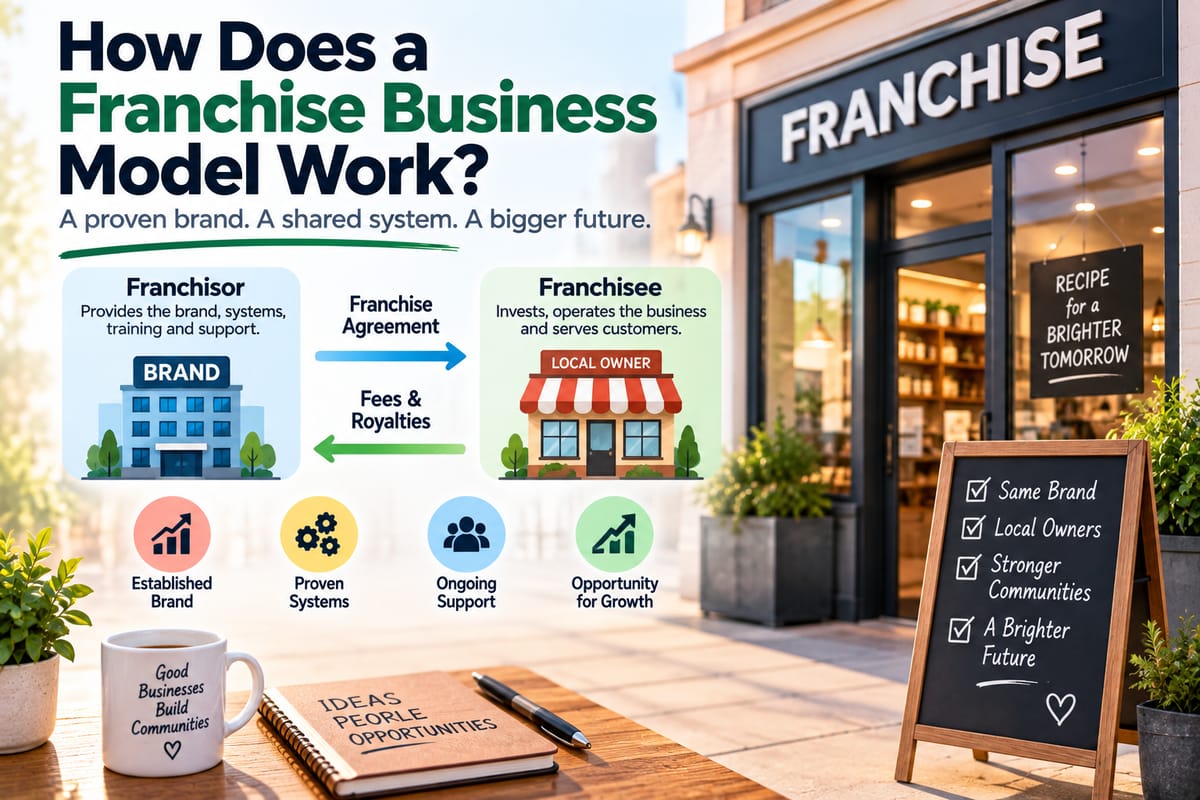
How Does a Franchise Business Model Work?
A franchise business model allows an entrepreneur to operate a business using an established company’s brand, products, systems, and operating methods. Instead of creating everything from scratch, the franchisee gains access to an existing business concept in exchange for fees and ongoing payments to the franchisor.
Franchising is common across industries, from restaurants and retail stores to education, fitness, hospitality, automotive services, and professional services. It can give entrepreneurs access to a recognized brand and proven operating framework, while allowing established companies to expand into new markets without owning and operating every location themselves.
However, buying a franchise does not mean buying a completely independent business. The relationship between the franchisor and franchisee involves specific rights, responsibilities, costs, standards, and restrictions.
Understanding how the franchise business model works is therefore important for anyone considering becoming a franchise owner or simply trying to understand how large franchise networks grow.
What Is a Franchise Business Model?
A franchise business model is a business arrangement in which one company, known as the franchisor, gives another party, known as the franchisee, the right to operate a business using its established brand and business system.
The franchisor typically provides some combination of:
- Brand name and trademarks
- Products or services
- Business processes
- Operating procedures
- Training
- Marketing support
- Technology systems
- Supplier relationships
- Store or facility design
- Ongoing operational guidance
In return, the franchisee generally pays an initial franchise fee and may also pay continuing royalties, marketing contributions, or other fees.
The franchisee usually owns and operates the individual business location, while the franchisor controls important elements of the overall brand and business system.
This creates a relationship where both sides have different responsibilities.
The franchisor focuses on maintaining and expanding the brand, developing the business system, and supporting franchise locations. The franchisee focuses on operating the individual location, serving customers, managing employees, controlling expenses, and generating revenue.
The Two Main Participants in Franchising
Understanding the difference between the franchisor and franchisee is central to understanding how the model works.
The Franchisor
The franchisor is the company that owns the brand, trademarks, intellectual property, products, services, and business system.
It develops the operating model and licenses that system to franchisees.
Depending on the industry, the franchisor may provide:
- Initial training
- Operations manuals
- Marketing materials
- Technology platforms
- Product specifications
- Supplier arrangements
- Site selection assistance
- Store design standards
- Employee training resources
- Ongoing business support
The franchisor also establishes standards that franchisees are expected to follow.
The Franchisee
The franchisee is the individual or company that receives permission to operate a franchise.
The franchisee normally invests capital into opening and running the location. Responsibilities can include:
- Finding or securing a suitable location
- Hiring employees
- Managing day-to-day operations
- Purchasing approved supplies
- Serving customers
- Managing local expenses
- Following brand standards
- Maintaining required quality levels
- Paying franchise-related fees
- Meeting financial and operational obligations
Although the franchisee has ownership or control over the individual business, that ownership comes with contractual obligations.
How Does Franchising Actually Work?
The process generally begins when an entrepreneur decides to purchase a franchise opportunity.
The prospective franchisee evaluates the brand, business model, investment requirements, operating expectations, market opportunity, and contractual terms.
If both parties agree to proceed, they enter into a franchise agreement.
The franchisee then typically invests in establishing the location and receives training and other support from the franchisor.
Once the business opens, the franchisee operates it according to the franchisor’s established system.
A simplified version of the process looks like this:
Franchise brand → Franchise agreement → Initial investment → Training and setup → Business launch → Ongoing operations → Fees and royalties → Continued franchisor support
The exact process varies significantly between industries and individual franchise systems.
What Does the Franchisee Pay For?
One of the defining characteristics of franchising is that the franchisee generally pays for access to the business system.
The costs can include several different categories.
Initial Franchise Fee
An initial franchise fee is commonly paid when entering the franchise system.
This fee provides the franchisee with certain rights under the franchise agreement, such as permission to operate under the brand and access to specified training or support.
The fee varies substantially between franchise systems.
Startup Costs
The franchise fee is only one part of the total investment.
A franchisee may also need money for:
- Real estate
- Lease deposits
- Construction
- Equipment
- Furniture
- Technology
- Inventory
- Licenses and permits
- Insurance
- Employee recruitment
- Initial marketing
- Working capital
This means an entrepreneur needs to evaluate the entire startup requirement rather than focusing only on the advertised franchise fee.
Royalties
Many franchise systems charge ongoing royalties.
These payments may be calculated as a percentage of sales, a fixed amount, or another formula specified in the franchise agreement.
For example, if royalties are based on revenue, a franchisee may owe the franchisor a predetermined percentage of sales regardless of the location’s final profit.
This distinction is important because revenue and profit are not the same thing.
A business can generate substantial sales while still facing significant expenses.
Marketing Fees
Some franchise systems also require franchisees to contribute to a marketing fund.
These funds may support national advertising, brand campaigns, digital marketing, promotional materials, or other activities intended to benefit the franchise network.
The precise use of these funds depends on the franchise agreement and the franchisor’s policies.
Why Do Businesses Use Franchising?
Franchising can provide a way for a successful business to expand without directly owning every new location.
Instead of funding and managing every outlet itself, the franchisor can work with independent franchise operators.
This can create a network of locations operating under a common brand.
For example, imagine a restaurant company has developed a successful operating system in one city.
Rather than opening and financing every new restaurant itself, it could allow qualified franchisees to open restaurants using its brand, menu, procedures, training, and supplier network.
The franchisee provides much of the capital and operational management.
The franchisor receives fees and potentially royalties while expanding its brand presence.
This is one reason franchising can become an important growth strategy.
Businesses considering different approaches to ownership, revenue generation, and expansion can also benefit from understanding the broader principles explained in the Complete Guide to Business Models and Revenue Strategies.
Why Entrepreneurs Choose Franchises
Entrepreneurs may consider franchising because it can provide access to an established business system.
Starting an independent business often requires the entrepreneur to develop everything from the ground up.
That can include:
- Creating a brand
- Developing products
- Establishing operating procedures
- Finding suppliers
- Designing marketing campaigns
- Building customer awareness
- Developing pricing strategies
- Creating training systems
A franchise may already have many of these components in place.
This does not eliminate the challenges of entrepreneurship, but it can change the type of work involved.
Instead of asking, “How do I create an entirely new business system?” the franchisee may spend more time asking, “How do I operate this established system effectively in my market?”
Franchising Is Not the Same as Starting an Independent Business
An independent business owner generally has greater freedom to determine how the business operates.
The owner can potentially choose:
- The brand identity
- Products
- Suppliers
- Pricing
- Marketing strategy
- Store design
- Business processes
- Customer experience
A franchisee typically has less flexibility because consistency is an important part of the franchise model.
For someone comparing the two approaches, understanding the broader process of entrepreneurship can be useful. The Complete Guide to Starting a Business explores the foundational decisions involved in building a business from the ground up.
The central trade-off is often independence versus access to an established system.
An independent owner may have more freedom but must develop more of the business infrastructure personally.
A franchisee may receive an established framework but must operate within defined rules.
The Importance of Standardization
Standardization is one of the most important features of franchising.
Customers generally expect a franchise brand to provide a reasonably consistent experience across locations.
A customer visiting a branded restaurant, hotel, fitness center, or service provider may expect similar products, service procedures, visual presentation, and quality standards.
To create this consistency, franchisors often establish detailed requirements.
These can cover:
- Employee procedures
- Product preparation
- Customer service
- Store appearance
- Equipment
- Branding
- Advertising
- Technology
- Inventory
- Safety procedures
- Record keeping
Standardization can help protect the identity of the brand across a large network.
At the same time, it can restrict the franchisee’s ability to experiment independently.
Training and Support
Training is another major component of many franchise systems.
New franchisees may need to learn how to operate the business before opening their location.
Training can cover areas such as:
- Business operations
- Customer service
- Sales
- Product preparation
- Technology
- Accounting procedures
- Inventory management
- Employee management
- Marketing
- Brand standards
Some franchisors also provide continuing support after the business opens.
This may include field representatives, updated training materials, operational guidance, marketing assistance, software systems, and periodic evaluations.
The amount and quality of support can differ considerably between franchise systems.
How Franchise Locations Make Money
The basic revenue process of a franchise location is similar to that of many other businesses.
The franchisee sells products or services to customers and collects revenue.
That revenue must then cover the business’s operating costs.
Typical expenses may include:
- Rent
- Employee wages
- Inventory
- Utilities
- Insurance
- Maintenance
- Technology
- Local marketing
- Taxes
- Loan payments
- Franchise royalties
- Other operating expenses
What remains after expenses represents the business’s operating profit before any applicable taxes or other owner-specific costs.
This is why franchise revenue alone does not tell the complete financial story.
A franchise with high sales can still face financial pressure if its rent, labor, inventory, royalties, or other costs are also high.
The Franchise Agreement
The franchise agreement is one of the most important documents in the relationship between the franchisor and franchisee.
It establishes the rules under which the franchise operates.
Depending on the franchise, the agreement may address:
- Franchise territory
- Contract duration
- Fees
- Royalties
- Marketing contributions
- Operating standards
- Training
- Supplier requirements
- Intellectual property
- Renewal
- Transfer of ownership
- Termination
- Dispute procedures
- Performance requirements
Because these terms can have significant financial and operational consequences, prospective franchisees generally need to understand the agreement thoroughly before committing.
Territory and Location
Location can play an important role in franchise performance.
Some franchise systems establish territories intended to define where a franchisee can operate.
Territory rules can address issues such as:
- Geographic boundaries
- Competition between franchise locations
- Customer markets
- Delivery areas
- Protected territories
- Online sales
Location selection itself can involve analyzing population, customer demand, traffic, competition, accessibility, rent, and other factors.
Even a strong franchise concept can face difficulties if a particular location does not generate sufficient customer demand.
How Franchises Maintain Brand Consistency
A franchise network depends heavily on customers recognizing and trusting the brand.
For this reason, franchisors may monitor franchise locations for compliance with established standards.
They can use:
- Regular inspections
- Performance reporting
- Customer feedback
- Quality-control programs
- Training assessments
- Technology systems
- Operational reviews
These systems are designed to ensure that individual franchise locations do not damage the broader brand.
The franchisee therefore has two related responsibilities: running a financially viable business and protecting the standards associated with the franchise brand.
The Role of Small Business Management in Franchising
Although a franchise may belong to a larger brand network, an individual franchise location often operates like a small business.
The owner may still need to manage employees, cash flow, inventory, customer relationships, scheduling, local marketing, and daily operations.
Strong management remains important even when the franchisor provides a detailed operating system.
The Complete Guide to Small Business Management provides broader context on the management responsibilities involved in running a small business.
A franchise system can provide structure, but it does not remove the need for effective leadership and financial discipline.
Advantages of the Franchise Business Model
Franchising can offer several potential advantages to both parties.
Established Brand Recognition
A franchisee may benefit from an existing brand that customers already recognize.
This can reduce some of the work associated with introducing an entirely new brand to the market.
Established Operating Procedures
The franchisee may receive a business system that has already been developed and documented.
This can provide guidance on many operational decisions.
Training and Support
Franchisees may receive initial and ongoing training that would otherwise have to be developed independently.
Shared Marketing
Franchise networks can coordinate larger marketing campaigns than an individual location might be able to finance alone.
Purchasing Relationships
Some franchise systems negotiate relationships with suppliers or establish preferred purchasing arrangements for franchisees.
Expansion for the Franchisor
For the franchisor, franchising can provide a method of expanding into new locations while franchisees provide much of the capital and local operational management.
Potential Challenges of Franchising
Franchising also comes with limitations.
Less Independence
Franchisees generally cannot make every business decision independently.
Brand standards and contractual requirements can restrict changes to products, pricing, marketing, design, and operations.
Ongoing Fees
Royalties and other recurring fees can reduce the amount of revenue available to the franchisee after expenses.
Brand Reputation Risk
A problem at one location can potentially affect customer perceptions of the wider brand.
Likewise, decisions made by the franchisor can affect franchisees even when individual owners disagree with them.
Contractual Restrictions
Franchise agreements can contain detailed requirements regarding how the business must be operated.
Market Differences
A business concept that works well in one market may encounter different customer preferences, competition, costs, or regulations in another.
Dependence on the Franchisor
Franchisees depend to some extent on the franchisor’s brand, systems, products, technology, and strategic decisions.
Is a Franchise a Scalable Business Model?
Franchising can support significant expansion because multiple independently operated locations can grow under the same brand and operating system.
This makes franchising closely connected to the broader concept of business scalability.
However, a franchise network is not automatically scalable simply because it has many locations.
Effective scaling still requires:
- Reliable operating processes
- Consistent quality
- Strong training
- Effective technology
- Supply-chain capacity
- Management systems
- Brand protection
- Financial controls
- Strong franchisee relationships
The broader principles discussed in What Makes a Business Scalable Over Time help explain why systems and repeatable processes matter when a business expands.
For a franchise network, these systems become particularly important because growth can involve hundreds or even thousands of independently operated locations.
Franchise-Owned Versus Company-Owned Locations
Many large businesses use a combination of franchise-owned and company-owned locations.
A company-owned location is operated directly by the brand.
A franchise-owned location is operated by an independent franchisee under a franchise agreement.
The two structures can coexist.
Company-owned locations can allow the brand to maintain direct control over operations and test new ideas.
Franchise locations can allow the brand to expand using franchisee investment and local management.
The balance between these approaches depends on the industry, strategy, capital requirements, and structure of the particular business.
What Makes a Franchise System Work?
A franchise relationship works best when both sides have compatible incentives.
The franchisee wants a business that can generate sufficient revenue to cover expenses and provide an acceptable return on investment.
The franchisor wants franchisees that operate effectively, maintain brand standards, and contribute to the strength of the overall network.
Several factors can support that relationship:
- A clearly defined business model
- Strong operating systems
- Effective training
- Consistent brand standards
- Transparent financial expectations
- Reliable franchisor support
- Competent local management
- Strong communication
- Appropriate territory planning
- Sustainable customer demand
When these elements work together, the franchise network can create a repeatable structure for opening and operating multiple locations.
What Should Entrepreneurs Consider Before Buying a Franchise?
A franchise should be evaluated as a business investment rather than simply as a recognizable brand.
Prospective franchisees can examine several areas before making a decision.
Total Investment
Look beyond the initial franchise fee.
Consider the full startup investment and the amount of working capital required before the location becomes financially stable.
Ongoing Expenses
Understand royalties, marketing fees, supplier costs, rent, labor, technology, insurance, and other recurring expenses.
Contract Terms
The franchise agreement determines many of the rights and obligations of the franchisee.
Operational Freedom
Entrepreneurs should understand exactly which decisions they can make independently and which require compliance with franchisor rules.
Training and Support
The quality and extent of training and ongoing support can significantly affect the experience of operating the franchise.
Market Demand
A recognizable brand does not guarantee sufficient demand in every location.
Local demographics, competition, customer behavior, and operating costs still matter.
Exit Options
Potential franchisees should also understand the rules surrounding renewal, sale, transfer, and termination of the franchise.
The Difference Between Buying a Brand and Buying a System
One of the most important concepts in franchising is that the franchisee is generally not paying only for a name.
The value of a franchise can also come from the system behind the name.
That system can include:
Brand + Products + Processes + Training + Technology + Marketing + Suppliers + Operational Support
The combination is what creates the franchise format.
A recognizable logo alone would not provide much operational value without a functioning business system behind it.
Why Systems Matter as Franchise Networks Grow
Imagine a company operating one successful location.
The owner can personally oversee almost every aspect of the operation.
Now imagine the company has 500 locations.
The original owner cannot personally manage every employee, customer interaction, inventory order, marketing campaign, or operational decision.
The business therefore needs systems that can be repeated across locations.
Franchising is built around this principle.
The franchisor develops a model that can be transferred to independent operators while maintaining enough consistency to preserve the brand.
That makes documentation, training, technology, measurement, and communication essential parts of a large franchise network.
Building a Business Within a Larger Business System
A franchise occupies an interesting position in the business world.
It provides entrepreneurs with the opportunity to operate their own location while participating in a larger commercial network.
The franchisor supplies the brand, business framework, and support structure.
The franchisee supplies investment, local management, employees, and day-to-day execution.
The model can therefore combine elements of entrepreneurship and standardized corporate systems.
For entrepreneurs, the most important distinction is that franchising offers a predefined path rather than complete independence. The business owner receives access to an established framework but accepts contractual responsibilities in return.
Understanding that balance makes it easier to see why franchising has become such a widely used approach to business expansion.
Turning a Franchise Concept Into a Working Business
A franchise business model works by connecting an established business system with independent operators who invest in and manage individual locations.
The franchisor provides the brand, intellectual property, operating framework, training, and ongoing support. The franchisee invests capital and takes responsibility for running the local business according to the agreed standards.
Revenue generated by the franchise location must cover operating expenses, franchise-related fees, and other costs before the franchisee can realize a profit.
The model’s strength comes from repeatability. When a business has reliable processes that can be taught, measured, and reproduced across different locations, it becomes possible to expand a recognizable brand without requiring the original company to directly operate every outlet.
For entrepreneurs, the key is understanding what they are actually buying: not simply a famous name, but participation in a defined business system with financial obligations, operating requirements, and shared responsibilities.




2 Comments
Micle harison
June 7, 2019Lorem ipsum dolor sit amet, usu ut perfecto postulant deterruisset, libris causae volutpat at est, ius id modus laoreet urbanitas. Mel ei delenit dolores.
John Doe
June 7, 2019Some consultants are employed indirectly by the client via a consultancy staffing company.