
How Hydropower Generates Electricity From Water
Water can do far more than support ecosystems, agriculture and human life. When it moves with enough force, it can also be used to generate electricity.
Hydropower, also called hydroelectric power, is one of the oldest large-scale methods of producing electricity from a renewable natural resource. It works by converting the energy of moving or falling water into mechanical energy and then into electrical energy.
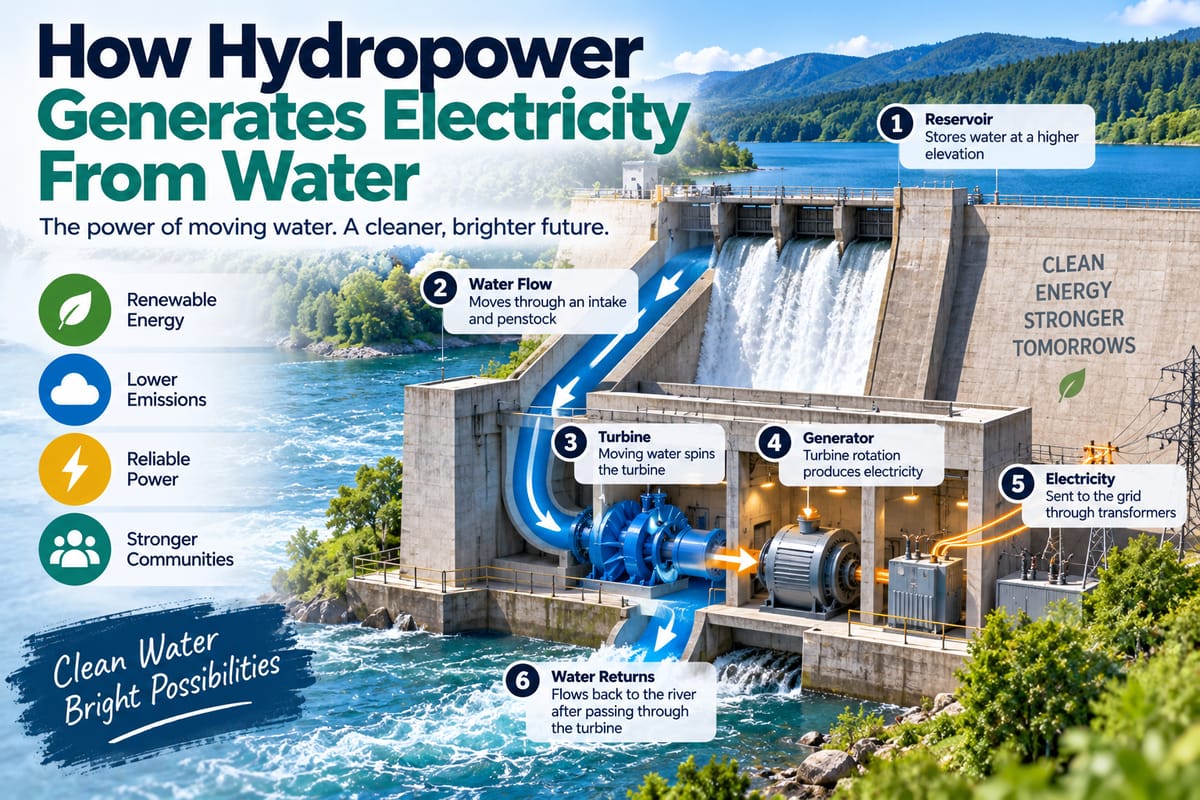
The basic idea is straightforward: water moves a turbine, the turbine turns a generator, and the generator produces electricity.
Behind that simple process, however, is a carefully designed system involving dams, reservoirs, waterways, turbines, generators, transmission equipment and environmental management.
Understanding how hydropower works helps explain why moving water is such an important energy resource and how it fits into the broader transition toward different forms of electricity generation.
What Is Hydropower?
Hydropower is electricity generated by harnessing the energy contained in moving water.
Water has potential energy when it is stored at a higher elevation. When that water is allowed to move downward, gravity converts some of that potential energy into kinetic energy.
A hydropower facility captures this movement and directs the water through equipment designed to extract useful energy.
The process can be summarized as:
Stored water → Moving water → Turbine rotation → Generator → Electricity
The amount of electricity that can be generated depends largely on how much water is moving and how much elevation difference, or hydraulic head, is available.
Why Moving Water Contains Energy
Water itself does not automatically produce electricity. The energy comes from its movement and position.
Consider water stored behind a dam. Because the reservoir is higher than the turbines below it, gravity can cause the water to flow downward when a controlled passage is opened.
The higher the water is stored, the greater its potential energy can be.
Similarly, a river flowing downhill possesses kinetic energy that can potentially be captured by a turbine.
This relationship between water, gravity and elevation is fundamental to conventional hydropower.
The Main Parts of a Hydropower Plant
Although hydropower facilities vary considerably in size and design, many contain several basic components.
These can include:
- Reservoir
- Dam
- Intake
- Penstock
- Turbine
- Generator
- Powerhouse
- Transformer
- Transmission lines
- Spillway
- Tailrace
Each component performs a different role in moving water through the system and converting its energy into electricity.
How a Hydropower Dam Works
A dam can create a reservoir by holding back a large volume of water.
The reservoir provides a controlled supply of water that can be released through the power plant when electricity is needed.
The dam also creates an elevation difference between the water stored upstream and the turbines located downstream or lower within the facility.
When operators allow water to pass through the intake, gravity pulls it toward the turbines.
The dam therefore serves more than one purpose. It can store water, control its movement and create the conditions needed to extract energy from its flow.
Not every hydropower facility requires a large dam, however. Some systems use the natural flow of a river with relatively limited storage.
How Water Reaches the Turbine
Once water enters the hydropower system, it must be directed toward the turbine.
In many conventional facilities, water travels through a large pipe called a penstock.
The penstock can carry water from the reservoir or intake toward the turbine under significant pressure.
As the water moves through the system, its stored energy is transformed into kinetic and pressure energy.
When the water reaches the turbine, it transfers energy to the turbine blades.
How Hydropower Turbines Work
A turbine is a mechanical device designed to rotate when moving water pushes against its blades or buckets.
There are several turbine designs, and the appropriate type depends on factors such as water flow and hydraulic head.
Common hydropower turbines include:
- Francis turbines
- Kaplan turbines
- Pelton turbines
Francis Turbines
Francis turbines are widely used in hydropower facilities and are suitable for a broad range of operating conditions.
Water enters the turbine and flows through its runner, causing it to rotate.
Kaplan Turbines
Kaplan turbines are generally associated with relatively high water flow and lower hydraulic head.
Their adjustable blades allow the turbine to operate efficiently across changing flow conditions.
Pelton Turbines
Pelton turbines are designed for high-head applications.
Instead of surrounding the turbine runner with a continuous flow of water, high-speed water jets strike specially shaped buckets attached to the runner.
The impact causes the turbine to rotate.
From Turbine Rotation to Electricity
The turbine itself does not directly produce electricity.
Its main job is to provide mechanical rotation.
The rotating turbine is connected to a generator.
Inside the generator, mechanical energy is converted into electrical energy through electromagnetic induction.
In simplified terms, the rotation causes magnetic fields and electrical conductors to interact in a way that produces an electric current.
The process is:
- Water moves through the turbine.
- The turbine rotates.
- The turbine shaft turns the generator.
- The generator converts mechanical energy into electrical energy.
- Electrical power is sent through transformers and transmission equipment.
This is the central energy-conversion process behind hydroelectric power.
What Happens Inside the Generator?
A hydropower generator contains components that create and respond to magnetic fields.
The turbine shaft turns the generator’s rotating component, commonly called the rotor.
The rotor’s magnetic field interacts with electrical conductors in the stationary part of the generator, known as the stator.
This interaction produces alternating electrical current.
The electricity then passes through electrical equipment that prepares it for transmission.
The generator is therefore the point where the mechanical energy obtained from moving water becomes usable electrical energy.
Why Transformers Are Needed
Electricity generated at a power plant is not necessarily transmitted at the same voltage used by consumers.
Transformers can increase the voltage for efficient long-distance transmission.
Higher transmission voltages reduce energy losses associated with resistance in electrical lines.
Closer to where electricity is consumed, other transformers can reduce the voltage to levels appropriate for distribution systems.
The hydropower plant is therefore connected to a much larger electricity network.
What Happens to the Water After It Passes Through the Turbine?
After transferring much of its usable energy to the turbine, the water exits through a passage called the tailrace.
It can then return to the river downstream.
Importantly, the water itself is not consumed during electricity generation.
The same water can continue downstream and participate in the natural water cycle.
This is one of the fundamental differences between hydropower and electricity generation methods that require fuel to be consumed.
Run-of-River Hydropower
Not all hydropower plants rely on large reservoirs.
Run-of-river systems use the natural flow of a river or stream to generate electricity.
Some water is diverted through a channel or pipeline and directed toward turbines before being returned to the river.
Because these facilities may have relatively little storage, their electricity output can depend more directly on river conditions.
During periods of high flow, generation may increase. During droughts or low-flow periods, generation can decline.
Pumped-Storage Hydropower
Pumped-storage hydropower works differently from conventional hydropower.
It uses electricity to pump water from a lower reservoir to a higher reservoir when electricity is available or demand is relatively low.
Later, when electricity demand increases, the stored water is released downhill through turbines to generate electricity.
This makes pumped storage function somewhat like a large-scale energy storage system.
The facility is not simply generating new energy from water. It is storing electrical energy in the form of elevated water and recovering some of that energy later.
Why Hydropower Is Considered Renewable
Water is continuously moved through the Earth’s hydrological cycle.
Solar energy drives evaporation, water vapor forms clouds, precipitation returns water to the surface and gravity moves water through rivers and other systems.
Because hydropower relies on this naturally recurring water cycle rather than a finite fuel that is burned during generation, it is generally classified as a renewable energy source.
The broader distinction between renewable and finite energy resources is explored in Renewable vs Nonrenewable Resources Explained.
However, renewable does not mean that hydropower facilities have no environmental effects.
The construction and operation of dams and other infrastructure can substantially alter rivers and surrounding ecosystems.
Hydropower and Natural Resources
Water is one of many natural resources that societies use to support economic activity and daily life.
Rivers can provide drinking water, irrigation, transportation, fisheries, recreation and energy.
Using water for electricity generation therefore needs to be considered alongside its other roles.
The relationship between natural resources and human societies is explored more broadly in How Natural Resources Support Human Civilization.
Hydropower planning often requires decisions about how water should be managed among different users.
How Much Electricity Can Hydropower Generate?
The electricity output of a hydropower facility depends primarily on two important physical factors:
- Water flow: How much water passes through the turbine
- Hydraulic head: How far the water falls or the pressure available to drive the turbine
A simplified relationship can be expressed as:
Power ≈ water density × gravity × flow rate × hydraulic head × efficiency
This means that a facility with a large amount of flowing water and a substantial elevation difference can potentially generate significant amounts of electricity.
The efficiency of the turbine and generator system also affects the final output.
Why Hydropower Can Be Highly Responsive
Some hydropower facilities can adjust their electricity production relatively quickly.
When electricity demand changes, operators can modify the amount of water flowing through the turbines.
This can make certain hydropower plants useful for balancing electricity systems.
Reservoir-based facilities may have particularly useful operational flexibility because stored water can be released when generation is needed, subject to water-management requirements and other constraints.
Pumped-storage facilities can provide another form of flexibility by storing electricity and generating it later.
Hydropower and Electricity Grid Stability
Electricity supply and demand must remain closely balanced.
If demand increases suddenly, electricity systems need generation or other resources capable of responding.
Some hydropower plants can change their output relatively quickly compared with certain forms of generation that are designed to operate at more constant output.
This flexibility can be valuable in electricity systems that contain substantial amounts of variable renewable generation.
Wind and solar power, for example, depend on weather and sunlight. Hydropower with suitable storage can sometimes provide electricity when those sources are producing less.
Environmental Effects of Hydropower
Hydropower has important environmental advantages, but it can also create significant ecological changes.
Large dams can:
- Flood land
- Alter river flows
- Change sediment movement
- Affect fish migration
- Transform aquatic habitats
- Change water temperatures
- Affect downstream ecosystems
- Alter local landscapes
The scale of these effects varies greatly from one project to another.
A small run-of-river installation can have a very different environmental footprint from a massive reservoir project.
How Dams Affect River Ecosystems
Rivers are dynamic systems.
They transport water, sediment, nutrients and organisms downstream.
A dam can interrupt some of these natural processes.
When sediment accumulates behind a reservoir, less sediment may continue downstream. This can change the physical characteristics of downstream habitats and river channels.
Dams can also affect fish that depend on migration between different parts of a river system.
Modern hydropower planning can incorporate measures intended to reduce these effects, but the effectiveness of such measures depends on the particular ecosystem and project design.
Hydropower and Communities
Large infrastructure projects can affect communities as well as ecosystems.
Creating a reservoir may require land to be flooded, potentially affecting homes, agricultural areas, cultural sites and other resources.
In some cases, communities may need to relocate.
Hydropower projects can also create economic opportunities through construction, employment, improved infrastructure and electricity access.
The social consequences of a project therefore depend on its location, design, scale, planning process and how affected communities are involved.
Hydropower Compared With Other Energy Sources
Hydropower is one part of a diverse electricity system.
Different energy sources have different characteristics.
| Energy source | Primary energy input | Renewable? | Key characteristic |
|---|---|---|---|
| Hydropower | Moving or falling water | Yes | Can provide flexible generation in suitable systems |
| Solar | Sunlight | Yes | Output varies with sunlight |
| Wind | Moving air | Yes | Output varies with wind conditions |
| Coal | Coal | No | Fuel is burned to produce heat |
| Natural gas | Natural gas | No | Fuel is burned to produce heat |
| Nuclear | Nuclear fuel | No, under conventional classification | Produces heat through nuclear reactions |
| Geothermal | Earth’s internal heat | Generally classified as renewable | Uses heat from beneath Earth’s surface |
The appropriate combination of energy sources depends on geography, resources, infrastructure, demand, environmental considerations and economic conditions.
How Hydropower Fits Into the Water Cycle
Hydropower does not operate separately from Earth’s natural systems.
The water used by rivers and reservoirs is part of the global hydrological cycle.
Water evaporates, condenses, falls as precipitation and moves across or beneath the Earth’s surface.
This continuous movement is central to both hydropower and ecosystems.
Understanding the physical processes that shape Earth’s surface and water systems can provide useful context. The Earth Science and Geology Complete Guide explores the broader science behind Earth’s physical systems.
Does Hydropower Use Up Water?
In a conventional hydropower plant, water is not destroyed or consumed as fuel.
It passes through the turbines and continues downstream.
However, reservoirs can experience water losses through evaporation, and water-management decisions can affect how much water is available for electricity generation at different times.
Hydropower therefore does not consume water in the same way that a fossil-fuel plant consumes fuel, but water availability remains a critical factor in its operation.
What Happens During Droughts?
Hydropower depends on water availability.
When precipitation decreases and river flows fall, reservoirs and run-of-river systems may have less water available for electricity generation.
Severe droughts can therefore reduce hydropower output.
This illustrates an important characteristic of renewable energy: renewable resources can still be affected by natural variability.
A hydropower system with substantial reservoir storage may be able to manage short-term fluctuations more effectively than a system that relies almost entirely on current river flow, but prolonged drought can affect both.
Hydropower and Climate Change
Changes in temperature and precipitation patterns can affect water availability in different regions.
Changes in rainfall, snowpack, evaporation and extreme weather can influence river flows and reservoir levels.
At the same time, hydropower can contribute electricity without directly burning fossil fuels during generation.
This creates a complex relationship between hydropower and a changing climate.
The long-term performance of individual hydropower systems depends on local geography, watershed conditions, infrastructure and future water availability.
Hydropower Versus Waste-to-Energy
Hydropower and waste-to-energy are both methods of generating electricity from resources that would otherwise serve different purposes.
Hydropower captures energy from moving water.
Waste-to-energy systems can use certain waste materials as fuel to produce heat and electricity.
These approaches operate through very different physical processes. How Waste-to-Energy Systems Generate Electricity explains how waste materials can be converted into useful energy.
Why Hydropower Remains Important
Hydropower combines several characteristics that make it valuable in many electricity systems.
It can provide substantial electricity generation where suitable water resources and geography exist. Some facilities can also store water, adjust generation and provide electricity when demand changes.
At the same time, hydropower projects can involve substantial environmental and social considerations.
There is therefore no single model for hydropower development.
A run-of-river facility, a small reservoir and a major dam can have very different benefits, risks and operating characteristics.
The Basic Hydropower Process in One View
The entire process can be reduced to a sequence of energy transformations:
1. Water is stored or naturally flows at elevation.
2. Gravity causes water to move downhill.
3. The moving water flows through a turbine.
4. The turbine converts water’s energy into mechanical rotation.
5. The turbine turns a generator.
6. The generator converts mechanical energy into electrical energy.
7. Transformers adjust the electricity for transmission.
8. Transmission and distribution systems deliver the electricity to users.
9. The water continues downstream and remains part of the hydrological cycle.
This process demonstrates one of the central ideas in energy science: energy can change from one form into another.
The Future of Hydropower
Hydropower is likely to remain part of electricity systems where suitable rivers, reservoirs and geographic conditions exist.
Future development can involve improving existing facilities, upgrading turbines and generators, adding modern monitoring systems, improving environmental protections and using pumped storage to support electricity-system flexibility.
At the same time, decisions about new hydropower projects must consider water availability, ecosystems, communities and competing demands for rivers and reservoirs.
The fundamental principle remains remarkably simple: use the movement of water to turn a turbine, use the turbine to turn a generator, and use the generator to produce electricity.
What makes hydropower significant is how effectively that simple physical process can be integrated into large electricity systems while working within the limits of Earth’s water resources.





2 Comments
Micle harison
June 7, 2019Lorem ipsum dolor sit amet, usu ut perfecto postulant deterruisset, libris causae volutpat at est, ius id modus laoreet urbanitas. Mel ei delenit dolores.
John Doe
June 7, 2019Some consultants are employed indirectly by the client via a consultancy staffing company.