
How Teams Adapt During Competition
Competition rarely unfolds exactly as teams expect.
A strategy that works during preparation may become less effective once an opponent responds. A key player may pick up a minor injury, weather conditions may change, fatigue can accumulate, or an opposing team may discover a weakness that was not obvious before the contest began.
The ability to adapt under those circumstances is one of the defining characteristics of successful team performance.
Adaptation does not necessarily mean abandoning the original game plan. More often, it involves making calculated adjustments while preserving the principles that shaped the strategy in the first place.
From changing formations and defensive assignments to managing player workloads and responding to an opponent’s tendencies, teams constantly make decisions as competition develops.
Why Adaptation Matters in Sports
Every competitive environment contains uncertainty.
Teams can prepare extensively, but preparation cannot account for every possible development during a game or match. Opponents are actively trying to disrupt plans, exploit weaknesses and create situations that force uncomfortable decisions.
Adaptation allows a team to respond rather than simply continue executing a plan that is no longer producing the desired results.
A basketball team might change its defensive coverage after an opponent begins attacking a particular matchup. A soccer team may alter its pressing strategy after the opposition consistently breaks through the first line of pressure. A volleyball team might change its serving targets after identifying a weakness in the opponent’s reception.
The specific adjustment depends on the sport, but the underlying principle remains similar: observe what is happening, interpret the information and modify the response.
Preparation Creates the Foundation for Adaptation
Good in-competition adaptation begins long before the contest starts.
Physical preparation, technical development and tactical understanding give athletes the tools they need to respond when circumstances change.
A strong physical foundation is particularly important because fatigue can affect decision-making as well as physical execution. The Complete Guide to Fitness for Athletes provides broader context on the physical qualities athletes need to perform consistently.
When athletes are physically prepared, coaches have more options available during competition. Players may be able to maintain intensity, execute tactical changes and recover between demanding sequences more effectively.
Preparation also includes understanding the team’s own strengths and weaknesses.
A team cannot adapt effectively if its players do not understand the tactical principles they are expected to follow.
Coaches Monitor the Game for Signals
Adaptation begins with observation.
Coaches and support staff monitor patterns throughout competition, looking for evidence that the original strategy is succeeding or failing.
They may examine:
- Where the opponent is creating scoring opportunities
- Which players are consistently winning or losing individual matchups
- How effectively the team is controlling possession or territory
- Whether defensive pressure is working
- How fatigue is affecting movement
- Which tactical patterns are producing opportunities
- Whether the opponent has changed its own approach
Some information is immediately visible, while other information may emerge only after several possessions, plays or phases of competition.
The challenge is distinguishing a meaningful pattern from a temporary event.
A single successful attack does not necessarily indicate a major tactical weakness. Repeated success in the same area may provide much stronger evidence.
Athletes Must Adapt, Too
Adaptation is not solely a coaching responsibility.
Athletes make constant decisions during competition, often with limited information and almost no time to think.
A defender may recognize that an opponent is repeatedly attempting the same move. A midfielder may notice that a passing lane has opened. A tennis player may realize that a particular serve is becoming predictable.
These observations can lead to immediate adjustments.
Athletes with a strong understanding of athletic performance principles can connect physical execution, technical skill, decision-making and tactical awareness rather than treating them as separate elements.
That allows players to respond more effectively when a competition moves away from the original plan.
Tactical Adjustments Can Change the Direction of a Contest
One of the clearest forms of adaptation involves tactics.
Teams can alter formations, defensive structures, pressing intensity, attacking patterns or the areas they target.
Consider a soccer team that begins a match using a high defensive line. If the opponent repeatedly finds space behind the defense, the coaching staff may instruct defenders to drop deeper.
The change could reduce the space available for through balls, but it might also surrender some territory.
This illustrates an important feature of adaptation: every adjustment creates trade-offs.
Changing one part of a strategy can solve one problem while creating another.
That is why how tactics create advantages in different sports is closely connected to the broader concept of adaptation. Tactical decisions are not simply about choosing an action; they involve evaluating how that action changes the competitive environment.
Opponent Analysis Helps Teams Make Better Adjustments
Teams enter competition with information about their opponents.
Coaches may study previous matches, identify common formations, examine individual tendencies and analyze how an opponent responds to pressure.
During the competition itself, that preparation can become a reference point for new decisions.
If an opponent behaves differently from what was expected, the team has to determine whether the change is intentional, situational or simply the result of the circumstances.
This makes opponent analysis and its effect on sports strategy an important part of competitive preparation.
The best analysis does not simply catalog what an opponent usually does. It helps teams understand why certain behaviors occur and what conditions might cause them to change.
In-Game Communication Keeps Adjustments Organized
Adaptation becomes much harder when players receive conflicting instructions.
Clear communication helps ensure that everyone understands what has changed and what remains the same.
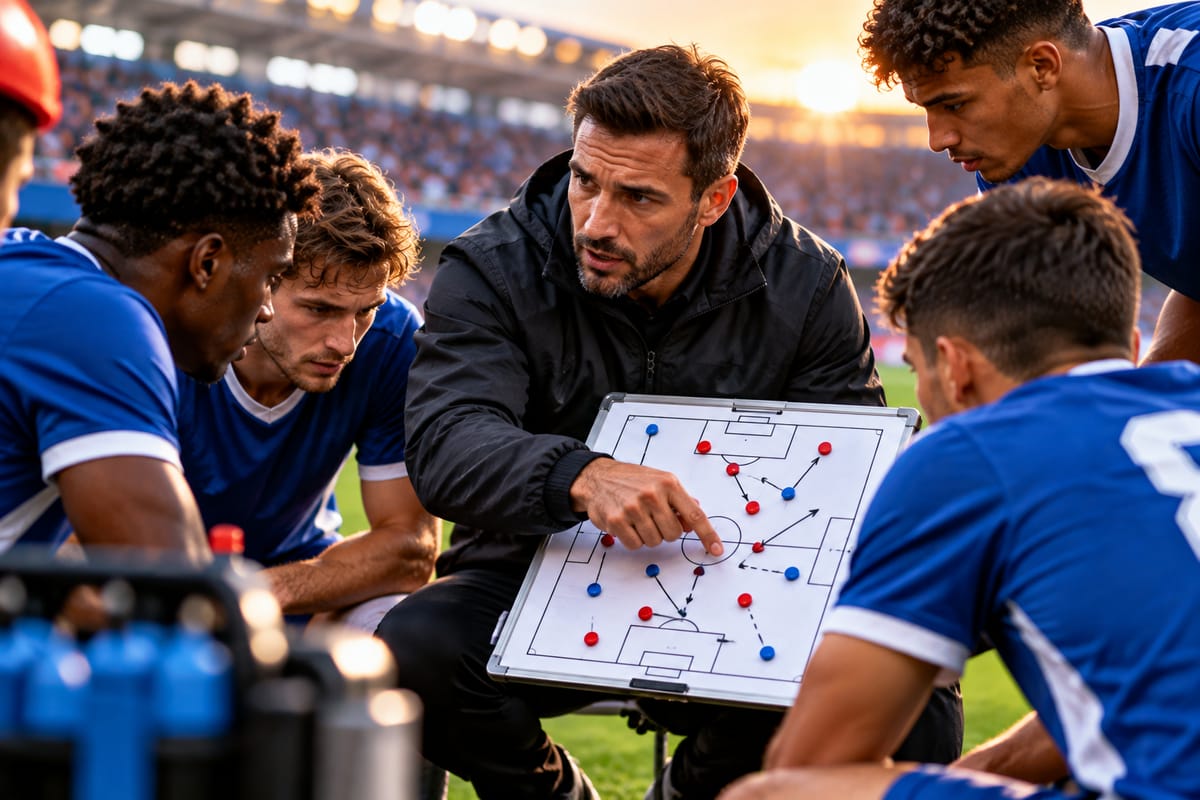
Coaches may communicate adjustments during timeouts, substitutions or stoppages. Players also communicate directly with teammates throughout the contest.
In some sports, the communication window may be only a few seconds.
A basketball coach might use a timeout to change a defensive coverage. A volleyball coach can provide instructions during a timeout between sets or rotations. In soccer, coaches may communicate from the sideline while players make smaller adjustments themselves.
The most effective communication is often simple.
Players do not necessarily need a lengthy explanation in the middle of competition. They need to understand what they should do differently and why the change matters.
Substitutions Can Be Part of Tactical Adaptation
Player substitutions are another important adaptation mechanism.
A substitution may be made because of injury or fatigue, but it can also be tactical.
A coach may introduce a faster player to exploit space, a stronger defender to protect a lead or a player with a particular technical skill to change the rhythm of the contest.
Substitutions can therefore alter the team’s tactical possibilities.
They can also influence the opponent’s decisions.
If an opposing team recognizes that a new player creates a particular threat, it may have to change its defensive approach. That adjustment can create opportunities elsewhere.
In this way, adaptation can become a continuous cycle in which one team’s decision triggers a response from the other.
Fatigue Changes the Tactical Equation
Physical fatigue can fundamentally alter how teams compete.
As athletes become tired, sprinting capacity, reaction speed, concentration and technical execution can decline.
Coaches therefore have to consider not only what strategy is theoretically effective but also what their players can realistically execute at a particular stage of the contest.
A high-intensity pressing strategy may be effective early in a match but become increasingly difficult to maintain later.
Similarly, a team may deliberately slow the pace when protecting a lead because controlling possession can reduce the number of high-intensity situations it must defend.
This is where physical preparation and tactical planning intersect.
A team’s ability to adapt depends partly on the physical resources available to execute the new strategy.
Teams Also Adapt to Game State
The score and remaining time can significantly influence decision-making.
A team that is leading late in a contest may prioritize risk management. A team that is behind may need to accept greater risk to create scoring opportunities.
The same tactical approach can therefore have very different value depending on the circumstances.
For example, a basketball team protecting a small lead may prioritize possession and high-percentage shots. A team trailing late in the game may attempt quicker attacks or more aggressive defensive pressure.
In soccer, a team protecting a narrow advantage may become more conservative, while a team behind may push additional players forward.
These changes demonstrate that tactics cannot be separated from context.
Weather and Playing Conditions Can Force Changes
Environmental conditions can also influence adaptation.
Rain can affect the speed and control of a ball. Strong winds can alter passing and shooting decisions. Extreme heat can increase the physical demands of competition.
Outdoor teams may therefore need contingency plans for changing conditions.
The adjustment could involve reducing the number of long passes, modifying defensive positioning or changing the pace of play.
Teams that have practiced different approaches before competition are generally better positioned to respond when conditions change unexpectedly.
Data and Technology Are Increasingly Supporting Adaptation
Modern teams have access to more performance information than ever before.
Video analysis, tracking systems and statistical tools can provide information about movement, possession, shot locations, player workloads and tactical patterns.
During or between competition periods, this information can help coaching staffs identify trends that might otherwise be difficult to see.
However, data does not automatically produce the correct decision.
Numbers need context.
A statistical change may reflect a tactical adjustment, an unusual sequence of events, player fatigue or differences in opponent behavior.
The value of technology comes from combining information with coaching expertise and the observations of athletes.
Not Every Adjustment Works
Adaptation carries risk.
A team may identify a genuine problem but choose an ineffective solution. It may react too quickly to a small sample of events or make too many changes at once.
Constant tactical changes can also create confusion.
Players need enough stability to understand their roles and execute them confidently.
This creates a balance between flexibility and consistency.
A team that refuses to change may become predictable. A team that changes constantly may lose its identity and structure.
Effective adaptation generally involves making changes that are purposeful rather than simply reacting to every event.
Learning From Failed Adjustments Matters
Not every competition will produce successful decisions.
A tactical adjustment that fails can nevertheless provide valuable information.
Teams can examine why the change did not work. Perhaps the players lacked the physical capacity to execute it. Maybe the opponent anticipated the adjustment. Or perhaps the strategy solved one problem while creating a larger one elsewhere.
Post-competition analysis allows teams to turn these experiences into future preparation.
Over time, this can expand a team’s tactical options.
Instead of having one preferred game plan, a team can develop several approaches that can be activated depending on the situation.
Adaptation Is a Continuous Competitive Process
The most interesting competitions often involve multiple layers of adjustment.
One team changes its approach. The opponent responds. The first team recognizes the response and makes another adjustment.
This creates a tactical conversation that continues throughout the contest.
At the individual level, athletes are doing something similar.
A tennis player changes serve placement. The opponent adjusts position. The server notices the new position and changes the next serve.
In basketball, a defender changes how they guard a screen. The offensive player recognizes the adjustment and changes the attack.
In team sports, these individual decisions occur simultaneously across the playing area.
Building Teams That Can Respond Under Pressure
The ability to adapt is ultimately connected to preparation, communication, awareness and decision-making.
Teams need physical conditioning so athletes can continue executing under fatigue. They need tactical principles so players understand what they are trying to accomplish. They need opponent analysis so unexpected behaviors can be recognized. And they need communication systems that allow adjustments to be made without creating unnecessary confusion.
Adaptation does not mean abandoning preparation.
In many cases, the best-adapted teams are those with the strongest preparation because their players understand the underlying principles well enough to modify their actions without losing structure.
Competition will always produce situations that cannot be predicted perfectly.
What separates one performance from another is often how effectively a team recognizes those moments, evaluates what is happening and responds with a coordinated adjustment.




2 Comments
Micle harison
June 7, 2019Lorem ipsum dolor sit amet, usu ut perfecto postulant deterruisset, libris causae volutpat at est, ius id modus laoreet urbanitas. Mel ei delenit dolores.
John Doe
June 7, 2019Some consultants are employed indirectly by the client via a consultancy staffing company.