
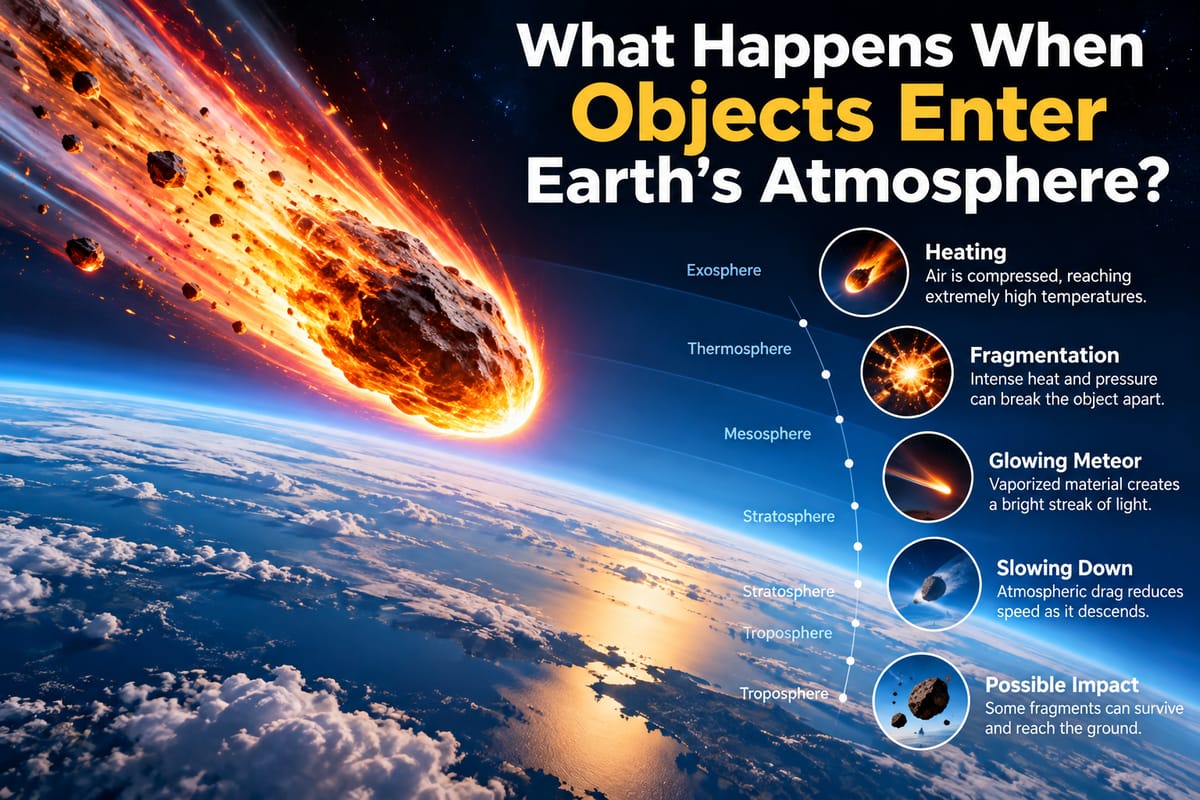
What Happens When Objects Enter Earth’s Atmosphere?
Earth’s atmosphere is constantly interacting with objects moving through space. Most are tiny particles that burn up high above the surface, while larger objects can produce spectacular flashes of light, sonic booms, or, in rare cases, reach the ground.
The outcome depends on several factors, including an object’s size, composition, speed, angle of entry, and the density of the atmosphere along its path.
Objects entering Earth’s atmosphere can include natural meteoroids, fragments from asteroids and comets, spacecraft, satellites, and human-made debris. Although these objects can approach Earth at enormous speeds, the atmosphere acts as a powerful barrier that can slow, heat, fragment, or completely destroy them.
Understanding this process provides a useful connection between space and Earth’s environment and helps explain why most small objects from space never reach the ground.
For a broader introduction to space science, The Complete Guide to Astronomy explores the major objects and processes that shape our understanding of the universe.
What Is Earth’s Atmosphere?
Earth’s atmosphere is the layer of gases surrounding the planet.
It is composed primarily of nitrogen and oxygen, along with smaller amounts of other gases and variable quantities of water vapor.
The atmosphere does not have a sharply defined outer boundary. Instead, it gradually becomes thinner with increasing altitude before blending into the surrounding space environment.
Different atmospheric layers have different temperatures, densities, and characteristics. These differences affect how incoming objects interact with the air.
The Complete Guide to Earth’s Atmosphere, Weather and Air provides additional background on the structure and behavior of the atmosphere.
Why Do Objects Heat Up During Atmospheric Entry?
One of the most visible effects of atmospheric entry is intense heating.
An object moving through the atmosphere at high speed compresses the air in front of it. The air can become extremely hot, while friction and other aerodynamic processes also contribute to heating.
The resulting temperatures can be high enough to melt or vaporize material from the object’s surface.
This process is commonly described as ablation when material is removed from an object’s surface by intense heating.
The glowing material and surrounding heated gas can create the bright streak associated with a meteor.
Does Friction Cause All Atmospheric Heating?
Friction is often used as a simple explanation for why spacecraft and meteors become hot, but the physics is more complicated.
At very high speeds, the compression of air in front of an incoming object is a major source of heating. The gas becomes extremely energetic as it is compressed and disturbed by the object’s passage.
The object’s shape, speed, atmospheric density, and flow of gas around its surface all influence the heating process.
This is why atmospheric-entry vehicles require carefully designed heat shields and aerodynamic profiles.
What Is a Meteoroid?
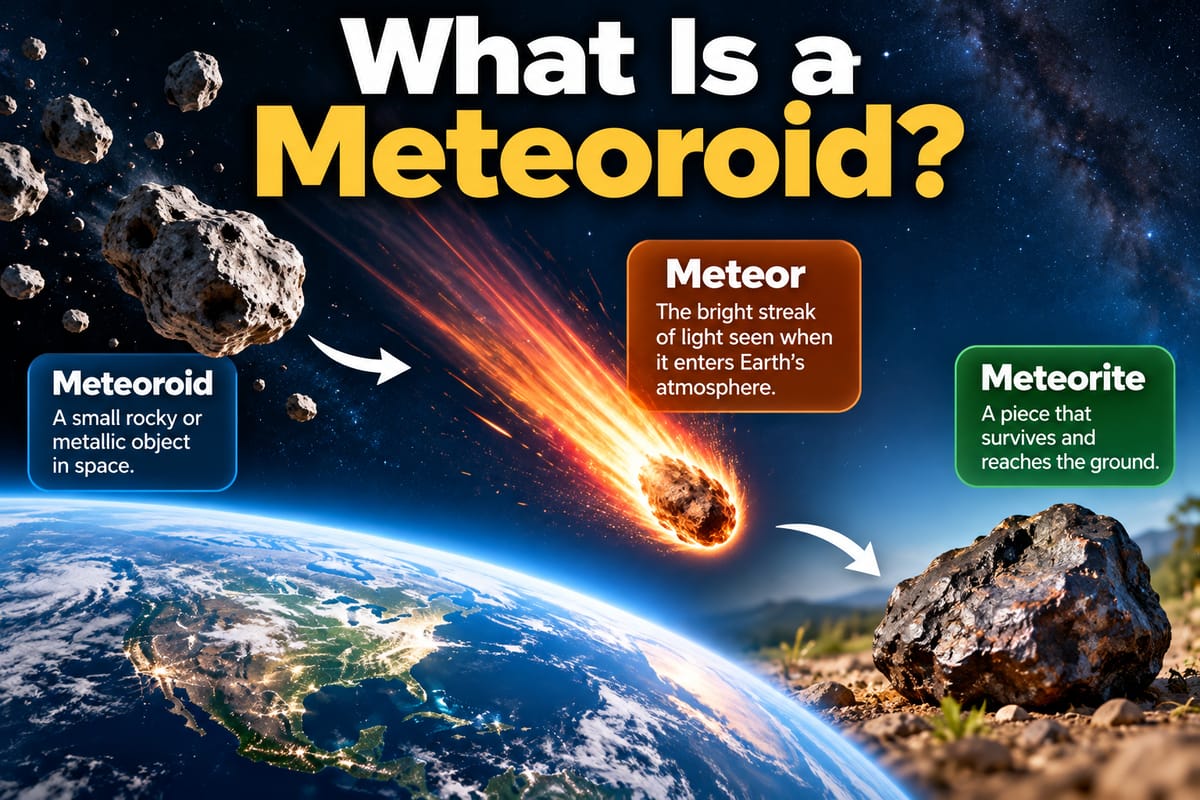
A meteoroid is a relatively small natural object traveling through space.
Meteoroids can originate from asteroids, comets, or collisions between larger objects. They can range from tiny particles to much larger rocky or metallic bodies.
When a meteoroid enters Earth’s atmosphere and produces a visible streak of light, the phenomenon is called a meteor.
If part of the object survives the atmospheric journey and reaches the ground, the recovered material is called a meteorite.
These terms describe different stages of the same general process.
Why Do Meteors Glow?
The bright streak of a meteor comes from the interaction between the incoming object and the atmosphere.
As the meteoroid travels rapidly through the air, it creates a highly energized region around itself. Material can be removed from the object while gases become excited and emit light.
The result can be a brief flash or a long, bright streak across the sky.
Most meteors last only a few seconds or less, although particularly bright events can be visible for longer.
What Happens to Small Objects?
Very small particles usually lose their material quickly as they pass through the atmosphere.
Dust-sized particles can slow down and become heated, while larger grains and fragments may produce visible meteors.
Many small objects are completely consumed or fragmented before reaching the surface.
This is one reason the atmosphere provides a significant degree of natural protection against the constant stream of small material entering Earth’s environment.
What Happens to Larger Objects?
Larger objects can behave very differently.
Because they contain more mass, they may not lose all of their material before reaching lower altitudes. Their size and composition can allow some or much of the original object to survive.
However, a larger object can also experience intense stresses as atmospheric pressure increases during descent.
The result can be fragmentation.
When an incoming object breaks apart, the pieces can spread across a wider area and create multiple luminous trails.
Why Do Some Objects Explode in the Atmosphere?
An incoming object can experience rapidly increasing aerodynamic pressure as it encounters denser air.
If the stresses exceed the object’s structural strength, it can break apart.
A sudden breakup can produce a powerful atmospheric explosion, sometimes called an airburst.
An airburst does not require the object to reach the ground. Significant energy can instead be released in the atmosphere.
The size, speed, composition, and structural strength of the object all influence how it behaves.
What Is a Meteor Shower?
A meteor shower occurs when Earth passes through a region of space containing numerous particles associated with a comet or, in some cases, an asteroid.
These particles enter the atmosphere along related trajectories, creating the appearance that meteors are emerging from a particular region of the sky.
The apparent point from which the meteors originate is called the radiant.
Meteor showers demonstrate that atmospheric entry is not limited to isolated objects. Earth’s orbit regularly carries the planet through streams of debris left behind by other bodies in the solar system.
Why Do Some Objects Survive?
Survival depends on more than size.
Composition is important. Metallic objects can behave differently from porous or fragile rocky material. Shape also matters because it affects aerodynamic forces and heating.
Entry speed and angle influence how much time an object spends traveling through different atmospheric densities.
A steep, fast entry can create intense heating and forces, while a shallow trajectory can produce a longer path through the atmosphere.
An object’s internal structure also matters. A strong, coherent body may survive conditions that cause a weaker object of similar mass to fragment.
What Happens When Spacecraft Enter the Atmosphere?
Human-made spacecraft also experience extreme conditions during atmospheric reentry.
Unlike a natural meteoroid, a spacecraft can be deliberately designed to survive the process.
Spacecraft returning from orbit travel at very high speeds. Their trajectory must be carefully controlled so that they encounter the atmosphere at an appropriate angle and speed.
A spacecraft entering too steeply can experience severe heating and aerodynamic forces. An overly shallow trajectory can also create problems by failing to produce the desired descent.
This is why atmospheric reentry is a carefully engineered part of many space missions.
The Role of Orbital Mechanics
Before an object can return from orbit, its motion must be changed.
A spacecraft in orbit is moving sideways at very high speed while continuously falling around Earth. To begin a controlled return, its velocity and trajectory must be altered.
This is governed by orbital mechanics.
The principles described in What Is Orbital Mechanics and How Does It Control Spacecraft Motion? help explain how spacecraft trajectories are calculated and adjusted.
Atmospheric entry is therefore not simply a matter of pointing a spacecraft toward Earth. Its velocity, trajectory, timing, and position all have to be considered.
How Gravity Affects Incoming Objects
Gravity is another major part of the story.
Earth’s gravity pulls objects toward the planet, but an object’s motion through space is determined by the combination of gravity and its existing velocity.
An object approaching Earth can accelerate as it falls deeper into the planet’s gravitational field.
The interaction between velocity and gravity determines the object’s trajectory before it encounters significant atmospheric resistance.
The broader principles are explored in How Gravity Controls Motion and Orbits in Space.
Atmospheric Drag Slows Objects Down
Once an object enters increasingly dense air, atmospheric drag becomes significant.
Drag is a force that opposes an object’s motion through the atmosphere.
The strength of drag depends on factors including:
- Object speed
- Object size
- Object shape
- Atmospheric density
- Surface characteristics
- Angle of travel
At high altitudes, the atmosphere is extremely thin, so drag is relatively limited. As the object descends, increasing air density can dramatically increase aerodynamic resistance.
This can reduce the object’s speed and change its trajectory.
Why Entry Speed Matters
The speed of an incoming object strongly influences its behavior.
Natural meteoroids can enter the atmosphere at very high velocities. Spacecraft returning from low Earth orbit also possess enormous kinetic energy.
The faster an object moves, the greater the energy involved in its interaction with the atmosphere.
A faster object can therefore experience severe heating and aerodynamic forces even if it is relatively small.
Speed also influences how much energy can be released if an object fragments or stops rapidly.
The Importance of Entry Angle
The angle at which an object enters the atmosphere can significantly affect its journey.
A relatively steep trajectory can cause an object to descend rapidly through increasingly dense air. This can produce intense heating and aerodynamic stresses.
A shallow trajectory can keep an object traveling through the atmosphere for a longer distance.
For spacecraft, the entry angle must be controlled carefully. For natural objects, the angle is determined by their incoming trajectory.
Different entry angles can therefore produce very different outcomes even for objects of similar size and composition.
What Happens to Space Debris?
Earth’s orbit contains human-made objects and fragments left over from space activities.
These include inactive satellites, spent rocket stages, fragments created by collisions, and other debris.
Some objects eventually lose orbital energy because of atmospheric drag and descend toward Earth.
For objects in low Earth orbit, even the extremely thin upper atmosphere can gradually reduce orbital energy.
As an object descends, atmospheric density increases, which increases drag and accelerates orbital decay.
Eventually, the object can enter the denser atmosphere and undergo reentry.
Does All Space Debris Burn Up?
No.
Whether an artificial object completely burns up depends on its size, materials, structure, orientation, and trajectory.
Some objects may disintegrate almost entirely. Others can survive partially and produce fragments that reach the surface.
Dense materials and compact components can be particularly resistant to atmospheric heating.
This is one reason engineers conduct reentry analyses when assessing the end-of-life behavior of satellites and spacecraft.
What Happens During a Controlled Reentry?
A controlled reentry is designed to guide a spacecraft toward a predetermined region.
Mission planners can calculate a trajectory that brings the vehicle into the atmosphere under known conditions.
The spacecraft’s heat shield or thermal protection system absorbs and manages the enormous heat generated during entry.
The vehicle then slows as it travels through denser air.
Depending on the spacecraft, additional systems such as parachutes, wings, lifting surfaces, or propulsion may be used during the later stages of descent.
How Heat Shields Protect Spacecraft
Heat shields are designed to protect spacecraft from extreme temperatures during atmospheric entry.
Different spacecraft use different thermal protection technologies.
Some systems rely heavily on ablative materials. These materials gradually decompose, melt, or vaporize and carry heat away from the spacecraft.
Other vehicles use reusable thermal protection systems designed to withstand repeated exposure.
The design depends on the spacecraft’s expected speed, mass, shape, mission profile, and reentry conditions.
What Happens to the Air Around an Incoming Object?
The atmosphere does more than simply slow an incoming object.
At extremely high speeds, the gas surrounding the object can become so energetic that molecules break apart and become ionized.
This creates a plasma-like region around the object.
The resulting flow can interfere with radio communications during portions of some atmospheric reentries.
This communication blackout is associated with the intense plasma created around certain spacecraft during high-speed entry.
Why Reentry Produces Sonic Booms
Objects traveling faster than the speed of sound can generate shock waves.
A spacecraft or other large object moving through the atmosphere can therefore produce a sonic boom.
The sound results from pressure waves generated as the object travels faster than those waves can move through the surrounding air.
Depending on the trajectory and altitude, people on the ground may hear a loud boom as the shock wave reaches them.
What Happens When an Object Reaches the Ground?
If part of a natural object survives atmospheric entry and lands on Earth, it becomes a meteorite.
Meteorites can provide valuable information about the early solar system because some contain materials that have remained relatively unchanged for billions of years.
Scientists can analyze their minerals, chemical composition, isotopes, and physical structures.
Some meteorites are fragments of asteroids, while others originate from bodies such as the Moon or Mars.
Why Atmospheric Entry Matters to Astronomy
Atmospheric entry provides scientists with opportunities to study material from space without sending a spacecraft to retrieve every sample.
Meteorites can be collected and examined in laboratories. Bright meteors can be observed using cameras and other instruments. Larger atmospheric events can provide information about the properties of incoming objects.
Astronomers can therefore learn about the solar system by studying what happens when space material interacts with Earth’s atmosphere.
The Atmosphere as a Natural Shield
Earth’s atmosphere provides a remarkable protective barrier.
Every day, enormous numbers of tiny particles encounter the planet. Most are slowed, heated, fragmented, or vaporized before they can reach the surface.
The atmosphere is not an impenetrable shield, however.
Larger objects can survive, fragment, or release significant energy before reaching the ground. The planet’s atmosphere reduces the number of objects that reach the surface, but it cannot eliminate the possibility entirely.
Atmospheric Entry Is a Battle Between Motion and Air
An object entering Earth’s atmosphere undergoes a dramatic transformation.
Its original trajectory is influenced by Earth’s gravity. As it encounters increasingly dense air, drag begins to slow it. Compression and aerodynamic heating raise temperatures around the object, while physical stresses can cause fragmentation.
Small objects may disappear completely. Larger objects may produce spectacular meteors or airbursts. Some fragments can survive to become meteorites, while engineered spacecraft can use carefully designed thermal protection systems to make a controlled return possible.
From natural meteoroids to returning spacecraft, atmospheric entry demonstrates how closely Earth’s environment is connected to the wider space around it. What begins as an object traveling through the near-vacuum of space can become a rapidly changing interaction involving gravity, aerodynamics, heat, plasma, and atmospheric chemistry—all within a matter of minutes.




2 Comments
Micle harison
June 7, 2019Lorem ipsum dolor sit amet, usu ut perfecto postulant deterruisset, libris causae volutpat at est, ius id modus laoreet urbanitas. Mel ei delenit dolores.
John Doe
June 7, 2019Some consultants are employed indirectly by the client via a consultancy staffing company.