
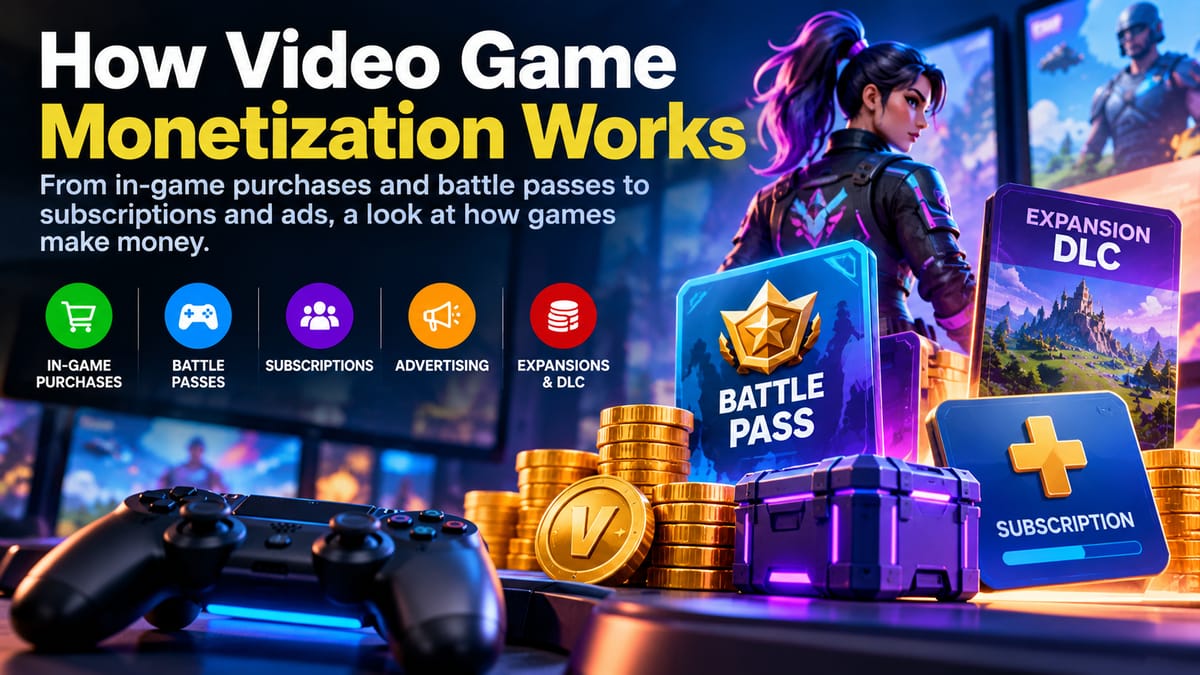
How Video Game Monetization Works
Video games have evolved from products people purchased once into expansive entertainment ecosystems that can generate revenue long after a player first downloads or buys a game.
A modern game may make money through a traditional upfront purchase, downloadable content, subscriptions, advertising, virtual items, battle passes, expansions or a combination of several models. Some games are free to play but generate substantial revenue from a relatively small percentage of highly engaged players.
Understanding how video game monetization works provides a useful look at both the business behind gaming and the strategies developers use to keep players engaged.
For a broader introduction to the medium, the Complete Guide to Video Games and Gaming explores how games are created, distributed and experienced across different platforms.
What Is Video Game Monetization?
Video game monetization refers to the methods developers, publishers and platforms use to generate revenue from games.
The basic idea is straightforward: a company creates and operates a game, while players provide revenue through one or more transactions.
The complicated part is determining when, how and how often players pay.
A traditional console game might generate most of its revenue when someone purchases it. A free-to-play mobile game, by comparison, may generate little or no money from the initial download and instead rely on purchases made inside the game.
Live-service games can go even further by maintaining revenue streams for years through seasonal content, cosmetic items, expansions and other offerings.
The Traditional Premium Game Model
One of the oldest monetization models is the premium game.
Under this approach, players pay an upfront price to purchase the game. Historically, this usually meant buying a physical disc or cartridge. Today, digital storefronts account for a substantial portion of game distribution.
The basic model remains familiar:
- A developer creates the game.
- A publisher or developer distributes it.
- The player pays an upfront price.
- The player receives access to the game.
Revenue from the initial sale can help cover development, marketing, distribution and platform costs.
Premium games can also generate additional revenue after launch through expansions and downloadable content.
Digital Distribution Changed the Business
Digital storefronts have transformed how games are sold.
Players can now purchase and download games directly through consoles, PCs, smartphones and other devices without visiting a physical retailer.
This reduces some traditional distribution costs and makes it easier for developers to continue selling games long after their original release.
Digital distribution also allows publishers to run discounts, bundles and special promotions while collecting information about purchasing behavior.
For smaller developers, digital storefronts can make it possible to reach international audiences without building a traditional physical distribution network.
Free-to-Play Games
The free-to-play model removes the upfront financial barrier.
Players can download and begin playing without purchasing the game. Revenue is generated through optional transactions made after the player enters the game.
This model is particularly common in mobile gaming, online multiplayer games and live-service titles.
The attraction for developers is scale.
Removing the purchase price can potentially increase the number of people who try the game. The business then depends on converting a portion of those players into paying customers.
A free game therefore does not mean that the business model has disappeared. Instead, the payment point has moved deeper into the player experience.
In-Game Purchases
In-game purchases allow players to buy digital goods or services while playing.
These can include:
- Character outfits
- Weapon skins
- Emotes
- Virtual currency
- Cosmetic items
- Character customization
- Boosts
- Additional content
- Convenience features
The specific approach varies considerably between games.
Some developers restrict purchases to cosmetic items that do not affect gameplay. Others sell items that can influence progression or provide various advantages.
The design of these systems can have a significant effect on how players perceive a game.
Cosmetic Items
Cosmetic monetization has become one of the most recognizable approaches in modern gaming.
A cosmetic item changes how a character, weapon, vehicle or other object looks without necessarily changing its underlying performance.
For example, a player might purchase a special character outfit simply because they like its appearance.
The appeal is connected to personalization and self-expression.
In multiplayer environments, cosmetic items can also become part of a player’s identity within a gaming community.
Because the items are digital, developers can continue creating new designs after launch without requiring players to purchase an entirely new game.
Virtual Currency
Many games use an internal currency system.
Instead of purchasing every item directly with real-world money, players first buy virtual currency. They can then spend that currency on items or services within the game.
This can simplify transactions and give developers more flexibility when designing different price points.
However, virtual currencies can also make it less immediately obvious how much an individual purchase costs in real-world terms.
For that reason, transparency around pricing has become an important consideration in discussions about digital game monetization.
Battle Passes
Battle passes have become another major monetization system, particularly in multiplayer games.
A battle pass typically provides a series of rewards that players unlock by playing the game and completing objectives during a specific period.
There may be a free track and a paid track.
The paid version can provide additional cosmetic items, currency or other rewards. Players are often encouraged to keep playing throughout the season because rewards are distributed across multiple levels.
This creates a connection between monetization and engagement.
Instead of asking players to make one large purchase, the system encourages continued participation over a period of weeks or months.
Seasonal Content
Many modern games operate around seasons.
Each season can introduce new maps, characters, challenges, story elements, cosmetics or gameplay features.
Seasonal content provides developers with regular opportunities to introduce new monetization options.
It also gives players reasons to return.
This model is particularly important for live-service games, where the goal is not simply to sell a game once but to maintain an active community over an extended period.
Downloadable Content and Expansions
Downloadable content, commonly known as DLC, provides another source of revenue.
DLC can range from relatively small additions to major expansions that significantly increase the size of a game.
Small DLC packages might include cosmetic items or additional missions. Larger expansions can introduce new areas, characters, storylines and gameplay systems.
For publishers, expansions can extend the commercial life of a successful game.
For players, they can provide additional experiences without requiring the developer to create an entirely new standalone title.
Subscription-Based Gaming
Subscriptions introduce recurring revenue into gaming.
Players may pay monthly or annually for access to a game, a collection of games or additional services.
Subscription models can take several forms.
A service might provide a rotating library of games, while another could offer multiplayer access, discounts and additional benefits.
Subscriptions can make revenue more predictable for companies because customers pay repeatedly rather than making a single purchase.
They also encourage companies to continually add value to the service to reduce cancellations.
Advertising in Games
Advertising is another monetization method, particularly in mobile and free-to-play games.
Developers can display advertisements during gameplay or offer optional advertisements in exchange for rewards.
For example, a player might choose to watch an advertisement to receive additional virtual currency or another in-game benefit.
Advertising allows developers to generate revenue from players who never make direct purchases.
However, too much advertising can disrupt the gaming experience, so developers have to balance revenue generation against player satisfaction.
Rewarded Advertising
Rewarded advertising is designed to make advertisements feel more like an optional exchange.
Instead of forcing a player to watch an advertisement, the game may offer a reward for choosing to view one.
Common rewards include:
- Extra lives
- Virtual currency
- Temporary boosts
- Additional attempts
- In-game resources
This approach can work particularly well in mobile games because it gives players some control over when advertisements appear.
The Importance of Player Engagement
Monetization works best when players continue returning to a game.
That makes engagement one of the most valuable assets in modern gaming.
Developers can encourage engagement through new content, competitive events, social features, progression systems and regular updates.
A player who remains active for months or years has many more opportunities to generate revenue than someone who downloads a game once and never returns.
This is one reason live-service games have become such an important part of the industry.
Live-Service Games
A live-service game is designed to evolve after its initial release.
Instead of considering launch day the end of development, the developer continues operating and updating the game.
These updates may include:
- New characters
- Maps
- Missions
- Events
- Cosmetic items
- Competitive seasons
- Balance changes
- Story content
The ongoing nature of the model creates an ongoing relationship between the company and its players.
That relationship can support recurring revenue through several monetization systems at once.
How Free-to-Play Games Can Make Money From Non-Paying Players
An interesting feature of free-to-play economics is that non-paying players can still be valuable.
A large active player base can make a game more attractive to paying customers.
For multiplayer games, having plenty of players helps matchmaking and creates a healthier community. Players who spend money may also be more likely to remain engaged when the game has an active population.
Non-paying players can therefore contribute indirectly to the ecosystem even when they never make a purchase.
The Role of Whales
Some free-to-play businesses generate a significant portion of their revenue from a relatively small number of high-spending players.
These customers are sometimes described in the industry as “whales.”
The economics behind this model mean that developers do not necessarily need every player to spend money.
Instead, they may design an ecosystem in which a small percentage of highly engaged customers account for a large share of revenue.
This can make the balance between monetization and player experience particularly important.
Monetization and Game Design Are Closely Connected
Modern monetization cannot always be separated from game design.
Progression systems, reward structures, events and social features can all influence whether players make purchases.
For example, a game may introduce a limited-time event alongside exclusive cosmetic items. The event encourages players to return, while the items create an opportunity for spending.
This means monetization is often incorporated into the structure of the experience rather than added as an entirely separate business function.
Why Limited-Time Offers Are Common
Limited-time offers create a sense of scarcity.
A cosmetic item or bundle might only be available for several days or during a particular season.
The temporary availability can encourage players to make a purchase sooner rather than waiting indefinitely.
From a business perspective, these events can create predictable periods of increased activity and spending.
However, aggressive use of scarcity can also frustrate players, particularly when they feel pressured to purchase something before it disappears.
Gaming Communities Can Influence Revenue
Gaming is inherently social for many players.
Communities form around multiplayer games, esports, streaming, social media and online discussion platforms.
This community activity can indirectly support monetization.
Popular cosmetic items, competitive events and new releases can become topics of conversation, encouraging additional players to participate.
Major gaming events can also create enormous attention around upcoming releases. For example, Gamescom Opening Night Live demonstrates how announcements, trailers and demonstrations can generate anticipation around the wider gaming ecosystem.
Esports Creates Additional Revenue Opportunities
Competitive gaming adds another layer to the business.
Esports organizations and publishers can generate revenue through sponsorships, media rights, ticket sales, merchandise and advertising.
Successful competitive games can benefit from the attention generated by professional players and tournaments.
This creates a feedback loop in which the game itself becomes both a product and an entertainment property.
The relationship between gaming and the wider entertainment economy is explored further in How Entertainment Companies Make Money.
Merchandise Extends Games Beyond the Screen
A successful game can become a broader intellectual property.
Characters and stories may appear on clothing, toys, collectibles, books and other merchandise.
This creates revenue opportunities outside the game itself.
Merchandise can also strengthen brand recognition and keep a game or franchise visible between major releases.
For companies with large entertainment portfolios, gaming can therefore become one part of a much broader commercial ecosystem.
Cross-Media Franchises Create New Revenue Streams
Some games exist within larger entertainment franchises.
A successful gaming property may eventually appear in movies, television shows, animation or other media.
The reverse can also happen when an established film or television franchise becomes the foundation for a video game.
This interconnected approach allows companies to monetize intellectual property across multiple formats.
The broader economics of this strategy are covered in How the Entertainment Industry Makes Money.
The Role of Platforms
Game developers do not operate entirely independently.
Console manufacturers, PC storefronts and mobile app platforms can play a significant role in distribution and monetization.
Platform owners may take a percentage of digital transactions conducted through their stores.
They can also provide payment infrastructure, user accounts, cloud services, advertising opportunities and subscription programs.
For developers, platform economics are therefore an important part of determining how much revenue ultimately reaches the company.
Mobile Gaming Uses a Particularly Flexible Model
Mobile games have become closely associated with free-to-play monetization.
The smartphone environment makes it easy for players to download a game, begin playing and make purchases without leaving the application.
Mobile games can combine several monetization systems, including:
- In-app purchases
- Virtual currency
- Advertising
- Subscription benefits
- Battle passes
- Cosmetic items
- Limited-time events
The combination allows developers to serve different types of players.
Someone who does not want to spend money can continue playing for free, while another player may purchase optional items or premium benefits.
Premium Games Are Not Disappearing
Despite the growth of free-to-play games, premium games remain an important part of the industry.
Many major releases continue to use an upfront purchase model, sometimes combined with expansions, cosmetic content or optional multiplayer services.
The difference is that modern games can combine several monetization strategies rather than relying on only one.
A premium game might generate revenue through its initial sale and later through expansion packs. A free game might combine cosmetics, battle passes and advertising.
The industry has become increasingly flexible in how it converts player interest into revenue.
The Business Goal Is Long-Term Value
At its core, video game monetization is about converting player engagement into sustainable revenue.
The most durable models generally need to accomplish two things at once: give players a reason to keep playing and provide opportunities to spend money without destroying the experience.
That balance is not always easy.
Players expect games to provide entertainment and value, while companies need revenue to fund development, servers, employees, updates and future projects.
As gaming continues to evolve, monetization is likely to remain closely connected to the way games are designed, distributed and experienced.
The modern video game is no longer simply a product sold at a particular moment. Increasingly, it is a continuing entertainment service, a social environment and, in some cases, part of a larger media franchise. That transformation has created an equally diverse range of ways for the businesses behind games to earn revenue.




2 Comments
Micle harison
June 7, 2019Lorem ipsum dolor sit amet, usu ut perfecto postulant deterruisset, libris causae volutpat at est, ius id modus laoreet urbanitas. Mel ei delenit dolores.
John Doe
June 7, 2019Some consultants are employed indirectly by the client via a consultancy staffing company.