
How Entertainment Has Changed Throughout History
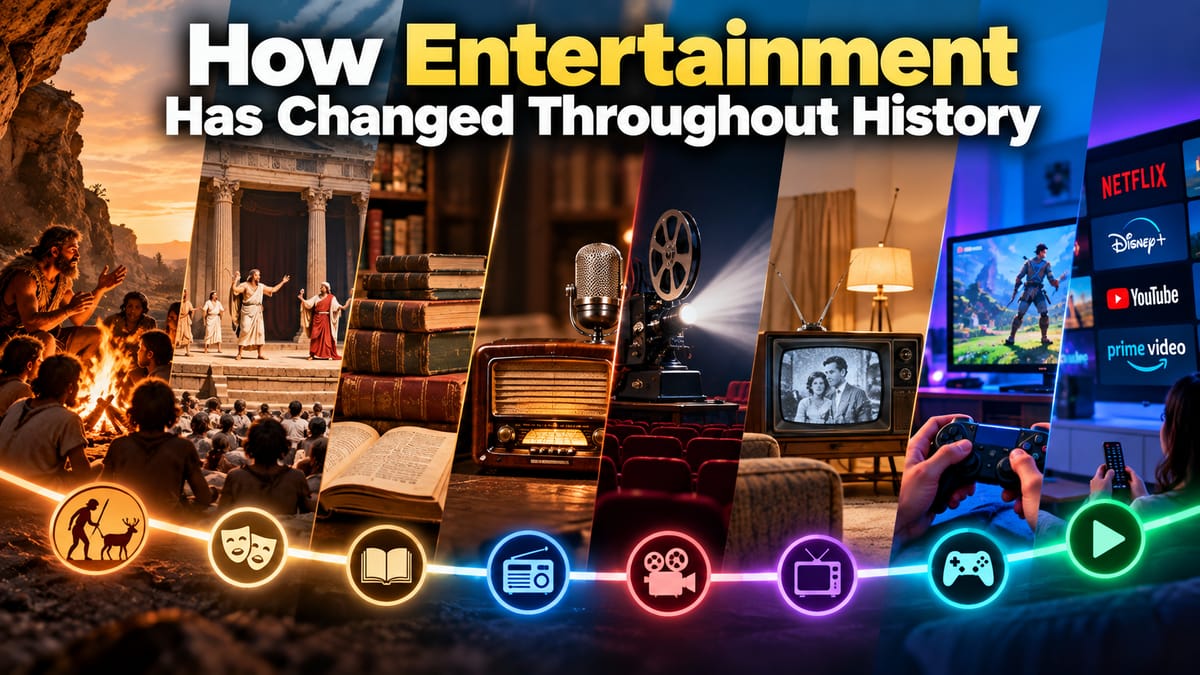
Entertainment has always been part of human life, but the way people experience it has changed dramatically over time. From storytelling around ancient fires to films, television, video games and streaming platforms, every generation has developed new ways to create, share and consume entertainment.
The basic purpose has remained surprisingly consistent. People seek entertainment to relax, connect with others, experience emotions, learn about the world and temporarily escape everyday routines. What has changed is the technology, culture and social structures that determine how those experiences are delivered.
The history of entertainment is therefore also a history of human communication. Every major shift in entertainment has reflected broader changes in society, from the development of writing and printing to radio, cinema, television, the internet and digital platforms.
Entertainment Began With Live Experiences
Long before recorded media existed, entertainment depended entirely on people being physically present.
Ancient societies used storytelling, music, dance, games and performances to entertain communities. Stories could be passed from one generation to another through spoken traditions, while musicians and performers created experiences that existed only at the moment they were performed.
Theater eventually became one of the most important organized forms of entertainment. Ancient Greek and Roman societies developed theatrical traditions involving actors, music, costumes, masks and carefully designed performance spaces.
These early forms of entertainment established many concepts that remain familiar today. Audiences gathered together, performers presented stories and communities shared a common cultural experience.
The major limitation was accessibility. A performance could only reach the people who were physically able to attend.
The Rise of Organized Public Entertainment
As civilizations became larger and cities developed, entertainment became increasingly organized.
Theaters, arenas, public festivals and sporting events attracted large audiences. Performances became professions, and entertainment began developing commercial structures around tickets, venues and performers.
In Europe, theatrical traditions continued evolving through the medieval and Renaissance periods. Traveling performers brought entertainment to different communities, while permanent theaters eventually became important cultural institutions.
The development of printing also transformed entertainment.
Books allowed stories to travel far beyond the location where they were originally created. Readers could experience novels, poetry, plays and other forms of written entertainment privately rather than gathering in a public space.
This was one of the earliest major shifts from live entertainment to reproducible entertainment.
Printing Made Stories More Accessible
The spread of printed books fundamentally changed the relationship between creators and audiences.
A performance could only happen in a particular place and time, but a printed story could be reproduced thousands of times. People could read it whenever they wanted and share it with others.
This created new opportunities for writers, publishers and readers.
Newspapers and magazines eventually expanded this model. Entertainment could now be distributed alongside news, commentary, illustrations and serialized stories.
Over time, printed entertainment became an important part of everyday life. Reading could be a private activity, a family experience or a social pastime.
The transformation illustrates an important pattern that would appear repeatedly throughout entertainment history: new technology tends to increase the distance between creators and audiences while simultaneously allowing creators to reach more people.
Photography and Recorded Sound Changed Entertainment Again
The nineteenth century introduced technologies that could capture and reproduce aspects of reality.
Photography allowed moments and people to be preserved visually. Recorded sound eventually allowed music and spoken performances to exist outside the original performance environment.
This changed music in particular.
Instead of needing to attend a concert to hear a particular performer, audiences could eventually purchase recordings and listen at home. Musicians could reach listeners who lived far away, while successful recordings could be reproduced repeatedly.
Entertainment was becoming less dependent on location.
At the same time, new technologies were creating entirely new creative possibilities.
Cinema Created a New Form of Storytelling
The development of motion pictures represented another major turning point.
Early films were relatively simple compared with modern productions, but filmmakers quickly discovered that moving images could tell stories in ways that theater could not.
Editing allowed filmmakers to control time, perspective and pacing. Close-ups could emphasize emotions, while different camera angles could create entirely different experiences.
Movie theaters became major entertainment destinations.
For audiences, cinema offered something new: the ability to watch performers and stories presented through recorded moving images rather than a live stage performance.
The movie industry eventually developed studios, stars, directors, producers and specialized production departments. Filmmaking became a complex creative and commercial system.
The history of this development is explored further in the broader evolution of modern entertainment media.
Radio Brought Entertainment Into the Home
Radio introduced another revolutionary change because it allowed entertainment to enter people’s homes without requiring a physical recording or public venue.
Families could gather around a radio and listen to music, comedy, drama, sports and serialized programs.
For the first time, a single broadcast could reach enormous audiences simultaneously.
Radio also changed the relationship between entertainment and time. Listeners could arrange their routines around scheduled programs, creating shared cultural moments around particular broadcasts.
The medium helped establish the idea of mass entertainment delivered directly into people’s homes.
Television Combined Images and Sound
Television took the concept of home entertainment even further.
Rather than relying primarily on sound, television combined moving images and audio. This made it possible for audiences to experience news, drama, comedy, sports and variety shows without leaving home.
Television became one of the dominant entertainment technologies of the twentieth century.
Families often organized their evenings around television schedules. Certain programs could attract enormous audiences, while television personalities and fictional characters became part of popular culture.
Television also changed advertising and the economics of entertainment. Companies could promote products directly to large audiences while broadcasters generated revenue through advertising and other commercial arrangements.
The rise of television demonstrated how entertainment could become deeply integrated into everyday routines.
Home Video Gave Audiences More Control
Traditional television schedules gave broadcasters considerable control over when audiences watched programs.
Home video began changing that relationship.
Video cassette recorders allowed people to record television programs and watch them later. Consumers could also rent or purchase movies and view them at home.
This was an important step toward the on-demand entertainment model that would eventually dominate digital media.
Audiences were gaining greater control over when they consumed entertainment.
The shift also changed the economics of filmmaking. Movies no longer depended exclusively on theatrical releases. A successful film could continue generating revenue through home-video releases, rentals and later television broadcasts.
Video Games Turned Audiences Into Participants
Another major transformation occurred with the development of electronic and video games.
Earlier forms of entertainment generally positioned audiences as spectators or listeners. Video games introduced a fundamentally different relationship between the consumer and the entertainment experience.
Players could make decisions, solve problems, compete against other people and influence what happened on screen.
Arcades became popular social entertainment spaces, while home consoles eventually brought gaming into living rooms.
As technology improved, video games became increasingly sophisticated. Three-dimensional graphics, online multiplayer systems, expansive virtual worlds and interactive storytelling turned gaming into one of the world’s major entertainment industries.
The medium also blurred traditional boundaries. Modern games can incorporate cinematic storytelling, music, live events, social communities and competitive sports-like experiences.
The Internet Changed Who Could Create Entertainment
The internet produced perhaps the most significant structural change in modern entertainment.
Previously, producing entertainment for a mass audience usually required access to expensive equipment, professional studios, broadcasters, publishers or distributors.
The internet reduced many of those barriers.
Anyone with suitable equipment and an internet connection could potentially publish videos, music, writing, photography or other creative work to a global audience.
This created new forms of entertainment built around websites, blogs, social networks, podcasts and online video platforms.
The relationship between creators and audiences also became more direct.
People could comment on content, share it with friends, build communities around creators and sometimes communicate directly with the people producing the entertainment they enjoyed.
Technology’s role in this transformation is explored in greater detail in how technology has changed the entertainment industry.
Social Media Made Entertainment More Interactive
Social media added another layer to digital entertainment.
Platforms built around short videos, images, live broadcasts and conversations allowed users to become both consumers and creators.
Entertainment could spread extremely quickly because audiences themselves became part of the distribution process. A person could watch a piece of content, share it and potentially expose it to thousands of additional people.
This changed the traditional idea of a media audience.
Instead of simply watching a television program or listening to a song, people could react, remix, comment, create responses and participate in communities around the content.
Creators could also build audiences without relying entirely on traditional entertainment companies.
Streaming Changed How People Watch and Listen
Streaming has arguably produced the most important change in entertainment consumption since the arrival of television.
Traditional broadcasting depended on schedules. Physical media required consumers to purchase or rent individual products.
Streaming brought large libraries of entertainment together on digital platforms that could be accessed whenever users wanted.
People could watch films and television shows on demand, listen to enormous music catalogs and increasingly consume live entertainment through internet-connected devices.
The result was a dramatic shift in consumer expectations.
Audiences became accustomed to choosing what they wanted to watch or listen to rather than waiting for a scheduled broadcast.
The broader impact of this transformation can be seen in how streaming changed entertainment consumption.
Entertainment Became More Personalized
Digital platforms have also made entertainment increasingly personalized.
Streaming services and online platforms can use information about viewing and listening behavior to recommend content to individual users.
Instead of presenting everyone with exactly the same entertainment schedule, digital platforms can offer different recommendations to different people.
This has created both opportunities and challenges.
Consumers can discover content that might previously have been difficult to find. At the same time, recommendation systems can influence what people encounter and which creators receive attention.
Entertainment discovery is therefore increasingly shaped by software as well as human choices.
Artificial Intelligence Is Opening Another Chapter
Artificial intelligence is now beginning to influence many parts of entertainment production and consumption.
AI tools can assist with tasks involving writing, visual effects, animation, music, editing, translation and content discovery. Entertainment companies are also exploring ways to use AI to analyze audiences and personalize recommendations.
At the same time, AI raises important questions about creativity, authorship and the role of human performers and creators.
The development of generative AI could eventually make some forms of entertainment significantly easier and cheaper to produce. It may also create new formats that are difficult to categorize using traditional definitions of film, music, gaming or television.
The broader discussion of advanced artificial intelligence can be explored through What Is Artificial General Intelligence?.
From Passive Audiences to Active Participants
One of the clearest patterns throughout entertainment history is the gradual increase in audience participation.
Ancient audiences watched live performances. Radio listeners primarily listened. Television viewers watched scheduled programs. Video-game players began actively controlling digital experiences.
The internet and social media pushed participation even further.
Today, audiences can create videos, remix music, livestream events, participate in online communities, produce podcasts, develop games and build entire entertainment brands.
The boundary between creator and consumer has become increasingly fluid.
Someone can watch a video in the morning, create their own response in the afternoon and build an audience around that response by evening.
Entertainment Is Becoming More Connected
Entertainment has also become increasingly interconnected across different media.
A successful film can inspire a television series, video game, soundtrack, merchandise and online community. A video game can become a film or television franchise. A musician can build an audience through social media before releasing music through streaming platforms.
This interconnected environment allows entertainment properties to exist across multiple formats simultaneously.
It also means that consumers are no longer necessarily loyal to one medium.
A person might watch a movie on a streaming service, discuss it on social media, play a related game and listen to its soundtrack on a music platform.
Entertainment has become an ecosystem rather than a collection of isolated industries.
Why Entertainment Keeps Changing
Entertainment changes because society changes.
People’s lifestyles, technologies, economic conditions and cultural preferences influence the kinds of entertainment they want and how they consume it.
Technology then creates new possibilities.
The printing press made written entertainment easier to reproduce. Recorded sound separated music from live performances. Cinema introduced recorded moving images. Television brought audiovisual entertainment into homes. The internet made global digital distribution possible, while streaming made enormous entertainment libraries available on demand.
Each transformation built on earlier developments.
Today’s entertainment industry is therefore not disconnected from its history. Modern streaming platforms, social networks, video games and AI-generated media are the latest stages in a much longer process.
The Future of Entertainment
The next generation of entertainment will likely continue combining technologies and formats that were once separate.
Artificial intelligence, immersive digital environments, virtual and augmented reality, interactive storytelling and increasingly sophisticated gaming platforms could create experiences that are more personalized and participatory than traditional media.
Yet some fundamental aspects of entertainment are unlikely to disappear.
People will continue looking for stories, music, humor, competition, drama, imagination and shared experiences. The devices and platforms may change, but the desire to be entertained is much older than any modern technology.
From ancient storytellers to AI-assisted creators, the history of entertainment shows a consistent pattern: the tools keep changing, but the human desire for compelling experiences remains.



2 Comments
Micle harison
June 7, 2019Lorem ipsum dolor sit amet, usu ut perfecto postulant deterruisset, libris causae volutpat at est, ius id modus laoreet urbanitas. Mel ei delenit dolores.
John Doe
June 7, 2019Some consultants are employed indirectly by the client via a consultancy staffing company.