
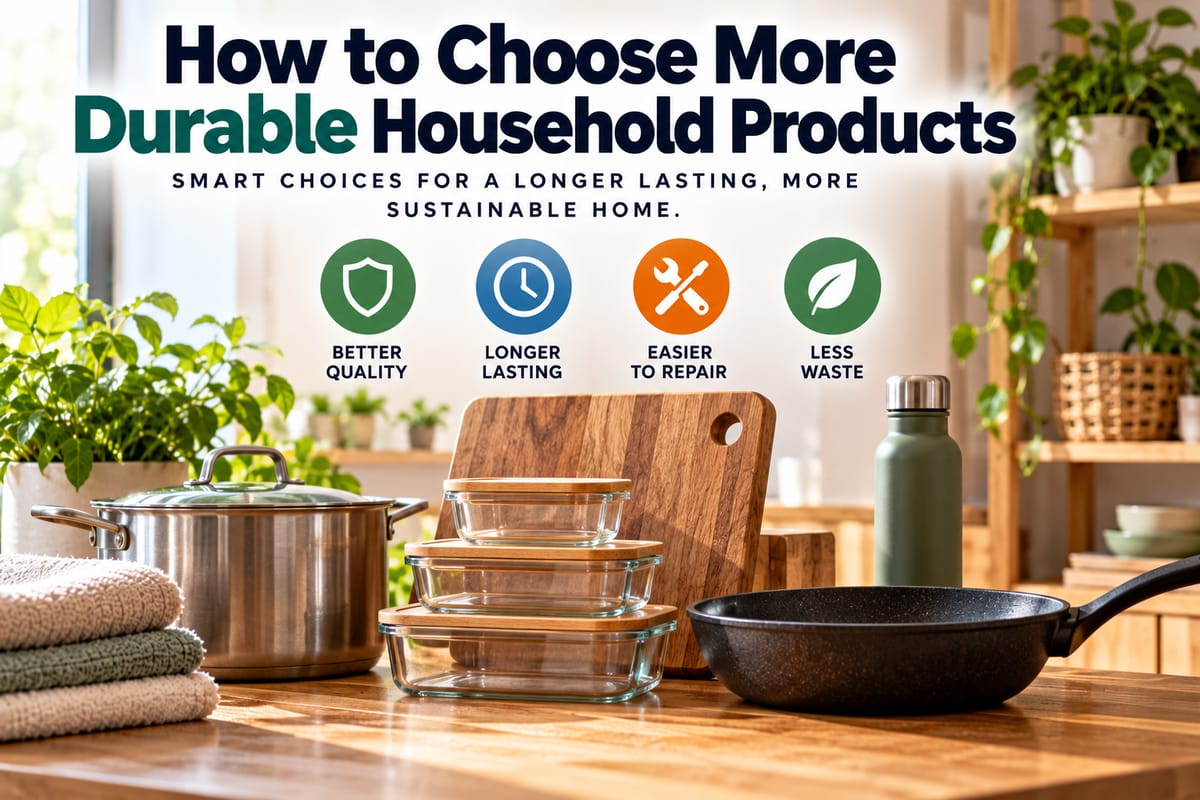
How to Choose More Durable Household Products
Household products are often purchased with convenience and price in mind, but durability can be just as important. A product that lasts for years may provide more value than a cheaper alternative that needs to be replaced repeatedly.
Choosing durable household products can also reduce the number of items entering the waste stream. When products remain useful for longer, households may buy fewer replacements and spend less time dealing with broken or worn-out items.
Durability does not necessarily mean buying the most expensive product available. It means looking beyond the initial price and considering how well an item is designed, how often it will be used, whether it can be repaired, and how long it is likely to remain functional.
What Makes a Household Product Durable?
Durability refers to a product’s ability to continue performing its intended function over time and under normal conditions of use.
Several factors can influence durability, including:
- Material quality
- Construction methods
- Design
- Manufacturing quality
- Maintenance requirements
- Repairability
- Frequency of use
- Resistance to wear
- Availability of replacement parts
A durable product should be appropriate for the conditions in which it will actually be used.
For example, a lightweight item may be perfectly durable when used occasionally but unsuitable for a household that relies on it every day.
Consider How Often You Will Use the Product
Frequency of use is one of the most important factors when deciding how much durability matters.
An item used every day generally deserves more attention than something used once or twice a year.
For frequently used household products, consider whether the item can withstand repeated use without losing functionality.
Examples include:
- Kitchen utensils
- Furniture
- Vacuum cleaners
- Storage containers
- Tools
- Clothing
- Appliances
- Cleaning equipment
Spending more on a durable product can make sense when the item is likely to be used regularly for many years.
Look Beyond the Initial Price
A low purchase price does not necessarily mean lower total cost, just as a higher price does not automatically guarantee better quality.
Consider the cost per year of use or cost per use.
For example, a $20 product that lasts one year may ultimately cost more over five years than a $60 product that lasts five years.
The calculation is not always this simple because maintenance, repairs, energy consumption, and replacement parts can also affect the total cost.
Still, thinking beyond the initial price can lead to better purchasing decisions.
Examine the Materials
The materials used in a product can provide clues about how it is likely to perform over time.
However, material names alone do not guarantee durability.
Consider whether the material is appropriate for the intended purpose.
For example:
- A kitchen surface should tolerate moisture and repeated cleaning.
- Outdoor furniture should be able to handle the relevant weather conditions.
- Storage containers should withstand repeated opening, closing, and cleaning.
- Everyday furniture should tolerate the expected weight and frequency of use.
The right material depends on the job the product needs to perform.
Pay Attention to Construction
Two products made from similar materials can have very different durability because of how they are constructed.
Look at areas where products commonly experience stress.
For furniture, this might include joints, hinges, legs, fasteners, and load-bearing areas.
For bags, inspect handles and seams.
For kitchen equipment, examine moving parts, connections, lids, and seals.
For tools, look at the connection between the working part and the handle.
A product with strong construction is generally better positioned to withstand repeated use.
Check Whether Replacement Parts Are Available
A product does not necessarily need to remain perfect forever to be durable.
One of the most useful characteristics of a long-lasting product is the ability to replace worn or damaged components.
Examples might include:
- Replacement filters
- Batteries
- Seals and gaskets
- Cables
- Handles
- Wheels
- Fasteners
- Removable accessories
If a small component fails but the rest of the product remains functional, being able to replace that component can prevent the entire item from becoming waste.
Look for Repairability
Repairability is closely connected to durability.
A product may be physically strong but still have a short practical lifespan if it cannot be repaired.
When comparing products, consider whether common problems can be fixed and whether replacement parts or repair services are available.
Learning how reuse and repair reduce household waste can help put repairability into the broader context of household consumption and waste reduction.
A repairable product can remain useful long after a less serviceable alternative would have been discarded.
Avoid Unnecessarily Complicated Designs
More features do not automatically make a household product better.
Every additional component can potentially create another point of failure.
For some purchases, a simpler design may be easier to maintain, clean, repair, and understand.
This does not mean avoiding advanced products. It means considering whether the additional features provide genuine value for the way the item will be used.
If a feature is unlikely to be used, it may not be worth choosing a product that includes additional complexity solely because it is available.
Consider Maintenance Requirements
Even well-made products need appropriate care.
Before buying something, find out what maintenance it requires.
Questions to consider include:
- Does it need regular cleaning?
- Does it require lubrication?
- Are filters or other components replaced periodically?
- Can it be safely stored in the household’s environment?
- Are special cleaning products required?
- Are replacement parts easy to obtain?
A product that is difficult to maintain may not last as long in a real household, even if it is technically well constructed.
Think About Your Household Environment
The environment in which a product is used can have a major effect on its lifespan.
Moisture, heat, sunlight, dust, heavy use, children, pets, and outdoor exposure can all influence how quickly household products wear out.
A product designed for indoor use may not be appropriate for an exposed outdoor location.
Likewise, a delicate item may not be practical in a high-traffic household.
Choose products based on actual conditions rather than ideal conditions.
Check Product Warranties Carefully
A warranty can provide useful information about a manufacturer’s expectations for a product.
However, a long warranty does not automatically mean that a product is highly durable.
Read the terms carefully to understand:
- What is covered
- How long coverage lasts
- What exclusions apply
- Whether labor is included
- Whether replacement parts are covered
- How claims are handled
A warranty can provide additional protection, but it should not replace careful consideration of the product’s construction and intended use.
Read Reviews for Long-Term Experiences
Product reviews can be useful when they contain specific information about how an item performs after extended use.
Instead of focusing only on comments about appearance or initial impressions, look for discussions of:
- Long-term reliability
- Common failures
- Ease of repair
- Material wear
- Maintenance
- Replacement parts
- Performance after repeated use
Reviews are individual experiences rather than guarantees, so they should be considered alongside product specifications and other available information.
Be Careful With Marketing Claims
Words such as “premium,” “professional,” “heavy-duty,” and “built to last” can sound persuasive, but they do not necessarily provide measurable evidence of durability.
Look for specific information about materials, construction, testing, warranties, repair options, and expected use.
Concrete details are generally more useful than broad marketing language.
For example, knowing that a product has replaceable components tells you more about long-term serviceability than simply being told that it is “premium.”
Choose Products Designed for the Job
Durability is partly about matching a product to its intended purpose.
A product can fail quickly when it is consistently used for something it was never designed to do.
For example, a household storage container designed for light indoor use may not be suitable for outdoor storage. A basic tool may not withstand professional-level workloads.
Before purchasing, consider the demands you will actually place on the product.
The goal is not necessarily to buy the most heavy-duty option. It is to buy one that provides an appropriate level of durability for the intended use.
Avoid Buying More Than You Need
Durability is only useful when the product is actually needed.
Buying an extremely durable item that sits unused in a cupboard may not be a better choice than buying a simpler product when necessary.
Reducing unnecessary purchases can prevent both financial waste and household clutter.
The principles discussed in how households can reduce unnecessary consumption can help households think about whether a product needs to be purchased at all before comparing different versions of it.
Consider Multipurpose Products Carefully
A multipurpose product can sometimes replace several separate items.
This can reduce the number of objects a household needs to purchase and store.
However, multipurpose designs are not always the best choice. If a product attempts to perform many functions but performs each poorly, it may be less useful than several well-designed specialized products.
Consider whether the combined functions are genuinely useful for your household.
Buy for Longevity, Not Trends
Trends can influence household purchasing decisions, particularly for furniture, décor, appliances, and other visible products.
A design that remains useful and appealing for many years may be more practical than an item that quickly feels outdated.
Choosing neutral, functional designs can sometimes make it easier to keep products longer.
This is especially relevant for expensive household items that are inconvenient or wasteful to replace simply because their appearance has fallen out of fashion.
Think About Energy and Operating Costs
Durability is not the only measure of long-term value.
An appliance may last many years but consume substantially more energy than a newer, efficient alternative.
When comparing household products, consider both physical lifespan and operating costs.
A useful evaluation may include:
- Purchase price
- Expected lifespan
- Energy consumption
- Maintenance costs
- Replacement parts
- Repair costs
- Disposal or recycling options
The cheapest purchase is not always the cheapest option over its full useful life.
Consider Whether the Product Can Be Reused
A durable product may eventually stop serving its original purpose.
That does not necessarily mean it has reached the end of its useful life.
Some items can be repurposed, passed to another household, donated, or used for a different task.
Designing purchases around longer useful lives can help reduce the amount of material that needs to be discarded.
Think About End-of-Life Options
No household product lasts forever.
Eventually, an item may become damaged beyond repair or simply reach the end of its useful life.
Before purchasing a product, consider whether its materials can potentially be recovered or recycled.
Understanding the complete guide to recycling can help households make better decisions about what happens to products after they are no longer useful.
Recycling is most effective when it is part of a broader approach that also includes buying thoughtfully, using products for longer, reusing items, and repairing them when practical.
Durability as Part of Sustainable Living
Choosing longer-lasting products can be one part of a broader approach to household sustainability.
The Sustainable Living Guide provides a wider perspective on how everyday decisions involving consumption, energy, resources, and waste can fit together.
Durability should not be considered in isolation. A product’s environmental impact can depend on its materials, manufacturing, transportation, maintenance, lifespan, and eventual disposal.
A well-made product that is used frequently for many years may provide substantial value, particularly when it prevents repeated purchases of short-lived alternatives.
Create a Simple Durability Checklist
Before making a significant household purchase, ask a few basic questions:
- How often will I use it?
- Is it designed for that level of use?
- What materials is it made from?
- How well is it constructed?
- Can it be repaired?
- Are replacement parts available?
- What maintenance does it require?
- How long is the warranty?
- What will it cost to operate?
- Can it be reused or recycled later?
The answers do not need to be perfect. They simply provide a more complete picture than looking at the purchase price alone.
Make Longevity Part of the Buying Habit
Choosing durable household products is ultimately about changing the way purchases are evaluated.
Instead of asking only, “How much does this cost?” consider asking, “How long will this remain useful, and what will it cost to own over that time?”
Durability, repairability, maintenance, practical design, and appropriate use can all contribute to longer product lifespans. When households combine those considerations with buying only what they need, reusing products where possible, and recycling appropriate materials at the end of their useful lives, individual purchasing decisions can become part of a more thoughtful approach to everyday consumption.


2 Comments
Micle harison
June 7, 2019Lorem ipsum dolor sit amet, usu ut perfecto postulant deterruisset, libris causae volutpat at est, ius id modus laoreet urbanitas. Mel ei delenit dolores.
John Doe
June 7, 2019Some consultants are employed indirectly by the client via a consultancy staffing company.