
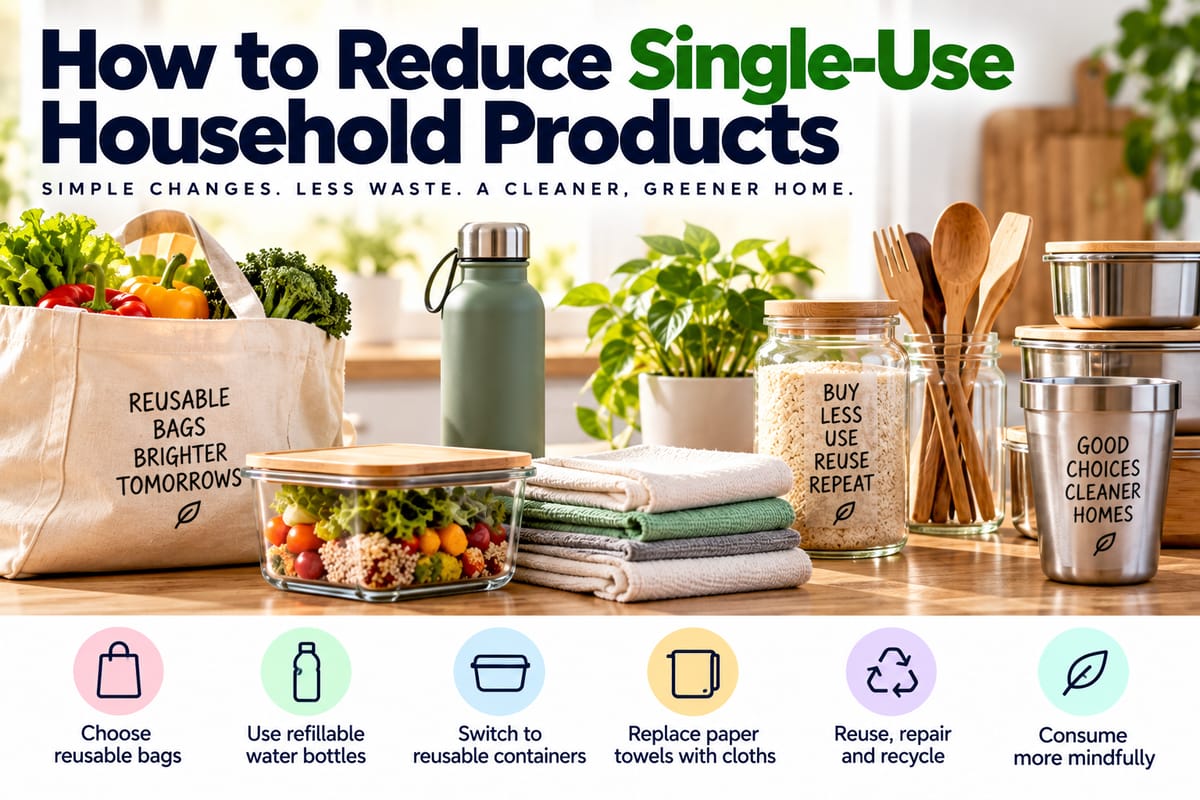
How to Reduce Single-Use Household Products
Single-use household products are convenient, inexpensive, and deeply embedded in everyday routines. Paper towels, disposable cleaning wipes, plastic bags, food containers, bottled water, and other throwaway items can make household tasks easier, but frequent use can also create unnecessary waste and recurring expenses.
Reducing reliance on these products does not require completely changing the way a household operates. Small substitutions, better planning, and reusable alternatives can gradually reduce the number of disposable items entering the home.
The goal is not to eliminate every single-use product. Instead, households can identify where disposable products are used most often and find practical alternatives that fit their routines.
What Are Single-Use Household Products?
Single-use household products are items designed to be used once or only a few times before being discarded.
Common examples include:
- Disposable shopping bags
- Paper towels
- Disposable cleaning wipes
- Plastic food containers
- Disposable plates and cups
- Plastic cutlery
- Bottled water
- Disposable razors
- Single-use cleaning products
- Individually packaged household supplies
Some products may technically be reusable for a short period, but are commonly discarded after limited use.
The environmental impact of these items depends on factors such as the materials used, how they are manufactured, transportation requirements, and what happens after disposal.
Why Reduce Single-Use Products?
The most obvious reason to reduce disposable products is to produce less household waste.
However, reducing single-use consumption can have several other benefits. Reusable products can sometimes lower long-term household expenses, while buying larger quantities or durable alternatives can reduce the frequency of shopping trips.
Reducing disposable products can also encourage households to become more intentional about what they purchase.
This broader approach is part of a sustainable living guide that considers how everyday choices can affect household resources, waste, and consumption.
Start by Identifying What Gets Thrown Away Most
The easiest place to begin is with observation.
For one or two weeks, pay attention to the household products being discarded regularly. Instead of trying to change everything at once, identify the items that appear most frequently.
A household might discover that it uses large quantities of:
- Paper towels
- Plastic shopping bags
- Bottled drinks
- Disposable food containers
- Cleaning wipes
- Disposable coffee cups
- Individually packaged snacks
Once the biggest sources of waste are clear, it becomes easier to prioritize practical changes.
Replace Paper Towels With Reusable Cloths
Paper towels are among the most common disposable household products.
Reusable cloths can handle many of the same everyday tasks, including wiping countertops, cleaning appliances, drying surfaces, and dealing with small spills.
A household can keep separate cloths for different purposes, such as kitchen cleaning, general dusting, and bathroom use. They can then be washed and reused.
Paper towels can still be useful for certain messy or hygienic situations. The objective is simply to avoid using them automatically when a washable cloth would work just as well.
Choose Reusable Shopping Bags
Reusable shopping bags are a straightforward alternative to disposable plastic or paper bags.
Keeping several bags in convenient locations can make them easier to remember. Some households keep bags near the front door, while others store them in a vehicle or beside frequently used shopping areas.
The key is convenience. A reusable alternative is much more likely to become a lasting habit when it is readily available.
Reusable bags should also be cared for properly. Washing or cleaning them periodically can help keep them in good condition.
Use Reusable Food Containers
Disposable food packaging can accumulate quickly, especially when leftovers, packed lunches, snacks, or prepared meals are frequently purchased or stored.
Reusable containers made from appropriate materials can replace many disposable options.
Different sizes can be useful for different purposes:
- Small containers for snacks
- Medium containers for leftovers
- Larger containers for prepared meals
- Leak-resistant containers for transporting food
- Reusable jars for dry ingredients
A simple collection of durable containers can reduce the need to repeatedly purchase disposable storage products.
Carry Reusable Water Bottles
Bottled water can create significant amounts of packaging waste when used regularly.
A durable reusable bottle can provide a convenient alternative when safe drinking water is available.
Keeping the bottle in a location where it is easy to remember can make the habit more consistent. It may also be useful to have more than one reusable bottle for different members of a household or different daily routines.
Regular cleaning is important, particularly when bottles are used throughout the day.
Reduce Disposable Cups and Cutlery
Disposable cups, plates, forks, spoons, and other eating utensils can often be replaced with washable alternatives.
At home, this is usually straightforward. The bigger challenge can be situations involving travel, work, school, picnics, or events.
A small reusable set can help in these circumstances. Depending on the situation, it might include a cup, water bottle, food container, and reusable utensils.
These items can become part of a regular everyday-carry system rather than something that has to be remembered separately every time.
Rethink Disposable Cleaning Wipes
Cleaning wipes are convenient, but they are designed for short-term use and disposal.
Reusable microfiber cloths, washable cleaning cloths, brushes, and sponges can perform many household cleaning tasks repeatedly.
Instead of automatically reaching for a disposable wipe, consider whether the same task can be handled with a washable cleaning tool.
Some situations may still call for disposable products, particularly where specific hygiene or contamination concerns exist. The objective is to reduce unnecessary use rather than eliminate every disposable cleaning product.
Buy Household Products With Less Packaging
Reducing single-use products also involves looking at the packaging surrounding the products being purchased.
When practical, households can compare products based on how much packaging accompanies them. Larger quantities may sometimes reduce packaging per unit, although buying more than the household can realistically use can create a different type of waste.
Refill systems can also reduce packaging. Some cleaning products, soaps, and other household supplies are available in concentrated or refillable formats.
The best choice depends on the product, price, storage space, and how frequently it is used.
Avoid Buying More Than You Need
One of the most effective ways to reduce household waste is to avoid unnecessary purchases in the first place.
Buying products simply because they are inexpensive, heavily promoted, or convenient can result in supplies that are rarely used.
Before purchasing something, consider:
- Do I already own something that performs the same function?
- How frequently will I actually use this?
- Is there a reusable alternative?
- Can I buy a smaller quantity?
- Does the product require disposable accessories?
- Can the item be repaired if it breaks?
Learning how households can reduce unnecessary consumption can help shift the focus from simply managing waste to preventing unnecessary consumption before it happens.
Choose Durable Products
Durability is an important consideration when replacing disposable household items.
A reusable product only provides a meaningful benefit if it is used enough times to justify the resources required to produce it.
Look for products that are:
- Durable
- Easy to clean
- Repairable
- Suitable for frequent use
- Appropriate for the intended task
- Made from materials that can withstand normal household conditions
A cheap reusable product that breaks quickly may not be a practical long-term solution.
Reuse Before Replacing
Before throwing away an item, consider whether it can serve another purpose.
Glass jars can sometimes become storage containers. Cardboard boxes can be used for organizing household items. Some packaging materials can be reused for storage, moving, crafts, or other practical purposes.
Not every item needs to be repurposed, but developing the habit of asking whether something still has a useful function can reduce unnecessary disposal.
Repair Instead of Automatically Replacing
Household items sometimes get discarded because repairing them seems inconvenient.
However, simple repairs can extend the useful life of clothing, furniture, containers, appliances, tools, and other possessions.
Learning how reuse and repair reduce household waste can help households look beyond the traditional pattern of buying, using, and throwing away.
Repair does not always make financial sense. If a product is unsafe, extremely inefficient, or significantly more expensive to repair than replace, replacement may be reasonable.
The important point is to consider repair as an option before automatically discarding an item.
Build Reusable Household Routines
The easiest habits to maintain are usually built into existing routines.
For example:
- Keep reusable bags near shopping areas.
- Store reusable food containers together.
- Keep cleaning cloths somewhere convenient.
- Place reusable bottles where they can be seen before leaving home.
- Wash reusable items as part of normal household cleaning.
- Keep a small reusable kit for work or travel.
When reusable products are convenient, switching away from single-use alternatives requires less effort.
Avoid Replacing Everything at Once
Reducing household waste does not require immediately replacing every disposable item with a reusable version.
Buying large numbers of new reusable products can itself create unnecessary consumption.
Instead, replace items gradually as existing supplies run out or wear out.
For example, when a household’s disposable cleaning supplies are depleted, it might introduce washable cloths. When an old food container breaks, it could be replaced with a durable reusable option.
This gradual approach can be more affordable and less wasteful.
Consider the Full Life Cycle of Products
A product’s environmental impact does not end when it enters the household.
Manufacturing, transportation, use, cleaning, repair, recycling, and disposal all require resources.
Reusable products can reduce waste, but they also require materials and energy to produce. Some reusable products require frequent washing, which uses water and energy.
This means households should focus on practical, long-term reuse rather than assuming that every product labeled reusable is automatically the best option.
The most useful question is often whether an item will genuinely replace many disposable products over its useful life.
Learn to Recycle What Cannot Be Reused
Some disposable products cannot realistically be eliminated.
Packaging, worn-out materials, and certain household products may still need to be discarded. In these cases, proper recycling can help recover materials where suitable recycling systems exist.
Understanding the complete guide to recycling can help households distinguish recyclable materials from items that belong in ordinary waste.
Recycling should generally be viewed as one part of waste reduction rather than the only solution. Reducing consumption and reusing products can prevent waste before recycling becomes necessary.
Make Waste Reduction a Household Habit
Long-term progress usually comes from repeated small decisions rather than occasional major efforts.
A household might begin by replacing one disposable product and then gradually expand the practice to other areas.
Families can also make the process easier by agreeing on simple household rules, such as using reusable shopping bags, carrying refillable water bottles, repairing suitable items, and checking whether something can be reused before throwing it away.
The goal is not perfection. Some disposable products will remain useful or necessary in particular situations.
Focus on Practical Changes That Last
Reducing single-use household products works best when alternatives are convenient, affordable, durable, and suited to everyday life.
The most effective changes may be surprisingly simple: carrying a reusable bag, switching from paper towels to washable cloths, storing leftovers in reusable containers, buying fewer unnecessary items, repairing possessions when practical, and recycling materials correctly.
Over time, these small changes can become normal household routines. Instead of constantly thinking about waste, households can build systems that naturally reduce the amount of disposable material they use and throw away.





2 Comments
Micle harison
June 7, 2019Lorem ipsum dolor sit amet, usu ut perfecto postulant deterruisset, libris causae volutpat at est, ius id modus laoreet urbanitas. Mel ei delenit dolores.
John Doe
June 7, 2019Some consultants are employed indirectly by the client via a consultancy staffing company.