
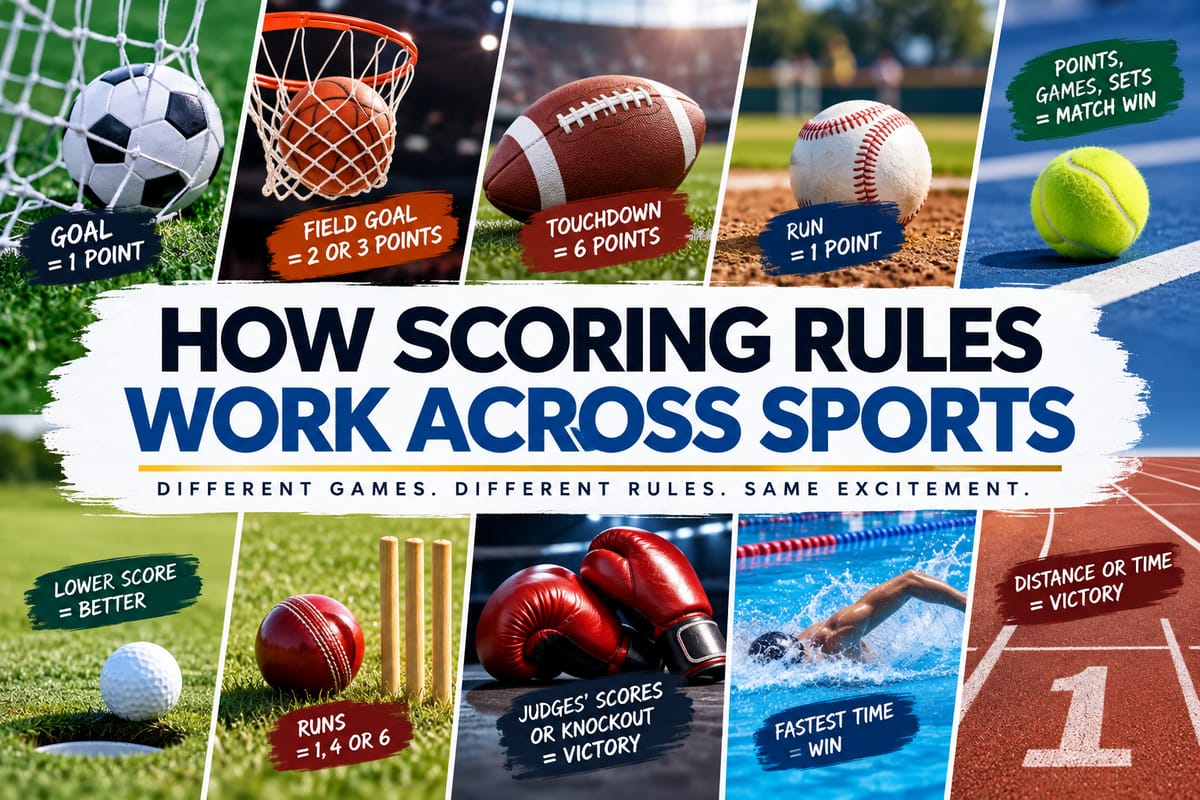
How Scoring Rules Work Across Sports
Scoring is one of the most recognizable parts of sports, but the way points are awarded can vary dramatically from one game to another.
A goal can decide a soccer match. A touchdown can transform an American football game. A basket can be worth one, two or three points in basketball. In tennis, players accumulate points within games, games within sets and sets within a match.
These differences are not accidental. Every sport develops scoring rules that fit its playing area, equipment, objectives and competitive structure.
Understanding those systems makes it easier to follow games, appreciate tactical decisions and recognize why certain plays are more valuable than others.
Why Sports Use Different Scoring Systems
The primary purpose of scoring is to provide a measurable way to determine which competitor performs better.
However, sports have different objectives.
In soccer, teams attempt to move the ball into a goal. In basketball, players put the ball through a hoop. In tennis, competitors attempt to win individual points and ultimately enough games and sets to win the match.
Those fundamental differences shape the scoring system.
The scoring structure also affects how a sport feels. A game in which one score can dramatically change the result creates a different strategic environment from one in which hundreds of points can be accumulated.
This is one reason understanding the Different Types of Sports and How They Are Classified can provide useful context. Team sports, individual sports, combat sports and precision sports often use very different approaches to determining winners.
Goals, Points and Runs
Sports commonly use several basic scoring concepts.
Goals
A goal generally refers to successfully sending an object into a designated scoring area.
Soccer is a straightforward example. A team scores when the ball legally crosses the goal line between the posts and beneath the crossbar.
Other sports also use goals or goal-like scoring areas, although the exact conditions differ.
Points
Points are used across many sports and can represent successful actions rather than simply reaching a physical target.
Basketball awards points for successful field goals and free throws. Tennis uses points as the smallest scoring unit within its game structure.
Runs
Cricket and baseball use the concept of runs to measure offensive scoring.
In baseball, a run is scored when a player legally touches all four bases and reaches home plate. In cricket, batters score runs by changing ends after striking the ball, with additional runs possible in certain situations.
These systems demonstrate how scoring can be built around movement rather than simply placing an object into a target.
Basketball Uses Different Values for Different Shots
Basketball provides one of the clearest examples of a multi-value scoring system.
A successful free throw is worth one point. A successful field goal from inside the three-point line is worth two points, while a successful shot from beyond the three-point line is worth three points.
This structure gives players and coaches an important strategic choice.
A team may prioritize high-percentage shots closer to the basket or attempt more three-point shots that provide greater value when successful.
The scoring system therefore influences offensive tactics rather than simply recording the outcome.
A team’s style of play can be shaped by how it balances shooting efficiency, shot value, possession and defensive pressure.
Soccer Keeps Scoring Relatively Simple
Soccer generally has one of the simplest scoring structures in major team sports.
A goal counts as one point, and the team with more goals at the end of regulation wins in competitions where a winner is required.
There are no two-point or three-point goals based on distance.
That simplicity places enormous importance on each scoring opportunity. A single goal can determine the outcome even after a long period of play.
Because goals are relatively scarce compared with many other sports, defensive organization and possession can be just as important as creating chances.
This is where How Tactics Create Advantages in Different Sports becomes particularly relevant. The value of a scoring opportunity cannot be separated completely from the tactics used to create it.
American Football Assigns Different Values to Scoring Plays
American football uses several types of scoring plays.
A touchdown is worth six points. After a touchdown, the scoring team has an opportunity to attempt an additional scoring play.
A successful extra-point kick is worth one point, while a successful two-point conversion is worth two.
A field goal is worth three points, and a safety awards two points to the defensive team.
This creates a more complicated scoring environment than sports such as soccer.
Teams must constantly evaluate whether to attempt a field goal, pursue a touchdown or try for two points after scoring a touchdown.
The score and remaining time can therefore influence decisions even after an offensive play has ended.
Tennis Uses a Layered Scoring Structure
Tennis has one of the most distinctive scoring systems in popular sports.
A match is divided into sets, sets contain games, and games contain individual points.
Within a traditional game, the scoring sequence is:
- Love
- 15
- 30
- 40
- Game
When both players reach 40, the game can enter a deuce situation. A player generally needs to win two consecutive points from deuce to win the game under the traditional advantage system.
Games then accumulate into sets, and sets determine the winner of the match according to the competition’s format.
This layered system means that a player can win more individual points than an opponent and still lose the match.
That is an important lesson in sports scoring: the number of points won is not always the same thing as the number of scoring units needed to win the competition.
Volleyball Rewards Winning Rallies
Volleyball uses rally scoring, meaning a point is awarded after each rally.
The team that wins the rally earns the point, regardless of which team served.
This makes every rally potentially important.
Teams must combine serving, receiving, attacking and defending because a mistake can directly give the opponent a point.
Volleyball also demonstrates how scoring rules can influence momentum. Because points are awarded continuously, a short sequence of successful rallies can quickly change the scoreboard.
Baseball Measures Scoring Through Runs
Baseball does not award different point values for different types of hits.
Instead, the fundamental scoring unit is the run.
A team scores when a runner legally touches first, second and third base before returning to home plate.
A home run can therefore produce different numbers of runs depending on how many runners are already on base.
A solo home run produces one run. A home run with three runners on base produces four runs.
This makes the value of an offensive play dependent partly on the situation.
A hit with runners in scoring position can have a very different effect from the same type of hit with empty bases.
Cricket Uses Runs and Boundaries
Cricket also uses runs as its primary scoring unit, but its scoring system includes several distinctive ways of accumulating them.
Batters can score by running between the wickets, while boundaries can produce automatic runs.
A ball reaching the boundary after bouncing generally produces four runs, while a ball that clears the boundary without bouncing produces six.
Additional runs can also result from certain bowling or fielding errors.
Because innings can involve large numbers of runs, cricket’s scoring system creates a different statistical environment from low-scoring sports.
Teams must consider both the rate at which they score and the number of wickets they have lost.
Golf Uses a Completely Different Concept
Golf demonstrates that scoring does not always mean accumulating points.
In stroke play, the objective is generally to complete the course using the fewest strokes.
A player’s score is measured against par.
A birdie means completing a hole one stroke under par, while an eagle is two strokes under par. A bogey is one stroke over par.
This means that a lower numerical score is better, unlike basketball, where a higher score is better.
Golf therefore highlights an important principle: the meaning of a number on the scoreboard depends entirely on the rules of the sport.
Combat Sports Can Use Rounds and Judges’ Scores
Boxing and other combat sports introduce another approach.
A fight can end through a knockout or other decisive result, but some contests go the full scheduled distance and are decided using judges’ scorecards.
Judges evaluate rounds according to the rules of the particular sport and award scores to the competitors.
This means the final result may depend on a combination of individual round performances rather than a single scoring play.
Combat sports therefore show how scoring can involve human evaluation as well as objective events.
Gymnastics and Other Judged Sports Work Differently
Some sports rely heavily on judges rather than simple points accumulated through successful plays.
Gymnastics, diving, figure skating and similar disciplines may involve judges evaluating technical execution, difficulty, artistry or other criteria established by the sport’s governing rules.
The exact scoring systems differ, but the basic idea is similar: competitors perform routines or skills, and their performances are converted into scores.
Because judging is involved, scoring rules in these sports often include detailed criteria designed to make evaluations as consistent as possible.
This makes officiating particularly important.
The Complete Guide to Sports Rules and Officiating provides broader context for understanding how officials interpret rules and manage competitive situations.
Overtime Can Change How Scoring Works
Some sports require a winner, even when the regulation period ends with the scores tied.
This can lead to overtime or other tiebreaking procedures.
The specific method depends on the sport and competition.
Basketball can use additional periods. American football has specific overtime procedures. Soccer competitions may use extra time and, in certain circumstances, a penalty shootout.
Tennis can use tiebreak procedures within sets.
The important point is that the regular scoring system may remain in place while the competition introduces additional rules for breaking a tie.
Penalties Can Affect the Score
Scoring is not always about gaining points.
Teams and competitors can also lose opportunities or have scores affected because of rule violations.
Depending on the sport, penalties may involve free throws, penalty kicks, yardage, loss of possession, deductions from scores or other consequences.
This is why scoring cannot be understood separately from the rules governing legal play.
A successful action only counts when it meets the conditions established by the sport.
Why Officiating Matters to Scoring
Officials play an important role in determining whether a scoring event should count.
They may need to determine whether a player was in a legal position, whether the ball crossed a boundary, whether contact was permitted or whether a violation occurred before the scoring action.
Technology has also become increasingly important in some sports.
Video review, goal-line technology, electronic line calling and other systems can help officials make decisions in situations where the original call is difficult to determine.
The purpose is not simply to produce a scoreboard number. Officials help ensure that the number reflects what happened under the rules.
Scoring Rules Shape Strategy
A scoring system can influence virtually every tactical decision made during a competition.
If a particular scoring play is worth more points, teams may design strategies to create opportunities for it.
If scoring opportunities are rare, teams may emphasize possession and defensive stability.
If every possession can produce points, coaches may place greater emphasis on minimizing mistakes.
This creates a direct relationship between rules and tactics.
For example, basketball’s three-point line encourages teams to consider shot selection differently from soccer, where all goals have the same value.
Likewise, a baseball team’s approach can change depending on how many runners are on base.
The scoreboard is therefore more than a record of what has happened. It can influence what competitors decide to do next.
Scoring Rules Also Shape Tournament Formats
The way a sport scores competitors can influence how competitions are organized.
Some tournaments use single-elimination formats, where one loss can eliminate a competitor. Others use round-robin systems in which teams or players accumulate results across multiple matches.
Some competitions use aggregate scores across multiple games or legs.
Understanding How Sports Competitions and Tournament Formats Work helps explain why the same scoring result can have different consequences depending on the structure of the competition.
A one-goal victory may be enough to advance in one tournament but insufficient in another where aggregate scoring is used.
Why Learning the Scoring System Makes Sports More Interesting
Once spectators understand how points are awarded, the strategic side of sports becomes easier to appreciate.
A three-point basketball shot is not simply a successful basket. It is an opportunity worth more than a conventional field goal.
A touchdown is not merely a score in American football; it can create a decision about whether to attempt one or two additional points.
A goal in soccer can change the tactical balance of an entire match because scoring opportunities are relatively limited.
A run in baseball can become particularly valuable when runners are already on base.
The scoring system gives context to these moments.
The Numbers Tell Different Stories Across Sports
Comparing scores across sports can be misleading because each sport uses numbers differently.
A 100-point basketball game, a 2-1 soccer match, a 6-4 tennis set and a 4-3 baseball game are not directly comparable measures of performance.
Each number reflects a different scoring structure, pace and competitive objective.
That is why understanding the rules behind the scoreboard is more useful than simply looking at the final number.
Scoring systems are designed around the fundamental characteristics of each sport. They determine what counts, how much it is worth and ultimately how a winner is identified.
Whether a sport uses goals, points, runs, strokes or judges’ scores, the scoring system provides the framework that turns athletic performance into a measurable competition.





2 Comments
Micle harison
June 7, 2019Lorem ipsum dolor sit amet, usu ut perfecto postulant deterruisset, libris causae volutpat at est, ius id modus laoreet urbanitas. Mel ei delenit dolores.
John Doe
June 7, 2019Some consultants are employed indirectly by the client via a consultancy staffing company.