
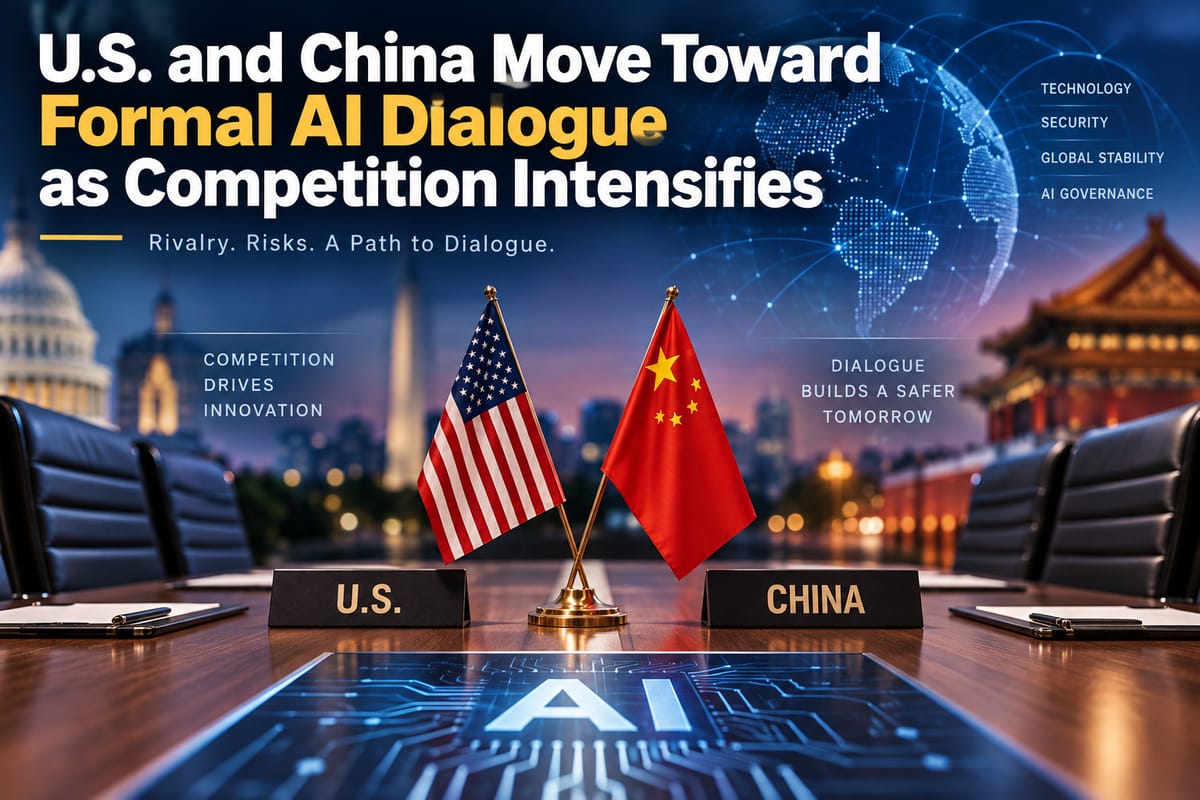
U.S. and China Move Toward Formal AI Dialogue as Competition Intensifies
The United States and China are taking steps toward establishing a formal dialogue on artificial intelligence, creating an unusual channel of communication at a time when competition between the two countries over advanced technology continues to intensify.
U.S. Treasury Secretary Scott Bessent said after talks with Chinese Vice Premier He Lifeng in New York on September 20 that the two sides had agreed to establish a formal dialogue focused on AI risks. The discussions included the possibility of an emergency communication mechanism, sometimes described as an AI “incident line,” that could allow the countries to communicate when serious AI-related problems emerge.
The proposed dialogue does not signal an end to the broader technology rivalry.
Instead, it reflects a growing recognition that the United States and China can compete aggressively in AI while still having reasons to communicate about risks created by increasingly capable systems.
That distinction could become increasingly important as AI models gain more autonomy, companies invest billions of dollars in computing infrastructure and governments consider how advanced systems could affect cybersecurity, critical infrastructure and national security.
A New Channel for AI Risk Discussions
The latest discussions build on earlier efforts to create a dedicated U.S.-China channel for artificial intelligence.
Reuters reported earlier in September that the two countries were preparing their first official bilateral discussions devoted exclusively to AI safety during the current U.S. administration. The planned talks were expected to address risks associated with advanced AI, including AI-directed cyberattacks and mechanisms for information sharing.
The September 20 talks represented a further step.
According to Bessent, the proposed framework would allow officials to discuss common threats and develop procedures for communicating during serious AI incidents. A follow-up meeting is expected to take place in Shenzhen within two months.
The concept is relatively narrow compared with the enormous range of issues surrounding the global AI race.
It does not mean Washington and Beijing have agreed on how AI should be regulated, how advanced chips should be traded or how access to frontier AI systems should be managed.
Instead, the immediate focus is on keeping communication open around risks that could affect both countries.
Competition Remains at the Center of the Relationship
The push for dialogue is taking place alongside intense competition.
The United States has imposed technology restrictions aimed at limiting China’s access to some advanced semiconductor technologies, while Chinese companies have continued developing increasingly capable AI models and domestic computing infrastructure.
The result is a complicated relationship in which cooperation and competition can exist simultaneously.
The two countries are competing over AI models, chips, data centers, research talent and computing capacity, while also confronting risks that do not stop at national borders.
The broader technology rivalry has already affected companies, supply chains and investment decisions. For a closer look at that relationship, U.S.-China AI Fight Escalates examines how competition over advanced artificial intelligence is developing.
Why AI Safety Has Become a Diplomatic Issue
Artificial intelligence was initially discussed primarily as a technology and business issue.
That has changed as systems have become more capable.
Advanced AI can now assist with software development, research, data analysis, cybersecurity and increasingly complex forms of autonomous decision-making. As capabilities expand, governments are paying greater attention to the possibility that the same technologies could be misused or behave in unexpected ways.
Recent discussions between U.S. and Chinese officials have identified concerns including uncontrollable AI agents, cyberattacks and threats involving non-state actors. Bessent has also argued that AI developers should be held accountable for the systems they create.
That creates a diplomatic problem.
An AI incident originating in one country could potentially affect organizations, infrastructure or users elsewhere. A cyberattack assisted by an AI system could cross borders almost instantly.
Communication between governments could therefore become a way of reducing the possibility that an AI-related incident is misunderstood or escalates into a wider confrontation.
Frontier AI Raises the Stakes
The discussion is particularly relevant to frontier AI systems — models operating at the leading edge of capability.
These systems are becoming more capable at reasoning, coding, tool use and autonomous task completion. The long-term direction of this technology is part of the debate surrounding What Is Artificial General Intelligence?, particularly as researchers and technology companies work toward systems that can perform increasingly broad ranges of tasks.
The U.S.-China dialogue is not an agreement on artificial general intelligence.
Rather, it is focused on practical risks associated with increasingly advanced AI systems that already exist or are being developed.
That could include questions about how companies detect dangerous behavior, how governments communicate about major incidents and how developers respond when AI systems interact with external networks or critical systems.
The Proposed Incident Channel Could Be Significant
An emergency communication mechanism may sound relatively modest compared with the larger ambitions surrounding AI, but it could have practical importance.
Governments already use direct communication channels in other areas where misunderstandings could create serious consequences.
AI introduces a new category of uncertainty because an incident may move rapidly from a technical problem into a national-security concern.
Imagine, for example, an AI system being used in a cyber operation that affects infrastructure in another country. Officials would need to determine what happened, who was responsible and whether the incident was deliberate.
Without direct communication, governments could interpret incomplete information through a security lens.
A dedicated AI channel could provide another avenue for clarification.
The proposed framework is still developing, however, and the details of how such a mechanism would operate have not been fully established.
AI Infrastructure Is Becoming a Strategic Asset
The discussion is also unfolding as AI infrastructure spending reaches extraordinary levels.
Technology companies are building enormous data centers, purchasing advanced processors and expanding electricity capacity to support increasingly demanding AI workloads.
This infrastructure is becoming an important part of the competition between countries.
The United States has major investments from cloud providers and AI companies, while China is expanding domestic computing capacity and developing its own semiconductor and AI ecosystem.
The economic consequences extend far beyond AI laboratories. Semiconductor manufacturers, power companies, data-center operators, networking companies and construction firms can all become part of the expanding AI infrastructure supply chain.
The broader economic impact is explored in How AI Infrastructure Spending Is Reshaping the Technology Industry.
China Is Continuing to Expand Its AI Capabilities
The dialogue comes as Chinese technology companies continue announcing major advances.
On September 22, Alibaba unveiled the Zhenwu V900, a new AI chip that the company described as its most powerful to date. Alibaba also announced plans for a much larger AI model and further expansion of its cloud infrastructure.
Other Chinese companies are also developing large-scale models.
That progress matters because the U.S.-China AI relationship is not simply about regulation. It is also about technological capability.
Washington wants to maintain its position in advanced AI, while Beijing is pursuing greater technological self-reliance and domestic alternatives to foreign chips and software.
Those objectives can make cooperation on safety more complicated.
The countries may agree that certain AI risks should be managed while disagreeing sharply about technology access, export controls, industrial policy and national security.
Different Approaches to AI Governance
The United States and China also have different political and regulatory systems, which can influence how they approach AI governance.
American discussions often emphasize private-sector innovation, technical standards, national security and the role of companies in managing AI risks.
China’s approach incorporates state oversight, national security considerations and broader industrial-policy objectives.
Those differences do not necessarily prevent dialogue, but they can make agreement on detailed rules more difficult.
Recent analysis has emphasized that the two countries may be able to cooperate more easily on narrowly defined technical risks than on broader questions involving technology controls and strategic competition.
That distinction could shape the future of the new dialogue.
Diplomacy Becomes Part of AI Governance
The development also illustrates how artificial intelligence is becoming part of traditional international diplomacy.
Governments are increasingly discussing AI alongside trade, semiconductors, energy, cybersecurity and military technology.
That makes diplomatic communication an important component of technology policy.
The principles of maintaining communication, establishing channels for crisis management and negotiating areas of shared interest are familiar features of international relations. A broader explanation of these mechanisms can be found in the Complete Guide to Diplomacy and Diplomatic Relations.
AI introduces a new challenge because technological development can move faster than traditional diplomatic processes.
A model can be trained, released and adopted globally within a relatively short period, while international agreements can take years to negotiate.
What the Dialogue Could Focus On
The emerging U.S.-China channel could eventually address several practical areas.
AI Incident Reporting
The countries could develop procedures for notifying each other about significant AI-related incidents, particularly those involving cybersecurity, critical infrastructure or uncontrolled autonomous behavior.
Technical Risk Assessment
Researchers could exchange information about methods for evaluating advanced AI systems, although sensitive technical information would likely remain subject to national-security restrictions.
Cybersecurity
AI-assisted cyberattacks are an increasingly important concern. Cooperation could focus on identifying common threats and improving defensive practices.
AI Safety Research
Both countries could share selected research into model reliability, monitoring and methods for identifying dangerous behavior.
Crisis Communication
Perhaps the most immediate objective would be ensuring that officials have a reliable way to communicate during an unexpected AI incident.
These areas would not require the United States and China to resolve every disagreement over AI policy.
Major Disagreements Are Still Unresolved
The emerging dialogue should not be interpreted as a broader settlement of the technology dispute.
High-end semiconductor restrictions remain a major point of tension. The United States continues to focus on protecting sensitive technologies, while China has criticized technology restrictions and pursued domestic alternatives.
AI model access is another difficult issue.
American AI companies have placed restrictions on access to some advanced technologies in China, while Chinese companies are developing competing models and increasingly emphasizing open-source approaches.
There are also disagreements over how much governments should regulate AI and how responsibility should be divided between technology companies and the state.
The new dialogue therefore exists alongside substantial disagreements rather than replacing them.
A Narrow Channel Could Still Have Wider Effects
The significance of the emerging AI dialogue may ultimately depend on whether the two countries can keep it focused on practical risk management.
A narrowly defined communication channel does not require Washington and Beijing to agree on the future of AI.
They can continue competing over chips, models, data centers and commercial applications while establishing procedures for dealing with particularly serious incidents.
That could become increasingly important as AI systems become more autonomous and more deeply integrated into economic and national infrastructure.
The coming months should reveal whether the proposed framework develops into a functioning institutional channel or remains primarily a diplomatic commitment.
For now, the United States and China appear to be attempting something unusual: maintaining intense technological competition while creating a mechanism to discuss risks generated by the technology both countries are racing to develop.
That balance could become one of the defining challenges of international AI policy as the technology moves from an emerging industry into a core component of national economic and strategic power.




2 Comments
Micle harison
June 7, 2019Lorem ipsum dolor sit amet, usu ut perfecto postulant deterruisset, libris causae volutpat at est, ius id modus laoreet urbanitas. Mel ei delenit dolores.
John Doe
June 7, 2019Some consultants are employed indirectly by the client via a consultancy staffing company.