
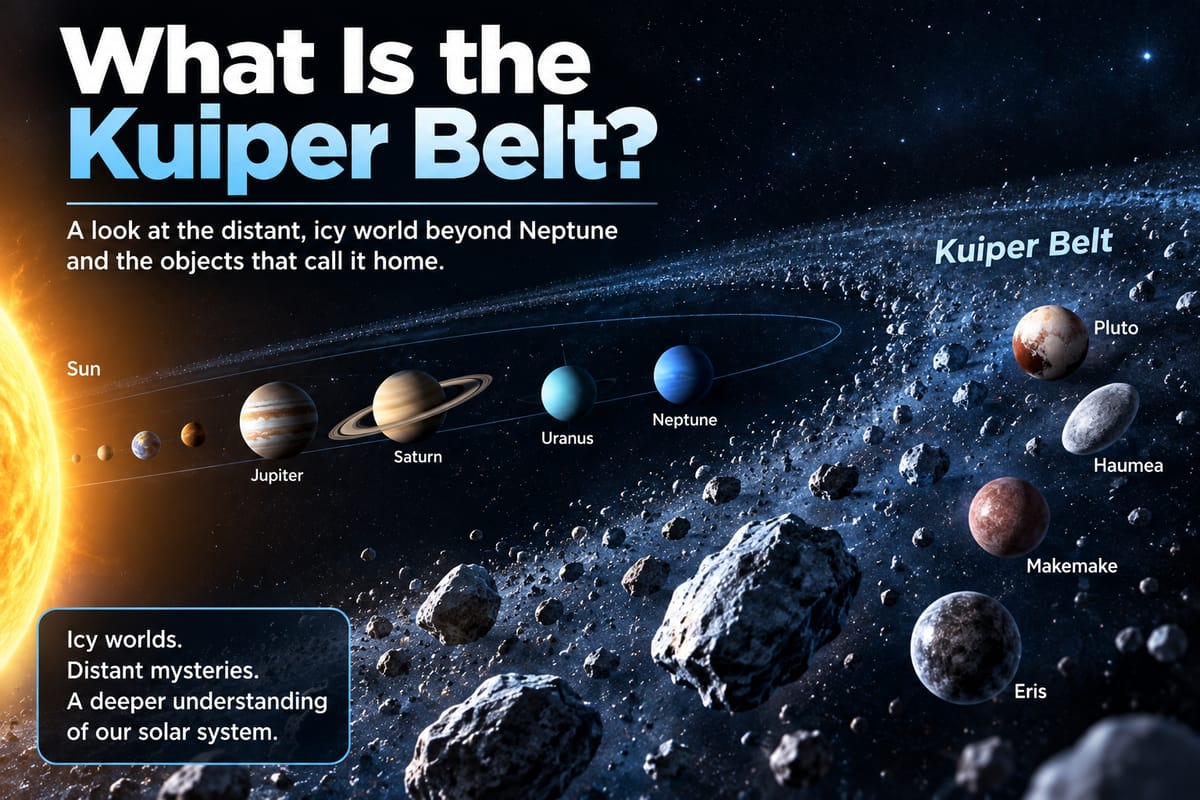
What Is the Kuiper Belt?
Beyond the orbit of Neptune lies one of the most intriguing regions of the solar system: the Kuiper Belt.
This distant zone contains countless small icy bodies left over from the formation of the solar system. Some are relatively small fragments, while others are large enough to be classified as dwarf planets. Pluto is the most famous example, but it is only one member of a much larger population.
The Kuiper Belt provides scientists with an important window into the early solar system. Because many of its objects have remained relatively cold and distant from the Sun for billions of years, they preserve clues about the materials and conditions that existed when the planets were forming.
Where Is the Kuiper Belt?
The Kuiper Belt begins beyond the orbit of Neptune and extends outward for a substantial distance.
Neptune orbits the Sun at an average distance of about 30 astronomical units, or AU, where one AU represents the average distance between Earth and the Sun. Many Kuiper Belt objects occupy regions farther from the Sun than Neptune.
The exact boundaries of the Kuiper Belt are not a simple circle with a clearly defined beginning and end. Its population changes with distance, and different groups of objects occupy different orbital regions.
The Kuiper Belt is therefore better understood as a broad population of icy objects beyond Neptune rather than a sharply defined ring.
The wider structure of the solar system is explored in The Complete Guide to Astronomy.
What Is Found in the Kuiper Belt?
The Kuiper Belt contains a diverse collection of small solar system bodies.
These include:
- Icy planetesimals
- Comets
- Dwarf planets
- Objects containing rock and ice
- Smaller fragments left from the solar system’s formation
Some Kuiper Belt objects are only a few kilometers across, while others are hundreds or thousands of kilometers wide.
The population is also diverse in terms of orbital shape, inclination, composition, and distance from the Sun.
Why Is the Kuiper Belt Icy?
The Kuiper Belt is extremely far from the Sun, so temperatures are much lower than those experienced by planets in the inner solar system.
At these distances, substances that would normally exist as gases closer to the Sun can remain frozen on or beneath the surfaces of distant objects.
Water ice is common, while other frozen compounds can also be present.
Scientists have detected evidence of materials such as methane and nitrogen ices on some of the larger distant worlds.
The presence of these frozen substances helps distinguish many Kuiper Belt objects from the rocky planets of the inner solar system.
How Did the Kuiper Belt Form?
The Kuiper Belt is closely connected to the formation of the solar system.
About 4.6 billion years ago, the Sun and planets formed from a rotating cloud of gas and dust. As material came together, much of it eventually became incorporated into the Sun and planets.
However, not all material became part of a major planet.
Some of the remaining material stayed in distant regions where temperatures were low enough for ice to survive.
The broad process of planetary formation and subsequent changes is explained in How the Solar System Formed and Evolved.
Why Didn’t the Kuiper Belt Become a Planet?
One of the key reasons is that the material in this region was never efficiently gathered into a single large body.
The gravitational influence of the planets, particularly Neptune, also played an important role in shaping the orbits of objects beyond it.
Early in solar system history, gravitational interactions moved and disturbed many smaller bodies. Some objects were pushed into different orbits, while others were scattered farther away or sent toward the inner solar system.
As a result, the region retained many smaller objects instead of forming one dominant planet.
Pluto and the Kuiper Belt
Pluto is the most famous object associated with the Kuiper Belt.
For many decades, Pluto was classified as the ninth planet. In 2006, the International Astronomical Union introduced a formal definition of a planet that required an object to orbit the Sun, be massive enough for its gravity to make it approximately round, and have cleared most other objects from its orbital neighborhood.
Pluto satisfies the first two criteria but does not meet the third.
It is therefore classified as a dwarf planet.
Its location and characteristics also make Pluto an important example of the types of worlds found in the outer solar system.
The diversity of planetary and dwarf-planet environments is discussed in the Complete Guide to Planets and Worlds.
Pluto Is Not Alone
The Kuiper Belt contains several other large objects.
Among the better-known examples are:
- Eris
- Haumea
- Makemake
- Quaoar
- Gonggong
- Orcus
- Sedna, which has an unusual orbit extending much farther from the Sun
These objects demonstrate that Pluto is part of a much broader population of distant worlds.
Some have moons, unusual shapes, rapid rotation, or surfaces containing different combinations of ice and rock.
Dwarf Planets in the Outer Solar System
Dwarf planets are particularly interesting because they occupy a middle ground between traditional planets and smaller bodies.
They are large enough for their own gravity to make them approximately round, but they have not cleared their orbital neighborhoods.
Several known or suspected dwarf planets are located in the outer solar system.
Studying them helps scientists understand how large planetary bodies develop and why some objects become planets while others remain smaller worlds.
The Kuiper Belt and Comets
The Kuiper Belt is also an important source of short-period comets.
Comets are icy bodies that can develop glowing comas and tails when they approach the Sun.
As a comet travels into the warmer inner solar system, sunlight can heat its surface and cause frozen materials to transition into gas. Dust and gas released from the nucleus can produce the familiar cometary appearance.
Some objects originating in the outer solar system can be disturbed from their original orbits and sent inward.
This means the distant Kuiper Belt is connected to some of the spectacular cometary activity observed closer to the Sun.
Neptune Helps Shape the Kuiper Belt
Neptune’s gravity has played a major role in determining the structure of the Kuiper Belt.
Objects passing relatively close to Neptune can experience gravitational interactions that alter their orbits.
Over billions of years, these interactions helped create distinct populations of objects with different orbital characteristics.
Some objects have nearly circular orbits, while others follow more elongated paths.
The relationship between Neptune and the distant objects beyond it is one of the reasons the Kuiper Belt has such a complicated structure.
Orbital Resonance in the Kuiper Belt
Some Kuiper Belt objects are in orbital resonance with Neptune.
An orbital resonance occurs when the orbital periods of two objects have a particular mathematical relationship.
For example, some objects complete two trips around the Sun in roughly the time Neptune completes three.
These resonant relationships can remain stable over extremely long periods because of the repeating pattern of gravitational interactions.
Pluto is associated with a 3:2 orbital resonance with Neptune.
This means Pluto completes two orbits around the Sun for approximately every three Neptune orbits.
Despite crossing the general radial range of Neptune’s orbit, Pluto and Neptune do not collide because their orbital motions remain synchronized in a stable pattern.
The Kuiper Cliff
One of the interesting features of the Kuiper Belt is a sharp decline in the number of known objects beyond a certain distance.
This feature is sometimes called the “Kuiper cliff.”
Scientists have proposed several explanations for the observed structure.
One possibility is that the region beyond the main Kuiper Belt was naturally depleted during solar system formation. Another possibility involves the gravitational history of Neptune and other planets.
There has also been discussion about whether undiscovered large objects or ancient gravitational interactions could have influenced the outer solar system.
The structure remains an active area of astronomical research.
Classical Kuiper Belt Objects
Some Kuiper Belt objects occupy relatively stable orbits and are commonly described as classical Kuiper Belt objects.
Their orbits generally have moderate distances from the Sun and are not strongly controlled by a major orbital resonance with Neptune.
Scientists study their orbital distributions to learn how the outer solar system evolved.
Some classical objects also have relatively low orbital inclinations, while others travel around the Sun on more tilted paths.
These differences preserve information about the gravitational events that occurred during the solar system’s early history.
Scattered Objects
Not every distant object belongs to the relatively stable main population.
Some objects have highly elongated or inclined orbits and are classified as scattered-disk objects.
These bodies may have experienced stronger gravitational interactions with Neptune during the solar system’s history.
Their orbits can take them much farther from the Sun than the main Kuiper Belt.
The scattered disk is therefore considered part of the broader population of icy bodies occupying the solar system’s outer regions.
What Is the Difference Between the Kuiper Belt and the Oort Cloud?
The Kuiper Belt and Oort Cloud are both associated with icy objects, but they occupy very different regions.
The Kuiper Belt is a relatively flattened region beyond Neptune. Its objects generally orbit the Sun in directions and planes related to the original planetary disk.
The Oort Cloud, by contrast, is thought to surround the solar system in a much more distant, roughly spherical distribution.
The Oort Cloud has not been directly observed as a population in the same way as Kuiper Belt objects. Its existence is inferred from the orbits of certain long-period comets.
The two regions therefore represent different parts of the solar system’s distant icy population.
Why Are Kuiper Belt Objects Important to Scientists?
Kuiper Belt objects are valuable because they preserve evidence about the solar system’s past.
The inner planets have undergone extensive geological and atmospheric changes. Earth, for example, has experienced erosion, tectonic activity, volcanic activity, biological evolution, and other processes that have altered its surface.
Many distant icy bodies have experienced much less change.
Their surfaces and compositions can therefore provide clues about the materials available when the solar system formed.
By studying these objects, scientists can investigate questions about:
- Planet formation
- Solar system migration
- Ancient chemistry
- Ice and rock distribution
- Gravitational interactions
- Comet origins
- The early solar system
New Horizons Explored the Kuiper Belt
NASA’s New Horizons spacecraft became the first spacecraft to conduct a close flyby of Pluto in 2015.
The mission revealed Pluto as a complex world with mountains, glaciers, valleys, plains, and a surprisingly active-looking surface.
After its Pluto encounter, New Horizons continued deeper into the Kuiper Belt.
In 2019, the spacecraft conducted a close flyby of Arrokoth, a distant Kuiper Belt object.
Arrokoth is particularly important because it provides a close look at a relatively pristine object from the outer solar system.
Its distinctive two-lobed shape suggests that two smaller bodies gradually came together during the early stages of solar system formation.
What Does Arrokoth Tell Us?
Arrokoth is far smaller than Pluto, but it has considerable scientific importance.
Its surface appears relatively undisturbed compared with many larger solar system bodies.
The object consists of two connected lobes, indicating that it formed through a gentle merger of smaller objects rather than a violent high-speed collision.
Observations of Arrokoth have provided additional evidence about how small bodies may have assembled during the early solar system.
This makes the Kuiper Belt more than a collection of distant rocks and ice. It is also a natural laboratory for studying planetary origins.
How Large Is the Kuiper Belt?
There is no single measurement that perfectly defines the outer edge of the Kuiper Belt.
Its main population extends tens of astronomical units beyond the Sun, but the broader population of related objects reaches considerably farther.
Some objects have highly elongated orbits that carry them hundreds of astronomical units from the Sun at their most distant points.
This demonstrates how difficult it can be to define the boundaries of the outer solar system.
For perspective, the scale of our planetary system is already enormous compared with everyday distances. The larger cosmic context is explored in How Large Is the Known Universe.
Why Is the Kuiper Belt So Difficult to Study?
Distance is the biggest challenge.
Even relatively large Kuiper Belt objects appear extremely faint from Earth because they are so far away and reflect only a small amount of sunlight.
Their great distances also mean that spacecraft take many years to reach them.
Ground-based and space-based telescopes can observe some Kuiper Belt objects, but detailed close-up information requires spacecraft encounters.
Scientists can nevertheless learn a great deal by studying the objects’ brightness, colors, spectra, orbital motion, and interactions with other bodies.
How Are Kuiper Belt Objects Discovered?
Astronomers search for distant objects by repeatedly photographing regions of the sky.
Stars appear essentially fixed from one image to another, while objects orbiting the Sun move against the background of distant stars.
Computer systems can compare images to identify these moving points of light.
Once an object is detected, astronomers can make additional observations to determine its orbit.
The more observations collected over time, the more accurately its path around the Sun can be calculated.
The Kuiper Belt Is Not an Empty Ring
Images of the solar system often show the planets separated by vast amounts of empty space.
Although the Kuiper Belt is incredibly sparse compared with Earth’s environment, it contains a substantial population of objects spread across an enormous volume.
Most of these objects are extremely far apart.
A spacecraft traveling through the Kuiper Belt is therefore not likely to encounter icy bodies constantly. Space remains overwhelmingly empty, even within regions containing thousands or millions of objects.
Could There Be More Large Worlds?
Astronomers continue to search for distant objects that have not yet been discovered.
Some large bodies could be difficult to detect because they are extremely far away, relatively dark, or located in regions that are difficult to observe.
There has also been scientific discussion about whether the outer solar system could contain a previously undetected large planet.
The idea has been proposed partly to explain unusual orbital patterns among some distant objects, but no such planet has been directly observed.
The question remains an example of how observations of small, distant objects can potentially reveal information about the architecture of the solar system.
The Kuiper Belt and the Future of Solar System Exploration
The Kuiper Belt represents one of the next major frontiers for robotic exploration.
Future spacecraft could investigate additional objects at close range, compare their compositions, study their surfaces, and investigate how different populations formed.
Long-duration missions could also provide more information about the outer solar system’s magnetic environment, dust, plasma, and other conditions.
Because travel times are long, missions to the Kuiper Belt require spacecraft that can operate reliably for many years.
Why the Kuiper Belt Matters
The Kuiper Belt is a vast population of icy worlds and smaller bodies beyond Neptune. It contains dwarf planets such as Pluto, numerous smaller objects, and bodies that can become sources of short-period comets.
More importantly, it preserves evidence from the earliest stages of solar system history.
Studying this distant region helps scientists understand how planets formed, how gravity reshaped their orbits, how icy bodies assembled, and how the solar system developed into the structure observed today.
Far from being an empty boundary around the planets, the Kuiper Belt is a record of the solar system’s deep past—and one of the most important places to study when trying to understand how our planetary neighborhood came to exist.



2 Comments
Micle harison
June 7, 2019Lorem ipsum dolor sit amet, usu ut perfecto postulant deterruisset, libris causae volutpat at est, ius id modus laoreet urbanitas. Mel ei delenit dolores.
John Doe
June 7, 2019Some consultants are employed indirectly by the client via a consultancy staffing company.