
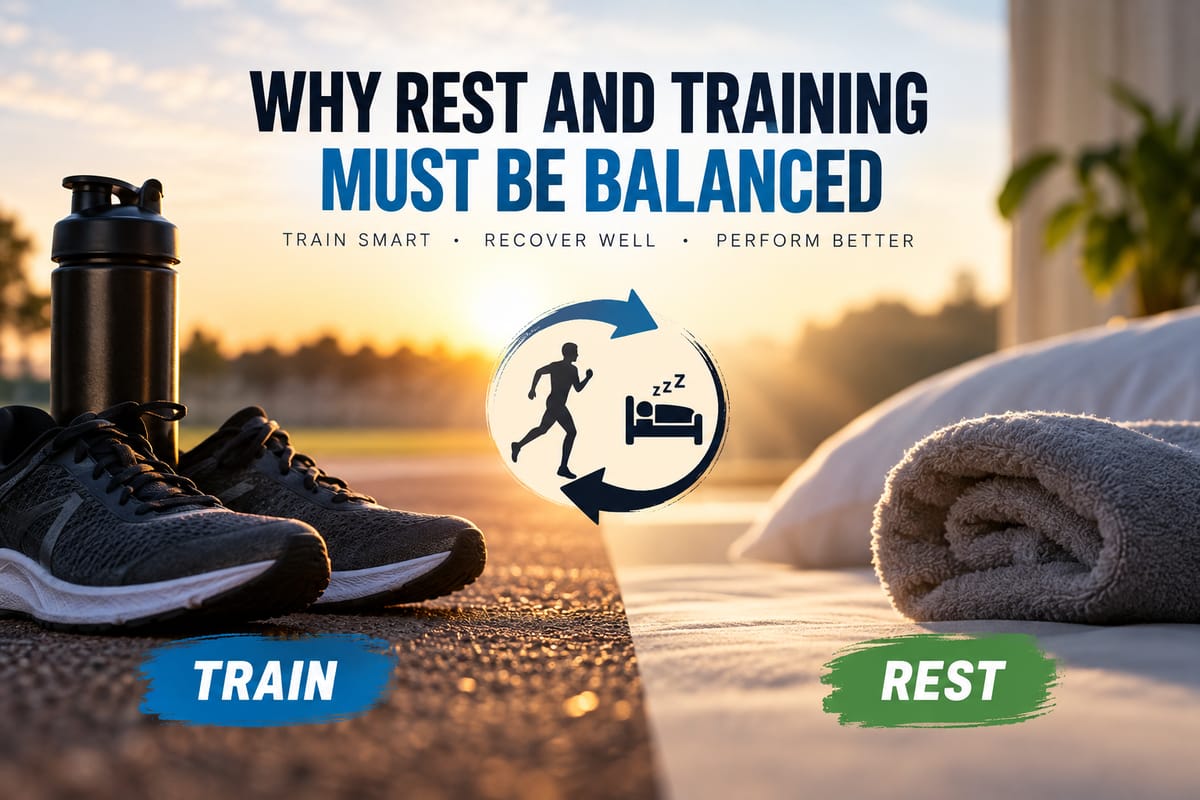
**Why Rest and Training Must Be Balanced
Athletic improvement is often associated with hard work: more training sessions, longer workouts, heavier weights, and greater intensity. But training is only one part of the performance equation. Without enough recovery, the body and mind may struggle to adapt to the demands being placed on them.
The balance between training and rest is what allows athletes to become stronger, fitter, faster, and more resilient. Training provides the stimulus for adaptation, while recovery gives the body an opportunity to respond to that stimulus. Too little training may limit progress, but too much training without sufficient recovery can lead to fatigue, declining performance, and a greater risk of injury.
Understanding this relationship is essential for athletes at every level, from beginners developing a routine to experienced competitors preparing for major events.
Training Creates the Stimulus for Improvement
Physical training places stress on the body. Muscles are challenged, energy stores are depleted, the nervous system works harder, and connective tissues experience additional loads. These stresses are not necessarily harmful when they are appropriately planned. In fact, they are necessary for improvement.
The body responds to repeated training by adapting to the demands it encounters. Muscles can become stronger, cardiovascular capacity can improve, movement can become more efficient, and athletes can develop greater tolerance for demanding workloads.
However, these adaptations do not occur simply because a workout was completed. They develop during the periods between training sessions, when the body has the opportunity to repair and adjust.
This is why effective training is not simply about doing more. It is about providing the right amount of stress and allowing enough time for the body to respond.
Rest Is Part of the Training Process
Rest is sometimes viewed as lost training time, particularly among athletes who believe that constant activity is necessary for progress. In reality, planned recovery is an essential component of a successful training program.
During recovery, the body works to restore energy reserves, repair tissues, and adapt to previous exercise. The nervous system also benefits from periods of reduced physical demand, while adequate sleep supports many of the processes involved in physical and mental recovery.
A useful overview of this relationship can be found in sports recovery explained: rest, adaptation and readiness, which highlights why recovery should be treated as part of athletic preparation rather than as an interruption to it.
Rest does not always mean complete inactivity. Depending on the athlete and training phase, recovery may involve a full rest day, lighter exercise, mobility work, easy aerobic activity, or simply reducing training intensity.
What Happens When Training Outpaces Recovery?
The body has a limited capacity to handle physical stress. When training demands consistently exceed recovery capacity, fatigue can accumulate.
An athlete experiencing excessive fatigue may notice several changes, including:
- Declining performance despite continued training
- Persistent muscle soreness or heaviness
- Reduced motivation to exercise
- Poorer concentration
- Disturbed sleep
- Irritability or mood changes
- Difficulty completing workouts that previously felt manageable
- Increased susceptibility to minor injuries or illness
One difficult workout does not automatically create a problem. Short periods of fatigue are a normal part of challenging training. The concern arises when an athlete repeatedly adds demanding sessions without giving the body sufficient opportunity to recover.
The result can be a cycle in which an athlete trains harder to compensate for declining performance, becomes increasingly fatigued, and then performs even worse.
Fitness Depends on More Than Workout Volume
A well-rounded approach to athletic fitness includes several physical qualities rather than focusing exclusively on how much an athlete can train.
Strength, endurance, speed, mobility, coordination, balance, and sport-specific skills can all contribute to performance. The appropriate combination depends on the demands of the sport and the athlete’s individual goals.
The complete guide to fitness for athletes provides a broader look at the physical qualities that contribute to athletic readiness.
This wider perspective also makes it easier to understand why simply increasing workout volume is not always the best way to improve. An athlete may gain more from a carefully structured week that combines different forms of training with adequate recovery than from repeatedly performing high-intensity sessions.
Strength Training Requires Recovery
Strength training is a clear example of why training and recovery need to work together.
Resistance exercise challenges muscles and the systems responsible for producing force. As an athlete adapts, appropriately programmed strength work can improve force production, stability, movement quality, and physical resilience.
But strength gains are not produced by endlessly repeating demanding sessions. The body needs time to recover between challenging workouts.
Athletes can use principles discussed in the complete guide to strength training to understand how resistance exercise can be incorporated into a broader training plan.
The right recovery period depends on factors such as exercise selection, training intensity, total workload, experience, sleep, nutrition, and the athlete’s other physical activities.
Conditioning Also Has to Be Managed
Strength is only one part of athletic preparation. Conditioning helps athletes handle repeated physical demands, sustain effort, and recover between bouts of activity.
However, conditioning sessions can also create substantial stress. High-intensity intervals, repeated sprints, long endurance sessions, and demanding sport practices all contribute to an athlete’s total workload.
Combining multiple demanding sessions without considering their cumulative effect can leave an athlete carrying fatigue from one workout into the next.
This is why how strength and conditioning improves athletic performance is best understood within the context of an overall program. Effective conditioning is not simply about making every session difficult. It is about developing the qualities an athlete needs while managing workload intelligently.
Sleep Plays a Central Role
Rest extends beyond days away from the gym or training field. Sleep is one of the most important forms of recovery available to an athlete.
During sleep, the body carries out processes involved in physical restoration and the brain processes information accumulated during the day. Adequate sleep can also support concentration, reaction time, mood, and the ability to perform technical skills consistently.
An athlete who trains intensely but regularly sacrifices sleep may undermine some of the benefits of that training.
Sleep requirements vary between individuals and can change during periods of heavy training, competition, travel, or stress. Rather than treating sleep as optional downtime, athletes should view it as part of their preparation.
Nutrition Supports the Training-Recovery Cycle
Training and recovery are also closely connected to nutrition.
Exercise increases the body’s need for energy and nutrients. Eating appropriately helps replenish energy stores and provides the raw materials needed for tissue repair and adaptation.
The precise nutritional strategy depends on the sport, training volume, body size, goals, and individual circumstances. Nevertheless, consistently under-fueling demanding training can make recovery more difficult.
Hydration matters as well. Fluid losses during exercise can affect physical performance, particularly during prolonged or intense activity. Replacing fluids appropriately is therefore another component of managing the training-recovery balance.
Rest Does Not Mean Losing Fitness
Some athletes worry that taking a rest day will cause them to lose their progress. For most training programs, an occasional recovery day is far more likely to support long-term consistency than to erase fitness.
Fitness develops over weeks, months, and years rather than from a single workout. A rest day within a well-designed program is therefore not a setback. It can help an athlete return to the next session with better energy and greater capacity to perform.
Short periods of reduced training can also be useful when fatigue has accumulated. Coaches may deliberately reduce workload during certain phases so athletes can recover before an important competition.
How Athletes Can Find the Right Balance
There is no universal training-to-rest ratio that works for every athlete. The appropriate balance depends on the individual’s sport, experience, goals, schedule, current fitness, and ability to recover.
Several principles can help athletes manage the relationship more effectively:
Monitor Performance
Performance trends can provide useful information. If an athlete repeatedly struggles with workloads that were previously manageable, accumulated fatigue may be worth considering.
Vary Training Intensity
Not every workout needs to be maximally demanding. Alternating harder sessions with easier training can help manage cumulative stress.
Schedule Recovery
Rest should be planned rather than added only after an athlete becomes exhausted. Recovery days can be incorporated into weekly training schedules just like workouts.
Pay Attention to Warning Signs
Persistent soreness, unusual fatigue, declining motivation, poor sleep, and worsening performance should not simply be ignored. They can indicate that training demands need to be reassessed.
Consider the Entire Workload
An athlete’s workload includes more than formal workouts. Games, practices, commuting, physical jobs, travel, and other activities can all contribute to overall stress.
Adjust When Necessary
Training plans should not be completely rigid. If an athlete is unusually fatigued, reducing the intensity or volume of a session may be more productive than forcing the original plan.
The Goal Is Sustainable Progress
The best training program is not necessarily the one that produces the most exhaustion. It is the one that allows an athlete to apply enough stimulus to improve while recovering sufficiently to repeat that process consistently.
Training and rest therefore work as partners. Training challenges the body; recovery allows it to adapt. Training develops capacity; recovery helps preserve the ability to train again. When the two are properly coordinated, athletes can build fitness without constantly operating at the edge of exhaustion.
Long-term athletic development depends on consistency, and consistency becomes much easier when recovery is treated as a fundamental part of the plan rather than something that happens only when training stops.




2 Comments
Micle harison
June 7, 2019Lorem ipsum dolor sit amet, usu ut perfecto postulant deterruisset, libris causae volutpat at est, ius id modus laoreet urbanitas. Mel ei delenit dolores.
John Doe
June 7, 2019Some consultants are employed indirectly by the client via a consultancy staffing company.