
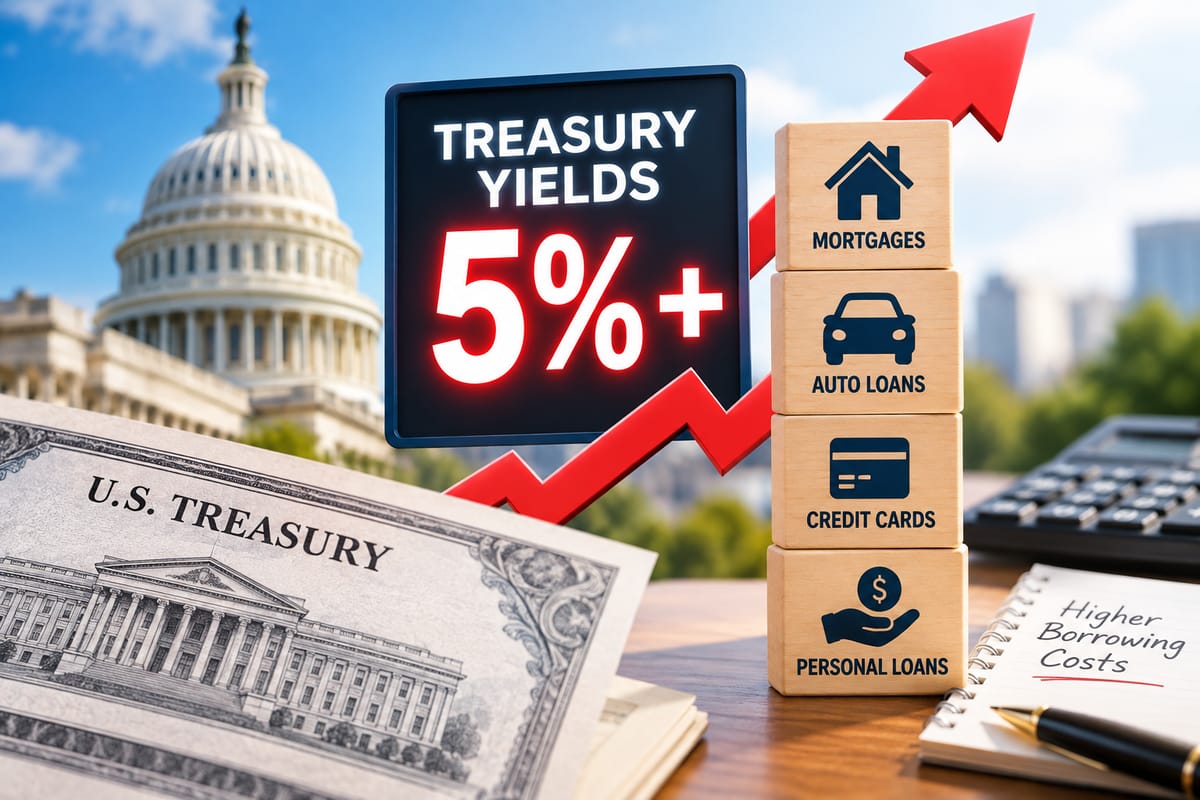
**Treasury Yields Above 5% Could Raise Borrowing Costs for Households
Treasury yields above 5% would represent an important development for households, investors, businesses, and financial markets. Although Treasury securities are generally viewed as among the safest investments available, their yields play a much broader role in the economy because they influence the interest rates that lenders charge across the financial system.
When Treasury yields remain elevated, borrowing costs can rise for mortgages, auto loans, credit cards, personal loans, and other forms of household credit. The effects are not necessarily immediate or identical across every type of loan, but higher benchmark yields can create a more expensive financial environment for consumers.
For households already managing tight budgets, another increase in borrowing costs could make debt payments more difficult and reduce the amount of money available for everyday spending, saving, and investing.
Why Treasury Yields Matter to Households
Treasury yields are often treated as a reference point for interest rates throughout the economy. Investors compare the potential return on other assets with the return available from government securities, while lenders consider broader market rates when determining how much to charge borrowers.
The relationship is not one-to-one. A mortgage rate, for example, includes additional factors such as lender costs, credit risk, market conditions, and the spread between mortgage-backed securities and Treasury securities.
Nevertheless, persistently high Treasury yields can contribute to higher overall borrowing costs.
This is one reason household finances can be affected by developments that initially appear to concern financial markets rather than consumers. Understanding that connection is part of understanding The Global Economy Explained, particularly the way financial markets transmit changes in interest rates into the broader economy.
How Yields Above 5% Can Push Borrowing Costs Higher
When Treasury yields rise, investors may demand higher returns from other fixed-income investments. Banks and other lenders also operate in an environment where the cost of obtaining and deploying capital is affected by market interest rates.
Several borrowing categories can therefore come under pressure.
Mortgages
Mortgage rates are particularly important because housing loans are typically large and long-term. Even a relatively small change in the interest rate can substantially affect the total amount a borrower pays over the life of a loan.
Higher market yields can contribute to upward pressure on mortgage rates, although mortgage rates do not move perfectly in step with Treasury yields.
For prospective buyers, the result can be higher monthly payments and reduced purchasing power. Existing homeowners with fixed-rate mortgages may be insulated from immediate changes, while borrowers with adjustable-rate loans can be more exposed.
The housing market has already demonstrated how sensitive affordability can be to interest-rate movements, as illustrated by Mortgage Rates Rise Again as Homebuyers Face Higher Monthly Payments.
Auto Loans
Vehicle financing can also become more expensive when interest rates remain high.
Because cars are frequently financed over several years, higher rates can increase monthly payments even when the vehicle’s purchase price remains unchanged. Consumers may respond by choosing less expensive vehicles, making larger down payments, delaying purchases, or seeking shorter or longer loan terms.
The trade-off is that extending a loan can reduce the monthly payment while increasing the amount of interest paid over time.
Credit Cards
Credit cards can be particularly sensitive to a high-rate environment because many cards carry variable interest rates.
Consumers who carry balances from month to month may therefore feel the effects more quickly than borrowers with fixed-rate debt. Higher interest charges can make it harder to reduce balances, especially when a large portion of each payment goes toward interest rather than principal.
For households already carrying significant revolving debt, this can create a persistent drag on monthly cash flow.
Personal Loans
Personal loans can also become more expensive when lenders face higher funding costs or when market rates remain elevated.
Borrowers with strong credit may still find competitive offers, but consumers with weaker credit profiles can face considerably higher rates. This makes shopping around, comparing total borrowing costs, and understanding loan terms increasingly important.
The Pressure on Household Budgets
The biggest concern for many families is not necessarily a single higher interest rate. It is the cumulative effect of several expensive financial commitments occurring at the same time.
A household might be dealing with a mortgage or rent increase, a vehicle payment, credit-card balances, insurance costs, utilities, and everyday living expenses. If interest costs rise while income does not increase at the same pace, less money remains available for discretionary spending and saving.
That dynamic can create a feedback effect.
Consumers may postpone major purchases, reduce restaurant and entertainment spending, delay home improvements, or draw down savings. Businesses can then experience weaker demand, potentially affecting economic growth.
The relationship between interest rates and household finances is explored more broadly in Consumers Feel Pressure as High Interest Rates Affect Household Budgets.
Why Treasury Yields Could Stay Elevated
Treasury yields can rise for several reasons, and the cause matters when considering how long higher borrowing costs might persist.
One factor is inflation. If investors believe inflation will remain above central-bank targets, they may demand higher yields to compensate for the reduced purchasing power of future payments.
Economic growth can also influence yields. Stronger-than-expected economic activity may encourage investors to anticipate higher interest rates for longer, pushing longer-term Treasury yields upward.
Government borrowing is another consideration. When the government issues large quantities of debt, investors may demand higher yields depending on market conditions, expectations, and the available supply of competing investments.
Expectations about monetary policy are also crucial. Investors constantly reassess whether central banks are likely to raise rates, hold them steady, or eventually reduce them.
That makes questions surrounding Will Interest Rates Fall Again? particularly important for households trying to determine whether today’s borrowing environment is temporary or likely to remain restrictive.
Not Every Borrower Feels the Same Impact
A rise in Treasury yields does not affect every household equally.
Someone with a fixed-rate mortgage secured several years ago may see little immediate change in their housing payment. A household with substantial savings may even benefit from higher interest rates if banks increase deposit yields.
By contrast, consumers carrying variable-rate debt or preparing to take out a new loan can be more exposed.
Credit quality matters as well. Borrowers with excellent credit may have access to lower rates than borrowers with weaker credit histories. The difference can become especially significant when overall borrowing costs are already elevated.
The structure of a household’s balance sheet therefore matters just as much as the headline Treasury yield.
Higher Yields Can Also Benefit Savers
The impact of higher Treasury yields is not entirely negative.
Higher market rates can create better opportunities for savers and investors seeking relatively conservative assets. Treasury securities, certificates of deposit, money-market products, and some savings accounts may offer more attractive returns than they did during periods of exceptionally low interest rates.
For households holding substantial cash, higher yields can provide additional interest income.
The challenge is that many consumers are both savers and borrowers at the same time. A family may earn more interest on savings while simultaneously paying more on a credit-card balance or new mortgage.
Whether higher rates help or hurt therefore depends heavily on the household’s financial position.
What Households Can Do in a High-Yield Environment
Consumers cannot control Treasury yields, but they can control some of the decisions that determine their exposure to higher interest rates.
Review Variable-Rate Debt
Households carrying variable-rate debt should understand how changes in market rates could affect future payments. Knowing the current rate, repayment schedule, and outstanding balance can make potential increases easier to anticipate.
Compare Loan Offers Carefully
When borrowing is necessary, consumers should compare more than the advertised interest rate. Fees, loan duration, repayment requirements, and the total amount of interest paid can all materially change the cost of borrowing.
Avoid Taking on Unnecessary Debt
A high-rate environment can make discretionary borrowing substantially more expensive. Delaying a nonessential purchase may sometimes be financially preferable to financing it at a high interest rate.
Strengthen Emergency Savings
An adequate cash reserve can reduce the need to rely on expensive credit when an unexpected expense appears.
Even when savings accounts offer higher yields, households should still consider liquidity and accessibility rather than chasing the highest advertised return.
Consider Refinancing Carefully
Refinancing can make sense when it meaningfully reduces borrowing costs, but fees and the remaining term of the original loan must be considered. A lower monthly payment does not automatically mean a lower overall cost.
What Higher Treasury Yields Could Mean for the Economy
The household impact is only one part of the broader picture.
Higher yields can increase financing costs for businesses and governments as well. Companies considering new investments may face higher borrowing costs, potentially affecting expansion plans, hiring, and capital spending.
Consumers may simultaneously become more cautious because financing large purchases is more expensive.
This is one mechanism through which financial conditions can influence economic growth. Higher rates can discourage borrowing and spending, helping moderate demand, but they can also create financial pressure for borrowers.
The challenge for policymakers and investors is determining whether elevated yields reflect a healthy economy, persistent inflation concerns, increased government borrowing, or expectations that interest rates will remain high.
The Importance of Watching the Yield Curve
The level of the 10-year Treasury yield often receives considerable attention because it influences many long-term borrowing costs. However, investors also examine the broader Treasury yield curve.
Different maturities can respond differently to expectations about inflation, economic growth, monetary policy, and government borrowing.
A rise in short-term yields can communicate something different from a sharp increase in long-term yields. For households, the distinction matters because different financial products are linked to different benchmarks and market conditions.
As a result, the headline figure above 5% should not be viewed in isolation.
Could Higher Yields Change Consumer Behavior?
If borrowing costs remain elevated for an extended period, household behavior can gradually change.
Consumers may become more selective about large purchases and place greater emphasis on affordability. Homebuyers may reduce their budgets, borrowers may prioritize paying down high-interest debt, and savers may become more interested in earning returns on cash.
These behavioral changes can eventually influence broader economic activity.
A consumer who decides not to finance a new vehicle, for example, is making an individual financial decision. When millions of households make similar decisions, however, the combined effect can influence demand across major parts of the economy.
A More Expensive Credit Environment Could Persist
Treasury yields above 5% would not automatically mean that every household loan becomes more expensive overnight. The transmission from government bond markets to consumer borrowing rates is more complicated than that.
But sustained high Treasury yields can contribute to a financial environment in which lenders, investors, businesses, and consumers all face higher costs of capital.
For households, the practical response is to focus on the parts of the financial picture they can control: borrowing selectively, comparing loan terms, managing variable-rate debt, maintaining emergency savings, and understanding how interest costs affect long-term financial goals.
The most important question may ultimately be how long elevated yields persist. If inflation eases and monetary policy becomes less restrictive, borrowing conditions could eventually improve. If inflation remains stubborn or investors demand higher compensation for holding long-term government debt, households could face a more prolonged period of expensive credit.
For consumers already managing stretched budgets, that distinction could make a meaningful difference in how much they pay to borrow—and how much they have left to save and spend.




2 Comments
Micle harison
June 7, 2019Lorem ipsum dolor sit amet, usu ut perfecto postulant deterruisset, libris causae volutpat at est, ius id modus laoreet urbanitas. Mel ei delenit dolores.
John Doe
June 7, 2019Some consultants are employed indirectly by the client via a consultancy staffing company.