
How Waste-to-Energy Systems Generate Electricity
Every community produces waste, from household garbage and food scraps to commercial refuse and discarded materials. Traditionally, much of that waste has been sent to landfills, where it can occupy valuable land and create environmental challenges.
Waste-to-energy systems offer another approach.
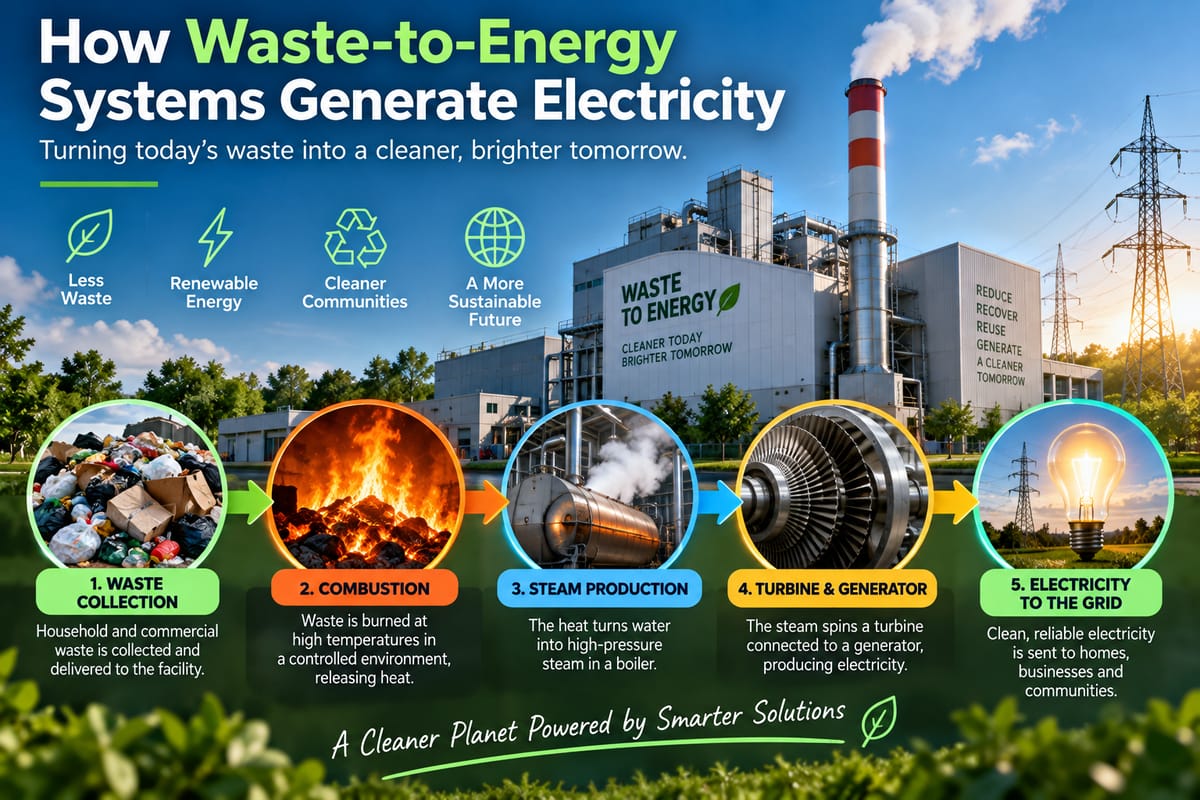
These facilities process certain types of waste and use the energy contained within them to generate useful heat, electricity, or both. In the most common systems, non-recyclable waste is burned under controlled conditions, producing heat that turns water into steam. The steam then drives a turbine connected to an electrical generator.
The process effectively turns part of the waste stream into an energy resource while reducing the volume of material that ultimately requires disposal.
However, waste-to-energy is not simply a matter of burning garbage. Modern facilities rely on sophisticated combustion systems, pollution controls, energy-recovery equipment, and waste-management practices to operate safely and efficiently.
What Is a Waste-to-Energy System?
A waste-to-energy system is a facility or technology designed to recover usable energy from waste.
The recovered energy can be used to:
- Generate electricity
- Produce steam
- Provide district heating
- Supply industrial heat
- Support combined heat and power systems
The term covers several different technologies, but combustion-based systems are among the most widely recognized.
A typical municipal waste-to-energy plant receives household and commercial waste that remains after recycling and other recovery efforts. The waste is processed and fed into a combustion chamber, where controlled burning releases thermal energy.
That heat becomes the starting point for electricity generation.
How Waste Becomes Electricity
The basic process can be understood through a series of stages.
1. Waste Is Collected
Households, businesses, and institutions generate waste that is collected through municipal or private waste-management systems.
The waste stream may contain materials such as:
- Paper
- Cardboard
- Food-contaminated materials
- Certain plastics
- Textiles
- Wood
- Packaging
- Other combustible materials
Recyclable materials may be removed before waste reaches an energy-recovery facility.
Understanding how waste moves from homes to collection, sorting, treatment, and disposal is an important part of the broader How Household Waste Management Works process.
2. Waste Is Delivered to the Facility
Collection trucks deliver waste to the waste-to-energy plant.
The facility typically stores incoming waste in a large enclosed receiving area. Large mechanical equipment, such as cranes, can move the waste and feed it into the combustion system.
Enclosed handling areas can also help control odors and prevent waste from escaping into the surrounding environment.
3. Waste Is Fed Into a Furnace
A crane or automated feeding system places waste into a combustion chamber.
The waste is burned at high temperatures under carefully controlled conditions.
The objective is to maintain combustion conditions that allow the waste to burn efficiently while minimizing the formation of unwanted pollutants.
The precise operating conditions depend on the facility design and characteristics of the waste.
The Role of Heat
The central concept behind most combustion-based waste-to-energy plants is simple:
Waste contains chemical energy, and combustion releases that energy as heat.
The heat produced inside the furnace is transferred to water flowing through a boiler.
The water absorbs thermal energy and becomes high-pressure steam.
This creates a crucial transition in the process:
Waste → Heat → Steam → Turbine → Electricity
The waste itself does not directly turn the generator.
Instead, its chemical energy is converted into heat, and the heat produces steam that drives mechanical equipment.
How the Boiler Produces Steam
The boiler is one of the most important components of a waste-to-energy facility.
Hot combustion gases pass through the boiler while water circulates through tubes or other heat-transfer surfaces.
The heat moves from the combustion gases into the water.
As the water reaches the required temperature and pressure, it becomes steam.
The steam contains substantial energy that can be converted into mechanical motion.
This is similar to the basic principle used in many conventional thermal power plants.
How the Steam Turbine Generates Electricity
High-pressure steam is directed toward a turbine.
A turbine contains multiple blades or stages arranged around a rotating shaft.
When the steam flows through the turbine, it pushes against the blades and causes the shaft to rotate.
The rotating shaft is connected to an electrical generator.
Inside the generator, mechanical rotation is converted into electrical energy through electromagnetic induction.
The electricity can then be transferred to the electrical grid or used by the facility itself.
In simplified form:
Steam pressure → Turbine rotation → Generator → Electricity
What Happens to the Steam Afterwards?
After passing through the turbine, the steam loses much of its energy.
It is then cooled and condensed back into water.
The water can be treated and returned to the boiler system, creating a cycle that allows it to be reused.
Depending on the plant design, some of the steam may also be extracted before reaching the end of the turbine to provide useful heat to nearby buildings or industrial facilities.
This is known as combined heat and power, or CHP.
Waste-to-Energy Can Produce Both Electricity and Heat
Electricity is only one possible energy product.
A waste-to-energy facility located near a district-heating network may supply hot water or steam for:
- Homes
- Offices
- Hospitals
- Schools
- Industrial facilities
- Commercial buildings
Using the heat that would otherwise be rejected can improve the overall energy efficiency of the facility.
A plant that produces electricity and useful heat can therefore extract more practical value from the same waste stream than a plant focused only on electricity generation.
What Happens to the Waste After Combustion?
Burning waste does not make all of it disappear.
The combustion process produces solid residues.
These generally include bottom ash and other materials collected from the plant’s pollution-control systems.
Bottom Ash
Bottom ash is the heavier material that remains after combustion.
It can contain minerals, glass, metals, and other non-combustible materials.
Some metals may be recovered from the ash for recycling.
Depending on local regulations and treatment processes, certain portions of the remaining material may be processed for other uses or sent for disposal.
Air Pollution Control Residues
Pollution-control equipment captures materials from the combustion gases.
These residues can contain concentrated pollutants and therefore require appropriate handling and disposal or treatment.
The management of these materials is an important part of responsible waste-to-energy operations.
How Waste-to-Energy Plants Control Air Pollution
One of the biggest concerns surrounding waste combustion is air pollution.
Burning waste can produce gases and particles that must be controlled before exhaust gases are released.
Modern facilities can use multiple pollution-control technologies, including systems designed to reduce:
- Particulate matter
- Acid gases
- Nitrogen oxides
- Heavy metals
- Organic pollutants
The exact combination of technologies varies according to the facility, waste composition, regulations, and plant design.
This issue needs to be considered within the wider context of environmental pollution. A useful overview is provided by Environmental Pollution Explained: The Complete Guide.
Why Waste Combustion Requires Careful Control
Waste is a highly variable fuel.
Unlike natural gas or some other fuels with relatively consistent compositions, household and commercial waste can change from one delivery to another.
One load might contain more paper and cardboard, while another might contain more food waste, plastics, textiles, or moisture.
These differences can affect combustion temperature, energy output, and emissions.
Waste-to-energy facilities therefore use monitoring and control systems to maintain appropriate operating conditions.
Flue Gas Treatment
After combustion, hot gases leave the furnace and pass through various treatment stages.
The precise sequence depends on the facility, but pollution-control systems can remove or reduce contaminants before the gases reach the chimney.
Equipment may include:
- Filters
- Scrubbers
- Electrostatic precipitators
- Fabric filters
- Selective catalytic or non-catalytic reduction systems
- Activated-carbon injection systems
Each technology addresses particular pollutants or groups of pollutants.
The overall objective is to produce an exhaust stream that meets applicable environmental standards.
Continuous Emissions Monitoring
Modern waste-to-energy facilities can use monitoring systems to measure emissions from their operations.
Depending on regulatory requirements and facility design, monitoring may include pollutants such as nitrogen oxides, sulfur compounds, carbon monoxide, particulate matter, and other substances.
Continuous monitoring provides operators with information about plant performance and helps identify problems that require attention.
Environmental regulations also establish limits intended to protect public health and the environment.
How Much Electricity Can Waste Produce?
The amount of electricity generated depends on several factors.
These include:
- The amount of waste processed
- Moisture content
- Energy content of the waste
- Combustion technology
- Boiler efficiency
- Turbine efficiency
- Plant operating conditions
- Internal electricity consumption
Waste with higher moisture content generally contains less usable energy because some of the combustion energy is consumed evaporating water.
Conversely, dry materials such as paper and certain plastics can contain considerable chemical energy.
This variability means that waste-to-energy plants must continuously manage their fuel supply.
Why Moisture Matters
Food waste and other wet materials can significantly affect the energy value of municipal waste.
Water does not provide useful combustion energy in the same way that combustible materials do.
Instead, energy is required to heat and evaporate it.
A waste stream with high moisture content can therefore produce less net energy than a relatively dry waste stream.
This is one reason waste composition is so important when evaluating the performance of a waste-to-energy facility.
Waste-to-Energy and Recycling
Waste-to-energy does not necessarily have to compete with recycling.
In a well-designed waste-management system, materials that can be economically and practically recycled can be recovered before the remaining waste is sent to energy recovery.
The goal is to use different treatment methods for different parts of the waste stream.
For example:
Reuse → Recycling → Organic treatment → Energy recovery → Final disposal
The exact hierarchy varies by location and waste type.
Energy recovery can therefore serve as one stage in a broader waste-management strategy rather than being the only method of dealing with municipal waste.
Why Waste Management Matters to the Environment
How society manages waste affects land, water, air quality, resource consumption, and greenhouse-gas emissions.
Landfills can require significant amounts of land and can generate methane as organic material decomposes under oxygen-limited conditions.
Poorly managed waste can also contribute to litter, water contamination, and other environmental problems.
For a broader examination of these relationships, How Waste Management Affects the Environment explains how different waste-management practices can influence ecosystems and environmental quality.
Can Waste-to-Energy Reduce Landfill Use?
One of the major advantages of waste-to-energy is volume reduction.
Combustion can substantially reduce the volume of combustible municipal waste that would otherwise require landfill disposal.
The remaining ash still needs appropriate management, but significantly less material may require final disposal.
For communities with limited landfill capacity, this can be an important consideration.
However, waste-to-energy does not eliminate the need for landfills completely.
Certain residues and materials that cannot be safely recovered may still require disposal.
Is Waste-to-Energy Renewable Energy?
The answer depends on what is being burned.
Municipal waste can contain both biogenic materials and fossil-derived materials.
Food waste, paper, cardboard, and wood originate from recently living biological material. Plastics and many synthetic products, by contrast, are primarily derived from fossil resources.
As a result, the energy produced from mixed municipal waste cannot simply be classified as equivalent to energy from wind or solar power.
The distinction between renewable and nonrenewable resources is explored in Renewable vs Nonrenewable Resources Explained.
The Carbon Question
Waste-to-energy facilities release carbon dioxide because combustion converts carbon-containing materials into gases.
The climate impact depends on the composition of the waste, the emissions from the facility, what energy source the waste-derived electricity replaces, and what would otherwise have happened to the waste.
Biogenic carbon and fossil-derived carbon are treated differently in many emissions-accounting systems.
This makes waste-to-energy’s climate performance more complicated than simply labeling it either “clean” or “dirty.”
Waste-to-Energy Compared With Landfilling
The environmental comparison between waste-to-energy and landfilling depends heavily on local circumstances.
Factors can include:
- Waste composition
- Landfill design
- Methane capture
- Energy recovery
- Plant efficiency
- Recycling rates
- Transportation distances
- Electricity generation mix
- Pollution-control performance
A modern landfill with effective methane capture may perform differently from an older landfill with limited controls.
Likewise, a highly efficient waste-to-energy facility can have a different environmental profile from an outdated or poorly operated plant.
There is therefore no single answer that applies equally to every facility and every community.
The Importance of Waste Prevention
Even when waste can be used to generate energy, preventing unnecessary waste is generally an important part of responsible resource management.
If a product never needs to be manufactured, transported, used, and discarded, the environmental impacts associated with those stages can potentially be avoided.
Waste-to-energy should therefore not be viewed as a reason to produce more waste.
Instead, it can provide a way to recover some value from materials that remain after reduction, reuse, recycling, and other recovery options.
What Makes a Waste-to-Energy Plant Efficient?
Several factors influence plant efficiency.
High-Quality Combustion
Stable combustion conditions help maximize energy recovery and support emissions control.
Efficient Boilers
Better heat-transfer systems can extract more energy from hot combustion gases.
Efficient Turbines
Modern turbine systems can convert more steam energy into mechanical power.
Heat Recovery
Using steam or hot water for district heating can increase the total useful energy recovered.
Reliable Operation
A plant that operates consistently can process more waste and produce more energy over time.
Effective Waste Preparation
Controlling the composition and characteristics of the waste feed can improve combustion performance.
The Role of Automation and Monitoring
Modern facilities use computerized control systems to monitor temperatures, pressures, oxygen levels, emissions, fuel feed rates, and other operating conditions.
Automated systems can adjust combustion conditions as the characteristics of incoming waste change.
This level of control is particularly important because municipal waste is not a standardized fuel.
Operators must balance energy recovery with safe combustion and emissions performance.
Can Metals Be Recovered From Waste?
Yes.
Some waste-to-energy plants recover metals from the ash produced after combustion.
Ferrous metals such as iron and steel can often be separated using magnetic systems.
Other technologies can potentially recover non-ferrous metals such as aluminum.
Recovering these materials provides another opportunity to extract value from the waste stream rather than sending everything directly to final disposal.
What Happens to Organic Materials?
Organic material behaves differently depending on the waste-management technology being used.
Some organic waste can be composted or processed through anaerobic digestion.
Other organic material may enter a municipal waste stream and ultimately be processed through combustion.
Different approaches have different energy, environmental, and resource-recovery characteristics.
This is why modern waste management is increasingly viewed as a system involving multiple treatment pathways rather than one universal solution.
Waste-to-Energy Around the World
Waste-to-energy technology is used in various countries and cities, particularly in areas where landfill space is limited or where district-heating networks can use recovered heat.
The design of facilities differs considerably between locations.
Some prioritize electricity production.
Others are designed to supply substantial quantities of heat.
Local waste composition also influences facility design.
A community producing relatively dry waste may have different energy-recovery potential from one with a waste stream containing large quantities of wet organic material.
What Are the Main Advantages?
Waste-to-energy systems can offer several potential benefits:
- Reduce the volume of waste requiring landfill disposal
- Generate electricity
- Provide useful heat
- Recover some metals
- Make use of residual waste
- Operate continuously rather than depending on sunlight or wind
- Provide a local waste-treatment option
- Potentially reduce dependence on landfill space
These benefits need to be evaluated alongside environmental costs and the quality of the facility’s pollution controls.
What Are the Main Challenges?
Waste-to-energy also has limitations.
These include:
- Air emissions
- Carbon dioxide emissions
- Ash management
- High construction costs
- Complex operating requirements
- Variable waste composition
- Competition with recycling in poorly designed systems
- Continued dependence on a steady waste stream
Facilities therefore require careful planning and strong regulatory oversight.
The Economics of Waste-to-Energy
Building a waste-to-energy plant can require substantial upfront investment.
Costs can include:
- Land
- Construction
- Furnaces
- Boilers
- Turbines
- Pollution-control equipment
- Waste-handling infrastructure
- Grid connections
- Maintenance
- Monitoring systems
Revenue can come from multiple sources, including electricity sales, heat sales, waste-treatment fees, and potentially recovered materials.
Whether a project makes economic sense depends heavily on local conditions.
Why Location Matters
A waste-to-energy plant’s location can affect both its environmental performance and economics.
A facility near a major population center may have access to a reliable waste supply and existing electricity infrastructure.
A location near a district-heating network may also allow the facility to sell useful heat.
Transportation costs matter as well. Moving waste long distances can consume energy and increase operating expenses.
Waste-to-Energy Is Part of a Larger Resource System
The most useful way to understand waste-to-energy is not as a replacement for every other waste-management method.
It is one component of a larger system.
A comprehensive approach may include:
- Preventing unnecessary waste.
- Reusing products.
- Recycling suitable materials.
- Composting or biologically treating appropriate organic waste.
- Recovering energy from suitable residual waste.
- Safely disposing of remaining residues.
The best strategy depends on the material involved and local infrastructure.
How Waste-to-Energy Fits Into the Energy Transition
Waste-to-energy occupies an unusual position in the energy landscape.
It is not identical to solar, wind, or hydropower, yet it can produce electricity from materials that society needs to manage anyway.
Its potential role depends on what happens to waste before and after energy recovery.
If recycling and reuse remove valuable materials first, energy recovery can focus on residual waste.
If waste prevention and material recovery are weak, however, relying heavily on combustion may create different environmental and resource-management concerns.
The technology therefore works best when integrated into a broader strategy rather than treated as a standalone answer.
Turning Residual Waste Into Useful Energy
Waste-to-energy systems demonstrate how a material traditionally viewed only as a disposal problem can also contain recoverable energy.
The process begins with waste collection and preparation, continues through controlled combustion and heat recovery, and ultimately produces steam that drives a turbine and generator.
At the same time, modern facilities must manage emissions, ash, resource recovery, and environmental impacts.
The technology is therefore more sophisticated than simply “burning garbage for power.” It is an engineered combination of waste treatment, thermal energy recovery, electricity generation, pollution control, and materials management.
As communities look for ways to reduce landfill dependence and recover greater value from discarded materials, waste-to-energy can remain one option within a broader waste-management strategy—particularly when prevention, reuse, recycling, and responsible disposal are considered alongside energy recovery.




2 Comments
Micle harison
June 7, 2019Lorem ipsum dolor sit amet, usu ut perfecto postulant deterruisset, libris causae volutpat at est, ius id modus laoreet urbanitas. Mel ei delenit dolores.
John Doe
June 7, 2019Some consultants are employed indirectly by the client via a consultancy staffing company.