
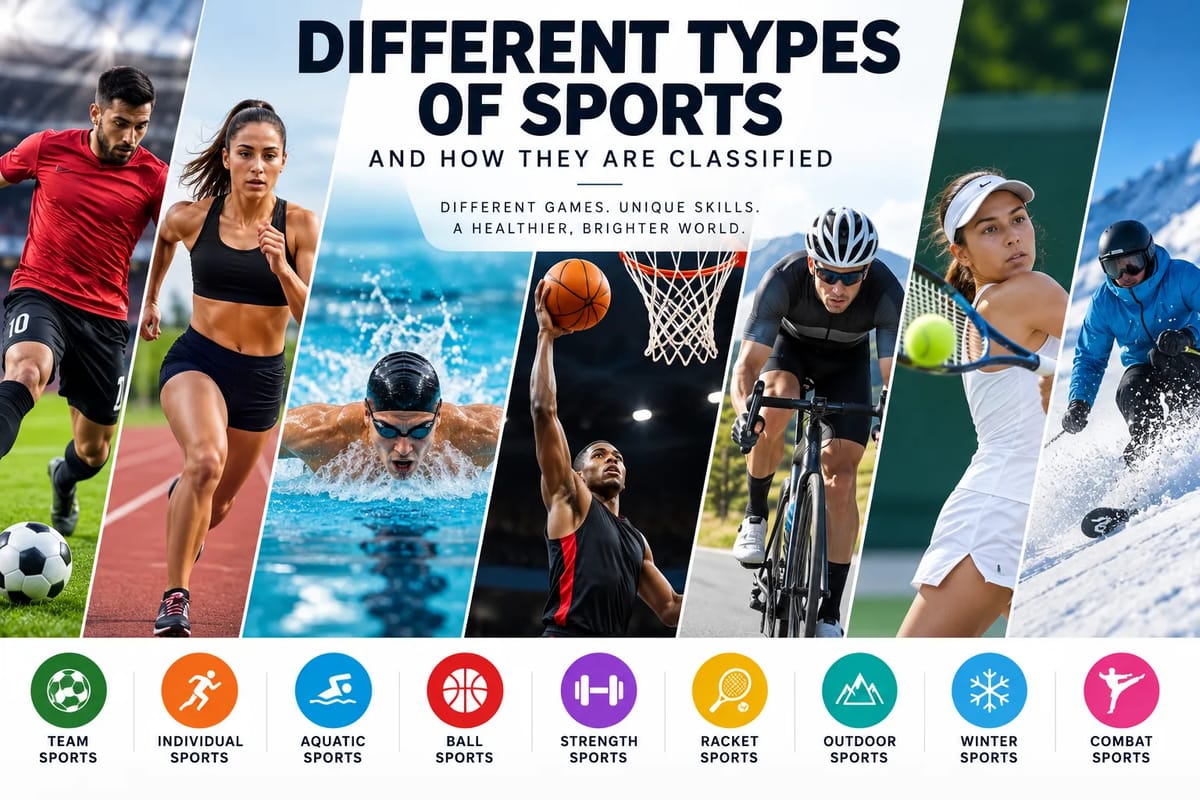
Different Types of Sports and How They Are Classified
Sports come in an enormous variety of forms, from individual activities such as swimming and athletics to team competitions such as football, basketball, and volleyball. Some sports take place on land, others in water or on ice, while others combine physical skill with specialized equipment, strategy, or technology.
Despite this variety, sports can be organized into meaningful categories.
Understanding how sports are classified makes it easier to see what different activities have in common, how their demands differ, and why athletes need different types of training depending on the sport they play.
Classification can be based on the number of participants, the primary physical demands, the environment, the equipment used, the objective of competition, or the way success is measured.
For a broader look at athletic ability and physical preparation, The Complete Guide to Fitness for Athletes explores the physical qualities athletes develop across different sporting disciplines.
What Is a Sport?
A sport is generally a structured physical activity or competition governed by established rules.
Sports typically involve some combination of physical skill, practice, competition, strategy, performance, and measurable outcomes.
The definition can become complicated at the edges because some competitive activities emphasize physical movement more heavily than others.
Traditional sports such as running, football, swimming, and wrestling clearly involve physical performance. Other activities may place greater emphasis on precision, coordination, concentration, reaction time, or technical skill.
What separates a sport from ordinary physical activity is often the presence of organized rules, structured competition, recognized skills, and an objective method of determining performance or winners.
Why Are Sports Classified?
Classifying sports helps athletes, coaches, educators, organizations, and fans understand the characteristics of different activities.
A classification system can help answer questions such as:
- How many people participate?
- Is the sport played individually or as a team?
- Does it emphasize endurance, strength, speed, or precision?
- Where is it played?
- What equipment is required?
- Is physical contact allowed?
- How is success measured?
- Does the sport depend more on direct competition or performance against a standard?
No single classification system captures every aspect of every sport.
A sport can belong to several categories simultaneously.
For example, swimming can be an individual sport, an aquatic sport, an endurance sport, and a timed sport. Football can be a team sport, a field sport, a ball sport, and a contact sport.
Individual Sports
Individual sports are primarily performed by one athlete competing independently.
The athlete’s performance is usually measured against another competitor, a score, a distance, a time, or a predefined standard.
Examples include:
- Athletics
- Swimming
- Tennis singles
- Boxing
- Wrestling
- Golf
- Gymnastics
- Archery
- Weightlifting
- Diving
- Cycling
- Figure skating
Individual sports can require exceptional self-discipline because the athlete has fewer teammates to share responsibility for performance.
Training, preparation, technique, concentration, and recovery can have a particularly direct relationship with results.
However, individual sports do not necessarily mean athletes train alone. Many individual athletes work with coaches, trainers, physiotherapists, nutrition professionals, and other specialists.
Team Sports
Team sports involve athletes working together toward a shared competitive objective.
Examples include:
- Football
- Basketball
- Volleyball
- Rugby
- Cricket
- Hockey
- Baseball
- Softball
- Handball
- Water polo
Team sports introduce additional dimensions that are less prominent in many individual competitions.
Athletes must coordinate their actions with teammates, understand tactical systems, communicate effectively, and adapt to the decisions of opponents.
Individual ability still matters, but success often depends on how effectively individual skills combine within the team’s overall structure.
For a deeper examination of athletic performance, Understanding Sports and Athletic Performance explains how physical and mental abilities contribute to sporting results.
Dual and Pair Sports
Some sports involve two competitors or pairs rather than large teams.
Examples include:
- Tennis doubles
- Badminton doubles
- Beach volleyball
- Pairs figure skating
- Synchronized diving
- Doubles rowing events
These sports occupy an interesting position between individual and team competition.
Each athlete must perform individually while also coordinating closely with a partner.
Communication, timing, positioning, and trust can therefore be especially important.
Ball Sports
Ball sports use a ball as a central piece of equipment.
They include a huge range of activities, including:
- Football
- Basketball
- Tennis
- Baseball
- Cricket
- Volleyball
- Golf
- Rugby
- Handball
- Table tennis
- Badminton
Ball sports can differ dramatically in their physical and tactical requirements.
Golf emphasizes precision and controlled movement.
Football requires endurance, speed, technical ability, tactical awareness, and repeated changes of direction.
Basketball combines explosive movements with coordination, agility, shooting, passing, and tactical decision-making.
The shared presence of a ball therefore does not mean the sports demand the same athletic qualities.
Combat Sports
Combat sports involve direct physical competition between opponents.
Examples include:
- Boxing
- Wrestling
- Judo
- Karate
- Taekwondo
- Brazilian jiu-jitsu
- Fencing
- Mixed martial arts
Combat sports generally have detailed rules designed to define permitted techniques and protect participants.
Different combat sports emphasize different combinations of striking, grappling, throwing, controlling, or weapon-based techniques.
They can require:
- Strength
- Speed
- Power
- Agility
- Balance
- Reaction time
- Coordination
- Cardiovascular fitness
- Tactical intelligence
- Mental discipline
Because of their physical nature, combat sports also place considerable importance on conditioning, technique, safety, weight management in some disciplines, and recovery.
Athletics and Track-and-Field Sports
Athletics is one of the broadest sporting categories and includes many events based on running, jumping, and throwing.
Track events include activities such as:
- Sprints
- Middle-distance running
- Long-distance running
- Hurdles
- Relay races
Field events include:
- Long jump
- High jump
- Triple jump
- Pole vault
- Shot put
- Discus
- Hammer throw
- Javelin
Athletics demonstrates how a single sporting family can contain events with radically different physical requirements.
A sprinter prioritizes explosive power and speed, while a distance runner depends heavily on aerobic endurance.
A shot-put athlete needs tremendous force production, whereas a high jumper requires a combination of speed, power, coordination, and technique.
Endurance Sports
Endurance sports require athletes to sustain physical effort over an extended period.
Examples include:
- Long-distance running
- Cycling
- Distance swimming
- Rowing
- Triathlon
- Cross-country skiing
Endurance performance depends heavily on the body’s ability to produce and use energy efficiently.
Important qualities include:
- Aerobic capacity
- Muscular endurance
- Energy management
- Pacing
- Mental resilience
- Technical efficiency
- Recovery ability
Different endurance sports place different demands on the body.
Cycling, for example, involves sustained lower-body work while swimming requires coordinated full-body movement and breathing control.
Strength and Power Sports
Strength sports emphasize the ability to produce high levels of force.
Examples include:
- Weightlifting
- Powerlifting
- Strongman competitions
Power sports place particular emphasis on producing force quickly.
Explosive jumping, throwing, sprinting, and Olympic weightlifting movements all involve significant power production.
Although strength and power are related, they are not identical.
Strength describes the ability to produce force.
Power involves producing force quickly.
An athlete can therefore be strong without being exceptionally explosive, and developing one quality does not automatically maximize the other.
Speed Sports
Speed is the defining competitive factor in many sports.
Examples include:
- Sprinting
- Track cycling
- Speed skating
- Short-distance swimming
- Motorcycle racing
- Automobile racing
Speed can refer to more than simply moving quickly.
Athletes may need rapid acceleration, maximum velocity, reaction speed, or the ability to repeatedly perform high-speed movements.
A sprinter and a goalkeeper, for example, both benefit from speed but use it differently.
The sprinter seeks to maximize running velocity, while the goalkeeper may need rapid reactions and explosive movement over a short distance.
Precision Sports
Precision sports emphasize accuracy and control.
Examples include:
- Archery
- Shooting sports
- Golf
- Curling
- Darts
- Billiards
- Diving
Physical strength may still matter, but successful performance often depends heavily on consistency, coordination, concentration, and fine motor control.
Small technical errors can have significant consequences.
Precision athletes therefore frequently spend substantial amounts of training time repeating movements and developing reliable performance under pressure.
Skill and Technique-Based Sports
Almost every sport requires skill, but some disciplines place particularly strong emphasis on technical execution.
Examples include:
- Gymnastics
- Diving
- Figure skating
- Artistic swimming
- Freestyle skiing
- Skateboarding
Athletes must often perform highly complex movements with exceptional coordination.
Technique can influence both performance and safety.
A gymnast performing a difficult routine, for example, must combine strength, flexibility, balance, spatial awareness, timing, and precise body control.
Water Sports
Water sports are performed in or on water.
Examples include:
- Swimming
- Diving
- Water polo
- Rowing
- Canoeing
- Kayaking
- Sailing
- Surfing
Water creates unique physical conditions.
Athletes must work against resistance while managing buoyancy, drag, balance, and breathing.
Swimming is particularly distinctive because efficient technique can dramatically influence energy expenditure and speed.
Other water sports introduce equipment, waves, currents, wind, or team tactics.
Winter and Ice Sports
Winter sports are associated with snow, ice, or cold-weather environments.
Examples include:
- Alpine skiing
- Cross-country skiing
- Snowboarding
- Figure skating
- Speed skating
- Ice hockey
- Curling
- Bobsleigh
- Luge
- Skeleton
These sports require specialized equipment and often demand strong balance and coordination.
Some, such as downhill skiing and bobsleigh, involve extremely high speeds.
Others, such as curling, rely heavily on precision and tactical decision-making.
Outdoor and Field Sports
Field sports are generally played on outdoor playing surfaces.
Examples include:
- Football
- Rugby
- Cricket
- Field hockey
- Baseball
- Softball
- Lacrosse
These sports often involve running, acceleration, changes of direction, tactical positioning, and interaction with teammates and opponents.
Environmental conditions can also affect performance.
Temperature, wind, rain, playing-surface conditions, and lighting may influence how athletes perform.
Indoor Sports
Indoor sports take place inside controlled environments such as sports halls, arenas, gyms, or specialized facilities.
Examples include:
- Basketball
- Volleyball
- Indoor football
- Badminton
- Table tennis
- Gymnastics
- Indoor athletics
- Futsal
Indoor environments can reduce the influence of weather and provide more consistent playing conditions.
However, the smaller spaces used by many indoor sports can increase the importance of reaction speed, close control, positioning, and rapid decision-making.
Contact and Non-Contact Sports
Another useful classification is based on physical contact between competitors.
Contact Sports
Contact sports permit or commonly involve substantial physical interaction.
Examples include:
- Rugby
- American football
- Boxing
- Wrestling
- Ice hockey
- Martial arts
These sports require athletes to prepare for physical impacts and develop appropriate techniques for movement, positioning, and protection.
Non-Contact Sports
Non-contact sports generally minimize or prohibit direct physical contact between competitors.
Examples include:
- Swimming
- Athletics
- Golf
- Archery
- Tennis
- Cycling
Some non-contact sports can still involve significant physical risks because of speed, equipment, falls, or environmental conditions.
Timed Sports
In timed sports, the clock plays a central role in determining performance.
Examples include:
- Sprinting
- Swimming
- Cycling
- Speed skating
- Skiing
- Rowing
The athlete who completes the course or event in the shortest time generally wins.
Timed sports allow highly precise comparisons between performances.
They also make pacing particularly important in longer events.
Scored Sports
In scored sports, performance is evaluated through points, goals, marks, or another scoring system.
Examples include:
- Basketball
- Football
- Volleyball
- Gymnastics
- Diving
- Figure skating
- Boxing
Scoring systems can vary enormously.
In football, goals determine the basic outcome.
In gymnastics and diving, judges evaluate technical and artistic components.
Understanding these scoring systems is essential for athletes and spectators alike. For more information, Complete Guide to Sports Rules and Officiating examines how rules, officials, and scoring systems shape competition.
Distance-Based Sports
Some sports determine success primarily by how far an athlete travels or how far an object is propelled.
Examples include:
- Long jump
- Triple jump
- Javelin
- Discus
- Shot put
- Hammer throw
Distance-based competition places enormous importance on technique, force production, body position, and consistency.
A small improvement in technique can sometimes produce a meaningful difference in the final result.
Objective Versus Subjective Sports
Sports can also be classified according to how performance is judged.
Objective Sports
Objective sports use relatively straightforward measurements to determine results.
Examples include:
- Running
- Swimming
- Cycling
- Weightlifting
- Long jump
Time, distance, weight, or another measurable result determines performance.
Subjective Sports
Subjective sports involve judges evaluating performance.
Examples include:
- Gymnastics
- Figure skating
- Diving
- Artistic swimming
Judges may evaluate factors such as technical execution, difficulty, form, creativity, and overall performance.
These sports require athletes to satisfy both technical and presentation standards.
Open-Skill and Closed-Skill Sports
Sports can also be distinguished by how predictable the environment is during performance.
Closed-Skill Sports
Closed-skill activities generally take place in relatively predictable environments.
Examples can include:
- Swimming
- Track running
- Diving
- Weightlifting
Athletes can practice specific movements repeatedly under relatively consistent conditions.
Open-Skill Sports
Open-skill sports require athletes to respond continuously to changing environments.
Examples include:
- Football
- Basketball
- Rugby
- Tennis
- Hockey
Opponents, teammates, ball movement, space, and tactical situations are constantly changing.
Athletes therefore need not only physical ability but also perception, decision-making, anticipation, and adaptability.
Individual Performance Within Team Sports
The distinction between individual and team sports can sometimes be misleading.
Team sports are made up of individual performances.
A football player must sprint, pass, tackle, control the ball, and make decisions individually. But those actions take place within a coordinated team system.
Similarly, a basketball player’s ability to shoot matters, but the effectiveness of that skill depends partly on positioning, teammates, defensive pressure, and tactical decisions.
This is why athletic performance cannot always be separated from the environment in which the athlete competes.
How Tactics Influence Sports Classification
Physical demands provide only part of the picture.
Strategy and tactics can fundamentally change how a sport is played.
Two sports may require similar levels of endurance but use that endurance in completely different ways.
A marathon runner manages a relatively predictable long-distance effort.
A football midfielder may repeatedly accelerate, decelerate, change direction, and recover while responding to tactical situations.
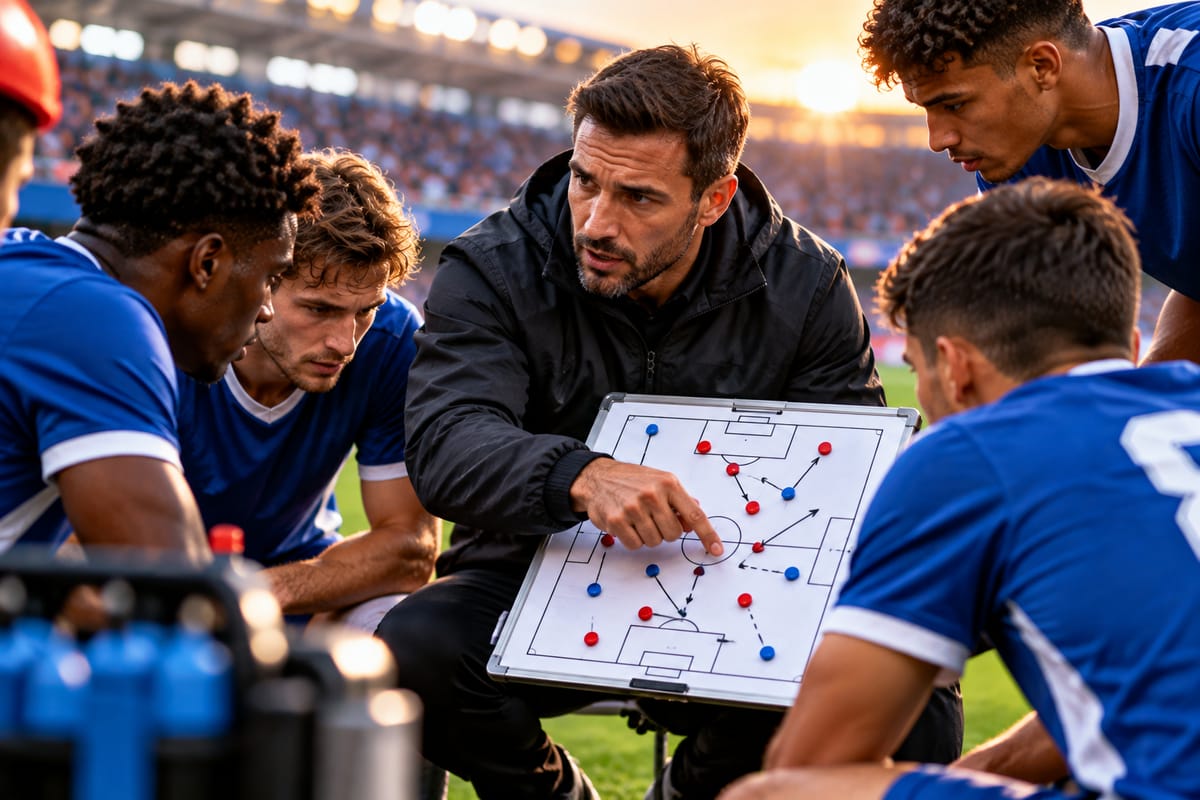
Tactical decisions can determine when athletes attack, defend, conserve energy, take risks, or change their positioning.
For a deeper examination of this subject, How Tactics Create Advantages in Different Sports explores how strategic decisions can influence sporting outcomes.
Why Different Sports Require Different Fitness
One of the biggest reasons sports classification matters is that athletes do not all need the same type of fitness.
A marathon runner needs exceptional endurance.
A powerlifter requires high maximal strength.
A sprinter needs explosive speed and power.
A gymnast needs strength, flexibility, coordination, and body control.
A football player needs a combination of endurance, acceleration, agility, strength, technical ability, and tactical awareness.
This means there is no single definition of being “fit” for sport.
Fitness is highly specific to the demands of the activity.
The Major Components of Athletic Performance
Although sports differ dramatically, many depend on a common set of physical qualities.
These include:
- Strength
- Power
- Speed
- Agility
- Balance
- Coordination
- Flexibility
- Mobility
- Cardiovascular endurance
- Muscular endurance
- Reaction time
The importance of each component depends on the sport.
A sport may require several qualities simultaneously, but usually some are more important than others.
For example, a goalkeeper needs rapid reactions and explosive movement, while a long-distance runner places much greater emphasis on aerobic endurance.
Sports Can Belong to Multiple Categories
The most important point about sports classification is that categories overlap.
Consider tennis.
Tennis can simultaneously be classified as:
- An individual sport
- A racket sport
- A ball sport
- A net sport
- An open-skill sport
- A precision sport
- A court sport
- A predominantly non-contact sport
- A scored sport
Swimming provides another example.
It can be classified as:
- An individual sport
- An aquatic sport
- An endurance sport
- A timed sport
- A closed-skill sport
- A non-contact sport
Football can be described as:
- A team sport
- A ball sport
- A field sport
- An open-skill sport
- A contact sport
- A scored sport
- A tactical sport
This overlapping structure demonstrates why there is no single universal classification system.
How Sports Classification Helps Athletes
Understanding the characteristics of a sport can improve training decisions.
A coach can identify the most important physical and technical qualities and design training around them.
For example, a sport requiring repeated explosive efforts may need training focused on power, acceleration, agility, and recovery between high-intensity actions.
A sport based on long-duration performance may require much greater emphasis on aerobic conditioning, pacing, and energy management.
Classification can therefore serve as a bridge between understanding a sport and designing an appropriate training program.
How Sports Classification Helps Spectators
Classification can also make sports easier to understand.
Knowing that a sport is primarily endurance-based, precision-based, tactical, or power-oriented gives spectators a better appreciation of what athletes are trying to accomplish.
A cycling race, for example, is not simply about who can pedal fastest.
It can involve drafting, positioning, pacing, energy conservation, attacks, teamwork, and timing.
Similarly, a gymnastics competition involves much more than performing difficult movements. Athletes must combine difficulty with execution, control, consistency, and presentation.
Understanding the underlying characteristics makes competition more meaningful.
A Simple Way to Classify Any Sport
When encountering an unfamiliar sport, several questions can quickly reveal its basic classification.
Ask:
- How many athletes compete?
- Is it individual, paired, or team-based?
- Where is it played?
- What equipment is required?
- Is physical contact involved?
- What physical qualities matter most?
- How is performance measured?
- How important are tactics and strategy?
- Is the environment predictable or constantly changing?
- Does a clock, score, distance, or judge determine the result?
These questions provide a useful framework for understanding almost any competitive sport.
Why There Is No Single Perfect Sports Taxonomy
Sports are too diverse to fit neatly into one rigid classification system.
A sport can be defined by its equipment, environment, participants, physical demands, rules, scoring system, or competitive structure.
Each approach highlights something different.
For example, classifying sports by physical demand helps coaches understand training requirements.
Classifying them by environment helps organizations understand facilities and equipment.
Classifying them by participants distinguishes individual and team competition.
Classifying them by scoring explains how winners are determined.
The best classification system therefore depends on the question being asked.
The Bigger Picture of Sporting Diversity
From a marathon runner managing energy over many miles to a gymnast performing a precisely timed routine, sports demonstrate an extraordinary range of human physical and mental abilities.
Some competitions reward speed.
Others reward strength, endurance, accuracy, flexibility, coordination, tactical intelligence, or technical mastery.
Many require several of these qualities at once.
That diversity is what makes sport such a broad field of human performance. Classifying sports does not reduce their differences; instead, it provides a way to understand those differences and recognize the specific skills behind each type of competition.
Whether an athlete competes alone or as part of a team, on land or in water, against a clock or against an opponent, every sport combines a distinctive set of physical, technical, tactical, and mental demands.



2 Comments
Micle harison
June 7, 2019Lorem ipsum dolor sit amet, usu ut perfecto postulant deterruisset, libris causae volutpat at est, ius id modus laoreet urbanitas. Mel ei delenit dolores.
John Doe
June 7, 2019Some consultants are employed indirectly by the client via a consultancy staffing company.