
How Cortisol Participates in Stress Responses
Cortisol is one of the body’s most important stress hormones. It helps the body respond to challenges, maintain blood pressure, regulate blood sugar, support metabolism and coordinate activity across several systems.
Despite its reputation as the “stress hormone,” cortisol is not inherently harmful. The body needs cortisol to function normally. Problems can arise when stress responses become too frequent, prolonged or poorly regulated, potentially disrupting sleep, mood, metabolism and other aspects of health.
Understanding how cortisol participates in the stress response provides a clearer picture of what happens inside the body when we experience pressure, uncertainty or danger—and why recovery is such an important part of maintaining healthy stress regulation.
What Is Cortisol?
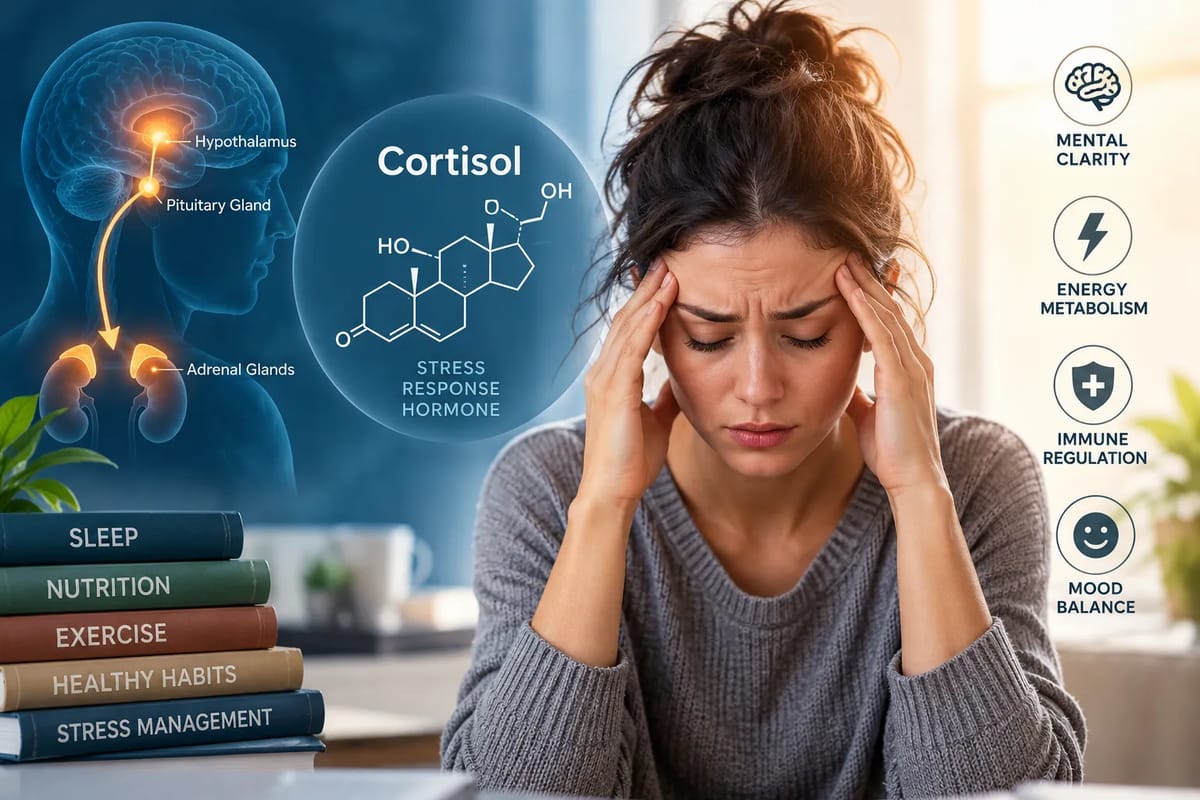
Cortisol is a steroid hormone produced primarily by the adrenal glands, two small glands located above the kidneys.
Its production is controlled by a communication network called the hypothalamic-pituitary-adrenal (HPA) axis.
The HPA axis connects parts of the brain with the pituitary glands and adrenal glands. Together, they help coordinate the body’s response to physical and psychological challenges.
Cortisol performs many normal functions, including helping the body:
- Maintain blood glucose levels
- Regulate metabolism
- Support blood pressure
- Respond to physical and psychological stress
- Modulate immune and inflammatory activity
- Maintain alertness
- Coordinate energy availability
Cortisol levels naturally change throughout the day. They are generally higher around the time of waking and gradually decline as the day progresses.
This daily rhythm is one reason cortisol should not simply be viewed as a hormone that is either “good” or “bad.” Its effects depend on timing, amount and the circumstances in which it is released.
How the Body Detects Stress
The stress response begins when the brain determines that something requires a response.
The trigger could be an immediate physical threat, but stress does not necessarily require physical danger. Work pressure, financial uncertainty, interpersonal conflict, lack of sleep and other demanding circumstances can also activate stress-related systems.
When the brain interprets a situation as stressful, the hypothalamus can initiate the HPA-axis response.
The process broadly works like this:
- The hypothalamus detects or responds to a perceived challenge.
- It releases corticotropin-releasing hormone (CRH).
- CRH signals the pituitary gland.
- The pituitary releases adrenocorticotropic hormone (ACTH).
- ACTH travels through the bloodstream to the adrenal glands.
- The adrenal glands respond by releasing cortisol.
At the same time, the body can activate the sympathetic nervous system, producing a faster, more immediate response involving hormones such as adrenaline.
These systems work together rather than functioning as completely separate reactions.
What Cortisol Does During Stress
Once cortisol enters the bloodstream, it helps prepare the body to deal with the challenge.
One of its most important roles is making energy more readily available.
During stressful circumstances, the body may need additional fuel for the brain and muscles. Cortisol contributes to maintaining adequate glucose availability and influences how the body uses carbohydrates, fats and proteins.
Cortisol also affects cardiovascular function and helps support blood pressure during a stress response.
At the same time, it influences immune activity and inflammation. Temporarily changing inflammatory activity can be useful when the body is responding to an immediate challenge.
In other words, cortisol is part of a coordinated survival system designed to prioritize immediate needs.
Cortisol and the Fight-or-Flight Response
Cortisol is often discussed alongside the “fight-or-flight” response, but it does not work exactly like adrenaline.
Adrenaline acts rapidly and contributes to immediate changes such as increased heart rate, faster breathing and heightened alertness.
Cortisol operates on a somewhat different timescale. It helps sustain the body’s response and ensures that sufficient energy remains available while the stressful situation is being managed.
This distinction matters because stress involves several overlapping biological systems.
A sudden frightening event might produce an immediate surge of sympathetic nervous system activity, while cortisol helps support the broader response that follows.
Once the perceived threat has passed, feedback mechanisms normally help bring these systems back toward their baseline state.
Why Cortisol Normally Falls After Stress
The body does not need to remain in a heightened stress state indefinitely.
The HPA axis contains an important negative-feedback mechanism. As cortisol levels rise, cortisol can signal the brain and pituitary to reduce further stimulation of the adrenal glands.
This helps prevent the stress response from continuing unnecessarily.
The process can be thought of as a biological thermostat.
A stressful situation increases the response. As the challenge is resolved, feedback mechanisms help turn the response down.
Healthy regulation therefore involves not only being able to produce cortisol when needed but also being able to reduce the response afterward.
Chronic Stress Can Change the Picture
Short-term stress and prolonged stress are not identical.
A temporary stress response can be useful. It helps an individual respond to an examination, difficult task, physical challenge or immediate threat.
Chronic stress is different because stressful circumstances may continue for extended periods or occur repeatedly without sufficient opportunities for recovery.
Long-term stress can influence sleep, mood, appetite, energy levels and other aspects of everyday functioning.
Importantly, this does not mean that every person experiencing chronic stress will have persistently elevated cortisol levels. Cortisol regulation is complex, and patterns can vary depending on the individual, timing, circumstances and duration of stress.
The relationship between psychological stress and cortisol is therefore more complicated than simply saying that “stress causes high cortisol.”
Cortisol and Sleep
Sleep and cortisol are closely connected because both follow daily biological rhythms.
Normally, cortisol follows a predictable pattern that helps support alertness during the day and prepares the body for waking.
Sleep, meanwhile, provides an important period of restoration and regulation.
Disruptions to sleep can affect stress regulation, while stressful experiences can make it more difficult to sleep. This creates a relationship in which stress and sleep can influence one another.
For a broader look at how sleep functions as a biological process, see The Science of Sleep.
Understanding this relationship is particularly important because improving sleep is not simply about spending more time in bed. Consistent schedules, light exposure, physical activity, environmental conditions and daily habits can all influence sleep and circadian rhythms.
Understanding Sleep, Stress and Recovery
Stress regulation cannot be separated from recovery.
The body needs periods in which demanding physiological systems can return toward their normal state. Sleep, relaxation, nutrition, physical activity and social connection can all form part of a broader recovery pattern.
Our related resource on Understanding Sleep, Stress and Recovery explores how these systems interact.
Recovery does not mean eliminating every source of stress. Everyday life inevitably involves challenges. Instead, healthy regulation involves having enough capacity to respond to demands and sufficient opportunities to recover afterward.
Cortisol and Daily Routines
Because cortisol follows a natural daily rhythm, regular routines can be relevant to stress regulation.
Consistent wake and sleep times, regular meals, physical activity and predictable periods of activity and rest can help support stable daily patterns.
This connects cortisol regulation with the science of everyday behavior.
The routines people repeat automatically can influence sleep, activity, food choices and periods of rest. The Science of Habits provides a broader look at how repeated behaviors become established and why changing them can be difficult.
Small changes to daily routines may not eliminate stress, but they can create more predictable conditions for recovery.
Exercise and Cortisol
Physical activity itself can temporarily influence cortisol.
This is not necessarily a negative effect. Exercise is a form of physical stress, and the body responds accordingly. Cortisol and other stress-related systems can become active during demanding physical activity.
The important distinction is between a temporary physiological response and a person’s broader ability to recover.
Exercise can have numerous benefits for physical and mental health when appropriately matched to an individual’s abilities and circumstances. However, training volume, intensity, sleep and recovery all matter.
Our article on Exercise Explained explores the underlying science of physical activity and how exercise affects the body.
Is Cortisol Always Harmful?
No.
Cortisol is essential for normal human physiology.
Without appropriate cortisol signaling, the body would have difficulty maintaining several important processes, including energy regulation and an adequate response to physical stress.
The problem is not cortisol itself. The more useful question is whether the body’s stress-response systems are responding appropriately to circumstances and returning toward normal afterward.
A short-term rise in cortisol during a demanding event is very different from a persistent or dysregulated stress response.
This distinction is frequently lost in popular discussions about “cortisol.”
Why Cortisol Tests Can Be Difficult to Interpret
Cortisol measurements can provide useful medical information, but interpreting them is not always straightforward.
Cortisol changes throughout the day, meaning that the timing of a sample can matter. Different testing methods also measure cortisol under different circumstances.
A single cortisol measurement therefore cannot necessarily provide a complete picture of someone’s overall stress level.
Medical professionals may use specific testing approaches when evaluating suspected disorders involving cortisol production. These situations are different from using a cortisol test as a general measure of everyday psychological stress.
People should be cautious about interpreting isolated hormone measurements without appropriate medical context.
What Happens When Stress Regulation Works Well?
A well-regulated stress response is flexible.
The body can increase alertness and energy availability when circumstances demand it and then gradually reduce that response when the challenge passes.
This flexibility is more important than maintaining a permanently low level of stress hormones.
Consider a demanding work presentation. Before the event, a person may become more alert and physically activated. During the presentation, those systems can help maintain attention and energy. Once the event ends, the body can gradually shift toward recovery.
That ability to move between activation and recovery is a central feature of healthy physiological regulation.
Supporting the Body’s Stress-Recovery Cycle
There is no single technique that eliminates stress or “balances cortisol” overnight.
Instead, several basic health behaviors can support normal physiological regulation:
- Maintain a consistent sleep schedule.
- Get regular physical activity appropriate for your fitness level.
- Make time for relaxation and recovery.
- Eat a varied and nutritious diet.
- Limit excessive caffeine if it interferes with sleep or increases feelings of anxiety.
- Maintain meaningful social connections.
- Break prolonged periods of sedentary work with movement.
- Address persistent sources of stress where possible.
- Seek professional support when stress becomes difficult to manage.
These strategies should not be understood as methods for forcing cortisol to a particular number. The goal is to support the body’s broader systems of regulation and recovery.
When Stress Deserves More Attention
Occasional stress is a normal part of life. Persistent stress that interferes with sleep, work, relationships or everyday functioning deserves greater attention.
Symptoms such as ongoing exhaustion, major sleep disruption, persistent anxiety, significant changes in appetite or unexplained physical changes can have many possible causes.
They should not automatically be attributed to cortisol.
If symptoms are persistent, severe or concerning, discussing them with a qualified healthcare professional is more appropriate than relying on hormone-focused supplements, online cortisol tests or self-diagnosis.
Cortisol Is Part of a Larger Stress System
Cortisol is neither simply a harmful “stress chemical” nor a hormone that should always be kept as low as possible. It is a carefully regulated part of a complex biological system that helps the body respond to challenges.
The most useful way to understand cortisol is in context.
Stress activates multiple systems. Cortisol helps mobilize energy and coordinate the response. Feedback mechanisms help reduce the response when the challenge passes. Sleep, exercise, daily routines and recovery all interact with these processes.
That bigger picture explains why managing stress is not about eliminating cortisol. It is about supporting the body’s ability to respond when necessary, recover when the challenge is over and maintain healthy rhythms from one day to the next.




2 Comments
Micle harison
June 7, 2019Lorem ipsum dolor sit amet, usu ut perfecto postulant deterruisset, libris causae volutpat at est, ius id modus laoreet urbanitas. Mel ei delenit dolores.
John Doe
June 7, 2019Some consultants are employed indirectly by the client via a consultancy staffing company.