
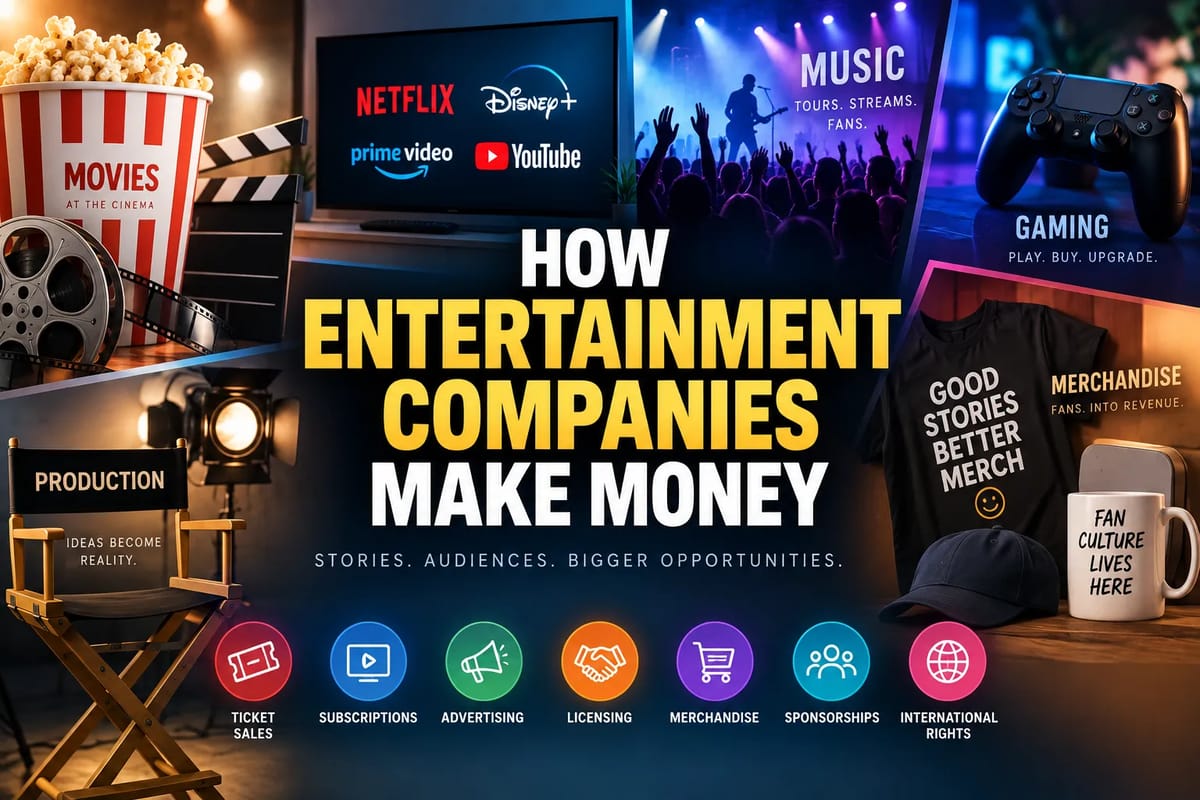
How Entertainment Companies Make Money
Entertainment is one of the world’s largest industries, but creating a successful movie, television program, song, game or live event is only one part of the business.
Behind the entertainment people consume every day is a complex economic system involving advertising, subscriptions, ticket sales, licensing, merchandise, sponsorships, distribution rights and intellectual property.
A single entertainment property can generate revenue through several channels over many years. A film may begin with theatrical ticket sales, move to digital rentals, become part of a streaming library and later generate money through licensing or merchandise. A television program can follow a similarly long path across broadcast networks, streaming services and international markets.
Understanding how entertainment companies make money means looking beyond what audiences see on screen. The real business often revolves around owning valuable content, attracting audiences and finding multiple ways to monetize their attention and intellectual property.
The Basic Entertainment Business Model
At its simplest, entertainment companies create or acquire content and then attempt to generate more revenue from that content than it costs to produce, market and distribute.
The process can involve several stages:
- Developing or acquiring intellectual property.
- Producing the entertainment.
- Marketing it to an audience.
- Distributing it through appropriate channels.
- Monetizing the audience.
- Extending the property’s commercial life.
Different entertainment companies specialize in different parts of this process.
A production company may focus primarily on creating content. A streaming platform may concentrate on distribution and subscriptions. A television network may combine programming with advertising. A major entertainment conglomerate may participate in almost every stage.
This interconnected structure is one reason the modern entertainment industry can be difficult to understand from the outside.
For broader context, Television and Streaming: Complete Entertainment Guide explores how television and streaming fit into the larger entertainment landscape.
Ticket Sales Are a Major Revenue Source
For movies, concerts, theater productions and sporting entertainment, consumers often pay directly for access.
Movie theaters sell tickets to audiences, while concert promoters and venues generate revenue from ticket purchases.
The company or organization behind the entertainment may not receive all of the money from each ticket.
For example, movie theaters and film distributors typically share theatrical revenue according to agreements governing the particular release. Concert revenue can similarly be divided among artists, promoters, venues and other participants.
Ticket sales therefore represent gross consumer spending rather than automatically equaling the producer’s profit.
Theatrical and live-event economics also depend heavily on costs.
A production that sells thousands of tickets can still perform poorly financially if production, marketing, venue and distribution expenses are extremely high.
Advertising Pays for Free Entertainment
Advertising is one of the oldest and most important entertainment business models.
Television networks, radio stations, websites, social platforms and other media companies can provide content to audiences without charging them directly while selling access to those audiences to advertisers.
The basic relationship looks like this:
Content → Audience → Advertising → Revenue
Advertisers pay because entertainment attracts people who may be interested in particular products or services.
The value of an advertising audience depends on factors such as:
- Audience size
- Demographics
- Viewing behavior
- Engagement
- Geographic location
- Purchasing power
- Content environment
This explains why two programs with similar audiences can generate different advertising revenue.
An audience that advertisers consider particularly valuable may command higher advertising rates.
Television Networks Combine Content and Advertising
Traditional television provides a clear example of the advertising model.
Networks acquire or produce programming and use it to attract viewers. They then sell advertising inventory around that programming.
Popular programs can be particularly valuable because they provide predictable audiences.
Television companies can also generate additional revenue through distribution arrangements with cable, satellite and other television providers.
This creates a business model with multiple revenue streams rather than relying exclusively on advertising.
Streaming Services Changed the Revenue Model
Streaming introduced a different approach to entertainment monetization.
Instead of paying for individual movies or television episodes, consumers can often pay a recurring subscription fee for access to a large library of content.
The basic model is straightforward:
Subscribers × Subscription Price = Subscription Revenue
But the economics are more complicated.
Streaming companies must spend money on:
- Original productions
- Content licensing
- Technology infrastructure
- Data centers
- Customer acquisition
- Marketing
- Employees
- Content delivery
- Platform development
A streaming service therefore needs enough subscribers, advertising revenue or other income to cover those costs.
The shift toward streaming fundamentally changed how audiences consume entertainment. How Streaming Changed Entertainment Consumption examines this transformation and its effects on viewing behavior.
Subscription Plans Create Recurring Revenue
One major advantage of subscriptions is predictability.
Instead of relying entirely on individual purchases, a company can receive recurring payments from a large customer base.
Subscription models can include multiple pricing tiers.
For example, a platform might offer:
- A lower-cost plan with advertising
- A standard plan
- A premium plan
- A family or multi-device option
Different plans allow companies to capture revenue from consumers with different preferences and budgets.
Subscription businesses also pay close attention to churn, which measures how many customers cancel their subscriptions.
A company can acquire millions of subscribers but still struggle financially if large numbers leave each month.
Advertising Is Returning to Streaming
Streaming does not necessarily mean eliminating advertising.
Many streaming services have introduced or expanded advertising-supported plans.
This creates two potential revenue sources from the same audience:
- Subscription payments
- Advertising revenue
The hybrid model can allow consumers to pay less in exchange for watching advertisements while giving the platform another way to monetize its audience.
For entertainment companies, the attractiveness of this approach depends on advertising demand, viewer engagement and the economics of each subscriber.
Content Licensing Generates Billions in Revenue
Entertainment companies often make money by allowing other businesses to use their content.
A company might license:
- Movies
- Television programs
- Music
- Characters
- Sports rights
- Books
- Formats
- Images
- Other intellectual property
Licensing agreements can be temporary or long-term and may cover specific geographic markets or distribution channels.
This can create revenue without requiring the original owner to directly operate the platform distributing the content.
A television company, for example, might license a program to an international broadcaster.
The broadcaster gets valuable programming, while the content owner receives licensing revenue.
International Distribution Expands Revenue
Entertainment is increasingly global.
A successful movie, television program or music recording can potentially reach audiences in numerous countries.
International distribution provides another opportunity to monetize content that has already been produced.
The same intellectual property can therefore generate revenue across multiple markets.
However, international expansion can involve localization, dubbing, subtitles, regulatory requirements, marketing and distribution costs.
Companies must balance the potential revenue opportunity with the costs and risks of entering each market.
Music Companies Use Multiple Revenue Streams
The music industry provides another example of diversified entertainment economics.
Artists and music companies can generate revenue through:
- Streaming
- Digital purchases
- Physical recordings
- Concerts
- Licensing
- Synchronization
- Merchandise
- Sponsorships
Streaming has become particularly important because recordings can generate revenue each time they are played through participating services.
Music can also be licensed for use in films, television programs, advertisements, video games and other media.
This creates value from a recording beyond the original consumer purchase.
Concerts Can Be Extremely Valuable
Live performances create a different economic opportunity.
Artists can generate substantial revenue through ticket sales, VIP experiences, sponsorships and merchandise.
Tours can also increase demand for recorded music.
A successful concert experience may strengthen an artist’s relationship with fans, encourage merchandise purchases and increase streaming activity.
However, touring also involves significant costs, including transportation, venues, staff, equipment, insurance and production.
Gross ticket revenue therefore does not represent an artist’s final earnings.
Merchandise Turns Entertainment Into Physical Products
Popular entertainment properties can generate revenue through merchandise.
Characters, fictional worlds, artists and franchises can become commercial brands.
Merchandise can include:
- Clothing
- Toys
- Collectibles
- Books
- Home goods
- Accessories
- Games
- Posters
- Limited-edition products
Merchandising is particularly powerful because it extends entertainment beyond the original viewing or listening experience.
A consumer who enjoys a fictional character may be willing to purchase a product featuring that character even when they are not actively watching the associated movie or program.
Intellectual Property Can Be More Valuable Than Individual Content
Entertainment companies often focus heavily on intellectual property, or IP.
An individual movie has a limited production cycle. A successful character or fictional universe can remain commercially valuable for decades.
Intellectual property can be reused through:
- Sequels
- Spin-offs
- Television programs
- Streaming series
- Games
- Books
- Merchandise
- Theme-park attractions
- Licensing agreements
This is one reason entertainment companies invest heavily in recognizable franchises.
The objective is not simply to make one successful piece of content.
It is to create intellectual property that can generate value repeatedly.
Video Games Have Their Own Revenue Models
The gaming industry combines entertainment with technology and software economics.
Games can generate revenue through:
- Upfront purchases
- Digital downloads
- Subscription services
- Downloadable content
- In-game purchases
- Expansion packs
- Advertising
- Licensing
- Merchandise
Some games are sold as complete products, while others continue generating revenue long after their initial release through updates and additional purchases.
Online games can be particularly valuable because they may maintain active communities for years.
Sports Entertainment Relies on Rights and Advertising
Sports are another major component of entertainment economics.
Sports organizations can generate revenue through:
- Broadcasting rights
- Streaming rights
- Ticket sales
- Sponsorships
- Advertising
- Merchandise
- Licensing
- Hospitality
Broadcasting rights can be particularly valuable because live sports can attract large audiences at predictable times.
Broadcasters may pay substantial amounts for the right to show competitions because those events can attract viewers and advertisers.
Sponsorships Connect Brands With Entertainment
Companies also pay to associate their brands with entertainment properties.
A sponsor might support:
- A concert
- A sports event
- A television program
- A film
- A festival
- A digital creator
- A gaming competition
Sponsorships can provide entertainment companies with additional revenue while giving brands access to a particular audience.
The commercial value depends heavily on audience size, demographics, engagement and the perceived relationship between the sponsor and the entertainment property.
Influencers and Creators Have Changed Entertainment Economics
Digital platforms have lowered some of the barriers to entering entertainment.
Individual creators can now build large audiences without traditional television networks, film studios or record companies.
Creators may monetize their audiences through:
- Advertising
- Sponsorships
- Subscriptions
- Memberships
- Merchandise
- Affiliate arrangements
- Digital products
- Licensing
This has changed the competitive landscape.
Entertainment is no longer controlled entirely by traditional studios, broadcasters and record labels.
Individual creators can build valuable intellectual property and direct relationships with audiences.
The Importance of Audience Attention
At the center of nearly every entertainment business model is audience attention.
Companies compete for people’s limited time.
A consumer can only watch so many movies, listen to so much music or spend so many hours playing games each day.
This makes attention a scarce resource.
Entertainment companies therefore track measures such as:
- Viewership
- Listening time
- Engagement
- Retention
- Repeat usage
- Audience demographics
- Subscriber growth
The more effectively a company attracts and retains attention, the more opportunities it may have to monetize that audience.
Why Popularity Does Not Always Mean Profit
A major misconception is that a popular entertainment property must automatically be profitable.
That is not necessarily true.
A production can attract a large audience while generating weak profits if its costs are excessive.
For example, a major film may require enormous spending on production and marketing. Strong ticket sales might not be sufficient to generate an attractive return after all participants and expenses are accounted for.
The same principle applies to streaming.
A platform can have millions of users but struggle if it spends too much acquiring customers or producing content.
Revenue and profitability are therefore very different measurements.
Content Costs Can Make or Break a Company
Entertainment production can be extremely expensive.
Large projects may require:
- Actors
- Writers
- Directors
- Producers
- Designers
- Editors
- Visual-effects teams
- Locations
- Equipment
- Marketing
- Distribution
A company must estimate whether the expected commercial value justifies those expenses.
This creates a fundamental challenge.
Entertainment is inherently uncertain. Nobody knows with complete confidence whether audiences will embrace a new movie, program, album or game.
Companies therefore use audience research, historical performance, talent, franchise recognition and other information to reduce uncertainty.
Why Franchises Are So Valuable
Established franchises can reduce some of the uncertainty associated with launching new entertainment.
Audiences already recognize the characters, themes or universe.
This recognition can make marketing easier and potentially create opportunities for merchandise, licensing and additional productions.
However, franchises also carry risks.
Companies can oversaturate audiences by releasing too much related content. Poorly received installments can weaken the reputation of the broader franchise.
Managing a franchise therefore requires balancing familiarity with creativity.
Entertainment Companies Are Becoming More Diversified
Large entertainment businesses increasingly operate across several categories.
A company may own:
- Film studios
- Television networks
- Streaming services
- Music operations
- Publishing businesses
- Gaming properties
- Sports rights
- Theme parks
- Consumer-product divisions
This diversification allows companies to monetize intellectual property in different ways.
A successful entertainment property might begin as a film and later become a streaming series, game, merchandise line or live attraction.
The broader business objective is to maximize the lifetime value of valuable intellectual property.
The Modern Entertainment Industry Is Built Around Multiple Revenue Streams
The economics of entertainment are no longer based on a single transaction.
A successful property can generate income repeatedly across different platforms and markets.
A simplified example might look like:
Film → Theater → Digital Rental → Streaming → Television Licensing → Merchandise → Games → International Licensing
Each stage creates another opportunity to monetize the same underlying intellectual property.
This explains why entertainment companies increasingly think about content as an asset rather than simply a one-time product.
For a broader explanation of the industry’s structure and economics, Understanding the Modern Entertainment Industry provides additional context.
How Entertainment Companies Decide What to Invest In
Because entertainment projects are risky, companies need to decide where to allocate limited resources.
They may evaluate:
- Expected audience size
- Production costs
- Existing fan bases
- Talent
- Franchise potential
- Distribution opportunities
- International appeal
- Merchandise potential
- Licensing opportunities
However, there is no formula that guarantees a hit.
Some low-budget productions become major successes, while expensive projects can disappoint audiences.
Entertainment remains an industry where creativity and commercial strategy have to coexist.
Why Owning Content Matters
One of the biggest strategic advantages an entertainment company can have is ownership of valuable intellectual property.
When a company owns content, it can potentially control how that content is licensed, distributed and monetized.
Ownership can create long-term revenue opportunities.
By contrast, a company that merely licenses content may have less control and could eventually lose access when an agreement expires.
This helps explain the enormous strategic importance of intellectual-property libraries in modern entertainment.
The Business of Entertainment Is Really the Business of Reusing Attention
Entertainment companies make money in many different ways, but the underlying principle is remarkably consistent.
They create or acquire content that attracts audiences, then develop ways to turn that audience attention into revenue.
That revenue may come from a ticket, subscription, advertisement, licensing agreement, sponsorship, merchandise purchase or digital transaction.
The most successful companies go one step further. They build entertainment properties that can continue generating value across multiple platforms and over many years.
In the modern entertainment economy, the biggest opportunity is rarely just selling one piece of content once. It is building valuable intellectual property, maintaining audience interest and finding increasingly creative ways to turn that relationship into sustainable revenue.




2 Comments
Micle harison
June 7, 2019Lorem ipsum dolor sit amet, usu ut perfecto postulant deterruisset, libris causae volutpat at est, ius id modus laoreet urbanitas. Mel ei delenit dolores.
John Doe
June 7, 2019Some consultants are employed indirectly by the client via a consultancy staffing company.