
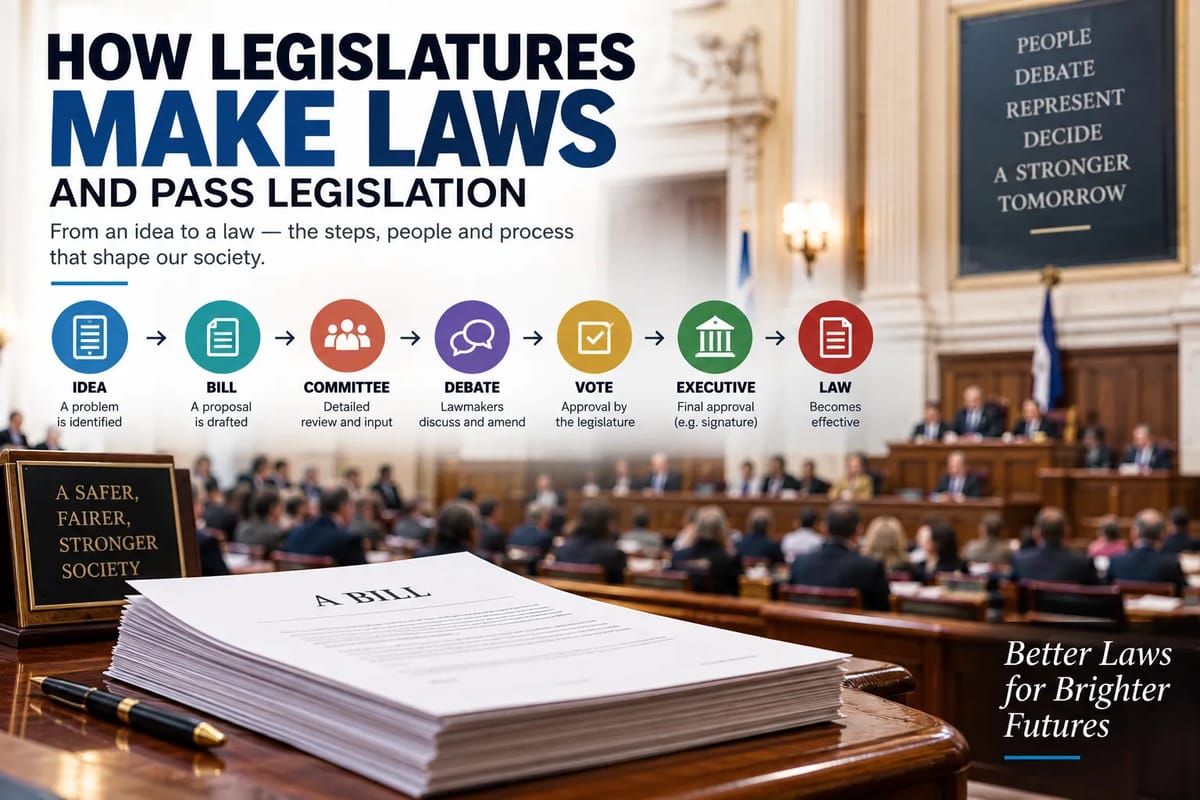
How Legislatures Make Laws and Pass Legislation
Laws shape almost every part of modern society, from how governments collect taxes and provide public services to how businesses operate and how citizens interact with one another.
But laws do not simply appear because a government decides that something should change. In most political systems, proposed laws must pass through a structured legislative process involving debate, review, amendments, voting, and approval.
Legislatures are the institutions primarily responsible for making laws. Depending on the country, they may be called parliaments, congresses, assemblies, chambers, or other names. Their exact powers and procedures vary, but the basic purpose is similar: representatives consider proposals for new laws or changes to existing laws and decide whether those proposals should become legally binding.
For a broader understanding of how governments and political institutions are organized, The Complete Guide to Political Systems provides useful context about the different ways political authority is structured around the world.
What Is a Legislature?
A legislature is a government institution responsible for debating and making laws.
In representative political systems, legislators are generally elected or otherwise selected to represent the interests of a population.
A legislature may also have responsibilities beyond lawmaking, including:
- Approving government spending
- Reviewing government policies
- Representing constituents
- Investigating government actions
- Approving certain appointments
- Ratifying treaties in some systems
- Holding government officials accountable
- Debating national issues
The exact powers of a legislature depend on the country’s constitution and political system.
Some legislatures have extensive authority over government policy, while others operate within systems where executive institutions have greater independent powers.
How Legislatures Fit Into Government
A legislature is usually one part of a broader political system.
Many constitutional systems divide government responsibilities among different institutions. A common model separates authority into legislative, executive, and judicial functions.
The legislative branch makes laws.
The executive branch generally implements and administers laws.
The judicial branch interprets laws and resolves legal disputes.
The boundaries are not identical in every country. Parliamentary systems, presidential systems, semi-presidential systems, and other arrangements distribute authority differently.
For more context, Understanding How Political Systems Work explains how different political institutions interact and how political authority is distributed.
What Is a Bill?
A bill is a formal proposal for a new law or a change to an existing law.
Before a bill becomes law, it normally has to pass through several stages.
A bill might propose to:
- Create a new legal requirement
- Change an existing law
- Repeal an existing law
- Establish a government program
- Allocate public funds
- Create or modify regulations
- Address a particular social or economic problem
The language and terminology vary between countries, but the basic idea is similar: a bill is a proposal that lawmakers consider before deciding whether it should become law.
Where Do Bills Come From?
Bills can originate in different ways depending on the political system.
In many legislatures, government ministers introduce bills on behalf of the executive.
Individual legislators may also introduce proposals.
Other sources of legislative ideas can include:
- Government departments
- Political parties
- Committees
- Experts
- Advocacy organizations
- Businesses
- Civil society groups
- Constituents
- Public campaigns
- Responses to social or economic problems
A proposal may begin as a policy idea long before formal legislative language is written.
For example, a government might identify a problem with existing environmental rules. Officials could research possible solutions, consult affected groups, develop policy options, and eventually translate the preferred approach into a bill.
The First Stage: Introducing a Bill
The legislative process usually begins when a bill is formally introduced.
The person or institution introducing the bill presents its proposed changes to the legislature.
Depending on the political system, the bill may receive a formal number and title.
At this stage, legislators and the public can begin examining what the proposal is intended to accomplish.
A bill’s introduction does not mean that it has become law.
It is the beginning of the legislative process.
The Importance of Debate
Debate is one of the defining features of legislative lawmaking.
Lawmakers may discuss whether the proposed legislation addresses a genuine problem, whether its provisions are practical, how much it will cost, and what consequences it could have.
Supporters may argue that the bill is necessary.
Opponents may argue that it is ineffective, too expensive, unnecessary, or potentially harmful.
Debate can also reveal problems that were not obvious when the bill was originally drafted.
In representative systems, legislative debate provides a formal setting in which competing political perspectives can be presented.
What Happens in Legislative Committees?
Committees play an important role in many legislatures.
Instead of requiring the entire legislature to examine every detail of every bill immediately, smaller groups of legislators can study particular subjects.
A committee might specialize in areas such as:
- Finance
- Agriculture
- Defense
- Education
- Health
- Environment
- Transportation
- Justice
- Foreign affairs
Committees can examine the technical details of proposed legislation and conduct hearings.
They may invite experts, government officials, organizations, businesses, or members of the public to provide information.
This process can make legislation more detailed and informed before it reaches a final vote.
Why Committees Matter
Legislative committees can perform a filtering and investigative function.
A committee may discover that a proposed law contains contradictory provisions, creates unintended consequences, duplicates an existing law, or requires additional funding.
Committee members can then recommend changes.
This process allows complex legislation to receive more detailed attention than may be possible during a general legislative debate.
Committees can also provide oversight by investigating how existing laws and government programs are working.
How Amendments Change Bills
Bills frequently change as they move through the legislative process.
Lawmakers can propose amendments, which modify the wording or substance of a bill.
An amendment might:
- Add a new provision
- Remove a provision
- Change a deadline
- Modify a funding amount
- Clarify legal language
- Create an exception
- Change who is affected
- Alter how a policy is implemented
Amendments can be introduced during committee consideration or during debates in the legislature, depending on the rules.
This means the version of a bill eventually passed by lawmakers may differ considerably from the original proposal.
The Role of Political Parties
Political parties often have a significant influence on the legislative process.
Members of the same party may generally share broad policy goals, making them more likely to support legislation introduced by their party’s leadership.
However, party members do not always vote together.
Individual legislators may oppose their party’s position because of their personal beliefs, constituent preferences, political strategy, or disagreements about specific provisions.
The balance of political parties within a legislature can therefore have a major influence on whether legislation succeeds.
Majority and Minority Positions
Many legislatures contain political majorities and minorities.
The party or coalition holding a majority of seats usually has greater ability to advance legislation.
But the precise relationship depends on the political system and legislative rules.
A majority party may control committee leadership, determine the legislative agenda, or have enough votes to pass ordinary legislation.
The minority can nevertheless play important roles by:
- Challenging proposed legislation
- Offering amendments
- Questioning ministers
- Conducting investigations
- Representing alternative viewpoints
- Mobilizing public attention
- Negotiating compromises
Strong legislative systems often depend on both majority decision-making and meaningful minority participation.
Voting on a Bill
Eventually, legislators vote on whether to approve the bill or a particular stage of it.
Voting procedures vary.
A legislature might use:
- Electronic voting
- Recorded votes
- Voice votes
- Roll-call votes
- Ballots
- Other formal procedures
The required majority can also vary depending on the type of legislation.
Some decisions may require a simple majority, while constitutional amendments or other major measures may require a higher threshold.
The exact voting rules are normally established by constitutional provisions, legislation, or legislative procedures.
Why Some Bills Need More Than One Vote
A bill often goes through multiple stages rather than receiving one vote from beginning to end.
Multiple stages allow legislators to examine the proposal from different perspectives and make changes before final approval.
A typical process might involve:
- Introduction
- Initial debate
- Committee examination
- Detailed consideration
- Amendments
- Further debate
- Final vote
The terminology and order vary between political systems.
The underlying principle is that significant legislation receives multiple opportunities for examination before becoming legally binding.
Bicameral Legislatures
Some countries have two legislative chambers.
This is known as a bicameral legislature.
The two chambers may have different names and responsibilities. A common arrangement involves a lower house and an upper house.
The lower chamber may be more directly connected to population-based representation, while the upper chamber may represent regions, states, provinces, or other political units.
In a bicameral system, legislation may need approval from both chambers.
This creates an additional layer of review.
What Happens When Two Chambers Disagree?
If two legislative chambers pass different versions of a bill, the political system needs a mechanism for resolving the disagreement.
Possible approaches include:
- Negotiation between chambers
- Conference committees
- Further amendments
- Reconsideration
- Additional votes
- Mediation between political leaders
The exact process depends on the country’s constitutional and legislative rules.
The goal is generally to produce a version of the legislation that satisfies the requirements for approval in both chambers.
The Executive’s Role
Passing a bill through a legislature does not always mean the legislative process is completely finished.
In some political systems, the head of state or another executive authority must formally approve the legislation.
This can take the form of:
- Presidential signature
- Royal assent
- Formal promulgation
- Another constitutional approval process
The authority given to the executive varies significantly between political systems.
In some systems, the executive has limited ability to reject legislation. In others, the head of state or president may have veto powers.
What Is a Veto?
A veto is the power to prevent a legislative measure from taking effect.
In systems where an executive veto exists, the executive may reject a bill passed by the legislature.
However, some legislatures can override a veto if they obtain a sufficiently large majority.
The purpose of a veto can be to create another check on legislative power.
It can also force lawmakers and executive officials to negotiate when they disagree about major policies.
How Laws Take Effect
Once a bill has completed the required legislative and approval stages, it becomes law according to the rules of that political system.
However, the law may not necessarily take effect immediately.
Some laws specify a future effective date.
Others may take effect as soon as they are formally enacted.
A law may also require government agencies to create regulations, procedures, or administrative systems before its provisions can be fully implemented.
This is where the executive and administrative branches become particularly important.
What Happens After a Law Is Passed?
Passing legislation is only part of the policymaking process.
Government institutions must generally implement the law.
This can involve:
- Creating administrative procedures
- Hiring or assigning officials
- Establishing programs
- Issuing regulations
- Allocating funds
- Informing the public
- Enforcing requirements
- Monitoring compliance
The effectiveness of a law can therefore depend heavily on how it is implemented.
A well-written law may fail to achieve its objectives if government agencies lack the resources or authority necessary to enforce it.
The Role of Regulations
Some laws establish broad requirements but leave technical details to government agencies.
Those agencies may then create regulations explaining how the law will operate in practice.
For example, a legislature might establish a broad environmental protection requirement while giving an environmental agency authority to establish technical standards.
Regulations can therefore turn broad legislative requirements into specific operational rules.
However, agencies generally must remain within the authority granted to them by law.
How Constitutions Limit Legislatures
Legislatures do not necessarily have unlimited lawmaking authority.
In constitutional systems, the constitution establishes fundamental rules about government power.
A constitution may determine:
- What the legislature can regulate
- How legislators are elected
- How laws must be passed
- What rights citizens possess
- How executive power is limited
- How courts review government actions
- How constitutional amendments occur
For a deeper examination of this foundation, Complete Guide to Constitutions explains how constitutions establish the basic rules within which governments operate.
Judicial Review and Legislation
Courts can play an important role in determining whether laws comply with constitutional or other higher legal standards.
In systems that recognize judicial review, courts may examine legislation and determine whether particular provisions are legally valid.
If a court finds that legislation conflicts with a constitution, the consequences depend on the country’s legal system.
A court may invalidate a provision, interpret it narrowly, or use another legal mechanism to address the conflict.
This creates another institutional check on legislative power.
How Public Opinion Influences Lawmaking
Legislators do not operate in isolation from society.
Public opinion can influence which issues receive political attention and how lawmakers approach legislation.
Citizens can influence lawmaking through:
- Elections
- Petitions
- Public consultations
- Community organizations
- Advocacy campaigns
- Contact with representatives
- Public demonstrations
- Media coverage
- Civil society organizations
The influence of public opinion varies from issue to issue.
Some legislation may reflect strong public demand, while other measures may involve difficult decisions that lawmakers believe are necessary despite limited popularity.
Why Representation Matters
Legislatures are designed in many political systems to represent different interests within society.
Representatives may speak for particular geographic areas, political parties, communities, or constituencies.
Representation can make lawmaking more responsive to citizens because legislators have incentives to understand the concerns of the people they represent.
However, representation can also create competing demands.
Different groups may want completely different outcomes from the same piece of legislation.
The legislative process provides a mechanism for negotiating those competing interests.
How Compromise Shapes Legislation
Few major laws are developed entirely according to one person’s original proposal.
Compromise is often necessary.
A bill may require support from legislators with different political priorities.
As a result, lawmakers may negotiate over:
- Funding
- Timelines
- Exemptions
- Enforcement
- Eligibility
- Responsibilities
- Implementation methods
The final law may therefore be different from what any individual group originally wanted.
Compromise can make legislation more broadly acceptable, although it can also make laws more complex.
Why Some Bills Fail
Not every bill becomes law.
A proposal can fail because:
- It does not receive enough votes
- A committee rejects it
- The legislative session ends
- Political priorities change
- Another chamber rejects it
- The executive vetoes it
- The proposal is withdrawn
- Political parties cannot reach an agreement
- Public or institutional opposition becomes too strong
A failed bill is not necessarily forgotten.
Its ideas may return in a later legislative session, potentially in a modified form.
How Democracy Connects to Lawmaking
In democratic systems, the legislative process provides a formal mechanism for translating political preferences into laws.
Citizens elect representatives.
Representatives debate policies.
Legislators vote.
The resulting laws establish rules that apply to society.
This process is closely connected to broader democratic principles such as representation, accountability, political participation, and institutional checks.
For a wider explanation of these principles, How Democratic Governments Work and Why They Matter examines how democratic institutions function and why they matter.
Why Transparency Matters
Transparent legislative processes make it easier for citizens to understand how laws are created.
Public access to information about bills, debates, committee hearings, amendments, and votes can help citizens evaluate the performance of their representatives.
Transparency can also discourage corruption and make it easier to identify who supported or opposed particular policies.
The exact level of transparency varies between countries, but public legislative records are an important part of accountable government.
How Citizens Can Follow Legislation
People do not need to be political professionals to follow the lawmaking process.
A citizen interested in a particular bill can generally look for:
- The original bill
- Proposed amendments
- Committee reports
- Legislative debates
- Voting records
- Explanatory documents
- Government statements
- Final versions of legislation
- Implementation information
Following these stages can provide a much more complete picture than simply reading a headline announcing that a bill has been introduced.
Why the Legislative Process Takes Time
People sometimes become frustrated when proposed laws take months or years to pass.
However, legislative procedures are deliberately designed to involve multiple stages of review.
Time can allow lawmakers to:
- Identify errors
- Gather evidence
- Consult experts
- Hear public concerns
- Negotiate compromises
- Analyze costs
- Consider unintended consequences
- Modify the proposal
The trade-off is that careful lawmaking can be slower than simply allowing a government to impose a policy immediately.
That delay can be an important feature of systems designed to limit concentrated political power.
How Lawmaking Differs Around the World
There is no single legislative process used by every country.
A presidential system may give the executive a strong veto.
A parliamentary system may allow the government to introduce legislation through its majority in parliament.
A federal system may divide legislative responsibilities between national and regional governments.
A constitutional monarchy may include a ceremonial head of state who formally approves legislation.
A system with proportional representation may produce coalition governments that must negotiate legislation among several parties.
These differences demonstrate why understanding the broader political system is essential when studying how laws are made.
The Basic Lawmaking Process in Simple Terms
Although procedures vary, the process can be simplified into a basic sequence:
Problem identified → policy proposed → bill drafted → bill introduced → debate → committee review → amendments → legislative votes → approval by required chambers → executive or constitutional approval → law takes effect → government implements it.
Not every law follows exactly this sequence, but it provides a useful framework for understanding legislative lawmaking.
Why Legislatures Matter
Legislatures are more than institutions that vote on bills.
They are places where competing political interests meet, policies are debated, public resources are allocated, and representatives are held accountable.
The lawmaking process forces political ideas to move through formal procedures.
A proposal must survive scrutiny, gain sufficient political support, and satisfy the constitutional and procedural requirements of the system.
That process can be slow and sometimes frustrating, but it serves an important purpose.
Laws have lasting consequences. Requiring proposed laws to pass through debate, review, amendment, and voting gives society opportunities to examine those consequences before new rules become legally binding.
Understanding how legislatures make laws therefore provides a clearer picture of how political decisions become the rules that shape everyday life.




2 Comments
Micle harison
June 7, 2019Lorem ipsum dolor sit amet, usu ut perfecto postulant deterruisset, libris causae volutpat at est, ius id modus laoreet urbanitas. Mel ei delenit dolores.
John Doe
June 7, 2019Some consultants are employed indirectly by the client via a consultancy staffing company.