
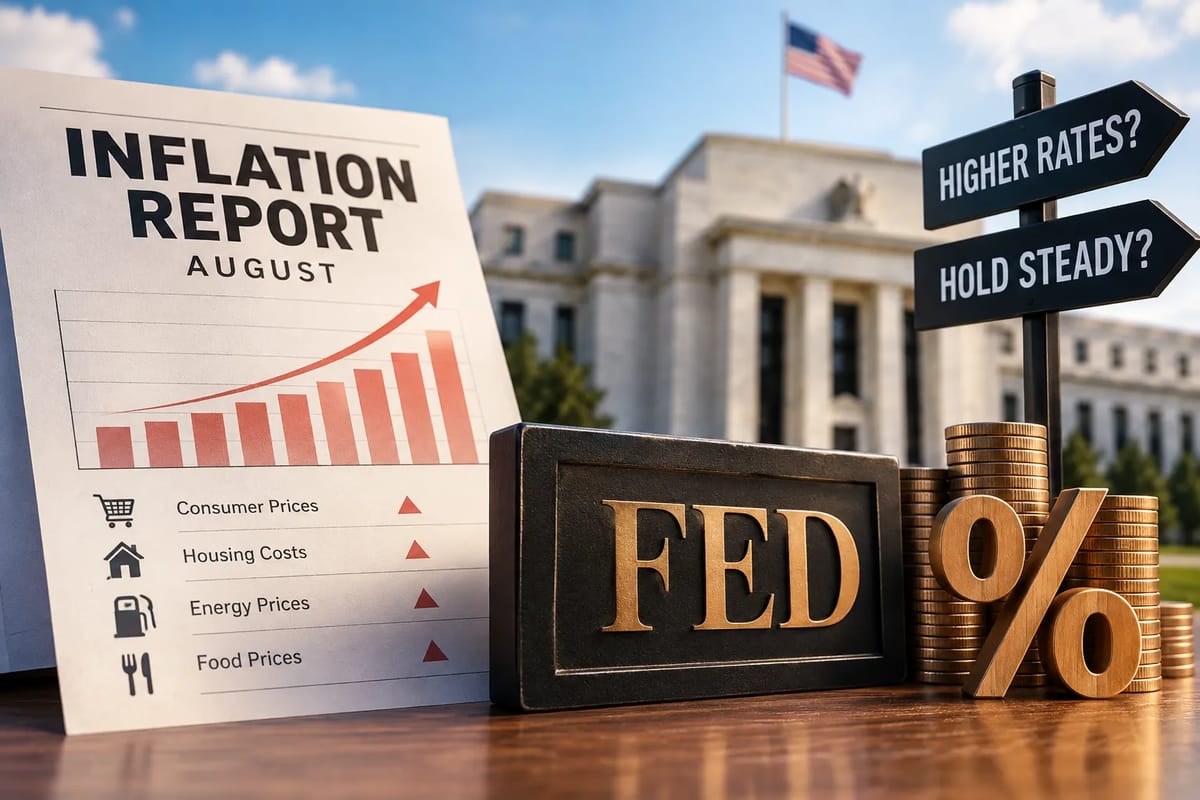
August Inflation Report Could Decide Whether the Fed Raises Interest Rates Next Week
The Federal Reserve is heading into its September policy meeting with an unusually difficult decision in front of it. After holding interest rates steady at its July meeting, policymakers are now weighing whether persistent inflation is strong enough to justify another increase or whether recent signs of cooling prices and a more balanced labor market warrant leaving rates unchanged.
The next major piece of evidence arrives with the August inflation report, scheduled for release Friday. With the Federal Open Market Committee meeting set for September 15–16, the data could play a major role in determining whether the Fed raises its benchmark interest rate next week.
The uncertainty is already showing up in financial markets. Recent reports indicate that traders have moved toward pricing in roughly a 60% probability of a quarter-point increase at the September meeting, although economists remain divided.
Why the August Inflation Report Matters So Much
The Federal Reserve’s policy decisions depend heavily on its assessment of inflation, employment and overall economic conditions. The August report is particularly important because policymakers have only a short period between its release and the September meeting.
The July meeting ended with rates unchanged, but three Federal Reserve officials dissented and preferred a quarter-point increase. That means the debate inside the central bank is already more complicated than a simple consensus to hold rates steady.
The latest employment data added another layer to that debate. U.S. employers added 162,000 jobs in August, while the unemployment rate remained around 4.1%. The stronger labor-market reading increased expectations that the Fed could have more room to raise rates if inflation remains stubborn.
That puts the inflation report in an especially important position.
If consumer prices show renewed strength, policymakers could interpret the combination of firm employment and persistent inflation as evidence that monetary policy is not restrictive enough. If inflation comes in softer than expected, the case for waiting becomes stronger.
Headline Inflation Versus Core Inflation
One of the most important distinctions for investors and households will be the difference between headline inflation and core inflation.
Headline inflation includes all major consumer categories, including food and energy. Core inflation excludes food and energy in an attempt to provide a clearer picture of underlying price pressures.
That distinction matters because energy prices have recently become a major source of uncertainty. Higher oil prices can push headline inflation higher quickly, but Federal Reserve officials may be more interested in whether price pressures are spreading through a broader range of goods and services.
Economists surveyed ahead of the report have been looking for roughly a 0.4% monthly increase in headline consumer prices and about a 0.2% increase in core prices, although estimates vary.
A core reading materially above expectations could therefore have a much larger impact on rate expectations than a headline increase driven primarily by energy.
The Fed Is Facing Conflicting Signals
The inflation report is not being released in isolation.
The Fed must interpret it alongside employment, consumer spending, wages, energy prices and other economic indicators. That makes the September decision particularly difficult because different parts of the economy are sending different signals.
On one side, inflation remains above the central bank’s long-run 2% objective. Stronger-than-expected employment has also reduced some concerns about a rapidly deteriorating labor market.
On the other side, several policymakers have argued that inflation is gradually cooling and that there may be little benefit in moving rates higher prematurely.
Federal Reserve Governor Christopher Waller recently indicated that he could support leaving rates unchanged if incoming inflation data continued to show progress. His comments underscored just how important the August numbers could be.
That disagreement means a small inflation surprise could potentially have an outsized effect on expectations for the September decision.
What a Hotter Inflation Report Could Mean
If August inflation comes in significantly above expectations, markets could quickly reassess the probability of a rate hike.
A stronger core reading would be particularly important because it could suggest that inflationary pressure is becoming more persistent rather than being driven primarily by volatile energy prices.
That could lead to:
- Higher Treasury yields
- Increased expectations for a Fed rate hike
- Greater borrowing costs
- Pressure on mortgage rates
- More expensive consumer credit
- A stronger U.S. dollar
- Potential pressure on interest-rate-sensitive stocks
It could also change expectations for the remainder of 2026.
Recent market pricing has already shifted toward the possibility of higher rates, with some investors now expecting additional increases beyond September.
For a broader explanation of how monetary policy connects with economic activity, readers can also explore The Global Economy Explained.
What a Cooler Inflation Report Could Mean
The opposite scenario could be just as significant.
If core inflation rises less than expected, or if the report shows continued moderation across several categories, investors could conclude that the recent inflation pressure is losing momentum.
That would strengthen the argument for keeping interest rates unchanged while policymakers wait for additional evidence.
A softer inflation reading could push:
- Treasury yields lower
- Rate-hike expectations lower
- Mortgage-rate expectations lower
- The dollar lower
- Interest-rate-sensitive stocks higher
It could also revive expectations for eventual rate cuts if inflation continues to moderate and the labor market loses momentum.
For households trying to understand where borrowing costs could go next, Will Interest Rates Fall Again? provides useful context on the forces that can eventually push rates lower.
Why Households Should Pay Attention
The Fed’s decision is not simply a Wall Street story.
Changes in the federal funds rate eventually influence a wide range of borrowing and saving conditions throughout the economy.
Credit-card rates, variable-rate loans, business borrowing costs and other forms of consumer credit can respond to changes in interest-rate expectations. Mortgage rates are influenced by a broader set of market forces, particularly Treasury yields, but expectations for Federal Reserve policy remain an important part of the financial backdrop.
Higher rates can also change the incentives for savers. Deposit rates may remain relatively attractive when monetary policy is restrictive, although the relationship varies across financial products and institutions.
For households already managing inflation-related pressure, the combination of higher prices and elevated borrowing costs can make monthly budgets more difficult to balance.
That is why inflation data can matter even to people who have little direct exposure to financial markets.
Inflation Is Still Closely Connected to the Global Economy
The U.S. economy does not operate in isolation.
Energy prices, international supply chains, tariffs, currency movements, geopolitical disruptions and foreign economic conditions can all influence prices paid by American households and businesses.
That broader context is particularly important now because oil prices have recently moved sharply higher amid geopolitical tensions, adding another potential source of inflation pressure.
Understanding how the global economy affects interest rates can therefore help explain why domestic monetary policy sometimes reacts to developments that originate outside the United States.
The Fed May Need More Than One Inflation Number
Although Friday’s report could significantly influence expectations, it is unlikely that policymakers will base their entire decision on a single monthly figure.
Central bankers typically look for sustained trends rather than relying exclusively on one data point.
That means the details inside the report could be just as important as the headline annual inflation rate.
Policymakers will likely examine:
- Monthly headline inflation
- Monthly core inflation
- Annual headline inflation
- Annual core inflation
- Shelter costs
- Services inflation
- Goods prices
- Energy prices
- Whether inflation is broadening or narrowing
- Whether recent trends are consistent with continued disinflation
The composition of the inflation increase could determine how seriously policymakers interpret the overall number.
A large increase caused mainly by energy prices could be viewed differently from a broad acceleration in services, housing and other categories.
Markets Could React Before the Fed Meets
Financial markets will not wait until September 16 to form an opinion.
Treasury yields, stocks, currencies and other assets can move immediately after the inflation data are released as investors update their expectations for monetary policy.
Recent trading already demonstrates how sensitive markets have become to the inflation outlook. The probability assigned to a September rate hike has moved substantially as new economic data and Federal Reserve commentary have emerged.
That means even a report that appears only slightly different from expectations could produce a large market reaction if it changes the perceived direction of Fed policy.
What Investors Will Watch Beyond the Headline Number
The most important question may not simply be whether inflation rises or falls.
Investors will want to know why it moved.
For example, a report showing modest headline inflation but accelerating core services prices could create a different market reaction from a report showing stronger headline inflation caused primarily by energy.
The same principle applies to shelter costs. Housing-related inflation has historically been important because it represents a large share of household spending and can take time to respond to changing economic conditions.
Investors will therefore be looking for evidence about whether underlying inflation is continuing to move toward the Fed’s objective or becoming stuck above it.
The Decision Comes Down to Inflation, Growth and Risk
The Fed’s September choice ultimately involves balancing two risks.
Raising rates too soon could unnecessarily slow economic activity and increase borrowing costs at a time when parts of the economy may already be losing momentum.
Waiting too long could allow inflation to become more entrenched and make it harder to bring price growth back toward the central bank’s 2% objective.
That tension explains why policymakers have been sending different signals.
Some officials appear concerned that inflation remains too high, while others believe the recent moderation deserves more time to continue.
The August inflation report could help narrow that disagreement.
What the Inflation Report Could Mean for Household Budgets
For consumers, the most important takeaway is that inflation and interest rates affect different parts of a household budget in different ways.
Persistent inflation raises the cost of goods and services, while higher interest rates increase the cost of borrowing. When both occur simultaneously, households can feel pressure from both sides.
Mortgage borrowers, prospective homebuyers, credit-card users and people carrying variable-rate debt may be particularly sensitive to changes in the interest-rate environment.
At the same time, savers may benefit from higher yields on certain deposit and fixed-income products.
For another look at how inflation data can filter through to household finances, see What the New PCE Inflation Data Could Mean for Interest Rates and Household Budgets.
Friday’s Data Could Set the Tone for September
The Federal Reserve’s September 15–16 meeting is approaching quickly, and the August inflation report arrives at a critical moment.
A hotter-than-expected report could strengthen the argument for another rate increase, particularly if core inflation accelerates broadly. A softer report could give policymakers more justification for maintaining the current rate setting while they wait for additional evidence.
But the bigger story is the underlying trend.
The Fed is trying to determine whether inflation is moving sustainably toward its 2% objective or whether recent progress is beginning to stall. The August data will not answer that question by itself, but it could significantly change the evidence policymakers have in front of them.
For households and investors, Friday’s report will therefore be worth watching not simply for the inflation number itself, but for what it says about the likely direction of borrowing costs, savings returns, financial markets and the broader U.S. economy in the months ahead.





2 Comments
Micle harison
June 7, 2019Lorem ipsum dolor sit amet, usu ut perfecto postulant deterruisset, libris causae volutpat at est, ius id modus laoreet urbanitas. Mel ei delenit dolores.
John Doe
June 7, 2019Some consultants are employed indirectly by the client via a consultancy staffing company.