
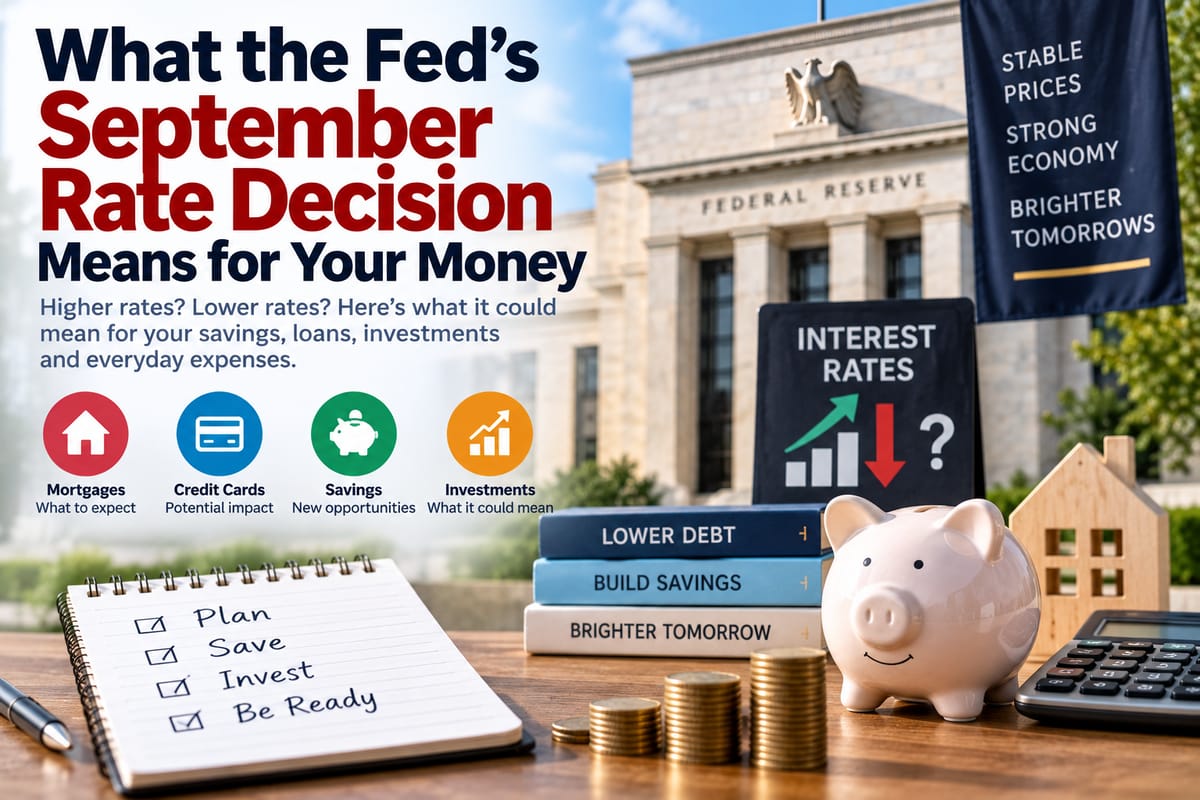
What the Fed’s September Rate Decision Means for Your Money
The Federal Reserve’s September interest-rate decision could have a noticeable impact on household finances, even if the central bank’s announcement appears to be aimed primarily at Wall Street.
The Federal Open Market Committee is scheduled to meet September 15–16, with its policy decision due Wednesday, September 16. As of September 14, the federal funds target range is 3.50% to 3.75%, but expectations for the September meeting have shifted sharply toward a possible quarter-point increase after stronger-than-expected inflation and labor-market data.
That uncertainty matters because the Fed’s decisions influence borrowing costs, savings rates, investment markets, housing affordability, and the broader economy.
For households, the important question is not simply whether the Fed raises, holds, or eventually lowers rates. It is what the decision means for the cost of borrowing, the return on savings, and the financial choices people make over the months ahead.
Why the September Fed Decision Matters
The Federal Reserve uses interest rates as one of its primary tools for influencing economic conditions.
When rates rise, borrowing generally becomes more expensive. Higher financing costs can discourage spending and investment, which can help reduce inflationary pressure.
When rates fall, borrowing can become less expensive, potentially encouraging consumers and businesses to spend, invest, and borrow more.
The relationship is not immediate or identical across every financial product. Mortgage rates, for example, are influenced heavily by longer-term Treasury yields and market expectations, while credit-card rates are generally much more closely tied to short-term interest rates.
That means even a single Fed decision can affect different parts of a household’s finances in different ways.
The Fed Is Facing a Difficult Inflation Picture
The September meeting comes at a particularly complicated time.
August consumer prices rose more than economists had expected. Core consumer prices increased 0.3% from July, while annual core CPI reached 2.4% and headline inflation reached 3.4%, according to recent data cited by Reuters. Producer prices also increased in August, while higher oil prices have added another source of inflationary pressure.
At the same time, the labor market has remained stronger than some earlier expectations suggested.
That combination creates a difficult policy choice: inflation remains above the Fed’s 2% target, but policymakers also have to consider economic growth and employment.
As a result, expectations for the September decision have changed quickly. A Reuters report on September 9 found that a majority of economists still expected the Fed to hold rates steady, while more Wall Street firms subsequently moved toward forecasting a quarter-point hike.
What a Rate Hike Would Mean for Your Money
If the Fed raises its target rate by 0.25 percentage point, consumers should not expect every interest rate in the economy to rise by exactly 0.25 percentage point.
Instead, the effects will filter through financial markets and lending products.
Some borrowing costs could increase relatively quickly, while other rates may already reflect expectations about the Fed’s future decisions.
For households, the biggest areas to watch include:
- Credit cards
- Home-equity lines of credit
- Variable-rate loans
- New mortgages
- Auto loans
- Personal loans
- Savings accounts
- Certificates of deposit
- Bonds and other investments
The impact will depend heavily on whether you are borrowing money, saving money, investing, or doing all three.
Credit-Card Borrowers Could Feel the Impact Quickly
Credit cards are one of the clearest areas where higher interest rates can become expensive.
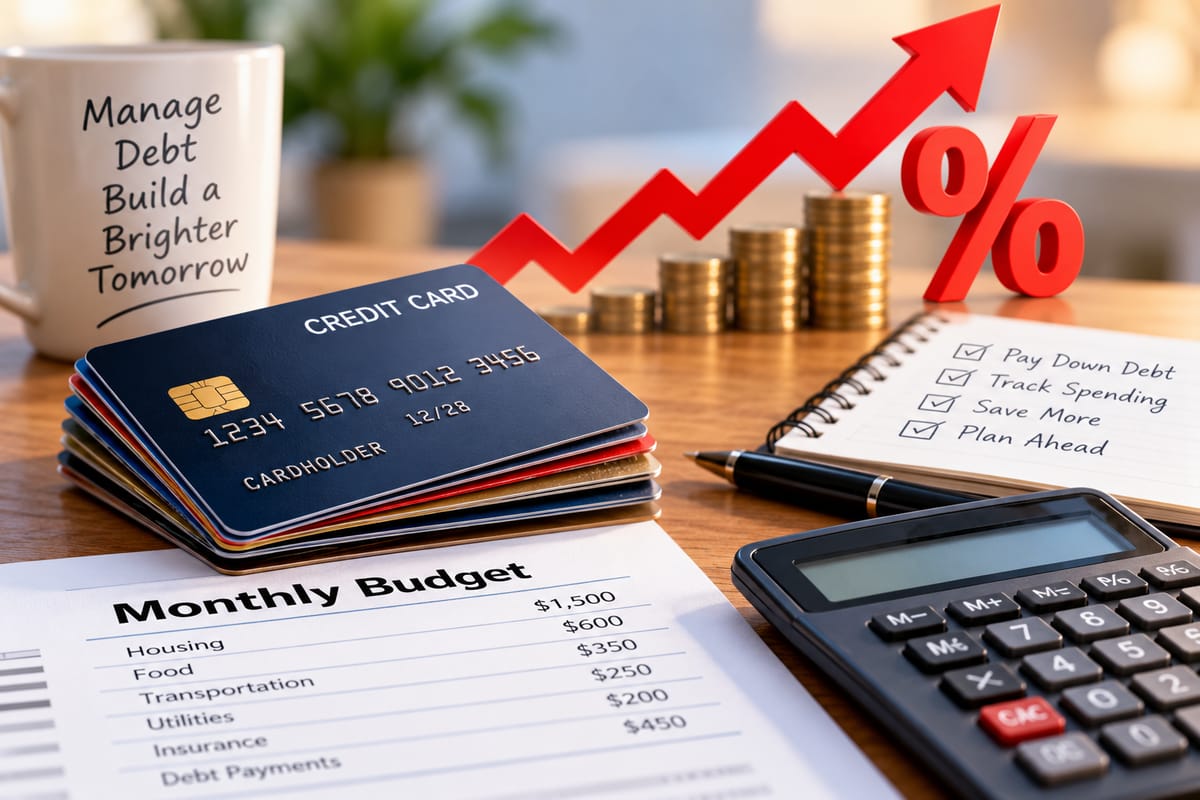
Many credit cards have variable interest rates that are influenced by broader short-term interest-rate conditions. When borrowing costs remain elevated, carrying a balance from month to month can become increasingly expensive.
For someone already carrying significant credit-card debt, even a relatively small rate increase can add to interest costs over time.
The most effective response is often not trying to predict the Fed perfectly. Instead, households can focus on reducing expensive revolving debt where possible.
Strategies may include:
- Paying more than the minimum payment
- Prioritizing high-interest balances
- Avoiding unnecessary new debt
- Comparing balance-transfer opportunities carefully
- Refinancing when a genuinely lower-cost option is available
- Building an emergency fund to reduce reliance on credit
This matters even more when household budgets are already under pressure. Our article on Consumers Feel Pressure as High Interest Rates Affect Household Budgets explores how elevated borrowing costs can affect everyday spending decisions.
Mortgage Rates May Not Move One-for-One With the Fed
Homebuyers sometimes assume that a Fed rate hike automatically causes mortgage rates to rise by the same amount.
The reality is more complicated.
Fixed mortgage rates are influenced significantly by longer-term bond yields, inflation expectations, economic growth, and investor demand.
Mortgage rates have already been moving higher. The average 30-year fixed mortgage rate recently reached 6.76%, its highest level since June 2025, while the 10-year Treasury yield has also climbed amid inflation concerns.
A Fed hike could put additional upward pressure on borrowing costs if markets interpret the decision and accompanying guidance as a signal that restrictive policy will remain in place for longer.
For prospective homebuyers, that means affordability may depend as much on the broader interest-rate outlook as on the September decision itself.
Existing Homeowners May Be in a Different Position
A homeowner with a fixed-rate mortgage generally does not see the interest rate on that existing loan change simply because the Fed changes its policy rate.
Someone with a fixed 30-year mortgage, for example, continues paying according to the terms of that loan.
However, homeowners with variable-rate debt may be more exposed to changes in short-term rates.
Home-equity lines of credit and other variable-rate borrowing arrangements can respond more directly to changes in the interest-rate environment.
That makes it important for homeowners to understand whether their debts carry fixed or variable rates.
Savers Could Benefit From Higher Rates
Higher interest rates are not bad news for everyone.
People with cash savings can benefit when banks and other financial institutions offer higher yields on deposits.
Savings accounts, money-market accounts, and certificates of deposit can become more attractive when short-term rates remain elevated.
However, consumers should not assume that every bank automatically passes higher rates on to customers.
Banks compete differently for deposits, and the rates offered can vary considerably.
Savers may therefore want to compare:
- Annual percentage yields
- Account fees
- Minimum-balance requirements
- Withdrawal restrictions
- CD terms
- Deposit insurance coverage
- Promotional versus ongoing rates
For people who have been holding large amounts of cash in low-yield accounts, the current environment can provide an opportunity to reconsider where emergency savings and short-term money are held.
But Savings Rates Could Fall Later
The other side of the equation is what happens if the Fed eventually begins cutting rates.
Deposit rates often decline as the broader interest-rate environment moves lower.
That creates an important consideration for savers: a high savings yield available today may not remain available indefinitely.
Consumers should therefore distinguish between making a short-term decision about where to keep cash and building a long-term financial strategy around the assumption that today’s interest rates will last forever.
The outlook for future policy remains uncertain, which is why our discussion of Will Interest Rates Fall Again? is relevant to anyone trying to plan ahead.
What the Decision Could Mean for Investments
The Fed’s decision can also affect stocks, bonds, and other financial assets.
A rate increase can place pressure on stock valuations because higher interest rates can make future corporate earnings less valuable in today’s dollars. Higher borrowing costs can also weigh on businesses and consumers.
But markets do not react simply to the rate decision itself.
Investors are also watching what the Fed says about the future.
If the central bank raises rates but signals that the move may be temporary, markets could respond differently than they would to a hike accompanied by expectations of additional increases.
That is why investors will likely pay close attention to the Fed’s statement, economic projections, and Chair Kevin Warsh’s press conference.
Bonds Could Become More Important for Household Portfolios
Higher interest rates can create challenges for existing bond prices but can also improve the yields available to people buying new bonds.
Bond prices and yields generally move in opposite directions. When market interest rates rise, existing bonds with lower coupon rates can become less attractive, pushing their market prices lower.
For long-term investors, however, higher yields can eventually provide opportunities to reinvest income at more attractive rates.
This is one reason a change in monetary policy should not automatically trigger a decision to sell investments.
A diversified portfolio should generally be evaluated according to a person’s time horizon, financial goals, risk tolerance, and overall asset allocation rather than one Fed announcement.
Inflation Still Matters More Than the Headline Rate
For household finances, the Fed’s interest-rate decision cannot be separated from inflation.
Even if wages rise, persistent increases in food, housing, transportation, energy, and other costs can reduce purchasing power.
Recent inflation data have complicated the Fed’s policy outlook. August consumer prices accelerated, while producer prices also showed continued pressure. Higher energy costs have added another concern for policymakers.
That makes inflation an important variable for anyone managing a household budget.
Our article on What the New PCE Inflation Data Could Mean for Interest Rates and Household Budgets provides additional context on the connection between inflation, monetary policy, and household finances.
What a Fed Rate Cut Would Mean
The opposite scenario deserves attention as well.
If the Fed eventually decides that inflation is sufficiently under control and economic conditions justify lower rates, borrowing costs could gradually become more favorable.
Potential effects could include:
- Lower interest costs on some variable-rate debt
- Improved borrowing conditions
- Potentially lower mortgage rates over time
- Reduced yields on some savings products
- Changes in bond prices
- Possible support for interest-sensitive sectors of the stock market
But a Fed cut would not automatically make everything cheaper.
Mortgage rates could remain elevated if long-term Treasury yields stay high. Banks could also adjust deposit rates at different speeds.
The broader economic circumstances surrounding a rate cut would matter just as much as the cut itself.
Why the Fed’s Guidance May Matter More Than the Initial Move
For consumers and investors, the most important information may not be the number announced on September 16.
It may be what policymakers signal about the months that follow.
If the Fed raises rates and suggests additional increases could be necessary, financial markets may adjust to a longer period of restrictive policy.
If the Fed raises rates but indicates that it expects inflation to moderate, markets could interpret the move as a more limited response to current conditions.
And if policymakers unexpectedly leave rates unchanged, investors will likely focus on whether the decision reflects confidence that inflation will cool or concern about economic weakness.
The central bank’s forward guidance can therefore influence financial conditions even after the initial announcement.
How Households Can Prepare for Any Outcome
Consumers do not need to predict the Fed’s next move perfectly to make sensible financial decisions.
Instead, households can focus on areas they can control.
Review Variable-Rate Debt
Identify loans and credit accounts whose interest rates can change.
Knowing how much a rate increase would affect monthly payments can make future budgeting easier.
Pay Down Expensive Debt
High-interest credit-card balances can become particularly costly when rates remain elevated.
Reducing those balances can provide a guaranteed financial benefit by lowering future interest costs.
Strengthen Emergency Savings
A strong emergency fund can reduce the need to rely on credit when an unexpected expense occurs.
Even if savings rates eventually decline, having accessible cash can provide valuable financial flexibility.
Compare Savings Rates
Consumers should periodically review where their cash is held.
A significant difference in interest rates can matter over time, particularly for larger balances.
Avoid Making Major Decisions Based on One Announcement
A single Fed meeting rarely determines the long-term financial outlook.
Homebuyers, investors, borrowers, and savers should consider their personal circumstances rather than making rushed decisions based solely on the latest headline.
What the September Decision Could Mean for Different Households
The same Fed decision can have very different effects depending on a person’s financial position.
| Household situation | Potential effect of higher rates |
|---|---|
| Credit-card borrower | Higher interest costs |
| Variable-rate borrower | Potentially higher monthly payments |
| New homebuyer | Potentially higher financing costs |
| Fixed-rate homeowner | Little direct change to existing mortgage rate |
| Cash saver | Potentially higher deposit yields |
| Bond investor | Existing bond prices may face pressure |
| Long-term stock investor | Higher rates can pressure valuations |
| Debt-free household with savings | Potential benefit from higher deposit yields |
This is why there is no single answer to the question of whether a Fed rate hike is “good” or “bad” for consumers.
Its effect depends on how each household earns, saves, borrows, and invests.
The Global Economy Also Matters
The Federal Reserve does not operate in isolation.
U.S. monetary policy affects global financial markets through the dollar, Treasury yields, capital flows, commodity prices, and international borrowing conditions.
A stronger dollar can influence import prices and international businesses. Higher U.S. yields can affect where global investors choose to put their money.
Economic developments overseas can also feed back into the U.S. economy through trade, energy markets, financial conditions, and consumer prices.
For a broader explanation of these connections, see The Global Economy Explained.
What Consumers Should Watch After the Announcement
Once the Fed releases its decision, households should look beyond the headline number.
Several signals will be especially important:
- The new federal funds target range
- The wording of the Fed’s policy statement
- Economic projections
- Inflation forecasts
- Employment projections
- The expected path of future rates
- Comments from the Fed chair
- Treasury-yield movements
- Mortgage-rate movements
- Changes in savings and lending rates
The combination of these signals will provide a better picture of where borrowing and saving conditions could be headed.
A Practical Money Checklist for September
The Fed meeting is also a useful reminder for households to review their own financial position.
Consider:
- Checking the interest rates on credit cards
- Reviewing variable-rate loans
- Comparing savings-account yields
- Reassessing emergency savings
- Reviewing mortgage options only if refinancing actually makes financial sense
- Avoiding unnecessary high-interest debt
- Reviewing investment allocations
- Checking whether short-term cash is earning a competitive return
- Updating the household budget for changing prices
- Keeping long-term financial goals separate from short-term market headlines
These steps can be useful regardless of whether the Fed ultimately raises rates, holds them steady, or signals future changes.
What the September Fed Decision Really Means for Your Money
The September decision is important, but it is only one piece of a much larger economic picture.
As of September 14, markets are increasingly leaning toward a quarter-point rate increase after stronger inflation and labor-market data, even though the outlook remains uncertain and economists have not been unanimous.
For households, the smartest response is not necessarily to guess what the Fed will do next.
It is to understand how interest rates affect your particular financial situation.
Borrowers should pay attention to expensive and variable-rate debt. Savers should make sure their cash is working efficiently. Homebuyers should consider both mortgage rates and overall affordability. Investors should avoid allowing one policy announcement to dictate long-term decisions.
The Fed can change the financial environment, but households still control many of the decisions that determine how prepared they are for it.
In a period when inflation remains elevated and the path of interest rates is unusually uncertain, that financial flexibility may be more valuable than trying to predict the next move.




2 Comments
Micle harison
June 7, 2019Lorem ipsum dolor sit amet, usu ut perfecto postulant deterruisset, libris causae volutpat at est, ius id modus laoreet urbanitas. Mel ei delenit dolores.
John Doe
June 7, 2019Some consultants are employed indirectly by the client via a consultancy staffing company.