
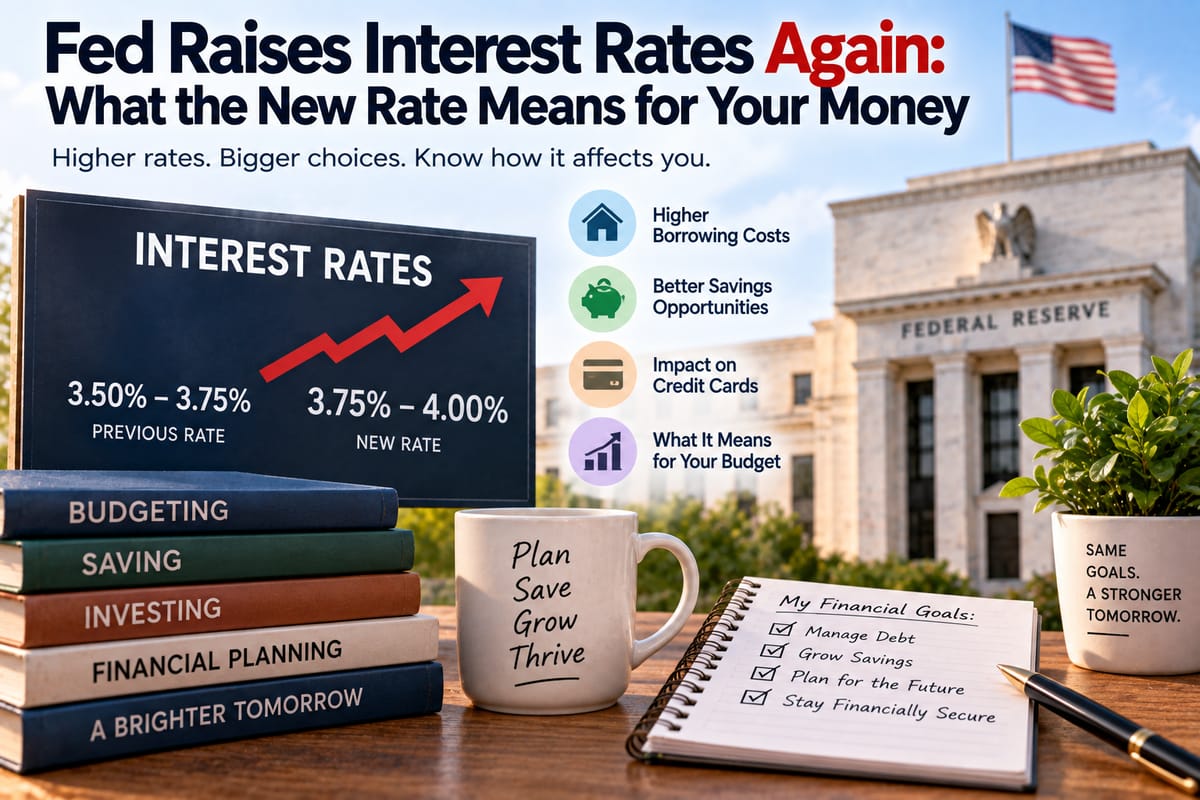
**Fed Raises Interest Rates Again: What the New Rate Means for Your Money
The Federal Reserve raised interest rates again this week, increasing the benchmark federal funds rate by a quarter percentage point as policymakers respond to inflation that remains above their 2% target.
The Federal Open Market Committee voted unanimously on September 16 to lift the target range to 3.75% to 4%, marking the first increase in the federal funds rate since July 2023. The Fed said economic activity remains solid, domestic spending has been resilient and inflation is still elevated.
For households, the decision can affect far more than the headline interest rate.
Credit cards, variable-rate loans, savings accounts, mortgages and other financial products can respond to changes in the broader interest-rate environment. The effects are not always immediate or identical, but the latest decision reinforces the possibility that borrowing costs could remain elevated for longer.
That makes the rate increase relevant for anyone managing debt, saving money, buying a home or planning a household budget.
Why the Fed Raised Rates
The Fed’s latest decision came as inflation remains higher than policymakers want.
The August Consumer Price Index showed consumer prices rising 3.4% over the previous 12 months. Prices increased 0.4% on a seasonally adjusted basis during August, while core CPI, which excludes food and energy, rose 2.4% over the year.
The Federal Reserve uses a different inflation gauge for its formal 2% target, the Personal Consumption Expenditures price index.
In its September economic projections, Fed officials raised their median forecast for 2026 PCE inflation to 3.7%, compared with 3.6% in their June projections. The median projection for 2027 PCE inflation remained 2.3%.
The rate increase therefore reflects the Fed’s assessment that inflation still requires restrictive monetary policy even as economic activity remains relatively strong.
For readers who want to understand how interest rates, inflation, employment and economic growth interact, The Global Economy Explained provides broader context.
The New Rate Is 3.75% to 4%
The quarter-point increase moves the federal funds target range from 3.5%-3.75% to 3.75%-4%.
The federal funds rate is the rate banks charge one another for overnight loans of reserve balances. Consumers do not normally borrow money directly at this rate, but it influences a wide range of short-term borrowing and saving rates throughout the economy.
That means the effect can eventually reach everyday financial products.
Credit cards with variable rates can become more expensive. Some home-equity borrowing can also become more costly. Certain savings products, meanwhile, may continue offering relatively attractive yields as financial institutions compete for deposits.
The precise impact depends on the product, lender and existing terms.
Credit Card Borrowers Could Feel the Increase Quickly
Credit cards are among the financial products most closely associated with changes in short-term interest rates.
Many credit cards have variable annual percentage rates. When benchmark rates rise, lenders can adjust those rates according to the terms of the card agreement.
For someone carrying a balance from month to month, even a relatively small increase can add to the amount of interest paid over time.
Consider a hypothetical $5,000 credit card balance. If the interest rate rises by one percentage point, the simple annual interest cost associated with that additional percentage point would be roughly $50 if the balance remained unchanged throughout the year.
Actual costs depend on compounding, payments and the card’s terms.
This is why households carrying revolving debt may want to prioritize understanding their interest rates and repayment schedules when monetary policy becomes tighter.
Savings Rates May Remain Attractive
Higher interest rates do not affect borrowers alone.
People with savings accounts, certificates of deposit and other interest-bearing products can potentially benefit from a higher-rate environment.
However, not every bank adjusts deposit rates at the same speed or by the same amount. Some accounts may offer significantly higher yields than others, while promotional rates can have expiration dates or eligibility requirements.
For savers, the important question is not simply whether the Fed raised rates. It is whether their own financial institution is passing enough of the higher-rate environment through to their account.
That makes it useful to review savings rates periodically rather than assuming that an existing account is still competitive.
Mortgage Rates Are More Complicated
The Fed’s policy rate does not directly determine the interest rate on a 30-year fixed mortgage.
Mortgage rates are heavily influenced by longer-term Treasury yields, mortgage-backed securities and expectations about future inflation and monetary policy.
As a result, a Fed rate increase does not automatically mean mortgage rates will rise by the same amount.
In fact, markets often respond to expectations before a central bank actually changes rates.
For prospective homebuyers, the broader interest-rate environment still matters because mortgage affordability depends heavily on both the loan rate and the size of the mortgage.
Households trying to understand how monetary policy affects borrowing costs can also review Will Interest Rates Fall Again? for additional context.
Auto Loans and Other Borrowing Costs
Car loans and other consumer loans can also be affected by higher interest rates, although the relationship varies by loan type.
A borrower with a fixed-rate auto loan generally does not see the interest rate change after the loan has been finalized. Someone applying for a new loan, however, may encounter different rates depending on market conditions and the lender’s pricing.
The same principle applies to many other forms of borrowing.
A higher-rate environment can make it more expensive to finance a large purchase, particularly when the loan balance is substantial or the repayment period is long.
For households already carrying several forms of debt, the cumulative effect can become more important than the change in any individual interest rate.
Household Budgets May Face a Double Challenge
Higher interest rates can create pressure at the same time that households are still dealing with elevated prices.
August CPI data showed that food prices were 2.7% higher than a year earlier, while shelter and other major household expenses continued to contribute to overall inflation. Gasoline prices were also a major contributor to the monthly increase in headline CPI during August.
That combination can make budgeting more difficult.
A household may be paying more for groceries and transportation while also facing higher interest costs on variable-rate debt.
The broader household impact of this environment is explored in Consumers Feel Pressure as High Interest Rates Affect Household Budgets.
What the Fed’s Economic Projections Show
The September projections provide some insight into how policymakers currently view the economy, although they are not promises about future decisions.
The median Fed projection puts the federal funds rate at 4.1% at the end of 2026, followed by 4.1% in 2027 and 3.9% in 2028. The median projection for 2027 PCE inflation is 2.3%.
Those projections suggest that policymakers, collectively, currently expect rates to remain relatively elevated rather than quickly returning to the unusually low levels seen during the pandemic period.
However, individual policymakers’ projections vary considerably. The Fed’s published range for the appropriate federal funds rate at the end of 2027 spans 3.1% to 4.4%.
That wide range highlights the uncertainty surrounding future monetary policy.
The Next Rate Decision Will Depend on Incoming Data
The Federal Reserve does not set rates according to a predetermined schedule of increases or decreases.
Future decisions will depend on incoming information about inflation, employment, economic growth, financial conditions and other developments.
The Fed’s next scheduled policy meeting is October 27-28, followed by another meeting December 8-9.
The September decision therefore does not establish a guaranteed path for the rest of the year.
For households, this means it can be risky to make major financial decisions based solely on expectations about what the Fed might do next.
What the Rate Increase Means for People With Debt
For borrowers, the latest decision is a reminder to examine how much of their debt is sensitive to changing interest rates.
A useful first step is to separate fixed-rate debt from variable-rate debt.
Fixed-rate loans generally provide more predictable payments because the contractual interest rate does not change during the fixed period. Variable-rate debt can become more expensive when benchmark rates rise.
Households can also calculate how much interest they are currently paying each month and identify which balances carry the highest rates.
Paying down expensive revolving debt can reduce the household’s exposure to future rate changes, although the best approach depends on each person’s financial circumstances and available cash reserves.
What It Means for Savers
For savers, the picture is different.
Higher short-term rates can create opportunities to earn more interest on cash, particularly when funds are placed in competitive savings products or fixed-term accounts.
But savers also need to consider inflation.
If an account earns interest at a rate below the rate at which consumer prices are rising, the money may still lose purchasing power in real terms even though the account balance is increasing.
The relationship between inflation and household purchasing power is explored in What the New PCE Inflation Data Could Mean for Interest Rates and Household Budgets.
Why the Decision Matters for Retirement Planning
Interest rates can also influence retirement planning.
Higher rates can provide better returns on some cash and fixed-income investments, but they can also affect borrowing costs, housing values and the broader economy.
Retirees and people approaching retirement may therefore need to consider both sides of the interest-rate equation.
Someone who depends heavily on interest income may welcome higher yields, while someone carrying a mortgage or other variable-rate debt may experience the opposite effect.
Diversification of income sources and careful management of cash reserves can become particularly important when economic conditions are changing.
Businesses and the Wider Economy
The Fed’s decision also affects businesses.
Higher borrowing costs can make companies more cautious about taking on debt to finance expansion, equipment purchases or other investments.
At the same time, tighter monetary policy can help moderate demand and inflation by making borrowing more expensive.
The Fed said economic activity was expanding at a solid pace, with productivity growth strong and capital investment robust. It also said job gains had kept pace with the workforce and unemployment had changed little.
This combination creates a complicated policy environment: inflation remains elevated, but economic activity has not shown the type of broad weakness that would necessarily point toward immediate rate reductions.
Why the New Rate Does Not Affect Everyone Equally
The impact of the Fed’s decision depends heavily on an individual’s financial position.
Someone with a large variable-rate credit card balance may notice higher costs relatively quickly. A household with substantial savings in a competitive interest-bearing account may benefit from higher yields.
A homeowner with a fixed-rate mortgage may see little direct change in the monthly mortgage payment.
Someone shopping for a new mortgage, car loan or other credit product could face different borrowing conditions.
This is why the same Fed decision can be financially positive for one household and challenging for another.
How Households Can Respond
The latest rate increase does not necessarily require dramatic financial changes.
Instead, households can use the new rate environment as an opportunity to review several basic areas:
- Check variable-rate debt: Identify loans and credit cards whose rates can change.
- Review savings yields: Compare the interest being earned on cash with available alternatives.
- Avoid unnecessary high-cost borrowing: Consider whether a major purchase can wait if financing costs are high.
- Review the household budget: Look for recurring expenses that have increased.
- Strengthen emergency savings: A cash buffer can reduce the need to rely on expensive credit.
- Understand loan terms: Know whether rates are fixed, variable or subject to future adjustment.
- Separate facts from forecasts: Future Fed decisions depend on incoming economic data.
These steps can help households make decisions based on their own financial circumstances rather than reacting to the headline rate alone.
A Higher-Rate Environment Could Last Longer
The September rate increase marks an important shift in the U.S. monetary policy cycle because it is the first federal funds rate hike since 2023. The Fed’s projections also show policymakers currently expecting the benchmark rate to remain around 4% through 2027 before gradually moving lower in their median projections.
That does not mean rates are guaranteed to follow that path.
Inflation could fall faster or slower than expected. Economic growth could strengthen or weaken. Energy prices and geopolitical developments could also alter the outlook.
For consumers, the practical lesson is that borrowing and saving decisions should account for the possibility of continued rate volatility.
The latest Fed decision has already changed the benchmark rate. What happens next will depend on the data—and for households, the most important question will be how those changing conditions affect the cost of borrowing, the return on savings and the amount of money left over in the monthly budget.




2 Comments
Micle harison
June 7, 2019Lorem ipsum dolor sit amet, usu ut perfecto postulant deterruisset, libris causae volutpat at est, ius id modus laoreet urbanitas. Mel ei delenit dolores.
John Doe
June 7, 2019Some consultants are employed indirectly by the client via a consultancy staffing company.