
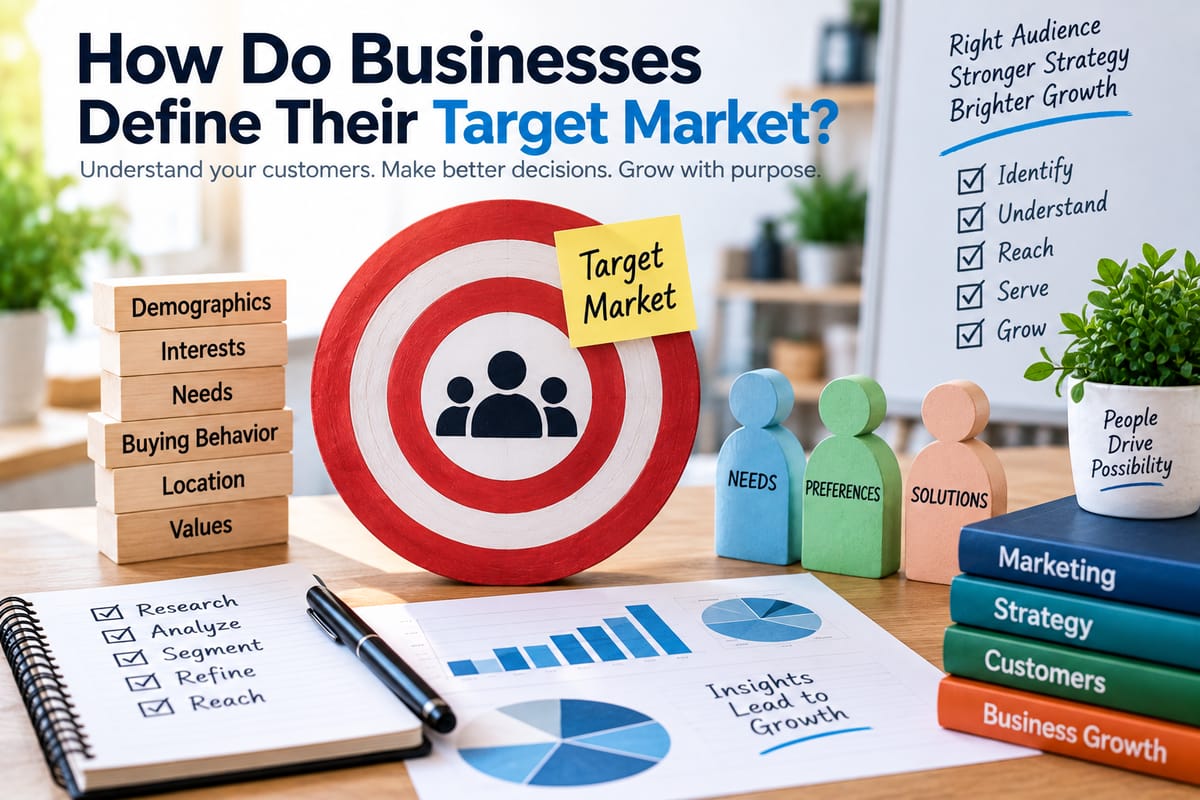
How Do Businesses Define Their Target Market?
A business cannot effectively serve everyone at once. Even companies with products designed for broad audiences usually need to understand which groups are most likely to buy, why they buy, and what they expect from the business.
This is where a target market becomes important.
A target market is the specific group of customers a business chooses to focus its products, services, marketing, pricing, and customer experience around. Defining that group helps businesses make more deliberate decisions instead of trying to appeal to an undefined audience.
Target-market analysis can involve demographics, location, income, interests, behaviors, needs, purchasing habits, and other characteristics. More importantly, it connects those characteristics to a genuine business opportunity.
Understanding a target market is therefore not simply a marketing exercise. It can influence product development, sales strategies, pricing, distribution, customer service, and long-term growth.
What Is a Target Market?
A target market is a clearly identified group of potential customers that a business intends to serve.
For example, a company selling premium running shoes might focus on recreational runners who exercise several times a week and are willing to spend more on specialized footwear.
Another company selling inexpensive school supplies might focus on parents and students looking for affordable everyday products.
Both businesses sell physical products, but their target markets can be very different.
A target market can be described using several characteristics, including:
- Age
- Location
- Income level
- Occupation
- Family circumstances
- Education
- Lifestyle
- Interests
- Purchasing behavior
- Product preferences
- Problems or needs
- Price sensitivity
- Buying frequency
The objective is not to collect as many characteristics as possible. It is to identify the characteristics that actually matter when customers decide whether to purchase.
Why Businesses Need a Target Market
Defining a target market gives a business a clearer foundation for decision-making.
Without a defined audience, a company may create products based on assumptions, advertise to people who are unlikely to buy, or communicate a message that is too general to resonate with anyone strongly.
A defined target market can help businesses answer questions such as:
- Who is most likely to need this product?
- What problem does the product solve?
- What influences customers when they make purchasing decisions?
- How much are customers willing to pay?
- Where do potential customers look for information?
- What alternatives are they already using?
- What makes them choose one business over another?
These questions connect marketing activity with broader business strategy.
Businesses can also learn more about how customers influence business decisions when they examine customer preferences, feedback, purchasing patterns, and changing expectations.
Start With the Problem the Business Solves
One of the most useful ways to define a target market is to start with the customer problem rather than the product itself.
Consider a business that sells meal-planning software.
Its product is software, but its customers may not be primarily interested in software. They may be interested in saving time, reducing food waste, organizing grocery shopping, or making it easier to prepare meals during busy weeks.
The business can therefore ask:
Who experiences this problem most frequently, and who is willing to pay for a solution?
The answer provides an initial foundation for identifying the target market.
This approach can prevent businesses from defining audiences based only on superficial characteristics.
Segment the Broader Market
Most markets contain different groups of customers with different needs.
Market segmentation is the process of dividing a broad market into smaller groups that share meaningful characteristics.
Common segmentation approaches include demographic, geographic, psychographic, and behavioral segmentation.
Demographic Segmentation
Demographics describe characteristics such as:
- Age
- Gender
- Income
- Occupation
- Education
- Household size
- Life stage
For example, a financial service may be designed specifically for young adults beginning to manage independent finances, while another may focus on established households preparing for retirement.
Demographics can be useful, but they rarely tell the entire story.
Two people with the same age and income can have completely different preferences and purchasing priorities.
Geographic Segmentation
Geographic segmentation divides customers according to where they live or operate.
Relevant factors can include:
- Country
- Region
- City
- Neighborhood
- Climate
- Urban or rural location
- Local economic conditions
A business selling winter clothing, for example, may prioritize customers in colder regions.
A restaurant may define its target market partly by proximity because customers generally need to be able to reach the location conveniently.
Psychographic Segmentation
Psychographics focus on characteristics such as:
- Lifestyle
- Values
- Interests
- Attitudes
- Preferences
- Personal priorities
This can help businesses distinguish between customers who look similar demographically but behave differently.
For example, two consumers may have comparable incomes but different attitudes toward sustainability, convenience, luxury, or price.
Behavioral Segmentation
Behavioral segmentation examines what customers actually do.
Businesses may analyze:
- Purchase frequency
- Average spending
- Brand loyalty
- Product usage
- Preferred purchasing channels
- Response to promotions
- Timing of purchases
- Previous interactions with the company
Behavior can sometimes provide stronger evidence than assumptions about who customers are.
Identify the Ideal Customer
After examining different segments, a business can create a practical description of the customer it is primarily trying to serve.
This is sometimes called an ideal customer profile.
For a consumer business, an ideal customer profile might describe:
- Age range
- Location
- Typical needs
- Spending capacity
- Common frustrations
- Preferred shopping channels
- Purchasing motivations
- Factors that influence buying decisions
For a business-to-business company, the profile may instead focus on:
- Industry
- Company size
- Annual revenue
- Geographic market
- Technology environment
- Decision-makers
- Business problems
- Purchasing process
- Budget considerations
The profile should remain grounded in evidence rather than becoming a fictional character created entirely from assumptions.
Look at Existing Customers
Businesses that already have customers have an important source of information available to them.
Customer data can reveal patterns that are difficult to identify through intuition alone.
A company can examine questions such as:
- Which customers purchase most frequently?
- Which products sell most often?
- Which customers generate repeat business?
- Where do customers come from?
- Which customer groups have the highest retention?
- Which products are commonly purchased together?
- What complaints appear repeatedly?
- Which customers refer other people?
These patterns can help a business refine its understanding of who receives the most value from its offerings.
However, businesses should avoid assuming that their current customers automatically represent the entire potential market.
Existing customers reflect the people the company has already reached, not necessarily everyone who could benefit from the product.
Research Potential Customers
Businesses can supplement internal data with customer research.
Research methods can include:
- Surveys
- Interviews
- Focus groups
- Customer feedback
- Reviews
- Sales conversations
- Website analytics
- Search behavior
- Industry research
- Competitor analysis
The purpose is to understand customers rather than simply confirm what the business already believes.
Good research can uncover problems that customers consider important but that the company has overlooked.
For example, a business might believe customers primarily care about low prices, while interviews reveal that delivery reliability is actually a major purchasing factor.
That discovery can change both the target-market definition and the company’s competitive strategy.
Analyze Customer Needs
A target market should be connected to a meaningful need.
Businesses can ask:
- What are customers trying to accomplish?
- What frustrates them?
- What prevents them from solving the problem?
- What alternatives have they tried?
- What would make a solution more convenient?
- What would make them willing to pay?
The strongest target markets often contain customers with a clear problem and a reason to seek a solution.
A large audience is not necessarily attractive if few people within it have a strong need for the product.
Consider Willingness to Pay
A group of people can have a problem without representing a commercially viable target market.
Businesses therefore need to consider whether potential customers are willing and able to pay for the proposed solution.
This involves examining:
- Customer income or business budgets.
- Existing spending on alternatives.
- Perceived value of the solution.
- Price sensitivity.
- Competitor pricing.
- Frequency of the need.
- Cost of switching from an existing solution.
A target market becomes more meaningful when there is a connection between customer need and purchasing capacity.
Examine the Competition
Competitor analysis can reveal how other businesses define and serve particular customer groups.
A company can examine:
- Who competitors appear to target.
- Which customer needs they emphasize.
- Their pricing structures.
- Their product features.
- Their distribution channels.
- Their marketing messages.
- Customer complaints about competing products.
- Areas competitors appear to overlook.
The objective is not necessarily to copy competitors.
Instead, the analysis can reveal opportunities for differentiation.
For example, several businesses may target the same broad customer group, but one company might focus specifically on customers who prioritize simplicity while another emphasizes customization.
Define the Target Market Narrowly Enough to Be Useful
A target market can be too broad to guide decisions.
“People who use smartphones” is technically an audience, but it is unlikely to provide enough direction for a specialized smartphone accessory business.
A more useful definition might identify people with a particular combination of needs, behaviors, and purchasing characteristics.
For example:
Adults who frequently travel for work and want compact technology accessories that simplify mobile productivity.
This definition provides more strategic information.
It can influence product features, advertising messages, pricing, packaging, distribution, and content.
However, businesses should avoid narrowing the market so aggressively that the potential customer base becomes unnecessarily small.
The goal is specificity without artificial restriction.
Distinguish Between the Target Market and Buyer Persona
These concepts are related but not identical.
A target market describes a broader customer segment.
A buyer persona is a more detailed representation of a typical customer within that segment.
For example:
Target market:
Small-business owners who need affordable accounting software.
Buyer persona:
A small-business owner who manages finances personally, has limited accounting experience, wants simple reporting, and prefers software that can be set up quickly.
The target market guides strategic decisions. The persona can help marketers develop more specific messaging and content.
Consider Customer Buying Behavior
Defining a target market requires understanding how people actually purchase.
Some customers make quick purchasing decisions based primarily on convenience or price.
Others conduct extensive research before committing.
Businesses can examine:
- How customers discover products.
- How long they take to make decisions.
- Who participates in the purchase.
- Which information sources they trust.
- Whether they compare competitors.
- What objections delay purchases.
- What causes repeat purchases.
This information can influence the channels and messages a company uses to reach its audience.
Identify Where the Target Market Can Be Reached
Knowing who the customer is does not automatically reveal how to reach them.
A business needs to understand where its target customers spend time and how they prefer to discover products.
Potential channels include:
- Search engines
- Social platforms
- Retail stores
- Marketplaces
- Industry events
- Professional networks
- Referrals
- Partnerships
- Online communities
- Direct sales
The appropriate channels depend on the audience.
A business selling professional services to companies may need a very different approach from a company selling inexpensive consumer products.
This is why target-market analysis and marketing strategy are closely connected. A broader marketing guide for businesses can help put audience research into the context of positioning, promotion, and customer acquisition.
Create a Clear Value Proposition
Once a business understands its target market, it can develop a value proposition that explains why the product or service matters to that audience.
A useful value proposition connects:
Customer need → Business solution → Relevant benefit
For example:
“For small businesses that struggle to manage invoices manually, our software provides a simpler way to create, track, and organize invoices.”
The statement is more useful than a generic claim such as “We provide innovative financial technology.”
A clear target market makes it easier to explain the specific problem being solved and the benefit being offered.
Test the Target Market Instead of Treating It as Permanent
A target market is a strategic hypothesis that can be tested and refined.
Businesses can launch campaigns, introduce products, conduct surveys, analyze sales, and gather feedback to determine whether their assumptions match customer behavior.
Useful measurements can include:
- Conversion rates.
- Customer acquisition costs.
- Repeat purchase rates.
- Customer retention.
- Average order value.
- Lead quality.
- Customer satisfaction.
- Product usage.
- Referral activity.
If a particular customer segment responds significantly differently from expectations, the business may need to revisit its assumptions.
The target market should therefore evolve as evidence accumulates.
Watch for Changes in the Market
Customer preferences are not permanent.
Changes in technology, income, lifestyles, competition, regulations, demographics, and cultural expectations can alter what customers need and how they purchase.
Businesses should periodically ask:
- Has the customer’s problem changed?
- Have new competitors entered the market?
- Has technology changed purchasing behavior?
- Has the price customers are willing to pay changed?
- Are customers using alternative solutions?
- Has the company’s own product changed?
- Are new customer segments emerging?
Regular review helps prevent a company from continuing to target an audience based on outdated assumptions.
Target Markets Can Influence Business Growth
A clearly defined target market can affect more than advertising.
It can shape product development, pricing, distribution, customer service, sales processes, and expansion decisions.
For example, if a company discovers that a particular customer segment has strong demand and high repeat-purchase rates, it may decide to develop additional products for that audience.
Target-market knowledge can therefore become part of a broader growth strategy. Businesses looking at the relationship between customers, operations, revenue, and expansion can also examine how businesses grow revenue, customers, operations and market share.
Target Market and Business Model
The customers a business chooses to serve can also affect how the company makes money.
A business serving price-sensitive consumers may rely on high sales volume and relatively low prices.
Another company serving a smaller group of specialized customers may charge more for expertise, customization, convenience, or premium service.
This connection makes target-market analysis relevant to the overall business model.
A company’s customer segment, value proposition, pricing approach, sales channels, and revenue mechanisms need to work together. The complete guide to business models and revenue strategies provides broader context for understanding these relationships.
Common Mistakes Businesses Make When Defining Target Markets
Trying to Serve Everyone
A business may believe that appealing to everyone will produce more customers.
In practice, overly broad messaging can make it difficult for any particular customer group to recognize why the product is relevant to them.
Relying Only on Demographics
Age, income, and location are useful, but they do not necessarily explain purchasing behavior.
Businesses should also consider needs, motivations, preferences, and actual behavior.
Assuming the Owner Is the Customer
Business owners often design products around their own experiences.
Personal experience can be useful, but it does not prove that a broader market shares the same needs.
Ignoring Unprofitable Customers
A large customer segment may generate considerable sales while producing weak margins or high service costs.
Businesses need to consider the economic value of different segments rather than looking only at customer numbers.
Never Revisiting the Definition
Markets change.
A target market defined several years ago may no longer accurately represent the company’s strongest opportunities.
Confusing Interest With Demand
People may say that they like an idea without being willing to pay for it.
Businesses should distinguish between stated interest and demonstrated purchasing behavior.
A Practical Process for Defining a Target Market
Businesses can use a straightforward process to move from a broad audience to a useful target-market definition.
Step 1: Define the Problem
Identify the customer problem the product or service solves.
Step 2: Identify Potential Customer Groups
List the different types of people or organizations that experience the problem.
Step 3: Segment the Market
Use demographic, geographic, psychographic, and behavioral characteristics where they are relevant.
Step 4: Research the Segments
Use customer conversations, surveys, sales data, analytics, reviews, and competitive research to understand each group.
Step 5: Evaluate Commercial Potential
Consider the size of the segment, strength of demand, purchasing power, competition, accessibility, and potential profitability.
Step 6: Select a Primary Target
Choose the segment that the business is specifically prepared to serve.
Step 7: Define the Value Proposition
Explain how the product or service addresses the target customer’s needs.
Step 8: Choose Appropriate Channels
Determine where and how the target audience can be reached.
Step 9: Test the Assumptions
Use real customer behavior to evaluate whether the target-market definition is accurate.
Step 10: Refine Over Time
Update the definition when customer behavior, competition, or business strategy changes.
A Target Market Is a Strategic Starting Point
Defining a target market gives businesses a clearer picture of whom they are trying to serve and why those customers might choose their products or services.
The process begins with understanding customer problems, then moves through segmentation, research, purchasing behavior, commercial potential, competition, and testing.
A strong target-market definition should be specific enough to guide decisions while remaining flexible enough to evolve as new evidence becomes available.
When businesses understand their customers more clearly, they can make more informed choices about what to sell, how to position it, where to promote it, and how to build sustainable relationships with the people they aim to serve.




2 Comments
Micle harison
June 7, 2019Lorem ipsum dolor sit amet, usu ut perfecto postulant deterruisset, libris causae volutpat at est, ius id modus laoreet urbanitas. Mel ei delenit dolores.
John Doe
June 7, 2019Some consultants are employed indirectly by the client via a consultancy staffing company.