
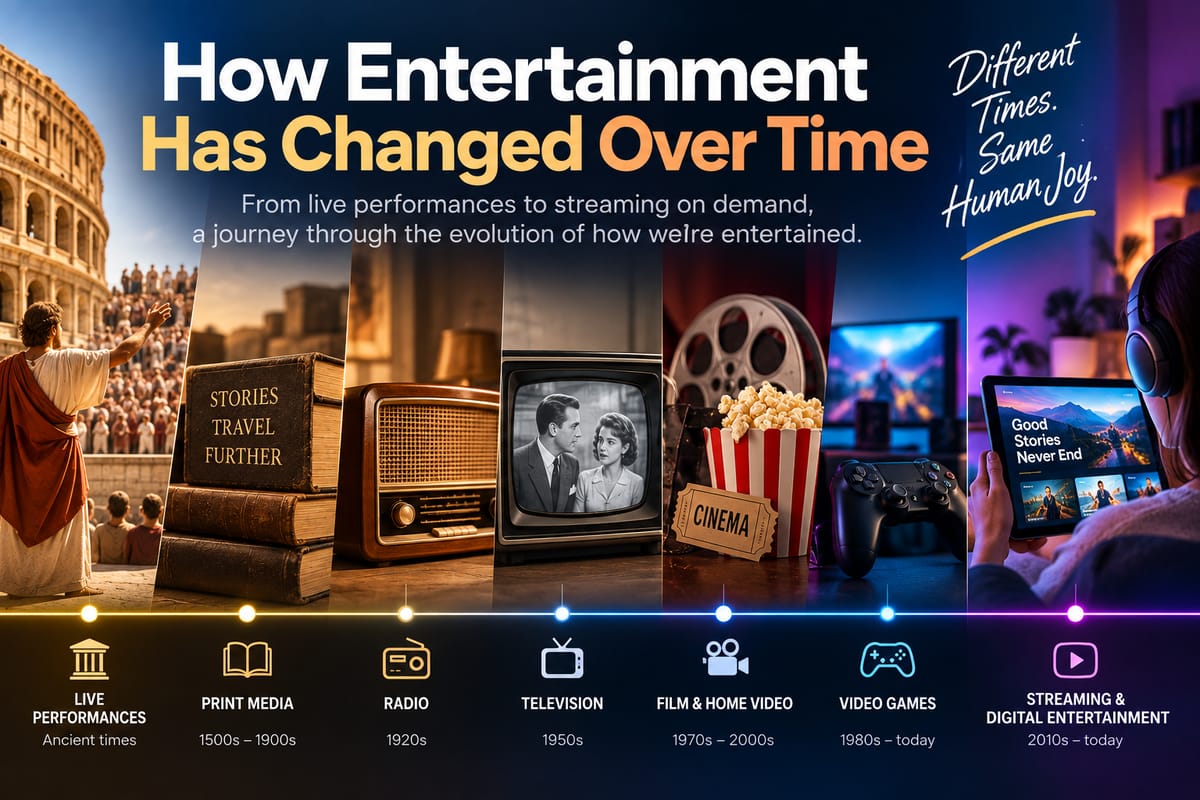
How Entertainment Has Changed Over Time
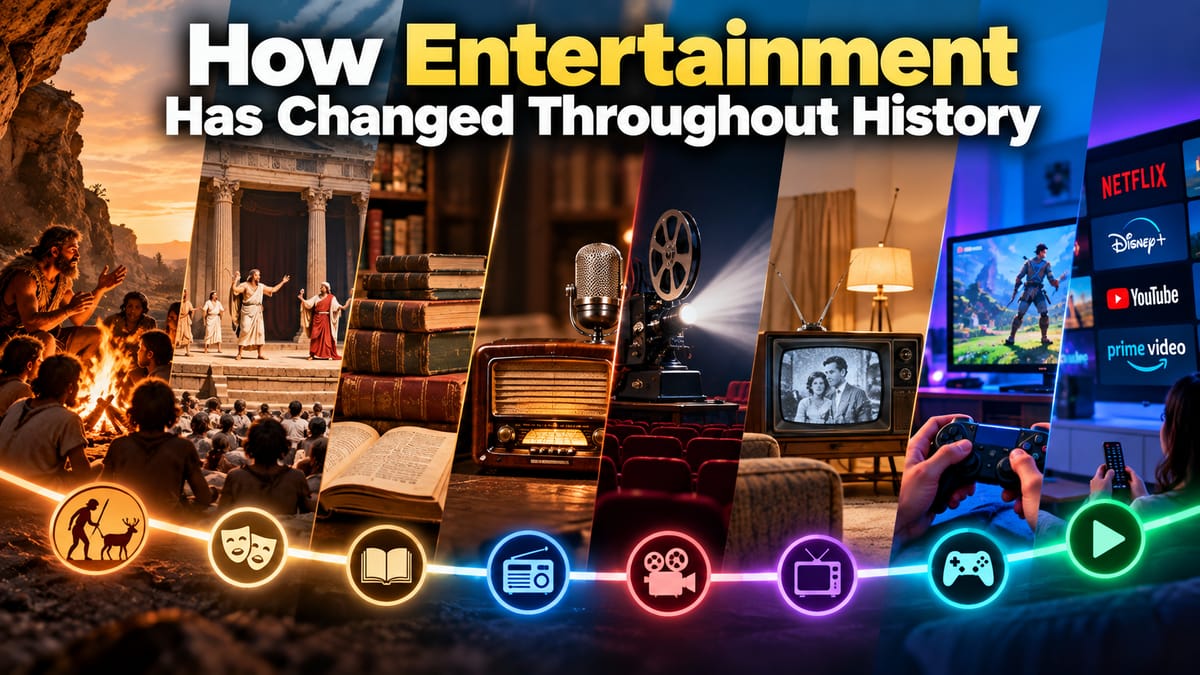
Entertainment has always reflected the way people live, communicate and spend their free time. From ancient performances in public spaces to movies watched instantly on smartphones, the ways people seek enjoyment have changed dramatically over the centuries.
What began largely as a shared, physical experience has evolved into an industry capable of delivering music, stories, games, live events and video to audiences almost anywhere. Technology has played a major role in that transformation, but changes in culture, economics and audience expectations have also shaped what entertainment looks like today.
Understanding how entertainment has changed over time offers a glimpse into both the history of popular culture and the forces that could shape its future.
Entertainment Began as a Shared Experience
Some of the earliest forms of organized entertainment involved people gathering together in the same physical location.
Ancient societies used storytelling, music, dance, sporting competitions, religious ceremonies and theatrical performances to bring communities together. These activities were often social as well as entertaining, giving people an opportunity to celebrate traditions, share stories and participate in important cultural events.
Theater became particularly influential in several ancient civilizations. Performers could tell stories to large audiences without relying on recorded media, while live music and public spectacles created experiences that depended on everyone being present at the same time.
This basic model remained important for centuries.
People went to theaters, festivals, fairs, concerts and sporting events because entertainment was something experienced collectively.
The Printing Revolution Changed How Stories Were Shared
The development of printing introduced a significant change.
Books, newspapers, magazines and other printed materials made it possible to distribute stories and information to much larger audiences. Entertainment no longer had to disappear when a performance ended.
A novel could be read by people in different cities. A newspaper could deliver serialized stories to thousands of households. Magazines could combine writing, illustrations and photography into new forms of popular entertainment.
Print also helped create recognizable forms of mass culture. Writers, performers and fictional characters could reach audiences far beyond their immediate communities.
The growth of newspapers and magazines eventually created an important foundation for the modern entertainment industry.
The broader evolution of modern entertainment media shows how these earlier forms of communication gradually developed into increasingly sophisticated media systems.
Photography and Recorded Media Changed the Meaning of Performance
Photography introduced another major development by allowing moments to be captured and reproduced.
Instead of experiencing an event only in person, people could preserve images of performers, places and historical moments. This idea of capturing reality would become even more powerful with the development of motion pictures.
Film transformed entertainment by combining visual storytelling with recorded performances.
Audiences could watch actors and stories repeatedly, while filmmakers could create environments and sequences that would be difficult or impossible to reproduce on a traditional stage.
Movie theaters became major entertainment destinations during the 20th century. Going to the cinema was not simply about watching a film; it was often a social occasion.
Radio Brought Entertainment Into the Home
Radio changed entertainment once again by allowing performances and programs to enter people’s homes.
Families could gather around a radio to listen to music, comedy, drama, news programs and sporting events. Unlike printed entertainment, radio could create a sense of immediacy.
A major event could be experienced by large numbers of people at approximately the same time.
Radio also introduced audiences to performers they might never have encountered in person. Musicians, actors, comedians and broadcasters could develop large followings without traveling to every community where their audiences lived.
The home was becoming an increasingly important entertainment venue.
Television Combined Sound and Images
Television took the home-entertainment model further by combining moving images with sound.
As television ownership expanded, families gained access to movies, scripted programs, sports, comedy, documentaries and live events without leaving their homes.
Television also changed the structure of entertainment production. Networks developed programming schedules designed to attract audiences at specific times of day, creating shared viewing habits.
For decades, television was one of the dominant ways people consumed entertainment.
Major broadcasts could become cultural events because millions of people were watching the same program at roughly the same time.
The changing relationship between traditional television and newer platforms is explored in the Television and Streaming: Complete Entertainment Guide.
Music Became Increasingly Portable
Music experienced its own technological transformation.
Records allowed listeners to replay professionally recorded performances. Cassettes introduced portability and made it easier for people to create personal collections. Compact discs offered another format with different storage and audio characteristics.
Then digital music fundamentally changed how people acquired and organized songs.
Instead of carrying physical albums, listeners could store large music libraries on computers and portable devices. Digital downloads made individual songs easier to purchase, while later streaming services made enormous catalogs available without requiring listeners to own individual recordings.
Music had moved from physical collections toward access-based consumption.
Home Video Changed Movie Consumption
Film also became more flexible with the arrival of home video.
Videocassettes allowed audiences to watch movies outside theaters and at times that suited them. Consumers could rent or purchase films and build personal collections.
DVDs later improved the experience with higher-quality digital video, additional features and easier storage.
This was an important shift because audiences gained greater control over when and where they watched entertainment.
The traditional cinema remained important, but it was no longer the only place where professionally produced films could be experienced.
The Internet Transformed Entertainment Distribution
The arrival of the internet created one of the biggest changes in entertainment history.
Digital networks allowed content to move quickly between creators and audiences. Websites, online forums, blogs and social platforms gave people new ways to discover and share entertainment.
The internet also reduced some of the barriers to becoming a creator.
Someone with a computer, camera or smartphone could potentially produce and distribute content without needing access to a traditional television network, record label or publishing company.
This contributed to the growth of independent creators, online personalities, podcasts, digital publications and user-generated video.
Entertainment became increasingly interactive.
Smartphones Put Entertainment in People’s Pockets
The smartphone accelerated these changes by combining several entertainment technologies into one portable device.
A modern smartphone can function as a music player, television, movie screen, gaming device, camera, reading platform and social-media terminal.
This has made entertainment available in more places than ever before.
People can watch a show while traveling, listen to music while exercising, play games while waiting for an appointment or follow a live event from almost anywhere with an internet connection.
The device itself has become less important than the services and content accessible through it.
Streaming Changed the Relationship Between Audiences and Content
Streaming has perhaps been the most significant recent transformation in how people consume recorded entertainment.
Instead of waiting for a television program to air or visiting a video store to rent a movie, viewers can select content from an online catalog and begin watching almost immediately.
Streaming has also changed expectations.
Audiences increasingly expect flexibility in what they watch, when they watch it and which device they use. Entire seasons of television series can be released at once, while recommendation systems can suggest content based on viewing habits.
The shift is examined more closely in How Streaming Changed Entertainment Consumption.
This model has also changed the business side of entertainment. Companies can distribute content globally without relying entirely on traditional broadcast schedules or physical media.
Social Media Made Audiences Part of the Entertainment System
Traditional entertainment generally separated creators from audiences.
A movie had actors and filmmakers, while viewers sat in theaters. A television program had presenters and producers, while audiences watched from home.
Social media blurred that distinction.
Audiences can now comment on content, share clips, create responses, participate in trends and produce their own material. A viewer can become a creator almost instantly.
This has produced new entertainment formats built around short videos, livestreams, podcasts, online communities and interactive experiences.
Popularity can also develop rapidly because content can be distributed through networks of users rather than traditional media companies alone.
Video Games Became a Mainstream Entertainment Industry
Gaming has undergone an equally dramatic transformation.
Early video games were relatively simple experiences, often played on arcade machines or basic home consoles. Advances in computing and graphics eventually produced increasingly sophisticated games with expansive worlds, detailed storytelling and online multiplayer features.
Gaming is now much more than a solitary activity.
Players can compete with or cooperate with people around the world, communicate through voice and text, watch professional competitions and follow gaming personalities online.
Mobile gaming has expanded the audience further by making games accessible through smartphones and tablets.
Technology Has Changed the Entertainment Industry
Technology has influenced virtually every stage of entertainment, from creation and production to distribution and consumption.
Digital cameras have changed filmmaking. Computer-generated imagery has expanded visual storytelling. Digital audio production has transformed music recording. Online platforms have changed distribution, while artificial intelligence is beginning to influence creative and production workflows.
The broader How Technology Has Changed the Entertainment Industry perspective shows why entertainment can no longer be separated from technological development.
However, technology does not simply replace older forms of entertainment.
Instead, new formats often exist alongside older ones.
People still attend concerts even though recorded music is widely available. Cinemas continue to attract audiences despite streaming. Books remain popular despite smartphones and digital media.
Entertainment tends to expand rather than move in a perfectly linear direction.
Audiences Have More Choice Than Ever
One of the defining characteristics of modern entertainment is the sheer amount of choice available.
A person with an internet-connected device may have access to millions of songs, thousands of movies and television programs, games, podcasts, books, livestreams and creator videos.
That abundance has created a different challenge: deciding what to watch, listen to or play.
Recommendation algorithms have consequently become increasingly important. Platforms use viewing, listening and engagement data to help users discover content they might enjoy.
At the same time, audiences can increasingly choose niche entertainment rather than relying only on content designed for the largest possible audience.
Entertainment Has Become More Personalized
Mass entertainment still exists, but personalization has become one of the defining features of modern media.
Two people sitting in the same room can use their phones to watch completely different videos, listen to different music or follow different creators.
Streaming services and social platforms can customize recommendations for individual users. Gaming platforms can connect players with communities that share particular interests.
This has created opportunities for specialized entertainment that might have struggled to reach a large audience through traditional media.
Live Entertainment Still Matters
Despite the growth of digital entertainment, live experiences remain important.
Concerts, theater productions, sports, festivals and other events offer something that recorded media cannot completely reproduce: physical presence and shared participation.
Audiences can react collectively to a performance, interact with performers and experience an event alongside other people.
Technology has not eliminated this experience. In many cases, it has helped promote and extend it through social media, livestreaming and digital communities.
The Line Between Creator and Consumer Is Fading
The modern entertainment landscape increasingly allows people to occupy both roles.
Someone might watch a video in the morning, create a short video during lunch and livestream a gaming session later that evening.
This flexibility is one of the biggest differences between today’s entertainment environment and the traditional media system.
The audience is no longer simply waiting for entertainment to arrive.
People can discover, remix, comment on, recommend and create content themselves.
What Comes Next for Entertainment?
The next stage of entertainment will likely continue combining established formats with emerging technologies.
Artificial intelligence could influence content production, personalization, visual effects, music creation and interactive experiences. Virtual and augmented reality may create more immersive forms of entertainment, while faster networks could make high-quality digital experiences increasingly accessible.
At the same time, traditional entertainment is unlikely to disappear simply because new technologies emerge.
People will continue to seek stories, music, humor, competition, creativity and social connection. The tools used to deliver those experiences may change, but the underlying desire for entertainment remains remarkably consistent.
From ancient storytelling and live performances to streaming platforms, smartphones and interactive digital worlds, entertainment has repeatedly adapted to changes in technology and society. The history of entertainment is therefore not simply a story about new devices or platforms. It is a story about how people continually find new ways to experience stories, connect with others and enjoy their free time.



2 Comments
Micle harison
June 7, 2019Lorem ipsum dolor sit amet, usu ut perfecto postulant deterruisset, libris causae volutpat at est, ius id modus laoreet urbanitas. Mel ei delenit dolores.
John Doe
June 7, 2019Some consultants are employed indirectly by the client via a consultancy staffing company.