
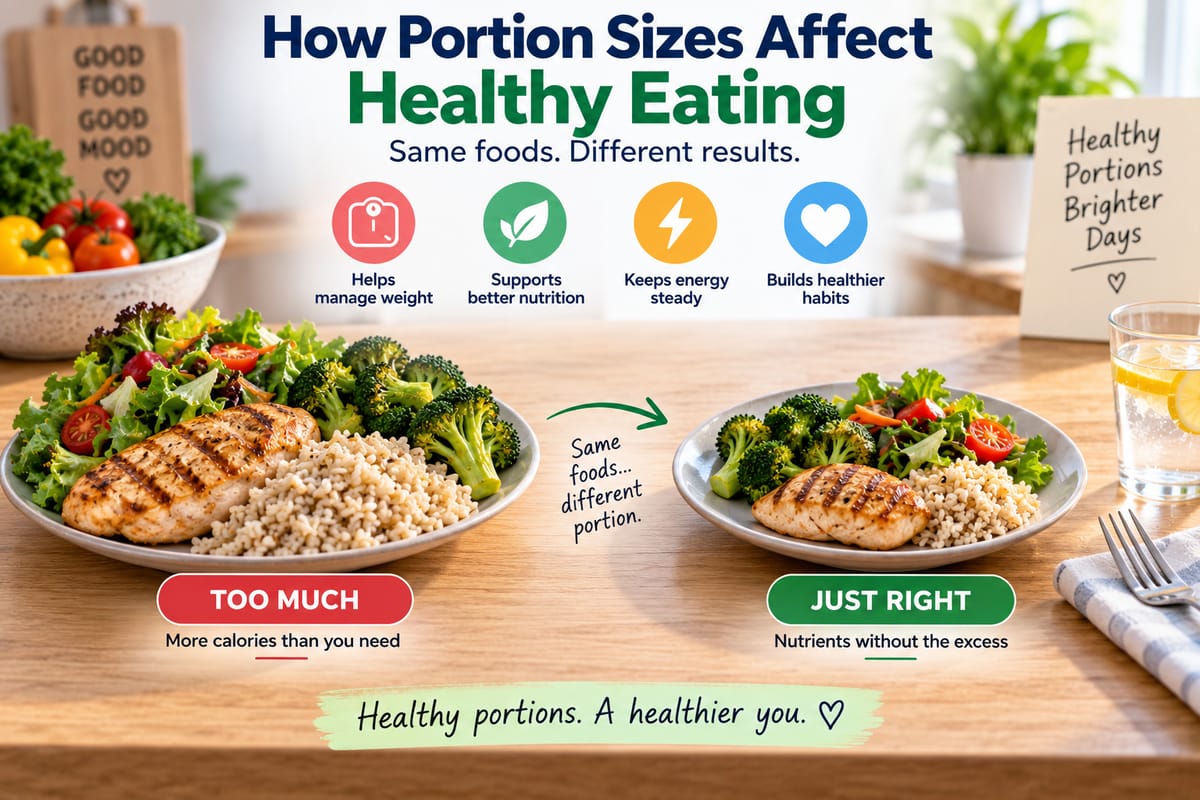
How Portion Sizes Affect Healthy Eating
Healthy eating is often discussed in terms of what foods people choose, but how much they eat can be just as important. Even nutritious foods can contribute more energy than a person needs when portions are consistently larger than appropriate for their individual needs.
Portion size can influence total calorie intake, nutrient intake, fullness, blood sugar patterns, and the overall balance of a diet. At the same time, healthy eating is not about constantly measuring every bite or avoiding satisfying meals.
Understanding the difference between portion size and serving size can help people make more informed choices while keeping eating practical and enjoyable.
What Is a Portion Size?
A portion is the amount of food a person chooses to eat at one time.
There is no universal portion that is appropriate for everyone. Energy and nutrient requirements vary according to factors such as age, body size, physical activity, health status, and individual circumstances.
A portion can therefore be smaller or larger than the amount listed as a serving on a nutrition label.
For example, if a packaged food lists one serving as a particular quantity, eating twice that amount means consuming two servings, even if the entire package is eaten as one personal portion.
Portion Size and Serving Size Are Different
The terms portion and serving are sometimes used interchangeably, but they have different meanings.
A serving size is generally a standardized or defined amount used to describe the nutritional content of a food. A portion is the amount someone actually eats.
Understanding this distinction can make nutrition labels easier to interpret.
If a snack contains two servings and someone eats the entire package, the calories, sodium, sugar, protein, and other nutrients listed per serving need to be considered accordingly.
Why Portion Size Matters
Portion size can influence how much energy a person consumes throughout the day.
Larger portions generally make it easier to consume more food, particularly when eating quickly or when food is highly palatable.
This does not mean large portions are always unhealthy. Someone with higher energy requirements may reasonably need more food than someone with lower requirements.
The important consideration is whether portions fit an individual’s overall nutritional and energy needs.
Portion Size Is Only One Part of Nutrition
Healthy eating cannot be reduced to portion control.
The nutritional quality of food matters as well. A small portion of a food that provides few essential nutrients is not necessarily a better choice than a larger portion of a nutritious food.
A balanced eating pattern should provide a range of nutrients from different food groups.
For a broader overview of how nutrients fit into healthy eating, see The Complete Guide to Nutrition.
The goal is to consider both quality and quantity rather than focusing exclusively on either one.
Macronutrients Influence Portion Composition
Foods contain different combinations of carbohydrates, proteins, and fats. These are known as macronutrients because the body needs them in relatively large amounts.
The balance of these nutrients can affect how satisfying a meal feels and how it contributes to overall dietary needs.
For example, a meal containing protein, fiber-rich carbohydrates, and healthy fats may provide greater fullness than a meal dominated by rapidly digested carbohydrates.
What Are Macronutrients and Why Do They Matter? provides more information about these major nutrients and their roles in the body.
Larger Portions Can Increase Energy Intake
Some foods contain considerable energy in relatively small amounts.
Oils, butter, nuts, seeds, fried foods, and some desserts can be energy-dense. Eating larger portions of these foods can increase total energy intake quickly.
This does not make these foods inherently unhealthy.
For example, nuts can provide protein, fiber, fats, vitamins, and minerals. Oils can provide fats that serve important physiological functions. The issue is that calorie-dense foods can contribute substantial energy even when the physical portion appears relatively small.
Being aware of this difference can help people build meals that are both satisfying and nutritionally balanced.
Vegetables Can Add Volume to Meals
Many vegetables contain substantial water and fiber relative to their calorie content.
Including vegetables in meals can increase food volume while contributing vitamins, minerals, and other beneficial compounds.
Examples include:
- Leafy greens
- Broccoli
- Cabbage
- Tomatoes
- Carrots
- Peppers
- Cucumbers
- Green beans
- Eggplant
Different vegetables provide different nutrients, so variety is useful.
Adding vegetables does not mean other foods need to be eliminated. Instead, they can become part of a meal that includes appropriate amounts of protein, carbohydrates, and fats.
Protein Can Contribute to Fullness
Protein plays important structural and functional roles in the body and can also contribute to feelings of fullness after eating.
Foods such as eggs, fish, poultry, beans, lentils, dairy products, nuts, seeds, and other protein-rich foods can be incorporated into balanced meals.
The appropriate amount varies between individuals.
Rather than focusing on a single ideal portion, it can be more useful to consider protein intake across the entire day and how it fits into the overall diet.
Fiber Can Affect How Filling a Meal Feels
Fiber is found naturally in foods such as vegetables, fruits, legumes, whole grains, nuts, and seeds.
High-fiber foods can contribute to fullness and support normal digestive function. Meals that contain fiber-rich foods may therefore feel satisfying even when their energy density is relatively moderate.
Increasing fiber gradually and drinking adequate fluids can help the digestive system adjust when someone is moving toward a higher-fiber eating pattern.
Portion Size and Blood Sugar
The amount and composition of a meal can affect blood glucose levels.
Carbohydrate-containing foods are broken down into glucose to varying degrees, and the body’s insulin and other regulatory mechanisms help manage blood glucose.
The overall composition of a meal, including protein, fat, fiber, and carbohydrate type, can influence how quickly glucose enters the bloodstream.
For a closer look at this process, How Blood Sugar Regulation Works explains how the body maintains blood glucose within a controlled range.
People with diabetes or other conditions affecting blood glucose should follow individualized dietary guidance from their healthcare professionals.
Portion Size and Metabolic Health
Portion size can also be considered within the larger context of metabolic health.
Metabolism involves numerous processes through which the body obtains, stores, and uses energy. Diet, physical activity, sleep, genetics, body composition, and other factors can all influence metabolic health.
Consistently consuming more energy than the body requires can contribute to changes in body weight and metabolic risk for some people, although the relationship between diet and health is complex.
The Complete Guide to Metabolic Health and Metabolism provides a broader explanation of how these systems interact.
Why Large Packages Can Encourage Larger Portions
Package size can influence eating behavior.
When food is purchased in a large container, it can be easy to serve more than intended, particularly when eating directly from the package.
This does not mean larger packages automatically cause overeating. However, dividing foods into smaller portions before eating can make quantities easier to recognize.
Using bowls, plates, or containers rather than eating directly from a large package can also create a clearer visual boundary around the amount being consumed.
Restaurant Portions Can Be Substantial
Restaurant meals can sometimes contain larger portions than people would normally prepare at home.
A large meal may contain multiple components, including a main dish, side dishes, sauces, and beverages.
Practical strategies can include:
- Sharing a meal
- Saving part of the meal for later
- Ordering a smaller option when available
- Adding vegetables or a salad
- Being mindful of high-calorie sauces and toppings
- Eating slowly enough to recognize fullness
These strategies do not require avoiding restaurants. They simply provide ways to make portions more manageable when meals are particularly large.
Slow Eating Can Help With Portion Awareness
The body does not necessarily signal fullness immediately after food is consumed.
Eating very quickly can make it easier to consume a large amount before recognizing that enough food has been eaten.
Slowing down can provide more time to notice taste, texture, satisfaction, and fullness.
Putting utensils down between bites, eating without rushing, and minimizing distractions can help some people become more aware of their eating experience.
Visual Cues Can Be Practical
Not everyone wants to weigh or measure food.
Visual cues can provide a simpler alternative for estimating portions. For example, meals can be structured around different food groups, with vegetables and other nutrient-rich foods occupying a substantial part of the plate alongside protein-rich foods and appropriate carbohydrate sources.
The exact proportions do not need to be identical at every meal.
Visual approaches are intended as practical guides rather than precise medical prescriptions.
Measuring Portions Can Be Useful in Some Situations
Food scales, measuring cups, and other tools can help people understand how much they are actually eating.
They can be particularly useful when someone is learning to interpret nutrition labels or trying to understand the difference between a listed serving and a typical personal portion.
However, measuring every food indefinitely is not necessary for everyone.
Once people become familiar with approximate quantities, they may prefer to rely on visual estimation and hunger and fullness cues.
Portion Sizes Should Reflect Individual Needs
There is no single portion size that is appropriate for every person.
A physically active person may require considerably more energy than someone who is sedentary. Children have different nutritional requirements from adults, while older adults may have different needs from younger adults.
Pregnancy, breastfeeding, certain medical conditions, medications, and other circumstances can also affect nutritional requirements.
This is why generic portion rules should not be treated as universal medical recommendations.
Children Need Age-Appropriate Portions
Children are still growing and developing, so their nutritional requirements differ from those of adults.
Portions should generally be appropriate for a child’s age and appetite rather than based on adult serving sizes.
Allowing children to respond to hunger and fullness cues can also be useful. Encouraging a varied diet is generally more constructive than pressuring children to finish every item on a plate.
Parents and caregivers can offer nutritious choices while allowing children some control over how much they eat.
Portion Control Does Not Mean Restriction
The phrase “portion control” can sometimes create the impression that healthy eating requires eating as little as possible.
That is not the goal.
The body needs adequate energy and nutrients. Consistently eating too little can also create nutritional problems.
A healthier interpretation is portion awareness: understanding how much food is being eaten and how that amount fits into an individual’s overall nutritional needs.
Be Careful With Calorie-Only Thinking
Calories provide useful information about energy, but they do not describe the complete nutritional value of food.
Two foods can contain similar amounts of energy while providing very different quantities of protein, fiber, vitamins, minerals, and other nutrients.
A healthy eating pattern should therefore consider the nutritional composition of meals rather than focusing exclusively on calorie totals.
Portion Awareness Can Support Balanced Meals
A practical meal does not need to be calculated perfectly.
A person might combine:
- Vegetables or other plant foods
- A protein source
- A whole grain or other carbohydrate source
- A source of healthy fats
- Fruit or another nutrient-rich food
The portions can then be adjusted according to hunger, activity, nutritional needs, and the rest of the day’s meals.
This flexible approach can make healthy eating easier to maintain.
Avoid Turning Portion Size Into a Source of Guilt
Eating a large meal occasionally is not evidence that someone has failed at healthy eating.
Celebrations, holidays, social events, travel, and other situations naturally change eating patterns.
Healthy eating is better understood as a long-term pattern rather than a requirement to eat identical portions every day.
A flexible approach can accommodate occasional larger meals without turning them into a reason for extreme restriction afterward.
Pay Attention to Drinks Too
Portion awareness applies to beverages as well as food.
Some drinks can contain substantial amounts of sugar or energy while providing relatively little nutritional value.
Sweetened soft drinks, specialty coffee beverages, energy drinks, and some fruit-based drinks can contribute to overall energy intake without creating the same sense of fullness as solid foods.
Water and other unsweetened beverages can be useful everyday choices, while individual preferences and nutritional requirements still matter.
Use Portion Awareness as a Long-Term Skill
Portion awareness is most useful when it becomes part of ordinary eating rather than a temporary diet rule.
Learning to recognize serving sizes, understand food labels, build balanced meals, eat attentively, and respond to hunger and fullness can gradually make portion decisions more intuitive.
The objective is not precision at every meal. It is developing enough awareness to make choices that fit an individual’s nutritional needs.
Making Portion Sizes Work With Healthy Eating
Portion size is an important part of healthy eating because the amount of food consumed influences energy and nutrient intake. But it should never be considered in isolation.
The nutritional quality of foods, balance of macronutrients, fiber intake, meal composition, activity level, individual health needs, and overall dietary pattern all matter.
A practical approach is to prioritize nutritious foods, include a variety of food groups, pay attention to portion size, eat at a comfortable pace, and adjust quantities according to individual needs.
Healthy eating does not require perfect measurements. It is about developing an eating pattern that provides adequate nutrition, supports wellbeing, and remains flexible enough to work in everyday life.



2 Comments
Micle harison
June 7, 2019Lorem ipsum dolor sit amet, usu ut perfecto postulant deterruisset, libris causae volutpat at est, ius id modus laoreet urbanitas. Mel ei delenit dolores.
John Doe
June 7, 2019Some consultants are employed indirectly by the client via a consultancy staffing company.