
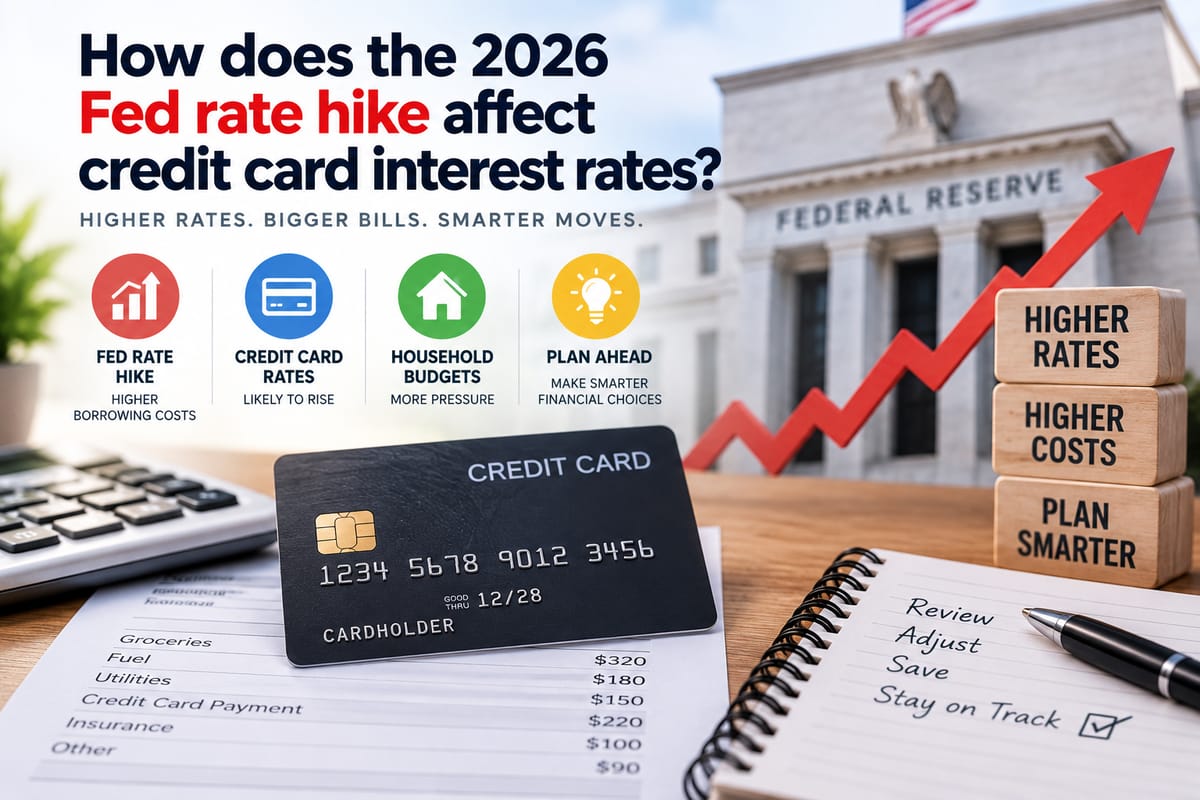
How Does the 2026 Fed Rate Hike Affect Credit Card Interest Rates?
The Federal Reserve’s September 2026 rate increase could make borrowing more expensive for millions of Americans who carry balances on variable-rate credit cards.
On September 16, the Federal Open Market Committee raised the federal funds target range by 0.25 percentage point to 3.75%–4.00%, marking a significant change in the short-term interest-rate environment. The Fed said inflation remained elevated and that the policy move was intended to support a return toward its 2% inflation goal.
For credit card users, the important issue is how that benchmark rate flows through to the rates banks charge consumers.
Unlike many fixed-rate loans, most credit card interest rates are variable and are commonly linked to the prime rate. That means a Fed rate increase can eventually translate into a higher annual percentage rate (APR) for affected cardholders.
Why a Fed Rate Hike Can Raise Credit Card APRs
The federal funds rate is the rate banks charge one another for overnight borrowing. Although consumers do not directly pay the federal funds rate when they use a credit card, changes in the Fed’s target range influence other short-term interest rates.
The prime rate typically sits about three percentage points above the upper end of the federal funds target range. Credit card issuers commonly use the prime rate as an underlying index and add their own margin to determine a cardholder’s variable APR.
That creates a relatively straightforward transmission mechanism:
Fed rate → prime rate → variable credit card APR → interest charged on revolving balances
So when the Fed raises its target range, the prime rate generally moves higher as well, and variable-rate credit cards tied to that index can follow.
How Much Could a Credit Card Rate Increase?
The September 2026 Fed move was a quarter-point increase, or 25 basis points. If a credit card’s APR is directly tied to the prime rate and its issuer adjusts the APR according to that index, the card’s APR can also rise by roughly 0.25 percentage point.
For example, a card with a variable APR of 24% could move to approximately 24.25% after a 25-basis-point increase, assuming the card’s pricing formula does not otherwise change.
The actual timing and mechanics depend on the cardholder agreement. The Consumer Financial Protection Bureau explains that variable APRs can change when the underlying index changes, while the card agreement specifies how the rate is determined.
The increase may sound small, but its effect becomes more noticeable when a consumer carries a large balance for a long period.
Cardholders Who Pay in Full May Feel Less Impact
A higher credit card APR does not necessarily mean every cardholder will immediately pay more interest.
Many credit cards offer a grace period on purchases. If a cardholder pays the full purchase balance by the due date, interest on those purchases can generally be avoided.
That means the Fed’s rate hike is particularly relevant to people who routinely carry balances from one billing cycle to the next.
For someone who pays the entire statement balance every month, changes in the purchase APR may have little or no direct effect on interest charges for those purchases.
The Cost Is Greater for Revolving Balances
Consumers who carry revolving balances can face a different situation.
Credit card issuers commonly calculate interest using a daily periodic rate and, in many cases, the average daily balance. As a result, interest can accumulate throughout the billing cycle rather than being calculated only once at the end of the month.
Consider a hypothetical $5,000 balance:
- At a 24% APR, the simple annualized interest rate corresponds to roughly $1,200 over a year before considering changes in the balance and compounding.
- At 24.25%, the equivalent annualized interest is about $1,212.50 under the same simplified assumptions.
- The difference from the 0.25-point increase alone is relatively small on a single $5,000 balance, but repeated rate increases can add up.
Actual credit card interest depends on the issuer’s calculation method, payment timing, daily balances and other terms.
Not Every Credit Card Rate Moves the Same Way
A Fed rate hike does not mean every credit card APR will increase by exactly the same amount.
Credit cards can have different pricing structures. Some rates are variable and tied to an index, while certain promotional rates or other arrangements may have different terms.
The CFPB notes that a variable APR changes with its underlying index, while a fixed APR does not fluctuate with an index in the same way.
Cardholders should therefore check their specific card agreement rather than assuming that every account will respond identically.
The Prime Rate Is the Key Number to Watch
For many credit card users, the prime rate is more directly relevant than the federal funds rate itself.
A typical variable credit card formula can be expressed conceptually as:
Credit card APR = Prime rate + issuer’s margin
The margin can vary considerably between cards and borrowers. The CFPB has noted that credit card APRs can include a substantial margin above the prime rate, meaning that the Fed’s policy rate is only one component of the final rate consumers pay.
This is why two consumers can have different APRs even when both cards are responding to the same change in the prime rate.
Higher Rates Can Put More Pressure on Household Budgets
Credit card debt can become more difficult to manage when interest rates rise because more of each payment may go toward interest rather than reducing the principal balance.
That can be particularly challenging for households already dealing with higher prices for housing, food, transportation and other necessities.
The broader relationship between borrowing costs and household finances is explored in Consumers Feel Pressure as High Interest Rates Affect Household Budgets.
For a household carrying multiple balances, even relatively small changes in APRs can become more significant when combined with other increases in monthly expenses.
Inflation Adds Another Layer of Pressure
Interest rates and inflation can affect household finances at the same time, but they do so through different channels.
Inflation can reduce purchasing power by making everyday goods and services more expensive. Higher credit card rates, meanwhile, increase the cost of borrowing for people who carry balances.
The interaction between these pressures is discussed in How Inflation Is Affecting Household Budgets.
When both costs and borrowing expenses are elevated, households may have less room in their monthly budgets to reduce debt or build savings.
What the Rate Hike Means for Minimum Payments
A higher APR does not automatically mean every cardholder’s minimum payment will rise by a fixed amount.
Credit card issuers use different formulas for calculating minimum payments, and those formulas can depend on the outstanding balance, interest charges, fees and other account terms.
However, a higher interest rate can make it harder for a fixed payment to reduce the balance quickly because more interest accumulates.
This can extend the amount of time it takes to repay debt if the consumer continues making only minimum payments.
Paying More Than the Minimum Can Matter
When a balance carries a high interest rate, making payments above the minimum can reduce the principal more quickly.
The exact savings depend on the balance, APR, payment amount and whether new purchases are added to the account.
Consumers should also be careful about continuing to charge new expenses while attempting to pay down an existing balance. Otherwise, payments may struggle to overcome the combination of interest and new spending.
For households under financial pressure, creating a realistic repayment plan can be more sustainable than simply making the largest payment possible for one month and then relying on the card again.
Could Credit Card Rates Fall Again?
The direction of credit card rates ultimately depends on the future path of the underlying indexes and each issuer’s pricing decisions.
The Fed’s September projections showed a median federal funds rate projection of 4.1% for the end of 2026, although individual projections varied. Those projections are not guarantees of future policy decisions.
Consumers following the outlook for borrowing costs may also be interested in Will Interest Rates Fall Again?.
The important point for cardholders is that a future Fed rate reduction could eventually place downward pressure on variable APRs, just as rate increases can place upward pressure on them. The timing and magnitude of any change would depend on the card’s terms and the movement of its underlying index.
The Fed Rate Is Only Part of the Bigger Economic Picture
Interest-rate decisions affect far more than credit cards.
Changes in the federal funds rate can influence borrowing costs, savings returns, business investment, consumer spending and broader financial conditions.
The wider connections between these areas are examined in The Global Economy Explained.
For individual consumers, however, the most immediate concern may be much simpler: how much interest will be charged on the balance already sitting on a credit card?
What Cardholders Can Do Now
A Fed rate increase does not require every credit card user to make a major financial change, but it can be a useful reason to review existing debt.
Consumers can consider:
- Checking the current APR: Review recent statements and the cardholder agreement.
- Confirming whether the APR is variable: Look for language connecting the rate to the prime rate or another index.
- Paying the full balance when possible: This can help avoid purchase interest when the card has a grace period.
- Paying more than the minimum: Additional payments can reduce the balance faster.
- Avoiding unnecessary new debt: Adding purchases while carrying a balance can make repayment more difficult.
- Comparing available alternatives: Depending on eligibility and fees, another credit product may have a lower borrowing cost.
- Contacting the issuer: Consumers experiencing financial difficulty can ask what repayment or hardship options may be available.
The best approach depends on the individual’s balance, income, credit profile and existing financial commitments.
A Small Rate Move Can Matter Over Time
The Federal Reserve’s September 2026 quarter-point increase does not instantly transform every credit card bill. But for borrowers with variable-rate cards and persistent balances, it can increase the cost of carrying debt.
The key connection is straightforward: the Fed influences the federal funds rate, the prime rate generally moves with it, and many variable credit card APRs are tied to the prime rate.
For households already managing elevated living costs, keeping track of credit card rates can therefore be an important part of managing monthly finances.
A higher APR may be only one small change in a household budget, but when combined with other expenses, reducing expensive revolving debt can become increasingly important.



2 Comments
Micle harison
June 7, 2019Lorem ipsum dolor sit amet, usu ut perfecto postulant deterruisset, libris causae volutpat at est, ius id modus laoreet urbanitas. Mel ei delenit dolores.
John Doe
June 7, 2019Some consultants are employed indirectly by the client via a consultancy staffing company.