
How Nuclear Energy Produces Electricity
Nuclear energy is one of the most powerful ways humans have learned to produce electricity. Unlike coal, oil, or natural gas, nuclear power plants do not burn a fuel to create heat. Instead, they release energy from the nuclei of atoms and use that energy to produce heat, which is then converted into electricity.
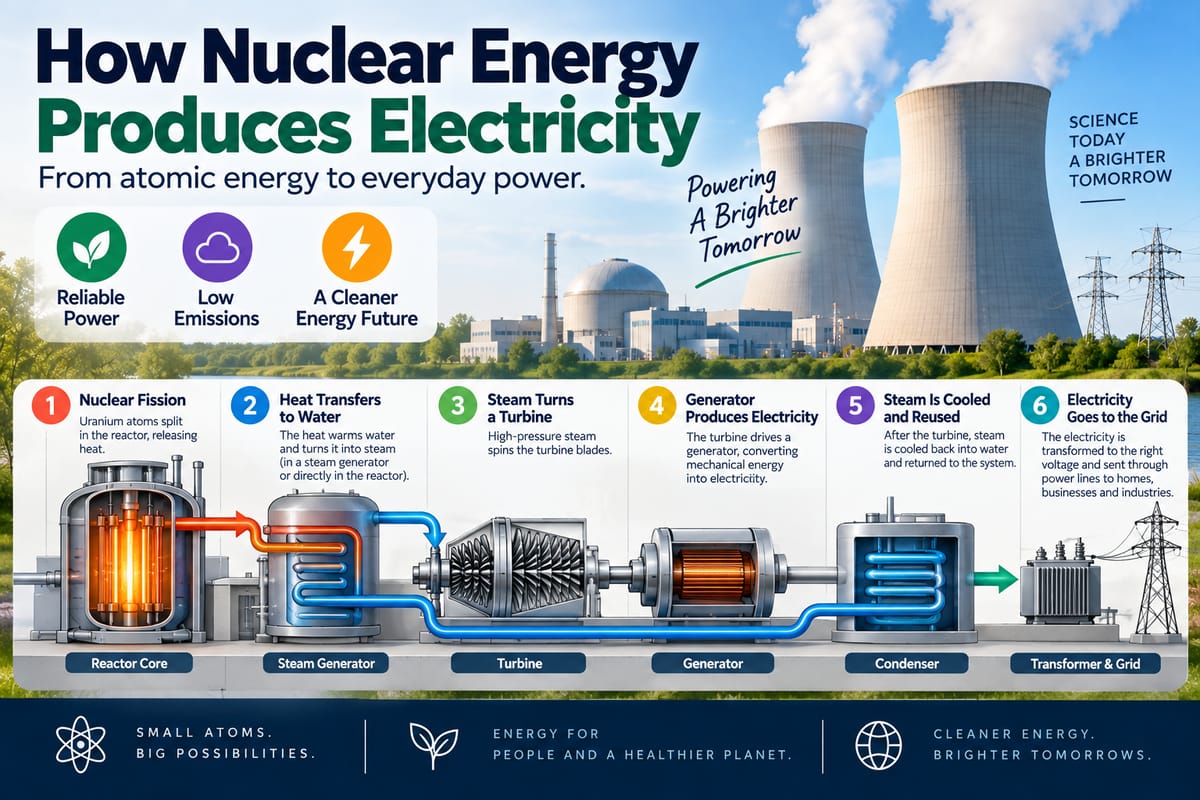
The basic principle is surprisingly straightforward: nuclear reactions produce heat, heat produces steam, steam turns a turbine, and the turbine drives a generator.
What makes nuclear power different is the enormous amount of energy contained within atomic nuclei. A relatively small quantity of nuclear fuel can release a substantial amount of energy compared with many conventional fuels.
What Is Nuclear Energy?
Nuclear energy is energy stored in the nucleus, or central core, of an atom.
Atoms contain a nucleus made primarily of protons and neutrons. Under certain conditions, the nucleus of an atom can change, releasing energy in the process.
Commercial nuclear power plants primarily use a process called nuclear fission.
During fission, the nucleus of a suitable heavy atom, such as uranium-235, splits into smaller nuclei. The process releases energy and additional neutrons, which can cause other nuclei to split.
When this process is controlled inside a nuclear reactor, the resulting heat can be used to generate electricity.
How Nuclear Fission Produces Heat
The first major stage of nuclear electricity generation takes place inside the reactor.
Nuclear fuel contains atoms capable of undergoing fission. When a neutron interacts with a suitable nucleus, the nucleus can split into smaller fragments.
This reaction releases:
- Heat
- Additional neutrons
- Radiation
- Energy associated with the products of fission
The newly released neutrons can cause additional fission reactions.
When conditions are carefully controlled, this creates a controlled chain reaction.
The heat generated by these reactions is transferred to a coolant circulating through or around the reactor core.
What Is a Nuclear Reactor?
A nuclear reactor is the part of a nuclear power plant where the controlled fission process takes place.
The reactor contains several important components that work together to maintain the reaction and transfer heat.
Depending on the reactor design, these can include:
- Nuclear fuel
- Fuel assemblies
- Control rods
- Coolant
- Reactor vessel
- Moderator
- Pumps
- Steam-generating equipment
The exact arrangement differs between reactor types, but the fundamental purpose remains similar: control the nuclear reaction and safely transfer its heat.
The Role of Nuclear Fuel
Uranium is the most widely used fuel for commercial nuclear power reactors.
Natural uranium contains several isotopes, including uranium-235 and uranium-238. Uranium-235 is particularly useful for sustaining a fission chain reaction.
Nuclear fuel is manufactured into carefully designed fuel assemblies that are placed inside the reactor.
The fuel remains inside the reactor during operation while fission gradually changes the composition of the material.
Eventually, the fuel becomes less useful for sustaining the desired reaction and must be removed and managed as spent nuclear fuel.
How the Chain Reaction Is Controlled
A nuclear chain reaction needs to be carefully regulated.
If too few neutrons continue producing fission, the reaction decreases. If too many reactions occur too quickly, the reactor can produce excessive heat.
Control systems are therefore designed to regulate the number of neutrons participating in the chain reaction.
Control rods are one important mechanism.
These rods contain materials capable of absorbing neutrons. Inserting them farther into the reactor core can reduce the number of neutrons available to cause further fission. Withdrawing them can allow the reaction rate to increase, within controlled operating limits.
This provides operators and automated systems with a way to regulate reactor power.
Why Water Is Often Used
Many nuclear reactors use water as part of their heat-transfer system.
Water can serve different functions depending on the reactor design. It can act as a coolant that carries heat away from the reactor core and, in some reactor types, as a moderator that helps slow neutrons.
Other reactor concepts use different coolants or moderators.
The choice of materials affects how the reactor operates, how heat is transferred, and how the overall power-generation system is designed.
From Nuclear Heat to Steam
The nuclear reaction itself does not directly generate electricity.
Instead, the heat produced by fission is used to create steam or transfer thermal energy to a system that produces steam.
This is a critical part of understanding nuclear electricity generation.
In a simplified sequence:
Fission → Heat → Steam → Turbine → Generator → Electricity
Different reactor designs accomplish the steam-generation stage in different ways.
How a Pressurized Water Reactor Works
Pressurized water reactors are one of the major reactor designs used around the world.
In a pressurized water reactor, water circulates through the reactor core under high pressure. The pressure keeps the water from boiling even though it becomes extremely hot.
The heated primary water then transfers its thermal energy to a separate water system through a steam generator.
The second water system turns into steam.
The steam travels toward the turbine, where it expands and transfers energy to the turbine blades.
This separation between the primary reactor coolant and the secondary steam system is an important feature of the design.
How a Boiling Water Reactor Works
A boiling water reactor uses a different arrangement.
In this type of reactor, water circulating through the reactor core is allowed to boil. The resulting steam is directed toward the turbine.
The turbine then converts the energy carried by the moving steam into rotational motion.
Although the arrangement differs from a pressurized water reactor, the overall purpose remains the same: convert nuclear heat into mechanical energy and then electricity.
How the Turbine Produces Mechanical Energy
Once steam reaches the turbine, it flows across a series of blades.
The moving steam pushes against the blades, causing the turbine shaft to rotate.
This is mechanical energy.
The process is similar in principle to many other electricity-generating systems. The major difference is how the heat needed to produce steam is created.
In a nuclear power plant, the heat comes from controlled nuclear fission rather than burning coal, natural gas, or another conventional fuel.
How the Generator Produces Electricity
The turbine is connected to an electrical generator.
As the turbine rotates, it turns components inside the generator. The generator uses electromagnetic induction to convert mechanical energy into electrical energy.
In simplified terms, movement between magnetic fields and conductive materials causes electric current to be produced.
The resulting electricity can then be transformed to appropriate voltages and delivered through the electrical grid.
This means the final electricity-generation stage of a nuclear power plant is based on electromagnetic principles rather than nuclear reactions directly producing electric current.
What Happens to the Steam?
After passing through the turbine, the steam needs to be converted back into water.
A condenser removes heat from the steam, causing it to return to liquid water.
The water can then be pumped back through the system and reused.
This creates a largely continuous cycle:
- Water is heated.
- Steam is produced.
- Steam turns the turbine.
- The turbine drives the generator.
- Steam is cooled.
- Water is returned to the system.
The process allows the plant to repeatedly use the same water within its steam cycle.
Where Does the Cooling Come From?
The condenser needs a way to remove heat from the steam.
Nuclear power plants may use different cooling arrangements depending on their design and location.
Cooling can involve:
- Rivers
- Lakes
- Oceans
- Cooling towers
- Recirculating systems
- Other engineered cooling arrangements
Cooling towers are particularly recognizable because they produce large white clouds that can resemble smoke.
In many cases, those visible clouds are primarily water vapor rather than combustion smoke.
Why Nuclear Plants Do Not Need Combustion
A major difference between nuclear power and fossil-fuel electricity generation is the source of heat.
Coal and natural gas plants burn fuel. The chemical energy stored in those fuels is released through combustion.
Nuclear reactors do not burn uranium.
Instead, energy is released when atomic nuclei undergo fission.
This difference affects the plant’s emissions profile and the types of waste it produces.
The broader distinction between energy sources is explored in Renewable vs Nonrenewable Resources Explained.
Nuclear Energy and Natural Resources
Uranium is a natural resource, which means nuclear electricity depends on materials extracted from the Earth.
Mining, processing, fuel manufacturing, transportation, reactor operation, and eventual waste management all form part of the wider nuclear fuel cycle.
Natural resources provide many of the materials required for modern societies, from metals and minerals to fuels and construction materials. How Natural Resources Support Human Civilization explores this broader relationship between natural resources and human development.
Nuclear Power Compared With Other Heat-Based Electricity
Nuclear power is not the only electricity-generation technology that uses heat to produce steam.
Coal and some natural gas plants also use heat to generate steam and turn turbines.
Other technologies can use heat in different ways as well.
The key difference is the original source of that heat.
For example:
- Coal plants use combustion.
- Natural gas plants commonly use combustion.
- Nuclear plants use fission.
- Some geothermal plants use heat from Earth’s interior.
- Some concentrated solar systems use sunlight to create high temperatures.
- Some waste-to-energy facilities use combustion of suitable waste materials.
The electricity-generation machinery can therefore look similar even when the energy source is completely different.
Nuclear Power and Waste-to-Energy
Waste-to-energy systems demonstrate another way heat can be used to generate electricity.
In many such systems, suitable waste is processed and heated to produce energy that can be used for steam generation and electricity production.
The article How Waste-to-Energy Systems Generate Electricity provides more context on this type of energy conversion.
The comparison highlights an important point: electricity generation often involves several energy conversions rather than a single step.
What Happens Inside the Reactor During Operation?
Inside an operating reactor, countless nuclear reactions take place within the fuel.
The reactor’s control systems regulate the reaction while coolant carries heat away from the core.
Sensors and monitoring systems track operating conditions such as:
- Temperature
- Pressure
- Coolant flow
- Reactor power
- Water levels
- Radiation levels
- Equipment performance
Operators and automated safety systems use this information to maintain the reactor within its designed operating conditions.
Why Reactor Safety Is Important
A nuclear reactor contains a large amount of energy and radioactive material, so safety is a fundamental part of nuclear plant design.
Nuclear facilities use multiple layers of safety systems and physical barriers.
These can include:
- Fuel cladding
- Reactor vessels
- Containment structures
- Cooling systems
- Emergency systems
- Monitoring equipment
- Backup power systems
- Automated shutdown mechanisms
The objective is to control the reactor under normal conditions and provide additional layers of protection if equipment or operating conditions deviate from expectations.
What Happens During a Reactor Shutdown?
A reactor can be shut down by reducing or stopping the chain reaction.
However, shutting down the fission chain reaction does not immediately eliminate all heat production.
Radioactive fission products continue to undergo radioactive decay, producing decay heat.
This means cooling remains important even after the reactor has stopped producing power through a sustained chain reaction.
The need to manage this residual heat is an important part of nuclear safety and reactor engineering.
What Is Spent Nuclear Fuel?
Nuclear fuel becomes less suitable for continued operation after spending time inside a reactor.
The resulting material is called spent nuclear fuel.
It contains radioactive materials and must be carefully handled, stored, and managed.
Spent fuel can initially be placed in specially designed pools that provide cooling and shielding. It may later be transferred to dry storage systems designed to safely contain the material.
Different countries use different strategies for managing spent fuel and radioactive waste.
Does Nuclear Energy Produce Greenhouse Gas Emissions?
Nuclear reactors do not burn fossil fuels during electricity generation, so they do not produce carbon dioxide through combustion in the same way coal-fired power plants do.
However, nuclear power is not completely disconnected from activities that can produce greenhouse gas emissions.
The broader nuclear fuel cycle can involve mining, processing, construction, transportation, and other industrial activities.
This means assessments of nuclear energy’s environmental impact generally consider the entire life cycle rather than only the operation of the reactor.
Nuclear Energy and the Environment
Like every major energy technology, nuclear power has environmental considerations.
These include:
- Uranium mining
- Land use
- Water consumption and cooling
- Thermal effects on water bodies
- Radioactive waste
- Decommissioning
- Construction materials
- Long-term waste management
At the same time, nuclear power can provide large amounts of electricity from relatively small quantities of fuel and can generate electricity without direct combustion emissions at the reactor.
Evaluating an energy technology therefore involves considering both its benefits and its environmental challenges.
How Nuclear Energy Fits Into Earth’s Energy Story
Humanity’s energy systems ultimately depend on materials and physical processes that are part of the natural world.
The uranium used as nuclear fuel was formed through natural processes long before modern civilization existed.
Understanding the origins and evolution of Earth’s materials provides useful context for understanding the resources humans extract and use. How Earth Formed and How Its Planetary Systems Work explores the larger planetary processes that shaped the environment in which these resources exist.
Why Nuclear Power Plants Can Generate Electricity Continuously
One feature of nuclear power is its ability to provide sustained electricity generation.
A reactor can operate for extended periods before needing to be refueled, although individual plants require maintenance and periodic shutdowns.
This differs from energy sources whose immediate availability depends strongly on changing weather conditions.
The ability to provide steady generation can make nuclear power part of a broader electricity system alongside other generation technologies.
The Complete Nuclear Electricity Process
The entire process can be summarized in a series of energy conversions:
1. Fission Releases Nuclear Energy
A neutron causes a suitable atomic nucleus to split.
2. Fission Produces Heat
The energy released during the reaction appears largely as kinetic energy of fission products, which becomes thermal energy.
3. Heat Produces Steam
The reactor’s heat-transfer system carries thermal energy to water, producing steam either directly or through a separate steam-generating system.
4. Steam Turns a Turbine
High-energy steam flows through turbine blades, causing the turbine shaft to rotate.
5. The Turbine Drives a Generator
The rotating turbine turns the generator.
6. Electromagnetic Induction Produces Electricity
The generator converts mechanical energy into electrical energy.
7. Electricity Enters the Grid
Transformers adjust the electrical voltage, allowing electricity to move through the transmission and distribution network.
8. Steam Is Condensed and Reused
After leaving the turbine, steam is cooled back into water and returned to the cycle.
The Big Picture
Nuclear electricity generation is essentially a carefully controlled chain of energy conversions.
The process begins with energy stored in atomic nuclei and ends with electrical energy delivered to homes, businesses, industries, and other users.
The nuclear reaction provides the heat, but the rest of the process resembles other forms of thermal electricity generation: heat moves through a system, steam drives a turbine, and a generator converts mechanical motion into electricity.
Understanding that sequence makes nuclear power easier to visualize. A nuclear plant is not simply a machine that “turns atoms into electricity.” It is a complex energy system that uses controlled fission to produce heat and then relies on familiar principles of thermodynamics, fluid movement, mechanical rotation, and electromagnetic induction to generate usable electrical power.




2 Comments
Micle harison
June 7, 2019Lorem ipsum dolor sit amet, usu ut perfecto postulant deterruisset, libris causae volutpat at est, ius id modus laoreet urbanitas. Mel ei delenit dolores.
John Doe
June 7, 2019Some consultants are employed indirectly by the client via a consultancy staffing company.