
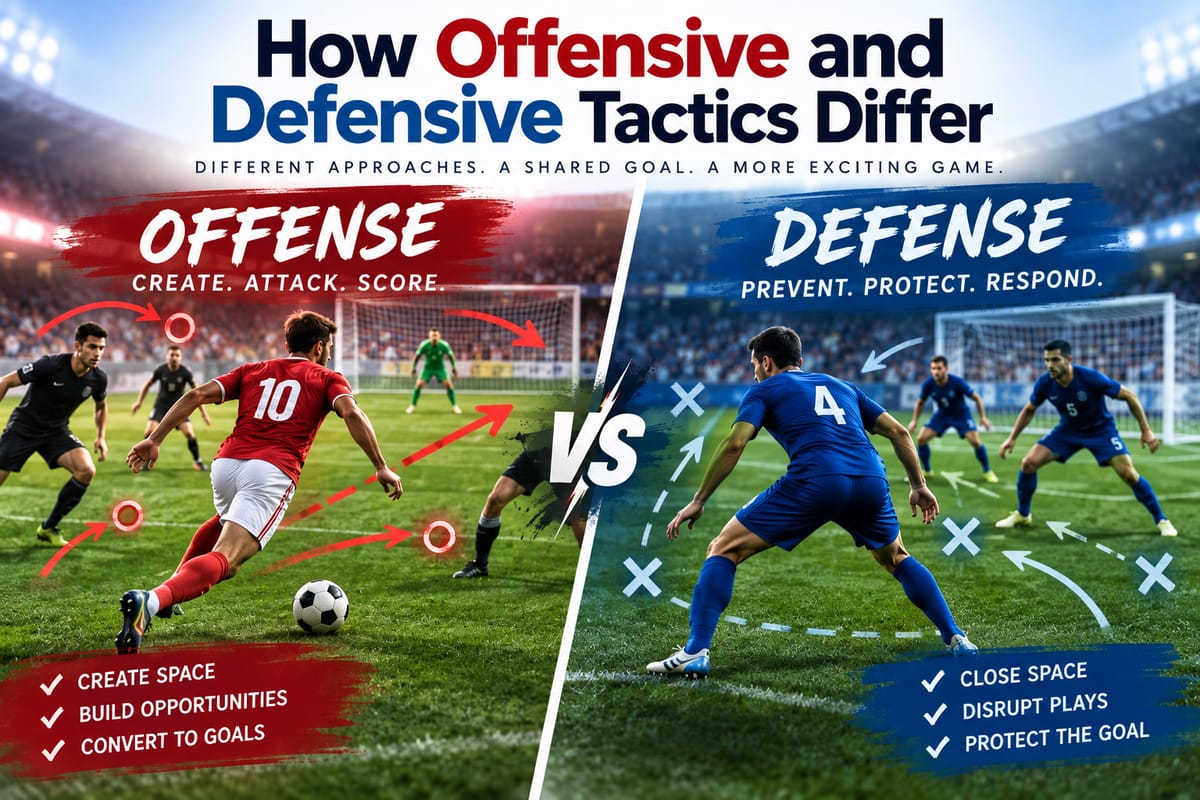
How Offensive and Defensive Tactics Differ
Sports are often described as contests between teams or athletes trying to score more points, goals, runs, or victories than their opponents. Behind those outcomes, however, are tactical decisions that determine how a team attacks, protects its position, manages space, and responds to changing situations.
Offensive and defensive tactics are two sides of the same competitive equation. Offensive tactics are designed to create opportunities and turn possession or positioning into scoring chances. Defensive tactics focus on limiting those opportunities, disrupting an opponent’s plans, and protecting the team’s own position.
Although the exact tactics vary between sports, the underlying principles are surprisingly similar.
What Are Offensive Tactics?
Offensive tactics are strategies used to create scoring opportunities and put pressure on an opponent.
Depending on the sport, this can involve controlling possession, creating space, moving players into advantageous positions, attacking weaknesses, or increasing the speed of play.
In soccer, for example, an attacking team may use quick passing and movement to break through a defensive structure. In basketball, offensive tactics can include screens, cuts, spacing, and ball movement designed to create an open shot.
In football, an offense may use running plays, passing formations, motion, and play-action concepts to exploit defensive weaknesses.
The central objective is generally the same: create an advantage and convert that advantage into a positive result.
What Are Defensive Tactics?
Defensive tactics are strategies designed to prevent opponents from creating or converting scoring opportunities.
A defense may attempt to control space, deny passing lanes, pressure the player with the ball, protect important areas, or force an opponent into a lower-quality decision.
Defensive tactics can be proactive rather than purely reactive. A team may deliberately pressure an opponent high up the field, trap a ball handler near the sideline, or position defenders to encourage a particular type of play.
Good defense is therefore not simply about stopping an attack. It is about influencing what the opponent is able to do.
The Main Difference Between Offense and Defense
The simplest distinction is that offense generally seeks to create opportunities, while defense seeks to remove or reduce opportunities.
| Offensive Tactics | Defensive Tactics |
|---|---|
| Create scoring opportunities | Prevent scoring opportunities |
| Exploit available space | Close or control space |
| Move defenders or opponents | Maintain defensive structure |
| Increase attacking pressure | Reduce attacking pressure |
| Seek favorable matchups | Prevent unfavorable matchups |
| Accept calculated risks | Manage and reduce risks |
| Convert advantages into scores | Turn defensive actions into transitions |
The distinction is not absolute, though. Modern sports increasingly blur the line between offense and defense.
A successful defensive action can immediately create an offensive opportunity. Likewise, an attacking team may use possession as a defensive tool because keeping the ball away from an opponent limits that opponent’s chances to attack.
How Offensive Tactics Create Space
Space is one of the most important resources in team sports.
Offensive players often try to stretch defensive structures horizontally or vertically. When defenders are forced to cover a larger area, gaps can appear between them.
Teams can create space through:
- Player movement
- Passing
- Screens and blocks
- Runs behind defensive lines
- Changes in tempo
- Position rotations
- Switching sides of the field or court
- Drawing defenders toward one area before attacking another
These approaches are part of the broader principles discussed in How Tactics Create Advantages in Different Sports.
The objective is not necessarily to create a large amount of open space. Sometimes a small positional advantage is enough to create a scoring opportunity.
How Defensive Tactics Deny Space
Defensive teams attempt to make useful space difficult to access.
One approach is to maintain a compact defensive shape. Players stay relatively close together, reducing the gaps an opponent can attack.
Another approach is pressure. Instead of allowing an attacker time to make decisions, defenders attempt to force rushed passes, poor shots, turnovers, or mistakes.
Defensive teams may also prioritize certain areas. For example, a basketball defense may protect the area near the basket while accepting more outside shots, while a soccer defense may protect the central areas of the pitch and force attacks toward the wings.
This demonstrates an important tactical principle: defending does not always mean preventing every possible action. It often means controlling which actions the opponent is allowed to take.
Tempo Is Important on Both Sides
The speed of a game can dramatically influence tactical decisions.
An offensive team may deliberately increase the tempo to catch a defense before it becomes organized. Fast transitions can produce opportunities before defenders return to their positions.
Other teams may prefer slower possession. By moving the ball patiently, they can search for weaknesses and avoid giving the opponent unnecessary transition opportunities.
Defensively, teams also manipulate tempo.
A defense can slow the game by maintaining possession after recovering the ball, reducing unnecessary fouls, or establishing its preferred structure before an opponent can attack.
The best tactical approach therefore depends partly on whether a team benefits from increasing or reducing the pace.
Offensive Tactics Often Involve More Visible Risk
Attacking usually requires some degree of risk.
A player attempting an aggressive pass may create a scoring opportunity if it succeeds but also give the opponent possession if it fails. A team committing additional players forward may increase its chances of scoring while leaving fewer players behind the ball.
This relationship between opportunity and danger is central to How Risk and Reward Affect Sports Strategy.
Defensive tactics also involve risk, but the risks are often structured differently.
A team that sends defenders forward to pressure an opponent may leave space behind them. A defender who attempts an aggressive tackle may win possession but could also miss and allow the attacker to advance.
Consequently, neither offense nor defense is completely safe. Both require decisions about how much risk is acceptable in a particular situation.
Defensive Tactics Can Become Offensive Opportunities
One of the most important features of modern sports is the transition between defensive and offensive phases.
A successful interception in soccer can become a counterattack. A basketball steal can immediately produce a fast break. A turnover in football can give the opposing offense an unexpected field-position advantage.
This means defensive players often need to think about what happens immediately after possession changes.
The best defensive action may not simply be the one that stops an attack. It may be the one that creates the best opportunity for the next phase of play.
How Teams Choose Their Tactical Approach
Coaches and athletes rarely select offensive or defensive tactics randomly.
Several factors can influence the decision.
Strengths and Weaknesses
A team may design its offense around its strongest players or attack areas where it has a clear advantage.
Defensively, it may attempt to neutralize an opponent’s most dangerous player or force weaker players to take greater responsibility.
Score and Game Situation
The score can change the tactical balance.
A team that is behind late in a game may need to accept more offensive risk. A team protecting a narrow lead may prioritize defensive organization and possession management.
The same team can therefore use very different tactics at different stages of the same competition.
Time Remaining
Time affects how much risk is reasonable.
Early in a match, a team may have enough time to patiently build opportunities. Near the end, the tactical priority can shift dramatically depending on the score and game context.
Opponent Characteristics
Teams also need to account for how their opponents play.
How Opponent Analysis Affects Sports Strategy explains why understanding an opponent’s tendencies can influence tactical preparation.
A team that struggles against high pressure may face an aggressive defensive approach. An opponent that is particularly dangerous on counterattacks may encourage a team to attack with greater caution.
The Role of Performance Analysis
Modern sports tactics increasingly rely on detailed performance data.
Coaches can examine information such as possession patterns, shot locations, passing networks, defensive actions, turnovers, movement, spacing, and transition efficiency.
Complete Guide to Sports Performance Analysis explores how this type of analysis can help teams understand what is happening during competition.
Performance analysis can reveal patterns that are difficult to identify through observation alone.
For example, a team may discover that its offense creates many opportunities from one side of the field but struggles to finish them. A defensive analysis might reveal that opponents repeatedly exploit the same area after possession changes.
These insights can lead to tactical adjustments.
Offense and Defense Are Constantly Interconnected
Although coaches and analysts often separate offense and defense for convenience, actual competition is much more fluid.
An offensive decision affects defensive positioning. A defensive decision affects the next attacking opportunity.
Consider a basketball team deciding whether to send additional players toward the offensive rebound. More players near the basket may increase the chance of recovering the ball, but fewer players will be available to defend a fast break.
The decision is simultaneously offensive and defensive.
Similar trade-offs occur across sports. A soccer team pushing fullbacks forward gains attacking numbers but may expose space behind them. A football team using an aggressive passing strategy can move the ball quickly but may become vulnerable to turnovers.
Why Tactical Flexibility Matters
A tactical plan that works perfectly in one situation may fail in another.
Opponents adjust. Players become tired. The score changes. Weather or playing conditions can change. Injuries can alter available personnel. A team’s initial strategy may simply fail to produce the expected result.
Successful teams therefore need tactical flexibility.
This can mean changing formations, modifying pressing intensity, slowing the pace, increasing attacking numbers, changing defensive assignments, or targeting a different area of the playing surface.
Flexibility does not necessarily mean abandoning the original game plan. It means recognizing when circumstances require an adjustment.
Communication Makes Tactics Work
Even the most sophisticated tactical system depends on execution.
Players need to understand their responsibilities and communicate when circumstances change.
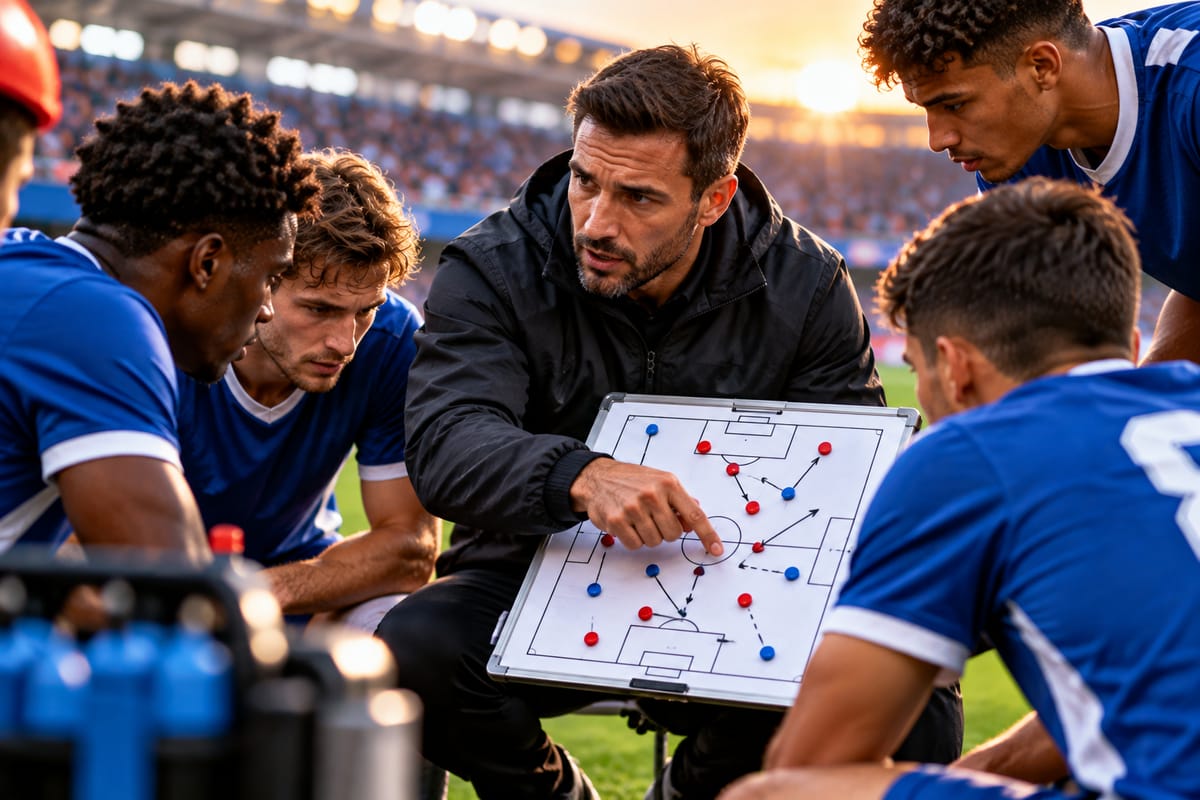
Defensive communication can help players maintain positioning, track opponents, and respond to movement. Offensive communication can coordinate runs, passing options, screens, and changes in positioning.
At higher levels of competition, players often need to recognize tactical situations themselves rather than waiting for instructions from the sideline.
That requires preparation, experience, and a shared understanding of the team’s tactical principles.
Individual Skill Still Matters
Tactics provide structure, but individual ability can change how effectively that structure works.
An offensive system may create an opening, but a player still needs the technical ability to exploit it. A defensive system may force an opponent into a difficult position, but a defender must still execute the necessary action.
This is why tactical analysis should not be separated completely from individual performance.
Teams need both an effective tactical framework and players capable of carrying it out under competitive pressure.
The Balance Between Attack and Defense
The difference between offensive and defensive tactics ultimately comes down to how teams manage advantages, space, pressure, and risk.
Offensive tactics generally attempt to create favorable situations. Defensive tactics attempt to prevent opponents from creating those same situations.
But the strongest tactical systems connect the two.
A defense that wins possession can launch an attack. An offense that loses the ball must immediately become organized defensively. A team that controls possession can use that control to limit the opponent’s opportunities.
The result is a continuous tactical cycle rather than two completely separate phases.
Why Tactical Decisions Matter Throughout a Game
Every possession, movement, defensive adjustment, and change in tempo can influence what happens next. The difference between a successful and unsuccessful tactic may be only a small positional advantage, a well-timed decision, or a player’s ability to recognize an opportunity.
That is why modern sports increasingly treat tactics as an ongoing process of observation, adjustment, and execution. Teams are not simply choosing between attacking and defending. They are constantly deciding when to create risk, when to control it, and how to turn one phase of play into an advantage in the next.



2 Comments
Micle harison
June 7, 2019Lorem ipsum dolor sit amet, usu ut perfecto postulant deterruisset, libris causae volutpat at est, ius id modus laoreet urbanitas. Mel ei delenit dolores.
John Doe
June 7, 2019Some consultants are employed indirectly by the client via a consultancy staffing company.