
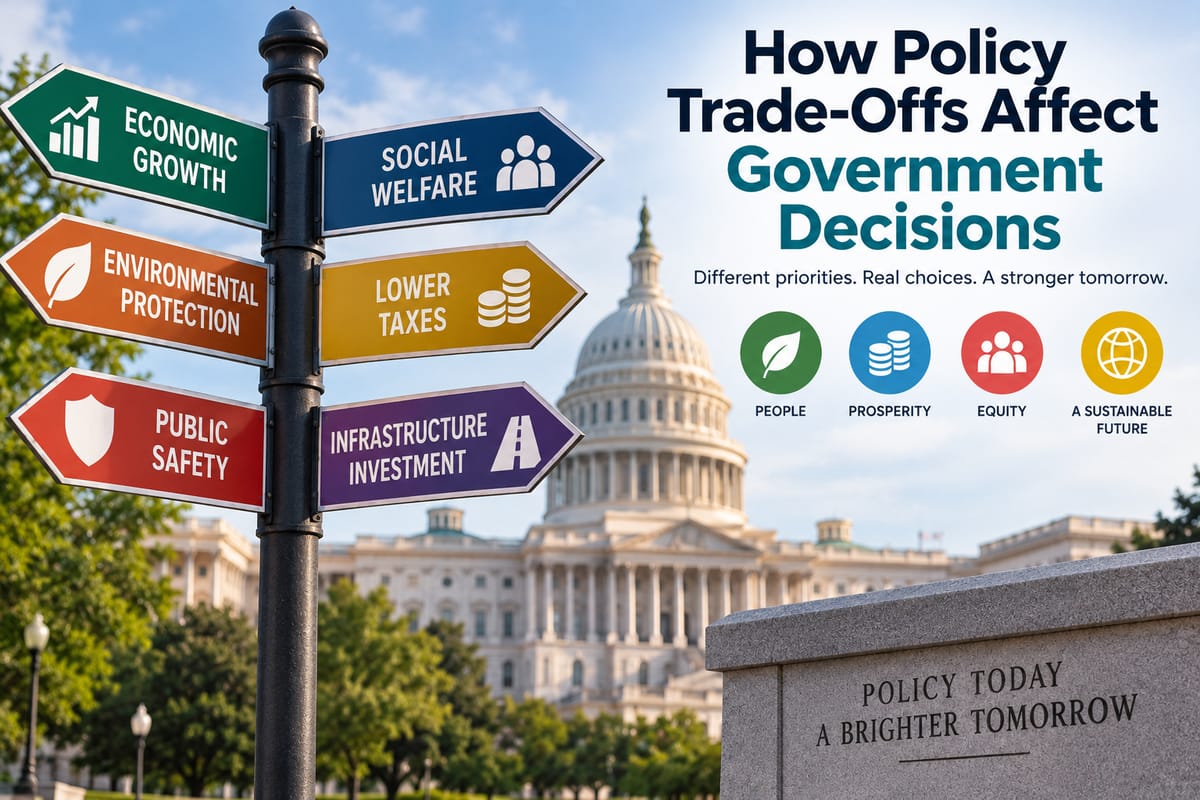
**How Policy Trade-Offs Affect Government Decisions
Governments rarely have enough money, time, authority, or administrative capacity to accomplish every public objective at once. As a result, policymaking often involves choices between competing priorities.
A government may want to expand healthcare services while improving infrastructure, reduce taxes while maintaining public programs, protect the environment while supporting economic activity, or respond to immediate problems while investing in long-term development.
These competing objectives create policy trade-offs.
A policy trade-off occurs when advancing one objective requires accepting a cost, limitation, or reduced emphasis somewhere else. The trade-off may involve money, time, political attention, administrative resources, economic effects, environmental consequences, or the interests of different groups.
Understanding these trade-offs helps explain why government decisions can be complicated even when policymakers agree on the general problem they want to address.
What Is a Policy Trade-Off?
A policy trade-off occurs when pursuing one policy goal affects the ability to pursue another.
For example, a government has a limited budget. If it allocates additional funds to building roads, fewer resources may be immediately available for other programs unless revenue increases or borrowing expands.
The decision is not necessarily about choosing between something good and something bad. It can involve choosing between several objectives that are all considered important.
The OECD describes policymaking as involving competing social values and interests and emphasizes the importance of identifying trade-offs and potential synergies between policy objectives.
This is one reason policymaking is different from a purely technical exercise.
Why Governments Face Trade-Offs
Government resources are limited.
Budgets have limits. Public agencies have finite numbers of employees. Legislatures have limited time to consider proposals. Infrastructure takes years to build, and administrative systems cannot implement unlimited programs simultaneously.
Governments also face competing demands from different parts of society.
A decision that benefits one group may impose costs on another. A policy that produces benefits in the long term may require short-term sacrifices. A national objective may sometimes conflict with a regional or local priority.
The World Bank notes that planning and budgeting processes help governments make decisions about policy trade-offs within fiscal constraints and connect policy objectives with available resources.
Budget Trade-Offs
Public budgets are one of the clearest places where trade-offs become visible.
Suppose a government has a fixed amount available for discretionary spending. Increasing expenditure in one area may require:
- Reducing spending elsewhere
- Increasing taxes or other revenue
- Borrowing additional money
- Delaying another program
- Finding efficiency savings
- Using reserves where available
Each approach has different consequences.
This means that announcing a new program is only one part of policymaking. Governments must also determine how the program will be funded and whether the necessary resources can be sustained.
Short-Term Needs Versus Long-Term Goals
Governments frequently have to balance immediate problems against longer-term objectives.
A sudden economic downturn, natural disaster, public health emergency, or security crisis may require immediate spending.
At the same time, governments may have long-term goals involving education, infrastructure, climate resilience, research, economic development, or institutional reform.
Resources directed toward an emergency response may reduce the amount available for some long-term investments in the short term.
Conversely, delaying immediate support in favor of long-term projects can leave pressing problems unresolved.
The challenge is often finding an appropriate balance rather than treating short-term and long-term priorities as completely separate.
Economic Policy Involves Multiple Objectives
Economic policymaking provides many examples of competing goals.
A government may seek to encourage economic growth while controlling inflation, maintain fiscal sustainability while supporting households, or increase investment while protecting public finances.
Taxes and government spending can affect economic activity, household incomes, business incentives, and government revenue.
The relationship between political choices and economic policy is explored further in How Politics Influences Economic Policy.
Because economic policies can produce different effects across households, businesses, industries, and regions, policymakers must consider more than a single economic indicator.
Environmental Protection and Economic Activity
Environmental policy can also involve trade-offs.
For example, stricter environmental standards may impose adjustment costs on some businesses or industries while producing environmental benefits.
Likewise, investments in cleaner infrastructure may require significant spending before their benefits become fully visible.
At the same time, failing to address environmental risks can create future economic costs.
Policy analysis therefore needs to consider both immediate effects and longer-term consequences.
The OECD emphasizes policy coherence as a way of identifying interactions between economic, social, and environmental objectives and managing trade-offs and spillovers.
Social Policy and Resource Allocation
Social programs can create another set of choices.
Governments may want to improve access to healthcare, education, housing, income support, childcare, or other public services.
But each program requires resources.
Policymakers may have to determine:
- Who qualifies for assistance
- How much support is provided
- How long support lasts
- How programs are funded
- Which groups receive priority
- How programs are administered
- Whether benefits should be universal or targeted
These are policy choices involving both practical constraints and competing public priorities.
Universal Programs Versus Targeted Programs
One common policy trade-off concerns whether a program should be broadly available or targeted toward specific groups.
A universal program may be simpler to administer and available to a wider population.
A targeted program may concentrate limited resources on people or communities identified as having greater needs.
Neither approach automatically eliminates trade-offs.
Universal programs can require more overall funding, while targeted programs can require eligibility systems and administrative processes.
The appropriate design depends on the policy objective, available resources, administrative capacity, and the characteristics of the population being served.
Policy Trade-Offs and Political Representation
Governments make decisions within political institutions that represent different constituencies and interests.
Legislators may represent particular geographic areas, political parties, constituencies, or broader policy positions.
This means that competing priorities can enter the policymaking process through political debate, committee work, negotiations, public consultations, and legislative votes.
Understanding how political representation works in legislatures and governments helps explain why policy decisions can involve negotiation among people with different priorities.
Representation does not eliminate disagreement. Instead, democratic institutions provide processes through which competing views can be expressed and decisions can be made.
National, Regional, and Local Trade-Offs
In countries where political authority is divided among different levels of government, policy trade-offs can occur between national and subnational priorities.
A national government may establish broad objectives while regional or local governments handle certain aspects of implementation.
Different levels of government may have different responsibilities, revenue sources, and political priorities.
The distribution of authority can therefore affect how policy choices are made.
The relationship is examined in How Federal and Decentralized Governments Divide Political Power.
Coordination between levels of government can be especially important when a policy involves shared responsibilities.
Evidence Can Help Identify Trade-Offs
Policy decisions often rely on economic data, scientific research, administrative information, public consultations, and evaluations of existing programs.
Evidence cannot eliminate disagreements about values or priorities, but it can help policymakers understand likely consequences.
For example, evidence may help estimate:
- Program costs
- Expected participation
- Distributional effects
- Environmental impacts
- Implementation challenges
- Possible unintended consequences
- Long-term outcomes
The OECD emphasizes that monitoring and evaluation can help governments understand whether policies are producing desired outcomes and better identify trade-offs and impacts.
This is particularly important when the consequences of a policy are uncertain.
Policy Trade-Offs Are Not Always Permanent
A trade-off that exists under one set of circumstances may change when conditions change.
For example, technological improvements can alter the cost of implementing a policy. New infrastructure can change transportation or energy options. Administrative reforms can reduce the cost of delivering a public program.
Policy design can also sometimes produce synergies, where progress toward one objective supports another.
The OECD distinguishes trade-offs from synergies: a synergy occurs when progress toward one policy objective makes it easier to achieve another.
This is why governments may search for policy combinations rather than relying on a single instrument.
Unintended Consequences Matter
A policy can produce effects that were not part of its original objective.
For example, a regulation designed to address one problem may create additional costs elsewhere. A subsidy intended to support one activity may change market incentives. A tax change can influence behavior in ways policymakers did not fully anticipate.
These effects do not necessarily mean a policy has failed. They demonstrate why policies need monitoring and evaluation.
The OECD notes that policy interactions can create spillovers and unintended effects when policies are designed in isolation.
Trade-Offs Between Different Groups
Policy choices can distribute benefits and costs differently.
A government decision may benefit:
- Consumers but increase costs for producers
- Current taxpayers but create obligations for future taxpayers
- Urban areas but have different effects in rural areas
- One industry while affecting another
- Current generations while creating long-term environmental consequences
These distributional effects are an important part of policy analysis.
They also help explain why political disagreement can persist even when people agree on the underlying facts.
Different groups may reasonably place different weights on the costs and benefits associated with a policy.
Political Negotiation and Compromise
Policy decisions frequently require negotiation.
Legislators, government departments, political parties, local authorities, businesses, civil society organizations, and members of the public may have different priorities.
Negotiation can result in policies that differ from the original proposals.
For example, lawmakers may modify a bill, adjust funding levels, change eligibility requirements, introduce exemptions, or phase implementation over several years.
Such changes can reflect attempts to reconcile competing objectives and build sufficient support for implementation.
Interest Groups and Policy Choices
Organized groups can also participate in policymaking by providing information, presenting arguments, engaging with officials, or advocating for particular outcomes.
The OECD notes that interest groups can provide governments with expertise and information that help policymakers understand options and trade-offs, while also emphasizing the importance of transparency and safeguards against undue influence.
This distinction matters because participation in policymaking and undue influence are not necessarily the same thing.
Transparent consultation can broaden the information available to policymakers, while weak safeguards can create risks that policy decisions become overly responsive to narrow interests.
Why Policy Coherence Matters
Governments often have multiple departments and agencies working on related issues.
A transportation policy can affect environmental objectives. Housing policy can affect infrastructure demand. Energy policy can affect industrial competitiveness and household costs. Education policy can affect workforce development.
If each policy is designed in isolation, one program can sometimes undermine another.
Policy coherence means considering these interactions rather than evaluating each decision separately.
The OECD identifies policy coherence as particularly important for complex challenges involving multiple sectors and levels of government.
How Governments Can Manage Trade-Offs
Governments can use several approaches to make trade-offs more explicit and manageable.
Set Clear Priorities
Policymakers can identify which objectives are most important and why.
Clear priorities help determine how limited resources should be allocated.
Compare Costs and Benefits
Where appropriate, governments can analyze the expected costs and benefits of different policy options.
This does not automatically determine the decision because some outcomes, such as fairness or environmental protection, may not be easily reduced to monetary values.
Examine Distributional Effects
Policymakers can assess who is likely to benefit and who may bear costs.
This can reveal effects that might be hidden by economy-wide averages.
Consider Alternatives
A government does not always have to choose between two extreme options.
Different tax structures, implementation schedules, eligibility rules, regulations, or spending arrangements may produce different combinations of costs and benefits.
Monitor Results
Once a policy is implemented, governments can evaluate its actual effects and adjust it when evidence shows that changes are needed.
Trade-Offs Can Change During Implementation
A policy can look different on paper than it does in practice.
Implementation may reveal unexpected administrative costs, changes in public behavior, or outcomes that were not anticipated during policy design.
This is why policy implementation and evaluation are as important as initial policymaking.
Monitoring can identify whether resources are being used effectively and whether the policy is achieving its intended objectives.
Public Policy Is More Than Choosing a Single Option
Government decisions are rarely about selecting an option with no disadvantages.
Instead, policymakers often compare different combinations of benefits, costs, risks, administrative requirements, and distributional effects.
The Complete Guide to Public Policy and Policymaking provides a broader framework for understanding how public problems move through the policymaking process.
Trade-offs are therefore built into many stages of government decision-making, from defining a problem to designing a policy, allocating resources, implementing programs, and evaluating results.
Why Trade-Offs Matter to Citizens
Policy trade-offs affect everyday life because government decisions influence the services people receive, the taxes they pay, the regulations they follow, and the economic and environmental conditions in which they live.
Understanding trade-offs can also make public policy debates easier to evaluate.
Instead of asking only whether a government supports or opposes a particular objective, it can be useful to examine what resources the policy requires, who benefits, who bears costs, what alternatives exist, and what evidence is available about its likely effects.
Making Government Choices More Transparent
Policy trade-offs cannot always be eliminated, but they can be made clearer.
When governments explain objectives, costs, alternatives, expected effects, and implementation constraints, the public has more information about how decisions were reached.
Evidence and evaluation can improve the technical understanding of those choices, while democratic institutions provide mechanisms for debate and accountability. The OECD similarly emphasizes evidence-informed decision-making, transparency, participation, and policy coherence as important elements of effective public governance.
Ultimately, government policymaking involves managing competing objectives under real-world constraints. The difficult part is often not identifying what society wants, but determining how limited resources and competing priorities can be reconciled, how the consequences are distributed, and how policies can be adjusted when circumstances change.


2 Comments
Micle harison
June 7, 2019Lorem ipsum dolor sit amet, usu ut perfecto postulant deterruisset, libris causae volutpat at est, ius id modus laoreet urbanitas. Mel ei delenit dolores.
John Doe
June 7, 2019Some consultants are employed indirectly by the client via a consultancy staffing company.