
**How Digital Distribution Works for Entertainment
Digital distribution has transformed the way people discover, access and experience entertainment. Movies, television programs, music, video games, podcasts, books and other forms of media can now reach audiences through internet-connected platforms without relying entirely on physical products or traditional broadcast schedules.
Instead of waiting for a movie to arrive in theaters, purchasing a DVD, or watching a television program at a fixed time, audiences can increasingly access entertainment through websites, apps, streaming platforms and digital marketplaces.
Behind that convenience is a complex distribution system involving content creators, studios, publishers, technology companies, distributors, platforms and consumers. Understanding how digital distribution works helps explain why the entertainment industry has changed so dramatically over the past two decades.
What Is Digital Distribution?
Digital distribution is the process of delivering entertainment content to consumers electronically, usually through the internet.
Rather than distributing a physical product such as a disc, printed book or game cartridge, companies deliver a digital file or provide access to content through an online service.
Common examples include:
- Streaming a movie through an entertainment platform
- Downloading a video game from a digital marketplace
- Listening to a song through a music service
- Watching a television series through an app
- Purchasing an electronic book
- Downloading a movie for offline viewing
- Listening to podcasts through a mobile application
- Accessing digital comics and other forms of online media
Digital distribution can involve either ownership or access. A consumer may purchase a digital movie and retain access to it, for example, or pay a recurring subscription that provides access to a large library without purchasing individual titles.
How Digital Entertainment Reaches Audiences
The basic process begins when entertainment content is created and prepared for digital delivery.
A studio might produce a film, a television company might create a series, or a game developer might finish a new title. The content then has to be converted, encoded, stored and delivered in formats that different devices and platforms can support.
A simplified distribution chain looks like this:
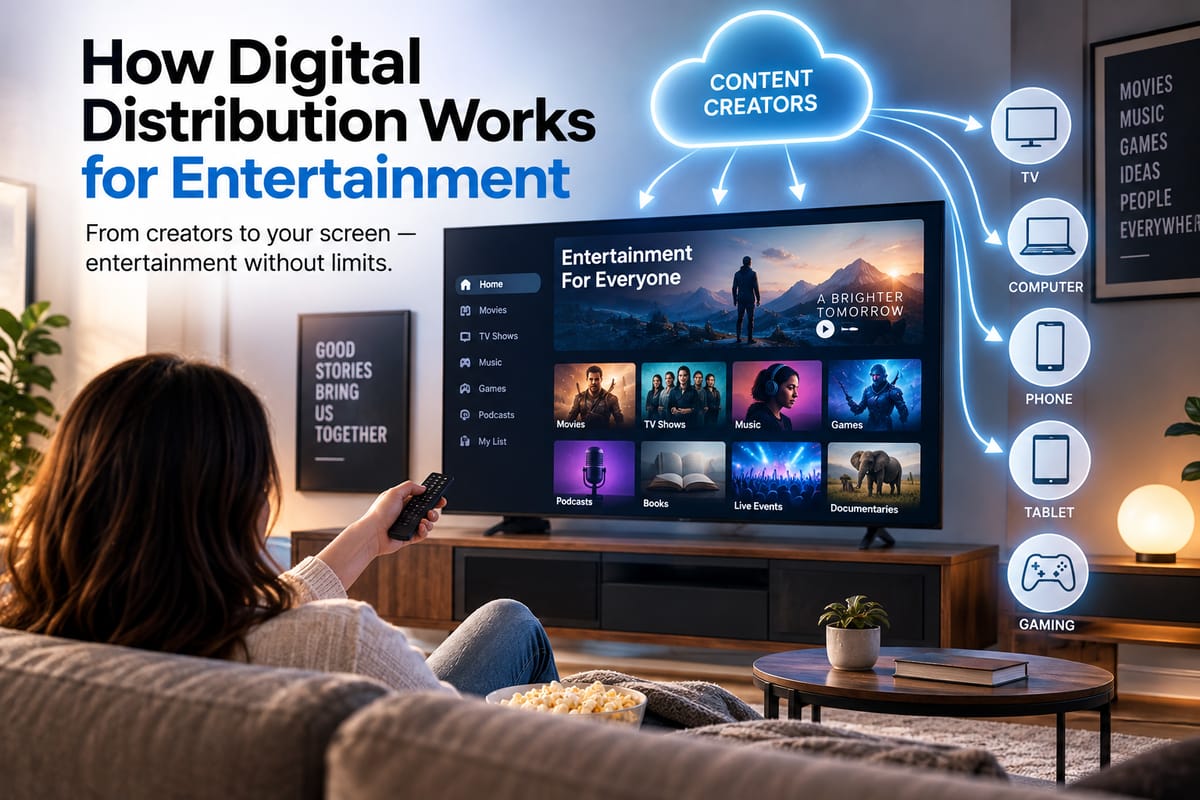
Creator → Rights holder → Digital distributor → Platform → Consumer
In practice, the chain can be considerably more complicated.
A production company may license content to several distributors. A distributor may negotiate with multiple platforms. A platform may then deliver the content to consumers across smartphones, televisions, computers, tablets and gaming devices.
This infrastructure has become a defining part of the Evolution of Modern Entertainment Media, as entertainment has moved from predominantly physical and scheduled formats toward increasingly digital experiences.
The Role of Digital Platforms
Digital platforms act as the connection between entertainment companies and audiences.
Streaming services, digital stores, app marketplaces and other platforms provide the technology needed to make content available to consumers.
A platform may handle several functions, including:
- Content discovery
- User accounts
- Payments
- Content storage
- Streaming
- Downloads
- Recommendations
- Advertising
- Access controls
- Device compatibility
- Usage analytics
For consumers, the platform can make digital entertainment feel almost instantaneous. Selecting a movie, song or game can trigger a complicated series of technical processes that happen largely in the background.
Streaming and Digital Distribution
Streaming is one of the most recognizable forms of digital distribution.
Instead of requiring consumers to download an entire entertainment file before using it, streaming allows content to be delivered continuously over an internet connection.
Video and audio are generally divided into smaller segments that can be transmitted and processed by a user’s device. This allows playback to begin before the entire piece of content has been transferred.
Streaming has dramatically changed how people consume entertainment. The broader transformation is explored in How Streaming Changed Entertainment Consumption.
Streaming also allows platforms to manage large libraries without requiring consumers to store every movie, television program or song locally.
What Happens When Someone Presses Play?
When a viewer selects a movie on a streaming service, several steps can happen within seconds.
First, the platform identifies the requested content and checks whether the user’s account has permission to access it.
The service then determines where the appropriate digital version of the content is stored and selects a suitable delivery route.
The content is sent through internet infrastructure to the user’s device. The device receives small portions of the video, processes them and displays the result on the screen.
At the same time, the platform can adjust the quality of the stream based on factors such as connection speed, device capabilities and network conditions.
If the connection becomes slower, the service may reduce video quality to keep playback going. When the connection improves, it can increase quality again.
Much of this happens automatically, which makes modern digital entertainment feel simple from the consumer’s perspective.
Why Content Is Encoded in Different Formats
Entertainment content can exist in extremely large digital files.
A high-quality movie, for example, can require substantial storage capacity and bandwidth. Delivering the original production file directly to every consumer would be inefficient.
Digital distributors therefore encode content into formats optimized for different devices and network conditions.
A single piece of entertainment may be prepared in multiple resolutions and technical formats.
A video could have versions designed for:
- Smartphones
- Tablets
- Computers
- Smart televisions
- Gaming consoles
- Lower-bandwidth connections
- High-resolution displays
This allows the distribution system to balance quality, file size and performance.
Digital Downloads Work Differently
Not all digital distribution involves streaming.
Digital downloads allow consumers to transfer content onto a device for later use. This approach is common with video games, electronic books, music, software and some movies and television programs.
The basic process involves downloading a digital file from a platform to local storage.
Once downloaded, the content may be available without an internet connection, depending on the platform’s licensing and access requirements.
Downloads can therefore be particularly useful for travelers or consumers who have unreliable internet connections.
The Importance of Digital Rights
Entertainment companies do not necessarily own every right associated with the content they distribute.
A movie might have different rights holders for different countries, distribution channels or periods. A television program could have separate agreements covering broadcast television, streaming, physical media and international distribution.
Digital distribution therefore requires sophisticated rights management.
Platforms need to know:
- Where content can be offered
- When it can be offered
- Which audiences can access it
- How long a license lasts
- Which devices are supported
- Whether advertising is permitted
- Whether downloads are allowed
These agreements can determine why a movie is available on one platform but absent from another.
They can also explain why entertainment libraries change over time.
Digital Distribution and Television
Television provides a useful example of how traditional and digital distribution models now overlap.
Traditional television generally depends on scheduled programming delivered through broadcast, cable or satellite systems. Digital platforms can instead provide programs on demand.
Consumers can select individual episodes, watch entire seasons and often pause or resume content across different devices.
The relationship between these models is examined in the Television and Streaming: Complete Entertainment Guide.
The result is a television environment where scheduled programming and on-demand viewing can exist alongside each other.
Advertising Is Another Distribution Model
Digital entertainment does not always require a direct subscription or purchase.
Advertising-supported platforms can provide content at little or no direct cost to consumers while generating revenue from advertisers.
In this model, the platform distributes entertainment while inserting advertisements into the experience.
Digital technology makes it possible to provide more targeted advertising than many traditional entertainment systems could offer. Platforms can use information about audience behavior and content preferences to help determine which advertisements to display.
This creates another important relationship between content, audiences, technology and revenue.
How Digital Distribution Changed Entertainment Business Models
Digital distribution has changed not only how entertainment reaches audiences but also how entertainment companies make money.
Traditional models often relied on combinations of:
- Ticket sales
- Physical media
- Television advertising
- Cable subscriptions
- Licensing
- Retail sales
Digital distribution has expanded that range to include:
- Streaming subscriptions
- Digital purchases
- In-app purchases
- Advertising-supported streaming
- Digital rentals
- Game subscriptions
- Premium memberships
- Direct-to-consumer sales
A single piece of entertainment can potentially generate revenue through several different digital channels.
Data Has Become Part of Distribution
One major difference between digital and traditional distribution is the amount of information platforms can collect about how audiences interact with content.
Digital services can potentially observe metrics such as:
- What users watch
- How long they watch
- When they stop watching
- What they search for
- Which recommendations they select
- Which content they replay
- Which devices they use
This information can influence decisions about marketing, recommendations and future content.
For entertainment companies, distribution is therefore no longer simply about moving content from a producer to an audience. It can also generate information that influences what gets promoted, produced and distributed next.
Recommendation Systems Help People Find Content
The enormous amount of digital entertainment available today creates another problem: discovery.
When audiences had access to relatively limited television schedules or physical shelves, the number of choices was constrained. Digital platforms can offer thousands or millions of pieces of content.
Recommendation systems help consumers navigate those libraries.
Algorithms can analyze viewing or listening behavior and identify content that may be relevant to a particular user.
Recommendations can influence which movies become popular, which songs receive additional attention and which television programs gain new audiences.
This means digital distribution can affect not only how entertainment reaches consumers but also what consumers are likely to discover.
The Role of Cloud Infrastructure
Large-scale digital distribution depends heavily on cloud computing and data-center infrastructure.
Entertainment platforms need substantial storage capacity to maintain enormous libraries. They also require computing resources to process requests, manage accounts, encode content and support millions of simultaneous users.
Content delivery networks can place copies or portions of digital content closer to audiences geographically. This reduces the distance information needs to travel and can improve playback performance.
The growth of these systems demonstrates How Technology Has Changed the Entertainment Industry, particularly as entertainment becomes increasingly dependent on software, networks and computing infrastructure.
Digital Distribution Is Not Limited to Movies and Television
The same basic principles extend across much of the entertainment industry.
Music
Music can be streamed, purchased digitally or downloaded for offline use. Digital platforms have become central to music discovery and distribution.
Video Games
Games can be purchased through digital marketplaces, downloaded directly to consoles and computers, or accessed through subscription services.
Books
Electronic books can be distributed through online stores and reading applications, eliminating the need for physical printing and shipping.
Podcasts
Podcasts are distributed through digital feeds and platforms, allowing listeners to access episodes whenever they choose.
Live Entertainment
Concerts, sporting events and other performances can also be distributed digitally through livestreaming services.
These examples demonstrate how digital distribution has become a broad infrastructure for entertainment rather than a niche alternative to physical media.
Challenges Facing Digital Distribution
Despite its advantages, digital distribution creates its own challenges.
Internet Dependence
Streaming generally requires a reliable internet connection. Poor connectivity can result in buffering, reduced quality or interruptions.
Licensing Restrictions
Content availability can vary by country because rights agreements differ across markets.
Platform Dependence
Creators and entertainment companies may become heavily dependent on large platforms to reach audiences.
Digital Piracy
The ability to copy and distribute digital files creates persistent challenges around unauthorized distribution.
Subscription Fatigue
Consumers can become frustrated when entertainment libraries are divided among numerous subscription services.
Content Discovery
Having enormous libraries does not necessarily make it easier for audiences to find something they actually want to watch or listen to.
What Digital Distribution Means for Creators
Digital distribution has lowered some barriers between creators and audiences.
Independent filmmakers, musicians, game developers, writers and other creators can use digital platforms to distribute work without always requiring traditional physical distribution networks.
At the same time, greater accessibility creates greater competition.
A creator can potentially reach a global audience, but that audience also has access to an enormous amount of competing content.
Visibility therefore becomes a major challenge.
Success increasingly depends not only on producing entertainment but also on discovery, audience engagement, marketing, platform relationships and the ability to maintain attention.
The Future of Digital Entertainment Distribution
Digital distribution is likely to continue evolving as internet infrastructure, artificial intelligence, cloud computing and consumer devices develop.
Entertainment platforms may become increasingly personalized, with recommendation systems helping audiences navigate larger libraries.
Artificial intelligence could also influence content localization, metadata generation, search, recommendations and other parts of the distribution process.
Meanwhile, improvements in internet connectivity and connected devices could make high-quality digital entertainment available across an even wider range of environments.
The underlying principle, however, is unlikely to change: entertainment needs an efficient way to move from creators and rights holders to audiences.
Digital distribution has turned that process into a technology-driven system capable of operating globally, continuously and at enormous scale. What began as an alternative to physical media has become one of the central foundations of the modern entertainment industry.



2 Comments
Micle harison
June 7, 2019Lorem ipsum dolor sit amet, usu ut perfecto postulant deterruisset, libris causae volutpat at est, ius id modus laoreet urbanitas. Mel ei delenit dolores.
John Doe
June 7, 2019Some consultants are employed indirectly by the client via a consultancy staffing company.