**How Politics and Economics Influence Each Other
Politics and economics are often discussed as separate subjects, but in practice they are deeply connected. Government decisions shape taxes, spending, regulation, trade, investment, and employment, while economic conditions influence public priorities, political debates, and the pressures facing governments.
This relationship is commonly studied through political economy, a field concerned with how political institutions, economic interests, incentives, and public policy interact. The World Bank describes political economy as an analysis of the relationships between political and economic processes, including the role of institutions, incentives, and competing interests.
Understanding this relationship helps explain why economic policies are rarely determined by economic calculations alone.
What Is Political Economy?
Political economy examines the intersection between political decisions and economic outcomes.
Economics generally studies how individuals, businesses, governments, and societies allocate scarce resources. Politics focuses on how collective decisions are made, who has influence, and how public authority is exercised.
Political economy brings these questions together.
For example, a government deciding whether to increase spending on infrastructure is making an economic decision, but the decision also involves political priorities. Leaders may consider employment, regional development, public demands, budget constraints, and the interests of different groups.
The same applies to taxation, trade policy, social programs, energy policy, and business regulation.
A broader understanding of these relationships can be found in The Global Economy Explained, where economic activity can be viewed as part of an interconnected system involving governments, markets, businesses, workers, and consumers.
How Politics Shapes the Economy
Governments influence economic activity through laws, regulations, public spending, taxation, infrastructure investment, and other policy decisions.
Fiscal policy is one of the clearest examples. Governments can influence economic conditions by changing tax levels, public spending, and borrowing. The International Monetary Fund notes that fiscal policy can affect macroeconomic stability, economic growth, and income distribution.
A government might invest in roads, schools, energy systems, or digital infrastructure. Such spending can create demand in the short term while potentially improving productivity over a longer period.
Governments can also establish rules that affect how businesses operate.
These rules can influence:
- Hiring and employment
- Competition
- Investment
- Consumer protection
- Environmental standards
- Financial markets
- International trade
- Property rights
- Business formation
The resulting economic effects can vary depending on how policies are designed and implemented.
Tax Policy Shows the Connection Clearly
Taxation sits directly at the intersection of politics and economics.
Governments need revenue to finance public services and other expenditures, but decisions about who pays taxes, how much they pay, and which activities receive tax treatment involve competing priorities.
Changes in income taxes, corporate taxes, consumption taxes, property taxes, or tax incentives can affect household finances and business decisions.
At the same time, taxation can influence political debates because different groups may experience tax changes differently.
This is why how tax policy reflects political choices is an important part of understanding the broader relationship between politics and economics.
Tax policy is not simply about collecting revenue. It can also affect incentives, consumption, investment, redistribution, and the distribution of economic resources.
Economic Conditions Influence Political Decisions
The relationship also works in the opposite direction.
Economic conditions can affect what voters, businesses, workers, and other groups expect from governments.
When economic growth is weak, unemployment rises, or household purchasing power comes under pressure, economic concerns can become more prominent in political discussions.
Inflation can have a similar effect because changes in the prices of food, housing, transportation, energy, and other necessities can directly affect household budgets.
Political leaders therefore operate within an economic environment that can shape public priorities and political pressures.
Research in political economy specifically examines how economic conditions influence political behavior and how political forces, in turn, affect economic policy.
Elections Can Affect Economic Policy
In electoral systems, politicians and political parties have incentives to respond to voters and organized interests.
This does not mean that every economic policy is designed around an election. Governments make decisions for many different reasons, including long-term development goals, legal obligations, economic conditions, institutional constraints, and international commitments.
However, political timing can matter.
Policies that produce visible benefits quickly may receive political attention, while reforms whose costs appear immediately but whose benefits arrive years later can face greater political difficulty.
The IMF’s discussion of political economy notes that policymakers must operate within political realities, while institutions and electoral systems influence which groups have greater influence over policy decisions.
Economic Interests Can Shape Politics
Businesses, workers, consumers, investors, industries, and other organized groups can have different economic interests.
A policy that benefits one sector may impose costs on another.
For example, changes in trade policy can affect domestic producers, exporters, importers, consumers, and workers differently. Energy policies can similarly produce different effects across households, companies, industries, and regions.
These differences can create political debates over the direction of economic policy.
Political institutions determine how these competing interests are represented and how they influence policy. The World Bank notes that policy decisions take place within political and social settings where groups with different levels of power interact.
Government Spending Connects Public Priorities and Economic Activity
Public spending is another major connection between politics and economics.
Governments decide how to allocate limited public resources among areas such as:
- Healthcare
- Education
- Infrastructure
- Defense
- Social protection
- Public administration
- Environmental programs
- Research and development
These choices can influence economic activity directly.
Infrastructure investment, for example, can create construction activity while potentially improving transportation and connectivity. Education spending can develop human capital, while healthcare spending can affect workforce participation and household financial security.
But government budgets are limited.
Increasing spending in one area can require higher taxes, additional borrowing, reductions elsewhere, or some combination of these approaches.
As a result, budget decisions frequently involve both economic trade-offs and political priorities.
Regulation Can Change Economic Incentives
Politics also affects the economy through regulation.
Governments establish rules governing financial institutions, labor markets, environmental practices, competition, consumer protection, and numerous other areas.
Regulation can create standards intended to address problems that markets may not resolve effectively on their own. However, regulations can also impose compliance costs on businesses and organizations.
The economic effects depend on the specific regulation, the sectors involved, enforcement practices, and the responses of businesses and consumers.
This makes policymaking a process of balancing different objectives rather than simply choosing between government and markets.
A broader examination of this process can be found in the Complete Guide to Public Policy and Policymaking.
Monetary Policy Has a Different Political Relationship
Monetary policy provides another important example of the relationship between politics and economics.
Central banks generally use tools such as interest rates and other monetary instruments to influence inflation, economic activity, and financial conditions. Fiscal policy, by contrast, involves government decisions over taxation, spending, and borrowing.
Many countries give central banks some degree of operational independence so that monetary policy can be conducted with a degree of separation from day-to-day political pressures.
That institutional arrangement does not mean monetary policy exists outside politics altogether. Central banks operate within legal frameworks established through political institutions, and their decisions can have significant consequences for households, businesses, governments, borrowers, and savers.
The IMF has noted that central-bank independence and autonomy can help institutions withstand political pressures when conducting monetary and macroprudential policy.
Public Debt Creates Another Link
Government borrowing demonstrates how political choices can have long-term economic consequences.
When government spending exceeds revenue, a government may finance the difference through borrowing. Borrowing can provide resources for public investment or allow governments to respond to economic shocks, but debt also creates future obligations.
Higher debt can mean greater interest payments, which may affect future budgets.
Governments therefore face choices involving current needs and future fiscal capacity.
The political dimension becomes especially important when governments debate whether to reduce spending, raise revenue, borrow more, or change the composition of public expenditure.
Economic Growth Can Change Political Priorities
Economic growth can transform the political environment as well.
As incomes, employment patterns, industries, and living standards change, societies can develop new priorities.
A growing middle class may demand different public services. Expanding industries may seek new infrastructure or regulatory frameworks. Urbanization can increase pressure for housing, transportation, and public utilities.
Economic transformation can therefore change the interests represented in politics.
The World Bank identifies jobs, productivity, economic transformation, regulation, infrastructure, and political economy as interconnected factors in development.
Economic Crises Can Reshape Political Debate
Periods of economic stress can make the relationship even more visible.
A financial crisis, recession, rapid inflation, sudden increase in energy prices, or disruption to international trade can force governments to make difficult decisions.
During such periods, policymakers may consider stimulus programs, spending adjustments, financial-sector interventions, tax changes, or other measures.
These responses can generate political disagreements because different groups may experience the costs and benefits differently.
Economic crises can therefore create pressure for immediate action while simultaneously increasing disagreement over what that action should be.
Institutions Help Determine the Relationship
Politics and economics do not interact in exactly the same way in every country.
Institutions matter.
Constitutions, electoral systems, legislatures, courts, central banks, regulatory agencies, local governments, political parties, and administrative systems can all affect how economic decisions are made.
Two countries facing similar economic problems can therefore respond differently because their institutions, political incentives, and policy-making processes differ.
The World Bank’s work on governance emphasizes that policy decisions are made within institutional and political environments where bargaining, participation, power, and accountability influence both policy selection and implementation.
Why Good Economic Ideas Can Face Political Obstacles
An economic policy can appear technically attractive while still encountering political resistance.
That can happen when a reform creates concentrated costs for a particular group while producing broader benefits that are spread across society.
For example, a reform might improve economic efficiency over the long term but require certain industries, workers, consumers, or taxpayers to adjust in the short term.
Those facing immediate costs may have strong incentives to oppose the change, while the eventual beneficiaries may be less organized.
Political economy examines precisely these kinds of incentives and conflicts. The World Bank has noted that political constraints can prevent governments from adopting or implementing policies that technical analysis identifies as important for sustained development.
Why Politics and Economics Cannot Be Fully Separated
Politics determines many of the rules within which an economy operates.
Economics, meanwhile, influences the resources available to governments and the conditions under which political institutions operate.
A government with limited revenue faces different choices from one with substantial fiscal capacity. A country experiencing rapid growth faces different political pressures from one dealing with prolonged unemployment. Changes in prices, wages, investment, trade, and employment can all influence the issues that receive political attention.
At the same time, political decisions can alter those same economic conditions.
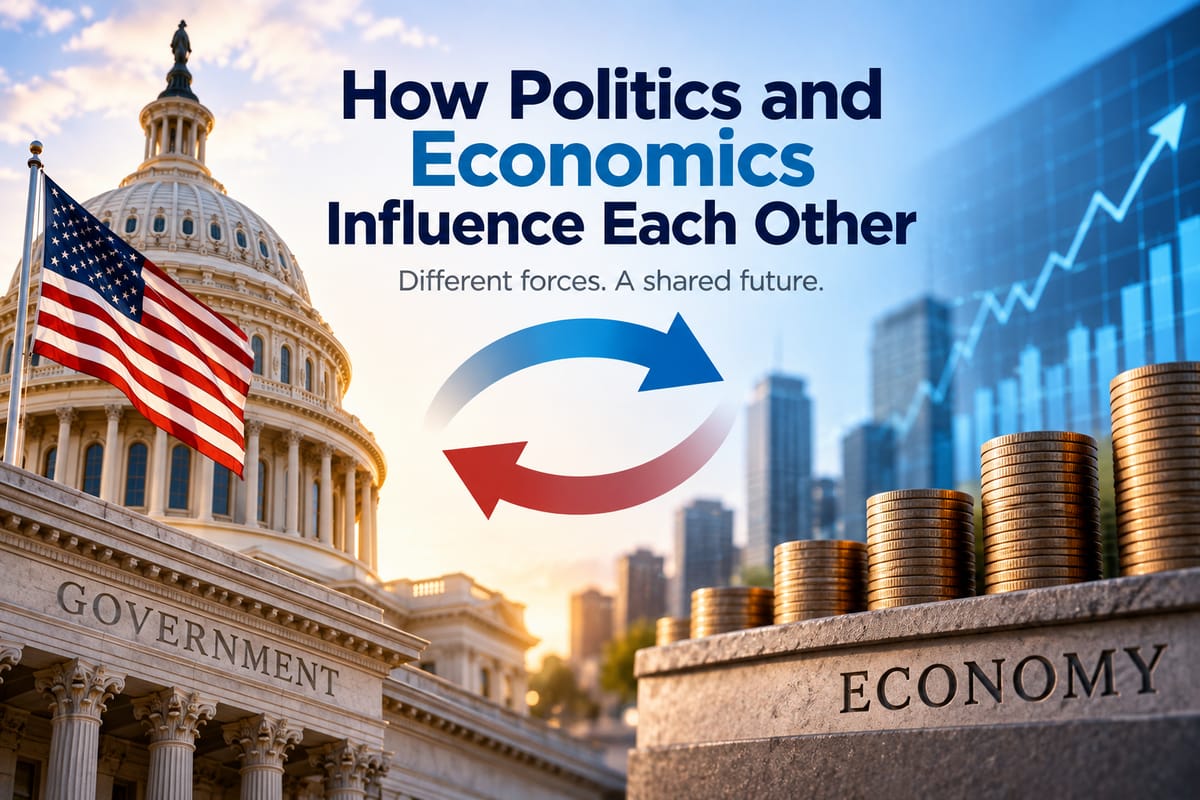
This creates a continuous feedback loop:
Political decisions → Economic effects → Public and economic responses → Political pressures → New policy decisions
The cycle does not produce the same outcome everywhere because institutions, economic structures, social groups, and historical circumstances differ.
The Two-Way Relationship at the Heart of Public Policy
Politics and economics influence each other because governments shape the rules and resources that structure economic activity, while economic conditions shape the interests, pressures, and challenges confronting political institutions.
Taxes affect households and businesses. Public spending affects demand and public services. Regulation affects incentives. Interest-rate decisions affect borrowing and investment. Economic growth affects employment and incomes. Inflation affects purchasing power. Public debt affects future fiscal choices.
None of these processes exists entirely in isolation.
Understanding the connection between politics and economics therefore means looking beyond individual policies and examining the institutions, incentives, economic conditions, and competing interests that shape how those policies are created and how their effects unfold over time.


2 Comments
Micle harison
June 7, 2019Lorem ipsum dolor sit amet, usu ut perfecto postulant deterruisset, libris causae volutpat at est, ius id modus laoreet urbanitas. Mel ei delenit dolores.
John Doe
June 7, 2019Some consultants are employed indirectly by the client via a consultancy staffing company.