
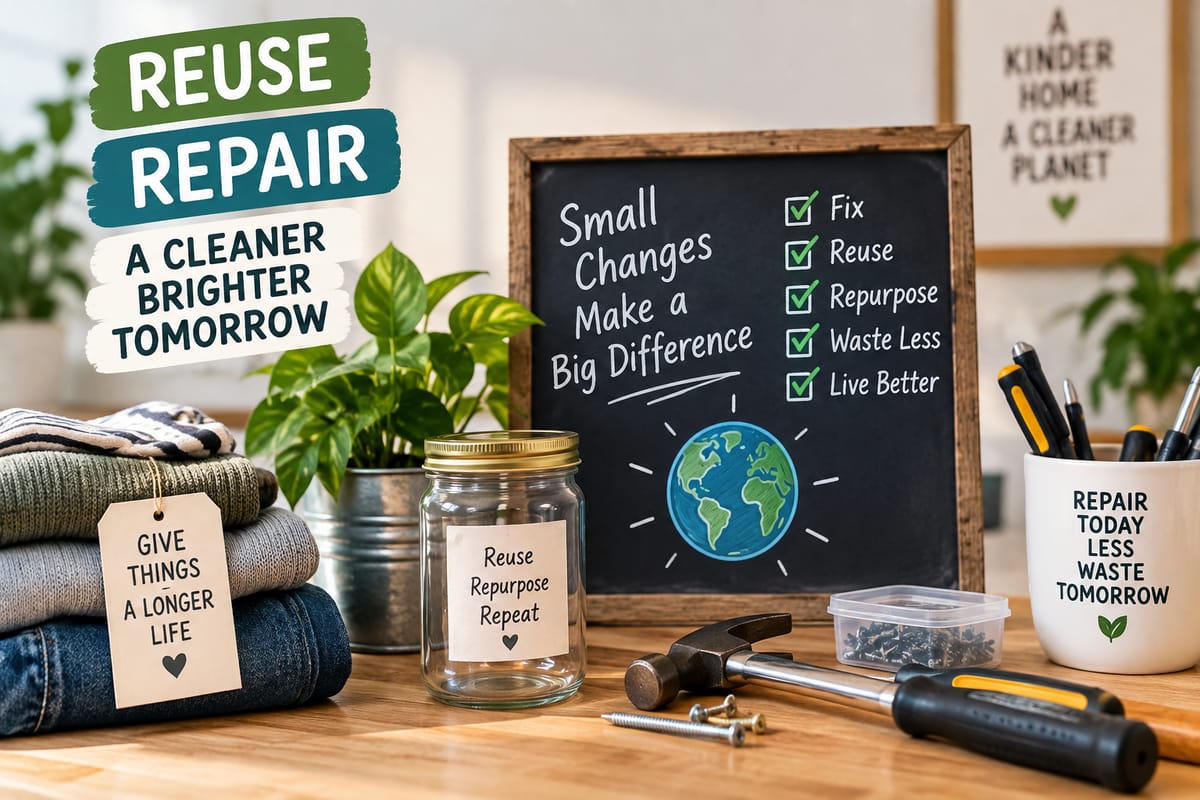
**How Reuse and Repair Reduce Household Waste
Household waste can seem like an unavoidable part of everyday life. Packaging, broken appliances, worn-out clothing, outdated electronics and damaged furniture can quickly accumulate, especially when replacing an item appears easier than fixing or repurposing it.
But not everything that reaches the point of being unwanted needs to become rubbish.
Reuse and repair offer practical ways to keep products and materials in circulation for longer. Instead of immediately throwing something away when it becomes damaged, outdated or inconvenient, households can look for opportunities to repair it, adapt it, donate it, resell it or use it for another purpose.
These choices can reduce the amount of waste sent to collection systems while also changing how households think about consumption.
What Reuse Means at Home
Reuse means using an item again rather than disposing of it after its original use.
The simplest examples are often already part of household routines. Glass jars can become storage containers, furniture can be passed to another family, clothing can be donated, and shopping bags can be used repeatedly.
Reuse does not necessarily require changing an object’s physical form. A desk that is given to another person remains a desk. A jacket passed to someone else continues serving its original purpose.
The key difference is that the useful life of the product is extended rather than ended.
What Repair Means
Repair involves restoring a damaged or malfunctioning product so that it can continue to perform its intended function.
A household might replace a broken zipper, mend a torn shirt, repair a leaking tap or replace a worn component in an appliance. Some repairs are simple enough to handle at home, while others require specialized skills.
Repair can also involve maintenance before something fails completely. Cleaning filters, tightening loose components, lubricating moving parts and following manufacturers’ maintenance instructions can help products remain functional for longer.
This makes repair part of a broader approach to preventing waste rather than simply dealing with waste after it has been created.
Why Reuse and Repair Matter
The most direct benefit is straightforward: an item that remains in use does not immediately become household waste.
When a chair is repaired instead of discarded, there is no need to dispose of the old chair at that moment. When clothing is repaired or passed to another person, its useful life continues. When an appliance can be fixed rather than replaced, the household avoids disposing of the existing product.
This can reduce the volume of material entering household waste streams.
For a broader look at how discarded materials move through collection, processing and disposal systems, households can explore How Household Waste Management Works.
Reuse Can Reduce the Need for New Products
Every new product requires resources to be extracted, processed, manufactured, packaged and transported.
Keeping an existing product in use can reduce the immediate need to purchase another item. This does not mean reuse eliminates the environmental impact associated with manufacturing. Rather, extending a product’s useful life can reduce how frequently a household needs to replace it.
Consider a piece of furniture. If a household replaces a table every few years because of minor damage, multiple tables may eventually be purchased and discarded. Repairing the original table can keep it functioning for much longer.
The same principle can apply to clothing, cookware, tools, electronics and household equipment.
Repair Can Prevent Premature Disposal
Many products are discarded while they still contain considerable functional value.
A phone with a damaged charging port, a chair with a loose joint or a jacket with a broken fastening may no longer work perfectly, but that does not necessarily make the entire item useless.
Repair separates the damaged component from the value of the whole product.
Instead of treating the failure of one part as the end of an object’s life, repair allows the household to restore its usefulness.
This approach can be especially valuable for products that are expensive or resource-intensive to manufacture.
Reuse and Repair Can Save Money
Waste reduction is not only an environmental issue. It can also affect household budgets.
Repairing something can sometimes cost less than purchasing a replacement, particularly when the underlying product remains in good condition. Reuse can be even less expensive when households repurpose items they already own or obtain usable products from friends, family, community groups or secondhand markets.
There are limits, however. A repair may not always make financial sense if labor and replacement parts cost more than a new product. Safety considerations can also make replacement preferable for certain damaged items.
The practical approach is to consider the item’s condition, repair cost, expected remaining lifespan and safety before deciding what to do.
Common Household Items That Can Be Reused
Many everyday products have uses beyond their original purpose.
Glass Containers
Glass jars can be cleaned and reused for food storage, organizing small household items, holding craft supplies or storing dry goods when appropriate.
Clothing
Clothing can be repaired, altered, donated, exchanged or transformed into cleaning cloths and other useful materials when it is no longer suitable to wear.
Furniture
Furniture can often be refinished, repaired, repainted or adapted for another room. A piece that no longer works in one location may still be useful elsewhere.
Packaging
Durable boxes and containers can sometimes be reused for storage, moving, organizing or shipping.
Household Tools
Tools that are no longer needed can be passed to another household rather than discarded, particularly when they remain functional.
Repairing Does Not Have to Mean Doing Everything Yourself
A common misconception is that reducing waste through repair requires every household to become skilled at fixing appliances, electronics or plumbing.
It does not.
Households can use local repair businesses, technicians, tailors, cobblers, furniture specialists and other professionals. Community repair events and skill-sharing initiatives can also provide opportunities to learn basic maintenance and repair techniques.
For more complicated products, professional assistance can be safer and more effective than attempting an unfamiliar repair.
The Connection Between Repair, Reuse and Recycling
Reuse and repair are closely related to recycling, but they are not the same thing.
Recycling generally involves processing discarded materials so they can be used as inputs for new products. Reuse keeps an existing item or component in use, while repair restores its functionality.
A household therefore has several possible options when an item is no longer wanted or appears to have reached the end of its useful life.
One possible order of consideration is:
- Can the item continue to be used as it is?
- Can it be repaired?
- Can someone else use it?
- Can it be repurposed?
- If none of these options work, can its materials be recycled?
- If recycling is not possible, how should it be disposed of responsibly?
This hierarchy can help households avoid treating disposal as the automatic first choice.
A more detailed explanation of recycling processes and household recycling decisions is available in The Complete Guide to Recycling.
Reuse Can Extend the Life of Clothing
Fast-changing consumer habits can make clothing a significant source of household waste.
A garment does not necessarily become useless because it has a small tear, a loose button or a damaged seam. Basic sewing skills can restore many items, while professional alterations can change the fit or appearance of others.
Clothing that no longer suits one person may also be donated, exchanged or sold.
Even when clothing is no longer suitable for wearing, some fabrics can be repurposed into household cloths or craft materials, depending on their condition.
Furniture Can Often Have a Second Life
Furniture presents another major opportunity for reuse and repair.
Scratches, worn finishes, loose joints and damaged handles do not always require an entire item to be discarded. Refinishing, tightening, replacing hardware or repairing structural components can restore functionality.
Furniture can also move between households. A bookcase that is no longer needed in one home may be exactly what another household needs.
This type of reuse prevents a functional object from becoming waste simply because its original owner has changed their needs.
Electronics Require More Care
Electronics can be more complicated because repairs may involve specialized tools, components or technical knowledge.
Nevertheless, some electronic products can be repaired by replacing batteries, screens, cables, storage components or other parts, depending on their design.
Before attempting an electronic repair, households should consider electrical and fire safety. Damaged batteries, power supplies and other hazardous components should not be handled casually.
When an electronic product genuinely reaches the end of its useful life, appropriate recycling or collection is generally preferable to placing it in ordinary household rubbish where specialized recycling systems exist.
Reuse Changes How Households Think About Ownership
The waste-reduction benefits of reuse are partly practical and partly behavioral.
When people begin viewing products as things that can have multiple owners, purposes or stages of use, disposal becomes less automatic.
A household may start asking different questions:
- Can this be fixed?
- Could someone else use it?
- Can I use it somewhere else?
- Can I change its purpose?
- Is the damaged part replaceable?
- Is the entire item really unusable?
These questions encourage a longer-term perspective on household possessions.
Waste Reduction Also Has Environmental Implications
Household waste does not simply disappear when it leaves the home. Collection, transportation, treatment and disposal can all have environmental consequences.
The scale and nature of those effects depend on the waste material and the management system involved. Some waste can be recycled or recovered, while other materials may require disposal.
The broader relationship between waste systems and environmental impacts is explored in How Waste Management Affects the Environment.
By preventing some waste from being created in the first place, reuse and repair can reduce the amount of material that needs to enter those systems.
Simple Ways to Build Reuse Into Everyday Life
Households do not need to overhaul everything at once.
A few practical habits can make reuse and repair more routine:
- Keep basic repair supplies available.
- Learn simple sewing and maintenance skills.
- Store reusable containers instead of automatically discarding them.
- Donate usable possessions before throwing them away.
- Consider secondhand items when replacement is necessary.
- Check whether an appliance can be repaired before buying another.
- Maintain products according to their instructions.
- Share rarely used tools and equipment with family, friends or neighbors.
- Repurpose suitable materials for storage or household projects.
- Separate genuinely recyclable materials from general waste.
These habits can gradually reduce the amount of material a household sends into the waste stream.
Reuse Fits Into a Broader Sustainable Lifestyle
Waste prevention is only one part of sustainable household living. Decisions about energy, water, transportation, food, purchasing and consumption can also influence a home’s overall environmental footprint.
Reuse and repair fit naturally into that wider approach because both encourage households to make greater use of resources that have already been consumed.
For a broader discussion of practical choices that can reduce environmental impact in everyday life, the Sustainable Living Guide provides a useful starting point.
Making Repair the First Question
The most important shift may be a simple one: pause before throwing something away.
An item that appears finished may only need a small repair, a new owner or a different purpose. Even when repair is not practical, considering reuse first can prevent usable products from becoming waste prematurely.
No single household can eliminate waste entirely. Products eventually wear out, materials become contaminated or damaged, and some items cannot be economically or safely repaired. But extending the useful life of everyday possessions can reduce unnecessary disposal and encourage more deliberate consumption.
In that sense, reuse and repair are not merely ways to deal with old belongings. They are practical habits that help households get more value from the products and resources they already have.





2 Comments
Micle harison
June 7, 2019Lorem ipsum dolor sit amet, usu ut perfecto postulant deterruisset, libris causae volutpat at est, ius id modus laoreet urbanitas. Mel ei delenit dolores.
John Doe
June 7, 2019Some consultants are employed indirectly by the client via a consultancy staffing company.