
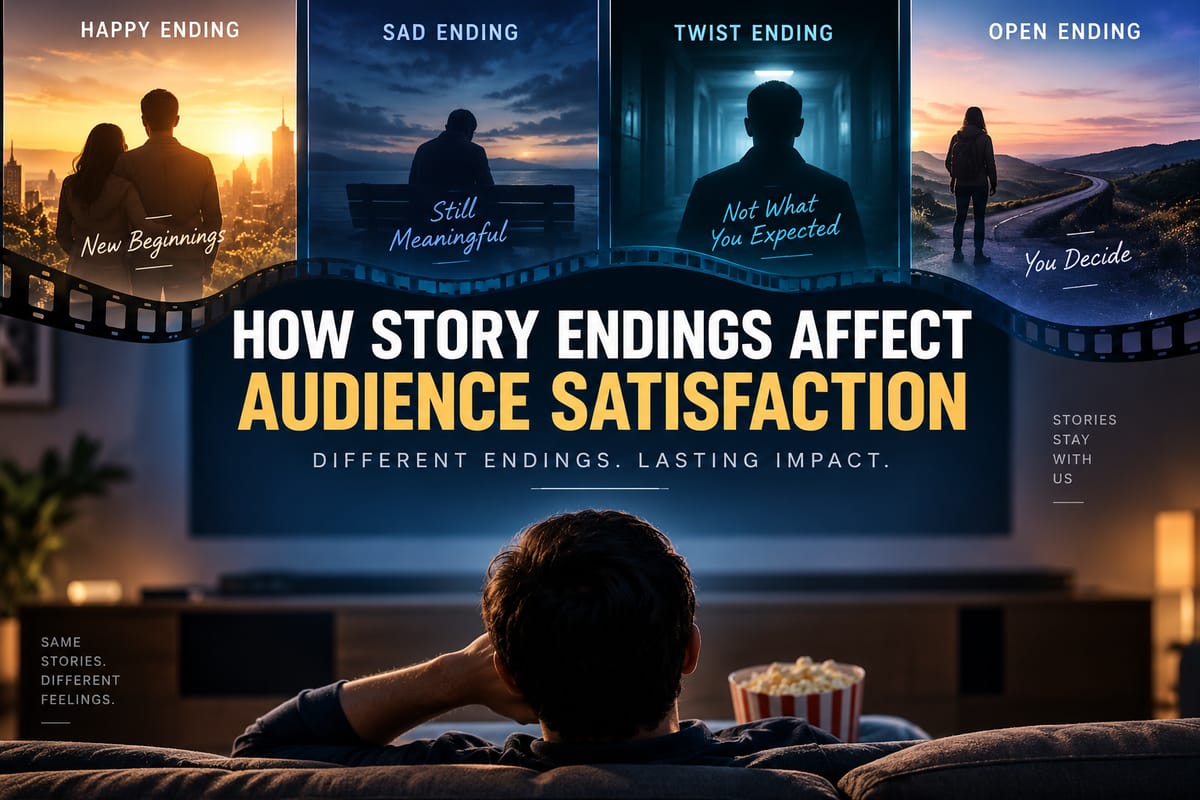
How Story Endings Affect Audience Satisfaction
A story can have memorable characters, compelling conflicts, and beautifully crafted scenes, yet still leave audiences disappointed if the ending does not deliver. The final moments of a movie, television series, novel, or other form of entertainment can strongly influence how people remember the entire experience.
Story endings matter because they provide a sense of resolution. They answer important questions, complete character journeys, reveal consequences, or deliberately leave certain mysteries unresolved. When an ending feels consistent with what came before it, audiences may leave feeling satisfied even if the story contains difficult or tragic events. When the ending feels rushed, confusing, or disconnected from the story, satisfaction can quickly decline.
Understanding why endings have such an influence reveals something fundamental about storytelling: audiences are not simply consuming individual scenes. They are building expectations, interpreting meaning, and anticipating how everything will eventually come together.
Why the Ending Carries So Much Weight
Audiences experience stories sequentially, but they often evaluate the entire narrative after reaching its final moment.
During a story, viewers form questions about the characters and conflicts. They wonder whether a protagonist will achieve a goal, whether a relationship will survive, whether a mystery will be solved, or whether an antagonist will face consequences. The ending becomes the point where many of those expectations are addressed.
This is one reason storytelling is closely connected to emotional satisfaction. Storytelling Explained: How Entertainment Creates Meaning explores how stories use characters, conflicts, themes, and narrative structure to create meaning for audiences.
A strong ending does not necessarily need to provide a happy outcome. A tragedy can be satisfying if it feels earned. A sad ending can be memorable when it follows logically from the characters’ decisions. Even an ambiguous ending can work when uncertainty is an intentional part of the story.
The important factor is often whether the ending feels appropriate to the journey.
Resolution Gives Audiences a Sense of Completion
One of the most important functions of an ending is resolution.
Resolution does not mean that every question must receive a literal answer. Instead, it means that the central narrative has reached a meaningful stopping point.
A detective story, for example, may resolve when the central mystery is explained. A coming-of-age story may conclude when the protagonist demonstrates how they have changed. A romantic drama may resolve through the characters’ decision about their relationship.
When major narrative threads are left unresolved without a clear purpose, audiences may feel that their investment has not been rewarded.
This is particularly noticeable when a story establishes an important conflict early on and then fails to address it properly. Viewers may spend hours following that conflict, only to discover that the final scenes provide little meaningful payoff.
Character Arcs Can Determine Whether an Ending Works
Audiences often become emotionally invested in characters rather than simply in plots.
A character might begin a story fearful, selfish, inexperienced, or uncertain and gradually change as events challenge their beliefs. The ending provides an opportunity to demonstrate what that journey ultimately meant.
For example, if a character spends an entire film learning to accept responsibility, an ending that shows them making a responsible decision can provide a satisfying sense of completion.
The opposite can also happen. If a character’s behavior suddenly changes without sufficient explanation, the ending may feel artificial.
This is why character development and plot resolution need to work together. A surprising ending can be effective, but the surprise generally needs to make sense within the character’s established personality and experiences.
Audience Expectations Shape Satisfaction
People do not approach stories without expectations.
Genres, marketing, trailers, previous installments, cultural conventions, and the story itself all influence what audiences anticipate.
A horror movie creates different expectations from a romantic comedy. A mystery encourages viewers to look for clues, while a fantasy adventure may prepare them for a larger conflict between opposing forces.
How Film Genres Shape Movie Experiences explains how genre conventions influence the way audiences approach and interpret movies.
These expectations do not mean that every story needs a predictable ending. In fact, audiences can enjoy endings that challenge conventions. The difference is between surprising an audience and violating the narrative expectations that the story itself has established.
A twist can feel satisfying when viewers can look back and recognize that the clues were present all along. It can feel frustrating when the twist depends on information that was never established.
Predictability Is Not Always a Problem
It is tempting to assume that audiences only want unexpected endings, but predictability can actually contribute to satisfaction.
Sometimes viewers know where a story is heading and enjoy watching the characters reach that destination. The emotional experience comes from seeing how the outcome unfolds rather than discovering what the outcome will be.
A familiar ending can therefore work when the journey toward it is engaging and emotionally convincing.
For instance, audiences may expect a hero to overcome an obstacle in a conventional adventure story. That does not necessarily make the final confrontation meaningless. The tension can come from the difficulties the character faces along the way and the emotional significance of overcoming them.
The problem is usually not predictability itself. It is a lack of meaningful payoff.
Surprising Endings Can Create Stronger Reactions
Unexpected endings can produce powerful audience responses because they force viewers to reconsider what they thought they understood.
A successful twist can change the interpretation of earlier scenes. Details that initially seemed insignificant may suddenly become important, giving the audience a reason to mentally revisit the story.
This can increase the story’s lasting impact.
However, surprise alone does not guarantee satisfaction. If an ending exists primarily to shock viewers without supporting the characters, themes, or established narrative logic, the reaction may quickly shift from surprise to frustration.
The strongest twists tend to combine surprise with inevitability: audiences did not expect the outcome, but once they understand it, the outcome makes sense.
Ambiguous Endings Leave Room for Interpretation
Not every story needs to explain everything.
Some filmmakers and writers intentionally leave questions unanswered. An ambiguous ending can encourage audiences to discuss what happened, interpret character motivations, or debate the meaning of the final scene.
This approach can create a different kind of satisfaction.
Instead of receiving certainty, audiences receive an opportunity to participate in the interpretation of the story. Two people may watch the same ending and develop different explanations while still finding the experience rewarding.
Ambiguity becomes problematic when audiences cannot determine whether an unanswered question was intentional or simply overlooked.
The surrounding narrative usually provides clues. If ambiguity is supported by the themes and tone of the story, it can feel deliberate. If major questions appear unresolved because the narrative ran out of time, the same technique may feel incomplete.
The Emotional Payoff Matters
Stories are emotional experiences, and endings often determine the emotional state audiences carry away.
A dramatic story may build toward grief, reconciliation, hope, triumph, or acceptance. The ending gives those emotions a final shape.
This does not mean every story needs to make audiences feel happy. Satisfaction and happiness are different.
A heartbreaking ending can leave audiences deeply satisfied because it delivers an emotionally coherent conclusion. Conversely, a cheerful ending can feel unsatisfying if it ignores the consequences of everything that happened previously.
Emotional consistency is therefore important. The final moments should generally reflect the emotional journey that the story has established.
Endings Can Change How Audiences Remember Earlier Scenes
One of the most interesting characteristics of storytelling is that the ending can influence perceptions of what came before it.
A revealing final scene may cause audiences to reinterpret earlier conversations. A character’s final decision may give greater significance to their previous struggles. A tragic outcome may make earlier moments appear more meaningful in retrospect.
This phenomenon helps explain why a disappointing ending can affect perceptions of an otherwise strong story.
If the final resolution makes earlier events feel pointless, audiences may reassess the entire narrative. On the other hand, an effective ending can strengthen the importance of details that initially appeared minor.
In this sense, the ending does not simply finish a story. It can provide a lens through which the entire story is remembered.
Production Choices Also Influence the Final Experience
Although storytelling decisions are central, the way a production is made can influence how an ending reaches audiences.
Editing, cinematography, music, acting, visual effects, pacing, and sound design all contribute to the final sequence.
A powerful screenplay may lose some of its impact if the final scenes are rushed or poorly paced. Similarly, a relatively simple resolution can become emotionally powerful through careful performances, music, and visual storytelling.
How Movies Are Made From Start to Finish provides broader context on the many production stages involved in transforming a movie idea into a finished screen experience.
The ending is therefore the result of numerous creative decisions rather than the work of the writer alone.
Pacing Can Make or Break a Finale
A story can have the right ending but still feel unsatisfying if it reaches that ending too quickly.
Pacing becomes especially important when several major conflicts need to be resolved at once. If a movie spends most of its runtime developing characters and complications but attempts to resolve everything in a few minutes, audiences may feel that important emotional moments were skipped.
The opposite problem can also occur.
An ending that continues for too long after the central conflict has already been resolved may reduce its emotional impact. Audiences can begin to feel that the story has effectively finished but refuses to stop.
Effective pacing gives important moments enough time to register without unnecessarily delaying the conclusion.
Different Types of Endings Produce Different Forms of Satisfaction
Stories can conclude in many ways, including:
- Happy endings, where major characters achieve desired outcomes.
- Tragic endings, where important characters experience loss or failure.
- Bittersweet endings, combining positive developments with significant sacrifice or sadness.
- Open endings, where important questions remain unresolved.
- Twist endings, where a final revelation changes the audience’s understanding.
- Circular endings, where the conclusion deliberately echoes the beginning.
- Reflective endings, where the emphasis is placed on what characters or audiences have learned.
None of these approaches automatically produces satisfaction.
Their effectiveness depends on the expectations established throughout the narrative and whether the final moments fulfill the story’s emotional and thematic purpose.
Why Weak Endings Can Overshadow Strong Stories
Audiences may forgive occasional weaknesses during a story if they believe those weaknesses are leading somewhere meaningful.
That expectation creates a kind of narrative contract.
Viewers invest their time because they expect the story to eventually provide some form of payoff. If the payoff does not arrive, earlier strengths may be overshadowed by disappointment.
This helps explain why discussions about movies and television series often focus heavily on their endings. The final episode or final scene can become the defining feature of an entire work.
A strong ending can elevate an otherwise imperfect story, while a poorly developed ending can become the dominant memory of an otherwise impressive production.
Modern Entertainment Has Changed How Endings Are Experienced
The way audiences consume entertainment has also changed.
Streaming platforms allow viewers to watch entire seasons quickly rather than waiting weeks between episodes. Social media allows people to discuss endings almost immediately. Online communities can dissect clues, theories, character decisions, and alternate interpretations within hours of a release.
The Evolution of Modern Entertainment Media shows how technological and cultural changes have transformed the ways people create, distribute, and consume entertainment.
This environment can increase the pressure surrounding endings. A controversial conclusion can generate enormous discussion, while a carefully constructed ending can inspire theories and conversations long after a movie or series has finished.
Audiences are no longer simply watching a story and moving on. They can immediately compare interpretations, debate unresolved questions, and revisit earlier scenes.
What Makes an Ending Feel Earned?
An ending tends to feel earned when it grows naturally from the story that preceded it.
Several elements can contribute to that feeling:
- Established character motivations — major decisions should connect to who the characters have been shown to be.
- Resolved central conflicts — the primary narrative questions should receive an appropriate payoff.
- Consistent themes — the ending should reinforce or meaningfully challenge the ideas explored throughout the story.
- Foreshadowing — important revelations should have some foundation within the narrative.
- Appropriate pacing — major emotional and narrative moments need enough time to develop.
- Emotional consistency — the final mood should make sense given the journey.
- Consequences — significant actions should have meaningful effects.
These principles do not create a formula for a perfect ending. They simply help explain why some conclusions feel connected to the story while others feel detached from it.
The Best Endings Give Audiences Something to Carry Forward
Audience satisfaction does not necessarily come from getting exactly the ending a viewer wanted.
Sometimes the most memorable endings challenge expectations, provoke difficult emotions, or leave audiences thinking about a story long after the credits have rolled.
What matters is that the ending gives the narrative a meaningful destination.
A satisfying ending can answer questions, complete a character journey, reinforce a theme, deliver an emotional payoff, or deliberately invite interpretation. It can be joyful, devastating, surprising, quiet, or unresolved.
Ultimately, audiences tend to judge an ending not only by what happens in the final minutes but by whether those final moments make the entire journey feel worthwhile. When the ending connects the story’s characters, conflicts, themes, and emotions into a coherent final experience, it can transform entertainment from something audiences simply watch into something they continue to remember.





2 Comments
Micle harison
June 7, 2019Lorem ipsum dolor sit amet, usu ut perfecto postulant deterruisset, libris causae volutpat at est, ius id modus laoreet urbanitas. Mel ei delenit dolores.
John Doe
June 7, 2019Some consultants are employed indirectly by the client via a consultancy staffing company.