
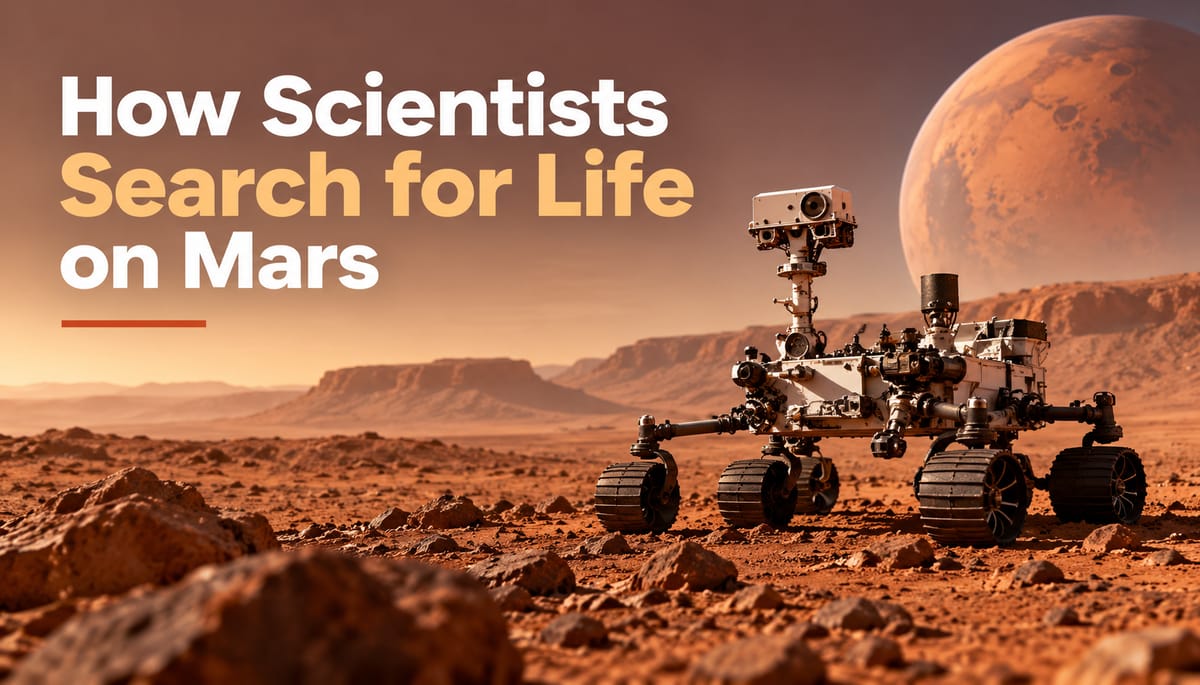
**How Scientists Search for Life on Mars
Mars has fascinated scientists for generations because, among all the planets in our solar system, it is one of the places where conditions may once have been suitable for life. Today, the planet is cold, dry and exposed to harsh radiation, but evidence suggests that ancient Mars was very different.
Scientists are therefore not simply looking for living organisms walking across the Martian surface. The search for life on Mars is much broader. Researchers are looking for chemical signatures, organic compounds, geological structures, water-related environments and other evidence that could indicate that microbial life existed there in the past or could potentially survive today.
The investigation combines planetary science, geology, chemistry, biology and robotics. It is also an important part of the broader field of astrobiology and life in space, which examines how life might originate, survive and evolve beyond Earth.
Why Mars Is a Major Target in the Search for Life
Mars is not the only world scientists consider potentially interesting for life, but it has several characteristics that make it particularly accessible for exploration.
The planet contains evidence that liquid water once flowed across its surface. Ancient valleys, dried-up river channels, minerals formed in watery environments and geological deposits all point toward a much wetter past.
Water is important because life as we understand it requires certain chemical and environmental conditions that are strongly associated with liquid water.
Mars is also relatively close to Earth compared with many other potentially habitable worlds. Robotic spacecraft can travel there using technologies that are already available, allowing scientists to study the planet directly.
Understanding Mars also contributes to our broader knowledge of planetary environments. A look at the complete guide to planets and worlds shows how different planetary conditions can shape the possibility of habitability.
Scientists Are Looking for Evidence, Not Just Organisms
One of the biggest misconceptions about the search for Martian life is that scientists expect to discover obvious organisms.
The reality is much more complicated.
If life ever existed on Mars, it may have been microscopic. If it disappeared billions of years ago, the physical evidence could have been altered or destroyed by geological processes and radiation.
Scientists may therefore search for several different categories of evidence:
- Organic molecules
- Minerals associated with ancient water
- Chemical patterns that could have biological origins
- Structures resembling microbial fossils
- Evidence of ancient habitable environments
- Potential biosignatures
- Changes in atmospheric gases
- Subsurface environments that could potentially support microorganisms
Finding any one of these clues would not automatically prove that life existed. Researchers would need to determine whether there are non-biological explanations for the observation.
The Importance of Water on Ancient Mars
Water is one of the central themes in Martian exploration.
Modern Mars has a thin atmosphere and extremely low temperatures at the surface, making stable liquid water difficult to maintain. However, geological evidence indicates that the planet once had rivers, lakes and possibly larger bodies of water.
Scientists study these ancient environments because they could have provided places where microorganisms might have developed or survived.
Certain minerals are particularly useful because they can preserve evidence of past interactions with water. Clay minerals, sulfates and other compounds can reveal information about the environmental conditions that existed when they formed.
Researchers can therefore reconstruct portions of Mars’ ancient history by studying its rocks and minerals.
Searching for Organic Molecules
Organic molecules are another important target.
Organic does not necessarily mean biological. Many organic compounds can form through non-biological chemical processes, including processes that occur in space and on planetary surfaces.
Nevertheless, finding certain combinations of organic compounds in an appropriate geological setting could provide valuable clues.
Scientists examine the composition of Martian rocks and soil to determine what molecules are present and how they may have formed.
The challenge is separating potential biological signals from chemistry that can occur naturally without life.
What Are Biosignatures?
A biosignature is a feature that could provide evidence of past or present biological activity.
Biosignatures can take many forms. They might include particular chemical compounds, unusual isotope ratios, mineral structures or combinations of environmental clues that are difficult to explain through non-biological processes.
The key word is could.
A potential biosignature is not automatically evidence of life. Scientists must investigate alternative explanations before drawing conclusions.
This is particularly important on Mars because the planet’s surface has been exposed to radiation, oxidation and other processes for extremely long periods.
Exploring Mars With Robotic Spacecraft
Much of what scientists know about Mars comes from robotic missions.
Orbiters can photograph the planet, map its surface and study its atmosphere. Landers can conduct experiments from fixed locations, while rovers can travel across the surface and investigate multiple geological targets.
These missions demonstrate why robotic spacecraft travel through and explore space is so important to modern planetary science.
Robotic explorers can carry instruments designed to analyze rocks, measure atmospheric conditions, examine soil and search for chemical compounds.
Their ability to investigate locations selected by scientists makes them essential tools in the search for evidence of ancient habitability.
Rovers Help Scientists Choose the Right Rocks
Mars rovers are particularly valuable because they allow scientists to examine geological features up close.
Instead of simply photographing a rock from orbit, a rover can approach it, inspect its surface, analyze its chemical composition and determine whether it is worth investigating further.
Scientists often look for rocks that may have formed in environments where water was present.
Sedimentary rocks are especially interesting because they can preserve evidence of ancient environments. A rock deposited in an ancient lake, for example, may contain chemical or physical clues about the conditions that existed when the sediment accumulated.
The selection of individual samples can therefore be extremely important.
Perseverance and the Search for Ancient Life
NASA’s Perseverance rover represents one of the most ambitious efforts to investigate whether Mars once supported microbial life.
The rover has been exploring Jezero Crater, a location selected partly because evidence suggests that it once contained a lake and river delta.
That geological setting is significant because river deltas on Earth can preserve organic material and other traces of ancient environments.
Perseverance is collecting and analyzing rock samples while also preparing selected samples for potential future return to Earth.
Laboratories on Earth can perform much more sophisticated analyses than most instruments that can realistically be sent aboard a rover.
Why Bringing Martian Samples to Earth Matters
A sample-return mission could dramatically expand scientists’ ability to investigate Mars.
Earth laboratories contain extremely sensitive instruments that can analyze tiny quantities of material in great detail. Researchers can also apply different analytical techniques to the same sample and preserve portions for future investigations.
That flexibility is important because scientists may discover new questions years after a sample is collected.
A returned Martian sample could potentially be examined for organic compounds, mineral structures, isotopic patterns and other possible evidence of ancient biological activity.
However, proving that a sample contains evidence of life would require extraordinary care. Scientists would need to rule out contamination and demonstrate that the evidence could not reasonably be explained by non-biological processes.
Could Life Still Exist on Mars?
The search is not limited entirely to ancient life.
Although the surface of Mars is hostile to most forms of known terrestrial life, scientists have considered whether microorganisms could potentially survive in protected environments beneath the surface.
Subsurface environments could offer protection from ultraviolet radiation and extreme surface conditions. Ice deposits and possible underground water reservoirs are therefore of interest to researchers.
Finding active life today would be an extraordinary discovery, but it may be considerably more difficult than identifying evidence of life that existed billions of years ago.
Searching for Life From Orbit
Spacecraft do not always need to land on Mars to contribute to the search for habitability.
Orbiters can study the planet on a much larger scale. They can map minerals, identify geological formations, monitor atmospheric changes and locate areas that could be promising targets for future missions.
This broader perspective is an essential part of space exploration explained, where observations from orbit, surface missions and laboratory research work together to build a more complete understanding of other worlds.
Orbital observations can also help scientists determine where future rovers or landers should investigate.
The Search for Methane and Other Atmospheric Clues
Mars’ atmosphere has attracted attention because scientists have investigated possible variations in gases such as methane.
On Earth, methane can be produced by biological activity, but it can also result from geological and chemical processes.
Consequently, detecting methane would not prove that Mars has life.
Scientists would need to determine where the gas originated, how it was produced and why its concentration changes over time.
Atmospheric chemistry can nevertheless provide another piece of evidence in the larger investigation.
Scientists Follow the Evidence Step by Step
The search for Martian life is not based on a single experiment.
Instead, researchers build evidence gradually.
A promising location may first be identified using orbital observations. A rover can then investigate the site directly. Instruments can analyze rocks and minerals, while cameras document the geological context.
If a sample appears particularly interesting, scientists can study it in greater detail or potentially preserve it for future analysis.
Each stage reduces uncertainty.
This method is important because extraordinary claims require evidence that can withstand extensive scientific scrutiny.
Why Finding Ancient Life Would Be So Important
Discovering evidence that life once existed on Mars would fundamentally change humanity’s understanding of biology.
Earth is currently the only world known to support life. A confirmed independent example of Martian life would demonstrate that biology emerged in at least two different locations.
That would raise profound questions about how frequently life develops throughout the universe.
It could also influence the search for life elsewhere, including environments on icy moons and planets orbiting other stars.
Even if Mars is ultimately found to have been lifeless, the investigation remains valuable. Understanding why one potentially habitable planet developed differently from Earth could reveal important information about the conditions required for life.
Mars Is Only One Piece of a Much Larger Search
Scientists are approaching the search for life on Mars cautiously because the evidence they seek may be subtle and billions of years old.
Rocks, minerals, organic molecules, atmospheric gases and geological formations can all provide clues, but interpreting those clues requires careful analysis.
The combination of orbital spacecraft, rovers, laboratory science and future sample analysis is gradually transforming Mars from a distant red planet into a world that can be investigated in remarkable detail.
The biggest discovery may eventually come from a tiny chemical signature preserved inside an ancient rock. If researchers can demonstrate that the evidence was produced by life, it would rank among the most important scientific discoveries in human history. Until then, every carefully selected sample and every new Martian observation brings scientists another step closer to answering one of humanity’s oldest questions: Are we alone?




2 Comments
Micle harison
June 7, 2019Lorem ipsum dolor sit amet, usu ut perfecto postulant deterruisset, libris causae volutpat at est, ius id modus laoreet urbanitas. Mel ei delenit dolores.
John Doe
June 7, 2019Some consultants are employed indirectly by the client via a consultancy staffing company.