
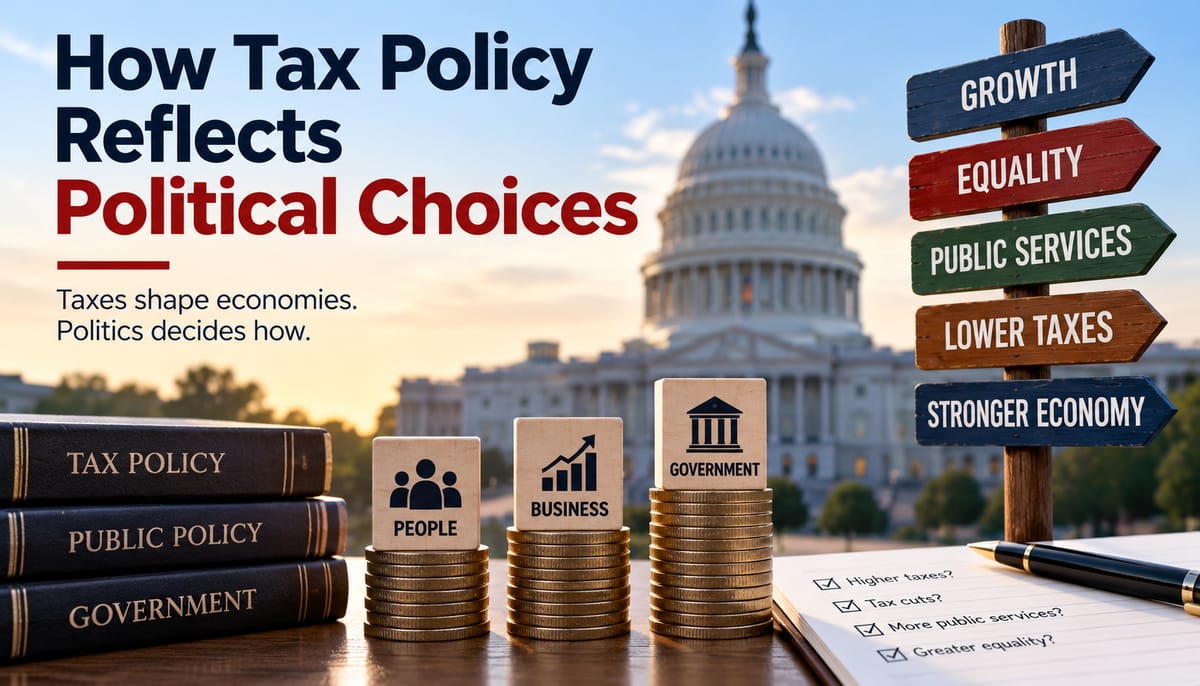
How Tax Policy Reflects Political Choices
Tax policy is often presented as a technical question about government revenue, economic growth, or public spending. But behind every tax rate, exemption, deduction, credit, and enforcement rule is a political decision about who should contribute, how much they should contribute, and what society should prioritize.
Governments need revenue to finance public services and fulfill their responsibilities, but there are many different ways to raise that money. Choosing between income taxes, consumption taxes, corporate taxes, property taxes, and other forms of taxation can affect households and businesses in very different ways.
That is why understanding tax policy requires more than looking at percentages. It also requires examining the political choices and competing priorities that shape the tax system.
What Tax Policy Actually Does
Tax policy determines how governments collect revenue from individuals, businesses, property, transactions, and economic activity.
A government may use taxes to accomplish several objectives at the same time. Raising revenue is usually the central purpose, but taxation can also influence behavior, redistribute income, encourage investment, protect domestic industries, or support particular economic activities.
For example, a government could lower taxes on new business investment to encourage companies to expand. It might impose higher taxes on tobacco or other products to discourage consumption. It could provide tax credits for activities that policymakers consider socially or economically beneficial.
These choices make taxation an important part of public policy and policymaking.
Tax rules therefore reflect both economic calculations and political judgments.
Why Different Groups See Taxes Differently
Tax policy affects different groups in different ways.
A reduction in personal income taxes may increase disposable income for workers, but it can also reduce government revenue unless other taxes or spending changes compensate for the difference.
A higher corporate tax rate may increase government revenue, but businesses may argue that it could affect investment decisions, hiring, or competitiveness.
A consumption tax can generate substantial revenue because it applies broadly to purchases, but lower-income households may feel its effects more strongly because they generally spend a larger share of their income on everyday necessities.
These competing effects create political debates over what constitutes a fair tax system.
The question is rarely simply whether taxes should be higher or lower. The more important question is often whose taxes should change and by how much.
Progressive and Regressive Choices
One of the most important political questions in taxation concerns how much people with different incomes should contribute.
A progressive tax system generally places a higher tax burden, as a proportion of income, on people with higher incomes. A proportional system applies broadly the same rate, while a regressive tax can take a larger share of income from lower-income households than from higher-income households.
These distinctions can become politically significant.
Supporters of progressive taxation may argue that people with greater financial resources have a greater capacity to contribute toward public services. Critics may argue that excessively high marginal rates could weaken incentives to work, invest, or build businesses.
The debate is therefore not only about mathematics. It reflects different ideas about fairness, opportunity, incentives, and the appropriate role of government.
Tax Policy and Political Ideology
Political parties and movements often approach taxation according to broader beliefs about government and the economy.
Parties that favor a larger public sector may support higher taxes when they believe additional revenue is necessary to finance healthcare, education, infrastructure, social programs, or other public services.
Parties that emphasize smaller government may favor lower taxes and reduced public spending, arguing that individuals and businesses should retain more of their income and make more economic decisions themselves.
There are, however, few political systems in which taxation fits neatly into two categories.
Governments frequently combine tax reductions with targeted increases. They may lower one tax while increasing another, introduce temporary incentives, or maintain relatively high rates while expanding exemptions and deductions.
The resulting tax system is often a compromise between competing political interests.
Legislatures Turn Political Preferences Into Tax Laws
Tax policy does not become law simply because a political party announces a proposal.
In most democratic systems, significant tax changes require legislative action. Representatives debate proposed legislation, consider amendments, negotiate with other political groups, and ultimately vote on whether measures should become law.
Understanding how legislatures make laws and pass legislation helps explain why tax proposals can change substantially between their initial announcement and final implementation.
A government may enter negotiations with one tax plan and leave with another after opposition parties, coalition partners, business groups, labor organizations, civil society groups, and individual legislators raise concerns.
The final tax law can therefore represent a political compromise rather than the original preference of any single group.
Representation Matters in Tax Decisions
Tax debates also reveal the importance of political representation.
Legislators represent constituencies with different economic circumstances. Urban workers, farmers, small-business owners, large corporations, retirees, investors, and low-income households can have very different interests when tax legislation is proposed.
This makes political representation in legislatures and governments particularly relevant to taxation.
A representative may support a tax measure because it benefits the national economy while facing pressure from constituents who believe the policy would increase their costs.
Political leaders must often balance local interests against broader economic objectives.
Tax Exemptions Are Political Choices Too
Political discussions about taxation often focus on tax rates, but exemptions can be equally important.
Governments frequently provide special treatment to particular activities, industries, organizations, or groups.
These provisions may be intended to encourage investment, support vulnerable households, promote charitable activity, develop specific industries, or achieve other policy objectives.
But exemptions also reduce the amount of revenue the government collects.
That creates a political question: which activities deserve preferential treatment, and why?
A tax exemption can therefore function as a form of policy support even when it does not appear in the government’s spending budget.
Businesses and Tax Competitiveness
Corporate taxation is another area where political choices can have wide-ranging consequences.
Governments compete with one another to attract investment, and tax policy can become part of that competition. A country may lower corporate tax rates or introduce investment incentives to make its economy more attractive to companies.
However, governments also need sufficient revenue to finance infrastructure, public services, and other priorities.
This creates a difficult balance.
If corporate taxes are too high relative to competing jurisdictions, policymakers may worry about investment and competitiveness. If they are too low, governments may struggle to collect enough revenue or may face criticism that businesses are not contributing a fair share.
Political choices determine where each government draws that line.
Tax Policy Can Change Economic Behavior
Taxes do not merely transfer money from taxpayers to governments. They can change incentives.
A tax on fuel can influence transportation choices. A tax credit for renewable energy can encourage investment in particular technologies. Higher taxes on certain products can affect consumer behavior.
Similarly, changes in capital gains taxation can influence investment decisions, while changes to payroll taxes can affect the cost of employing workers.
Because taxation changes incentives, policymakers must consider both immediate revenue and longer-term behavioral responses.
A politically attractive tax increase may generate less revenue than expected if people and businesses significantly change their behavior in response.
The Politics of Tax Cuts
Tax cuts can be politically powerful because their effects may be relatively easy for voters to understand.
A government can present a reduction in income tax, sales tax, or another levy as a direct improvement in household finances.
But tax cuts also raise questions about government finances.
If spending remains unchanged, lower tax revenue can increase budget deficits or public borrowing. Alternatively, the government may reduce spending elsewhere or introduce different taxes to compensate.
The political debate therefore often shifts from whether a tax cut sounds attractive to how it will be financed and who will benefit most.
The Politics of Tax Increases
Tax increases can be more politically difficult.
Even when a government argues that additional revenue is necessary to finance important services or reduce public debt, taxpayers may oppose paying more.
Political leaders may therefore design increases that target specific groups, products, or income levels.
The structure of the increase matters. A higher tax on luxury goods may be perceived differently from a higher tax on basic household necessities. Similarly, a higher rate on high incomes may produce a different political reaction from a broad increase affecting most workers.
These distinctions illustrate how tax design can influence public acceptance.
Tax Policy and Public Spending Are Connected
Taxation cannot be considered separately from government spending.
Citizens often evaluate taxes partly according to what they believe they receive in return. Roads, schools, hospitals, security, public transportation, social programs, and other government services all require resources.
A government that raises taxes while improving visible public services may make a different political argument from one that raises taxes primarily to address fiscal problems.
Likewise, a government seeking to reduce taxes may need to explain whether public services will remain unchanged or whether spending reductions will be necessary.
Tax policy is therefore closely connected to competing visions of what government should provide.
Different Political Systems Produce Different Tax Choices
The political institutions of a country can influence how taxation is designed.
Presidential and parliamentary systems can create different relationships between executives and legislatures. Coalition governments may need to negotiate tax proposals among multiple political parties, while governments with strong legislative majorities may have more freedom to implement their preferred policies.
Federal systems can create another layer of complexity because national, regional, and local governments may each have their own taxing powers.
The broader complete guide to political systems provides useful context for understanding why similar economic challenges can produce different policy responses in different countries.
Public Opinion Can Shape Tax Policy
Political leaders rarely operate independently of public opinion.
Taxes can become major campaign issues, particularly when households are experiencing economic pressure.
A proposal to increase taxes may face strong opposition if voters believe their incomes are already under strain. Conversely, voters may support additional taxation when they believe the revenue will finance essential services or address a widely recognized problem.
Public opinion can also change over time.
Economic crises, rising inequality, large budget deficits, or changes in government services can alter how people think about taxation.
Political parties respond to these shifts because tax policy can have significant electoral consequences.
Interest Groups Also Influence Tax Decisions
Tax legislation can affect powerful economic interests, making it an important target for lobbying and advocacy.
Businesses may seek favorable treatment for particular industries. Labor organizations may campaign for policies that protect workers. Professional associations, nonprofit organizations, consumer groups, and other organizations may advocate for changes that align with their interests.
This does not necessarily mean that tax policy is determined entirely by special interests. Legislators still have to consider voters, fiscal conditions, economic evidence, political ideology, and competing policy objectives.
Nevertheless, organized groups can influence which tax proposals receive attention and how specific provisions are designed.
Tax Policy Reflects Choices About the Future
Tax systems can also reveal what governments believe their economies should look like in the future.
A government focused on industrial development may use tax incentives to attract manufacturers. Another may emphasize technology investment, housing construction, research, environmental goals, or small-business development.
Tax policy can consequently become a tool for shaping economic priorities.
The effects may take years to become visible, which means governments must balance immediate political pressures with longer-term objectives.
Why Tax Debates Rarely Have Simple Answers
There is no universally accepted tax system that perfectly balances fairness, economic growth, simplicity, revenue generation, and political acceptability.
Every tax structure involves trade-offs.
A system designed to maximize revenue may create concerns about incentives. A system designed to minimize taxes may limit government resources. A system with numerous exemptions may encourage specific activities but become complicated and difficult to administer.
Political choices determine which trade-offs a government is willing to accept.
That is why two countries with similar economies can adopt very different tax policies.
Reading Tax Policy as a Political Statement
Tax policy provides a useful window into a government’s broader priorities.
The distribution of tax burdens can reveal how policymakers think about inequality and fairness. Tax incentives can show which industries or activities they want to encourage. Changes to consumption taxes can indicate how governments are balancing revenue needs against household costs.
Even decisions not to change a tax can be politically meaningful.
Maintaining an existing exemption, postponing a tax increase, or refusing to reduce a particular rate can reflect pressure from voters, businesses, coalition partners, or other political groups.
Ultimately, tax policy is about more than collecting money. It is one of the clearest ways governments translate political values, economic priorities, and competing interests into practical rules that affect everyday life.


2 Comments
Micle harison
June 7, 2019Lorem ipsum dolor sit amet, usu ut perfecto postulant deterruisset, libris causae volutpat at est, ius id modus laoreet urbanitas. Mel ei delenit dolores.
John Doe
June 7, 2019Some consultants are employed indirectly by the client via a consultancy staffing company.