
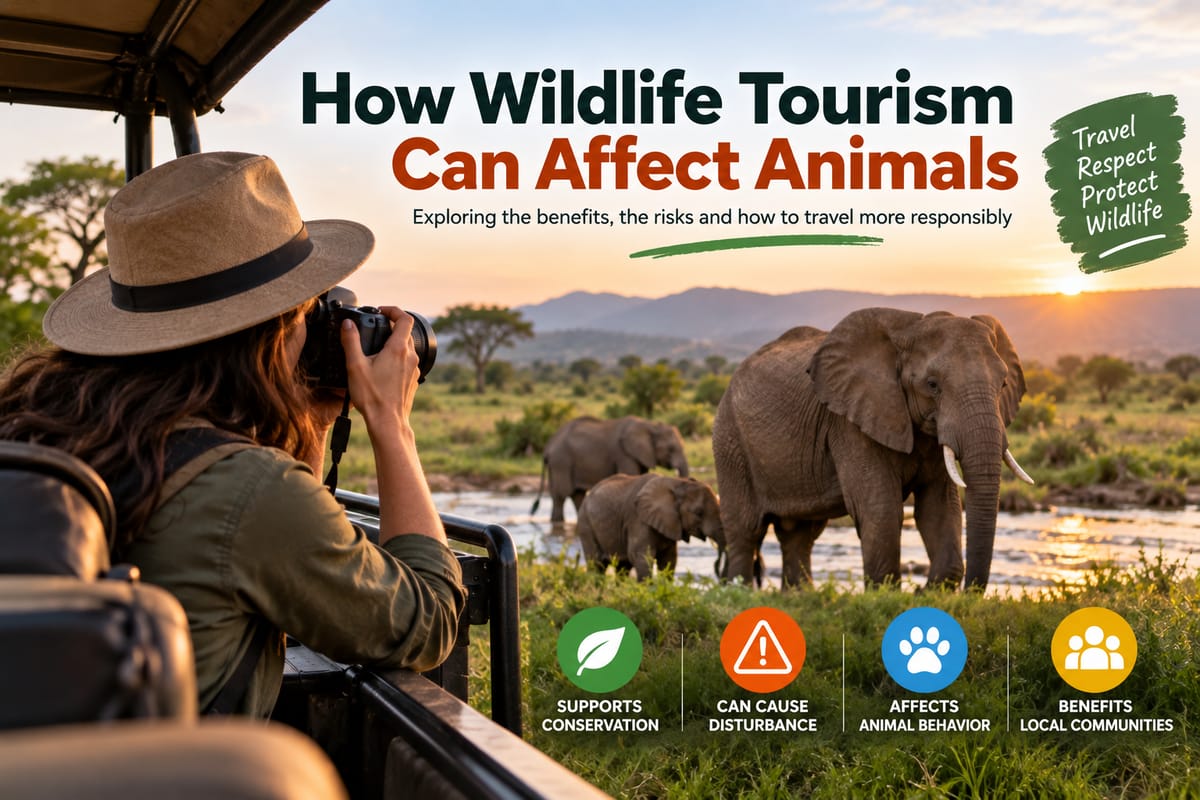
**How Wildlife Tourism Can Affect Animals
Wildlife tourism gives people the opportunity to see animals in their natural environments, learn about ecosystems, and develop a deeper appreciation for nature. Safaris, whale-watching trips, birding excursions, marine tours, and visits to protected areas can create memorable experiences while generating revenue for conservation and local communities.
But wildlife tourism can also affect the animals it is intended to showcase.
The presence of visitors, vehicles, boats, aircraft, noise, artificial lighting, and human activity can change how animals behave. In some destinations, tourism revenue supports habitat protection and anti-poaching programs. In others, poorly managed tourism can contribute to stress, habitat disturbance, feeding changes, or dangerous interactions between people and wildlife.
The effects depend heavily on the species, environment, number of visitors, type of tourism, and how carefully tourism activities are managed.
What Is Wildlife Tourism?
Wildlife tourism involves traveling to observe, photograph, or otherwise experience wild animals.
It can take many forms, including:
- Safari drives
- Whale and dolphin watching
- Birdwatching
- Gorilla and primate trekking
- Marine wildlife excursions
- Wildlife photography tours
- Guided nature walks
- Visits to national parks and protected areas
- Wildlife observation from boats or specialized vehicles
Some experiences take place in completely wild environments, while others occur in managed reserves or conservation areas.
The distinction matters because different settings create different pressures on animals and their habitats.
Why Wildlife Tourism Can Be Valuable
Wildlife tourism can provide economic incentives for protecting natural areas.
Visitors spend money on accommodation, transportation, park fees, guides, food, equipment, and other services. A portion of this economic activity may support conservation programs or provide income to communities living near wildlife habitats.
Tourism can also create employment opportunities for guides, drivers, conservation workers, hospitality staff, researchers, and local businesses.
When communities benefit from wildlife tourism, protecting animals and their habitats may become more closely connected to local economic interests.
However, tourism revenue does not automatically translate into effective conservation. The outcome depends on how tourism is organized, how revenue is distributed, and whether conservation is actually prioritized.
Animals Can Change Their Behavior Around Tourists
Wild animals respond to their surroundings. When vehicles, people, boats, or other disturbances repeatedly enter their environment, animals may alter their behavior.
They might:
- Move away from frequently visited areas
- Become more tolerant of human presence
- Change feeding times
- Alter travel routes
- Spend less time resting
- Change where they reproduce
- Modify communication patterns
- Avoid certain habitats
The significance of these changes varies between species.
The broader principles are explored in How Animal Behavior Works and Why Animals Adapt, which explains how animals respond to environmental pressures and changing conditions.
A behavioral change is not necessarily harmful by itself. The concern arises when repeated disturbances interfere with feeding, reproduction, resting, migration, or other essential activities.
Disturbance Can Affect Feeding
Tourist activity can sometimes interfere with feeding behavior.
If animals repeatedly move away from approaching vehicles or groups of people, they may lose time that would otherwise be spent searching for or consuming food.
This can become more significant when animals already face limited food availability.
Predators may also respond to tourist activity. If vehicles approach hunting animals too closely, the animals may abandon a hunt or change their behavior.
The effects can be difficult to observe because an animal may appear calm while still changing its behavior in response to people.
Tourism Can Affect Reproduction
Breeding and raising young are particularly sensitive periods for many species.
Disturbance near nesting sites, breeding grounds, dens, or areas where young animals are raised can cause animals to change their behavior or move away.
For some species, repeated disturbance can potentially affect reproductive success.
This is one reason wildlife tourism operators may establish seasonal restrictions, minimum distances, designated viewing areas, or limits on visitor numbers in particularly sensitive locations.
Protecting breeding areas can be more important than maximizing opportunities for visitors to see animals at close range.
Young Animals May Be Especially Vulnerable
Young animals can be more sensitive to disturbance because they depend on adults for protection, food, and learning.
In some species, mothers may become defensive when people approach their offspring. In others, repeated disturbances can influence where families rest or feed.
Tourists may also unintentionally disrupt natural learning.
Young animals learn behaviors from adults and their surroundings. If human presence repeatedly changes normal activity, it may influence how animals interact with their environment.
This is particularly relevant for species with complex social structures and long periods of parental care.
Habituation Is Not Always Harmless
Animals that encounter people repeatedly may become accustomed to human presence. This process is known as habituation.
Habituation can make wildlife observation easier because animals may no longer immediately flee when vehicles or people appear.
But reduced fear of humans can sometimes create risks.
Animals may begin approaching roads, campsites, buildings, or people because they associate humans with food or safety. This can increase the possibility of conflict.
Habituation therefore does not automatically mean that tourism is harmless. The long-term consequences depend on the species and circumstances.
Feeding Wild Animals Can Create Problems
One of the most direct ways tourism can change animal behavior is through feeding.
When visitors intentionally feed wild animals, animals may learn to associate humans with food.
This can produce several problems.
Animals may become dependent on human-provided food, approach people aggressively, or spend less time searching naturally for food. Human food may also be inappropriate for their nutritional needs.
Animals that repeatedly approach tourists can create dangerous situations for both people and wildlife.
For these reasons, feeding wildlife is prohibited or restricted in many protected areas.
Wildlife Photography Requires Care
Photography is an important part of modern wildlife tourism, but the desire to capture a close or unusual photograph can sometimes encourage risky behavior.
Visitors may move too close to animals, leave designated paths, use drones where they are prohibited, or encourage guides to approach animals repeatedly.
A photograph may last only a few seconds, while the disturbance caused to an animal can have consequences beyond the moment.
Responsible wildlife photography generally means prioritizing the animal’s welfare over getting a particular image.
Vehicles Can Affect Wildlife
Safari vehicles and other forms of transportation allow people to observe animals without physically approaching them on foot. However, vehicles can still affect wildlife.
Multiple vehicles gathering around a single animal can create noise, restrict movement, or make it difficult for the animal to leave an area.
Vehicle traffic can also contribute to habitat disturbance, particularly in heavily visited areas.
Rules governing vehicle numbers, speed, routes, and minimum viewing distances can help reduce these effects.
Marine Wildlife Tourism Has Its Own Challenges
Whale watching, dolphin tours, snorkeling, diving, and other marine activities can expose aquatic wildlife to boats and swimmers.
Boats can produce underwater noise and may alter animal movement. Repeated approaches can interfere with feeding, resting, communication, or travel.
Propellers also create a physical risk to animals when vessels operate too close to them.
Responsible marine tourism therefore often depends on rules concerning vessel speed, approach direction, distance, and the duration of encounters.
Tourism Can Affect Habitats, Not Just Animals
The effects of wildlife tourism extend beyond direct interactions with animals.
Tourism infrastructure may include roads, lodges, campsites, parking areas, viewing platforms, trails, airstrips, and other facilities.
If poorly planned, development can fragment habitats or disturb areas that animals depend on.
Even seemingly minor changes can matter when they occur in sensitive ecosystems.
Understanding these relationships requires looking at the wider ecological picture. Biodiversity Explained provides useful context for understanding why protecting different species and their habitats matters to healthy ecosystems.
Wildlife Tourism Can Affect Species Interactions
Animals do not exist independently of one another.
Predators, prey, competitors, pollinators, scavengers, and other organisms interact in complex ways. Changing the behavior or distribution of one species can sometimes influence other species.
For example, if tourism repeatedly causes a particular herbivore to avoid an area, predators that normally hunt there may also change their movements.
Likewise, disturbances to nesting or feeding areas can have effects that extend beyond the individual animals directly exposed to tourism.
The broader ecological relationship is explored in How Species Interactions Shape Ecosystems.
Tourism Can Support Conservation
The relationship between tourism and wildlife is not exclusively about potential harm.
Well-managed tourism can help fund conservation.
Entrance fees, tourism taxes, permits, concession fees, and other revenues can contribute to:
- Habitat protection
- Wildlife monitoring
- Anti-poaching efforts
- Scientific research
- Ranger programs
- Community conservation initiatives
- Environmental education
- Infrastructure for protected areas
Tourism can also increase public awareness of threatened species.
A person who observes elephants, gorillas, sea turtles, or whales in the wild may develop a stronger interest in protecting those animals and their habitats.
Local Communities Are Part of the Equation
Wildlife habitats often overlap with areas where people live, work, farm, or operate businesses.
Conservation strategies that ignore local communities can create conflicts.
Tourism can provide alternative sources of income and create opportunities for local residents to participate in guiding, hospitality, conservation, transportation, crafts, and other industries.
When communities receive meaningful benefits from wildlife tourism, they may have stronger economic incentives to support conservation.
The distribution of tourism revenue therefore matters.
A destination can attract large numbers of visitors while local residents receive relatively little of the resulting economic benefit. In such circumstances, tourism may not create the same conservation incentives as a system where communities have a meaningful role and share in the benefits.
Conservation and Tourism Need to Work Together
Wildlife tourism works best when tourism objectives do not override conservation requirements.
This can involve:
- Limiting visitor numbers
- Establishing minimum viewing distances
- Restricting access to sensitive areas
- Creating seasonal closures
- Regulating vehicle traffic
- Training guides
- Prohibiting wildlife feeding
- Managing waste
- Controlling noise
- Monitoring animal behavior
- Educating visitors
The goal is not necessarily to prevent people from experiencing wildlife. Instead, it is to structure tourism around the ecological needs of the animals being observed.
A broader overview of this approach can be found in Conservation Explained: Protecting Nature for Future Generations.
How Tourists Can Reduce Their Impact
Travelers have an important role in responsible wildlife tourism.
Before booking an experience, visitors can research how the operator treats animals and whether the activity follows recognized wildlife-viewing practices.
During an encounter, travelers can:
- Maintain the required distance
- Avoid feeding animals
- Keep noise levels low
- Follow guide instructions
- Stay on designated paths
- Avoid chasing or blocking animals
- Never touch wild animals unless the activity is explicitly designed and managed for appropriate contact
- Avoid using drones where they are restricted
- Take photographs without prioritizing proximity
- Respect temporary closures and viewing limits
The most memorable wildlife experience does not necessarily require getting as close as possible.
Why Responsible Wildlife Tourism Matters
Wildlife tourism exists because people value seeing animals in natural environments. That interest can provide substantial benefits for conservation, communities, and local economies.
But wildlife should remain the priority.
An animal that changes its behavior, abandons food, leaves a breeding area, or approaches humans because of repeated tourist interactions may be experiencing consequences that visitors cannot immediately see.
Good wildlife tourism recognizes that observation should have limits.
Creating Better Wildlife Experiences
The future of wildlife tourism depends partly on finding a balance between access and protection.
Visitors want meaningful encounters with nature. Communities need sustainable economic opportunities. Conservation organizations need resources to protect habitats and species. Tourism operators need viable businesses.
These goals can coexist when tourism is carefully managed.
The most responsible wildlife experiences place the needs of animals and ecosystems at the center of the activity. They give wildlife space, minimize disturbance, support conservation, and help visitors understand that wild animals are not attractions that exist for human entertainment.
When tourism is designed around those principles, seeing wildlife can become more than a memorable travel experience. It can also contribute to a broader effort to protect the species, habitats, and ecological relationships that make those encounters possible.


2 Comments
Micle harison
June 7, 2019Lorem ipsum dolor sit amet, usu ut perfecto postulant deterruisset, libris causae volutpat at est, ius id modus laoreet urbanitas. Mel ei delenit dolores.
John Doe
June 7, 2019Some consultants are employed indirectly by the client via a consultancy staffing company.