
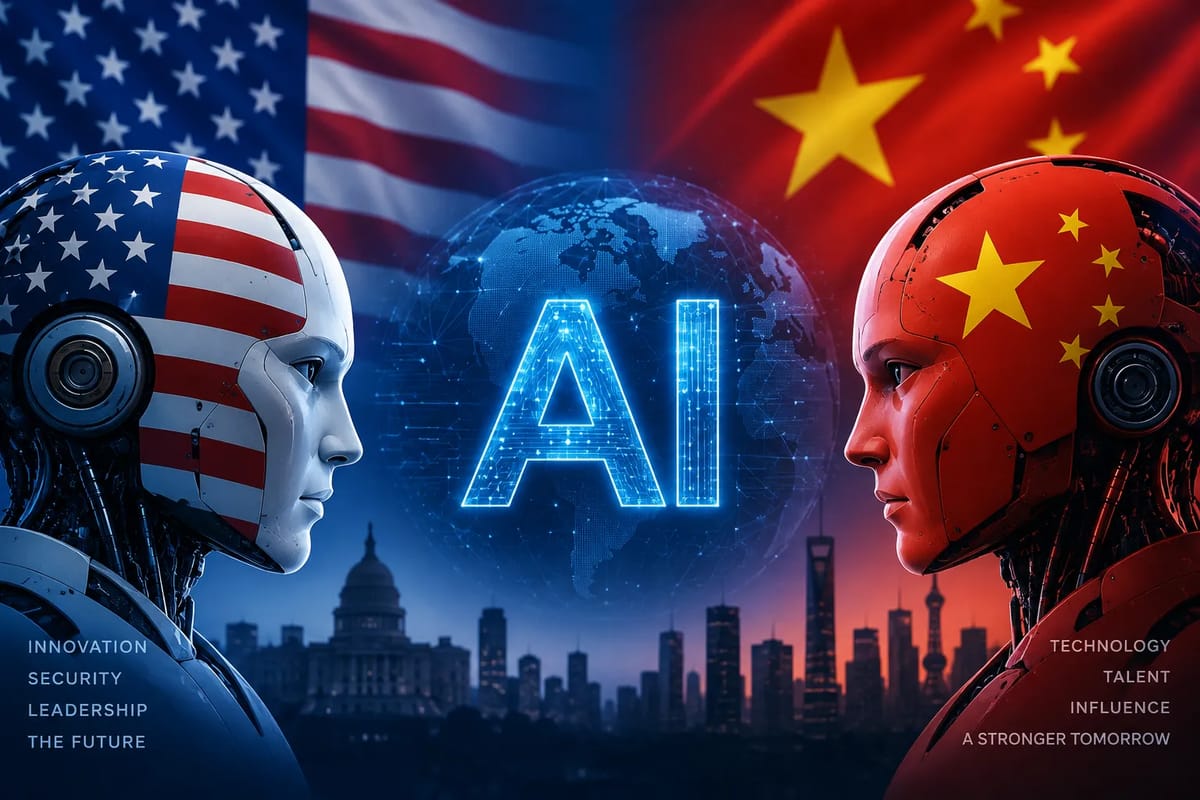
U.S.-China AI Fight Escalates as Washington Accuses Chinese Firms of Copying Frontier AI Models
The competition between the United States and China over artificial intelligence is entering an increasingly contentious phase, as Washington accuses Chinese companies of using techniques that could allow them to reproduce the capabilities of leading U.S. AI models.
The dispute highlights a broader struggle over who will control the technologies, computing infrastructure and intellectual property shaping the next generation of artificial intelligence. It also shows why the rivalry is no longer limited to semiconductor manufacturing or access to advanced chips. The underlying models themselves have become a major strategic asset.
For the United States, concerns about model copying raise questions about intellectual property, national security and the effectiveness of restrictions designed to limit China’s access to cutting-edge AI technology. For China, the rapid development of domestic AI systems demonstrates the country’s determination to reduce its dependence on American technology.
Why the U.S.-China AI Competition Is Intensifying
Artificial intelligence has become one of the most important areas of technological competition between Washington and Beijing.
The United States remains home to many of the world’s leading AI developers, semiconductor companies and cloud-computing providers. American firms have invested heavily in increasingly capable foundation models that can generate text and images, write software, analyze information and perform increasingly complex reasoning tasks.
China, meanwhile, has built a large domestic AI ecosystem involving technology companies, universities, startups and semiconductor manufacturers.
The competition is therefore happening across several interconnected layers:
- Advanced AI models
- AI accelerator chips
- Semiconductor manufacturing
- Cloud computing
- Data centers
- AI research talent
- Software ecosystems
- Intellectual property
- National security applications
The controversy over model copying adds another dimension to this competition because it involves the methods used to reproduce or improve AI capabilities rather than simply developing hardware independently.
What Does AI Model Copying Mean?
AI models are extraordinarily complex systems trained on enormous quantities of data. Developing a frontier model can require substantial computing resources, engineering expertise and research investment.
One technique that has attracted attention is commonly described as model distillation.
In a simplified form, distillation allows one AI system to learn from the outputs of another system. Instead of directly obtaining the underlying proprietary model, developers can use responses generated by a more capable model as training material for another model.
Distillation itself is not inherently illegitimate. It is a well-established technique in machine learning and can be used for legitimate research and engineering purposes.
The controversy arises when developers allegedly use large quantities of outputs from proprietary models in ways that violate contractual restrictions, intellectual-property protections or other rules.
That distinction is important because demonstrating that two models behave similarly does not automatically establish that one company illegally copied another company’s technology.
Determining what actually happened can require examining training data, model behavior, technical documentation, access records and the terms governing the use of the original AI system.
Why Frontier AI Models Matter
The stakes are particularly high because frontier AI models are becoming increasingly capable.
The most advanced systems are moving beyond simple question answering. Depending on the model and application, they can assist with programming, research, mathematical reasoning, document analysis, planning and other sophisticated tasks.
This raises a larger question about where AI development is heading.
For readers interested in the broader evolution of increasingly capable artificial intelligence, What Is Artificial General Intelligence? provides useful context on the concept of machines eventually performing a much broader range of intellectual tasks.
The distinction between today’s specialized AI systems and hypothetical artificial general intelligence is significant. Nevertheless, the rapid improvement of foundation models is one reason governments increasingly view advanced AI as strategically important.
Washington’s Concerns Go Beyond Intellectual Property
Accusations of AI model copying are not simply about commercial competition.
The U.S. government has increasingly treated advanced artificial intelligence as a national-security issue. Washington’s policies toward China have included restrictions involving sophisticated semiconductor technology, advanced computing equipment and other technologies that could contribute to high-end AI development.
The underlying concern is that access to advanced AI capabilities could have implications for:
- Military research
- Cybersecurity
- Intelligence operations
- Surveillance
- Autonomous systems
- Scientific research
- Industrial competitiveness
- Critical infrastructure
If a company can obtain the capabilities of a frontier model without making comparable investments in training and computing, policymakers may see that as undermining technology controls intended to slow or constrain strategic competitors.
The question then becomes considerably larger than whether one company has copied another company’s software.
China’s AI Industry Is Becoming More Self-Sufficient
China has spent years attempting to build a technology ecosystem that is less dependent on American suppliers.
That effort has become particularly important as U.S. restrictions have made access to some of the world’s most advanced AI chips and semiconductor manufacturing technologies more difficult.
Chinese companies have responded by investing in domestic chips, AI models, cloud infrastructure and software.
The country’s semiconductor ambitions are especially important because powerful AI models require enormous amounts of computing power.
Our coverage of the semiconductor side of this competition, China’s AI Chip Race Accelerates as SMIC Raises Prices on Surging Demand, examines how rising demand for domestic AI hardware reflects the broader push to expand China’s computing capabilities.
The model and hardware races are closely connected. A country can develop sophisticated AI algorithms, but its ability to train and deploy them at scale ultimately depends on access to sufficient computing infrastructure.
AI Model Competition Is Becoming a Technology Arms Race
The phrase “AI arms race” is often used loosely, but the competition between the world’s two largest economies increasingly has characteristics associated with a strategic technology race.
Each side has incentives to move quickly.
For American companies, staying ahead can mean maintaining technological leadership, attracting investment and establishing dominant AI platforms.
For Chinese companies, closing the gap can reduce dependence on foreign technology and strengthen domestic capabilities.
Governments also have incentives to support their respective industries.
This creates a feedback loop:
- New AI capabilities increase strategic importance.
- Governments introduce policies designed to protect technological advantages.
- Restrictions encourage domestic alternatives.
- Domestic alternatives improve.
- Competition increases further.
- Companies invest more heavily in research and infrastructure.
The result can be a cycle in which technological development and geopolitical policy increasingly influence one another.
The Role of AI Chips Cannot Be Ignored
The model controversy is only one part of a much larger technological battle.
Advanced AI requires specialized computing hardware. Graphics processing units and other accelerators are used to train and run large models, while data centers require enormous quantities of electricity, networking equipment and cooling infrastructure.
This makes semiconductor policy central to AI policy.
Restrictions on advanced chips are intended in part to limit access to computing capabilities that could support sophisticated AI development. But restrictions can also create incentives for domestic semiconductor companies to develop alternatives.
That is one reason China’s progress in AI hardware deserves attention alongside developments in its AI models.
Could Model Copying Accelerate AI Development?
There is an interesting technological paradox at the center of the dispute.
If capable models can be used to help train other capable models, the cost and time required to develop competitive systems could potentially fall.
That could accelerate innovation across the industry.
Smaller companies might gain access to capabilities that would otherwise require enormous research budgets. Researchers could experiment with more efficient architectures. Developers could potentially create smaller models capable of performing sophisticated tasks at lower computational costs.
But the same process creates difficult questions about intellectual property and incentives.
If companies believe competitors can simply reproduce the capabilities of their most expensive models, they may have less incentive to invest billions of dollars in research and infrastructure.
The industry therefore faces a difficult balance between encouraging technological diffusion and protecting the investments that make frontier AI development possible.
What This Means for American AI Companies
For U.S. AI companies, the controversy could lead to greater emphasis on protecting model outputs and technical systems.
Companies may strengthen restrictions around API access, monitor unusual usage patterns and develop techniques designed to make unauthorized model replication more difficult.
They may also become more cautious about how much information their systems reveal through public interfaces.
At the same time, companies have to maintain useful products. An AI system that becomes excessively restrictive can be less attractive to legitimate users.
This creates a technical and commercial challenge: companies must make their models useful while protecting valuable intellectual property.
What This Means for Chinese AI Developers
Chinese AI companies face a different set of challenges.
They must continue improving their models while operating under restrictions affecting access to some advanced chips and computing technologies.
Domestic development therefore becomes increasingly important.
Companies that can achieve competitive performance using domestically available hardware and software could gain a major strategic advantage.
Success would not necessarily require Chinese models to reproduce every capability of American systems. Instead, developers could pursue alternative architectures, more efficient training methods and specialized models optimized for particular applications.
That could produce a more diverse global AI ecosystem.
The Apple Example Shows How Competition Is Spreading
The technology rivalry is also affecting multinational companies operating between the two markets.
Apple’s efforts to adapt its AI strategy for China demonstrate how difficult it can be for global technology companies to operate across competing technology ecosystems.
Our related analysis, Apple’s China AI Strategy Takes Shape as the iPhone Maker Builds a Localized Apple Intelligence Model, looks at how AI localization can become necessary when regulatory requirements, infrastructure and technology partnerships differ between markets.
This trend could become increasingly important.
Instead of one globally identical AI ecosystem, the industry could gradually develop separate regional ecosystems with different models, hardware, regulations and cloud infrastructure.
Could the World End Up With Two AI Ecosystems?
One of the most consequential long-term possibilities is technological fragmentation.
The United States and its allies could increasingly develop around one set of AI standards, hardware suppliers and software platforms, while China and its partners develop another.
Such fragmentation could affect more than AI companies.
It could influence:
- Smartphones
- Cloud computing
- Enterprise software
- Data centers
- Robotics
- Autonomous vehicles
- Scientific computing
- Cybersecurity
- Consumer applications
Companies operating globally could be forced to develop different products for different markets.
That would increase costs and potentially slow the spread of new technologies.
However, competition could also encourage innovation as different ecosystems experiment with different approaches.
The Bigger Question Is Who Controls the AI Stack
The dispute over model copying ultimately points toward a broader issue: control of the AI stack.
The AI stack includes everything from semiconductor manufacturing and computing infrastructure to foundation models, applications and distribution platforms.
Control at any single layer can provide strategic advantages.
A company might have an exceptional model but depend on foreign chips. Another might have strong domestic hardware but weaker software. A third might control a major consumer platform capable of distributing AI services to hundreds of millions of people.
The countries and companies that can integrate the greatest number of these layers may ultimately have the strongest position.
This is why the U.S.-China AI competition cannot be understood simply by comparing individual chatbot models.
Why the Dispute Could Shape AI’s Next Decade
The accusations surrounding AI model copying are likely to become part of a much larger debate about how advanced artificial intelligence should be developed and governed.
Governments will have to decide how intellectual-property rules apply to AI-generated outputs. Companies will need to determine how much access users should have to powerful models. Researchers will continue debating the boundaries between legitimate knowledge transfer and unauthorized replication.
Meanwhile, technological progress will continue.
The United States has significant advantages in AI research, semiconductor design, cloud infrastructure and venture investment. China has enormous engineering talent, a huge technology market and substantial state and private-sector investment in AI and semiconductor development.
Neither side has an obvious path to permanently ending the competition.
The AI Race Is Becoming a Race Over Knowledge
The most important development may be that the AI competition is moving beyond the question of who can build the biggest model.
The next phase could revolve around who can develop the most efficient models, secure the necessary computing infrastructure, protect intellectual property and deploy advanced AI at massive scale.
If AI capabilities can increasingly be transferred from one system to another, technological leadership could become harder to protect—and easier for competitors to challenge.
That makes the U.S.-China dispute about more than accusations of copying. It is increasingly a contest over who develops, controls and benefits from the intelligence technologies that will shape the next era of computing.




2 Comments
Micle harison
June 7, 2019Lorem ipsum dolor sit amet, usu ut perfecto postulant deterruisset, libris causae volutpat at est, ius id modus laoreet urbanitas. Mel ei delenit dolores.
John Doe
June 7, 2019Some consultants are employed indirectly by the client via a consultancy staffing company.