
What Could Happen to the Universe in the Future?
The universe is changing all the time.
Galaxies are moving apart, stars are being born and dying, black holes are growing, and the overall structure of the cosmos continues to evolve. But what happens when we look far beyond the timescales of human history?
The future of the universe could extend for trillions upon trillions of years—and potentially far longer.
Scientists cannot predict every detail of what will happen because the distant future depends on fundamental properties of the universe that are still being studied. However, modern cosmology provides several broad possibilities for how the cosmos could evolve.
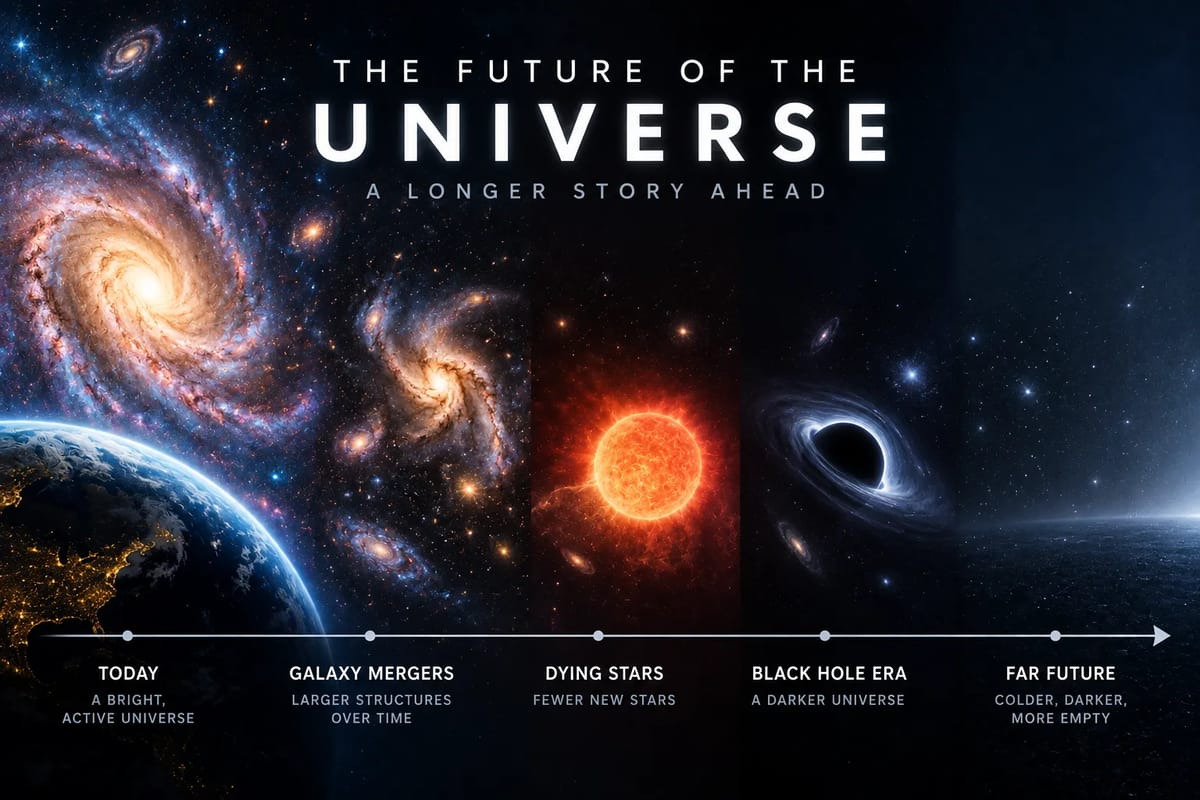
The most widely discussed scenario involves a universe that continues expanding indefinitely, eventually becoming colder, darker, and increasingly dominated by remnants of stars and black holes.
Understanding these possibilities requires looking at the universe as a constantly evolving system rather than something that remains fixed.
For a broader foundation, The Complete Guide to Astronomy explains the major concepts scientists use to study stars, galaxies, planets, and the universe itself.
The Universe Is Still Expanding
One of the most important facts about the universe’s future is that space itself is expanding.
Distant galaxies are generally moving away from one another as the universe expands. This does not mean that galaxies are necessarily flying through space from a single central point. Instead, the distances between large-scale structures increase as space expands.
Observations indicate that this expansion is accelerating.
A mysterious component called dark energy is thought to be responsible for much of this accelerated expansion, although scientists do not yet fully understand what dark energy actually is.
The nature of dark energy is therefore one of the biggest unanswered questions in modern cosmology.
If the accelerated expansion continues indefinitely, it will profoundly influence the universe’s long-term future.
What Happens to Galaxies?
The expansion of the universe does not affect every structure in exactly the same way.
Gravity can hold nearby galaxies together even while the universe expands on much larger scales.
Our own galaxy, the Milky Way, belongs to a group of galaxies known as the Local Group. Over extremely long timescales, gravitational interactions can cause galaxies within such groups to merge.
The Milky Way and the Andromeda Galaxy, for example, are expected to interact and eventually merge as their gravitational relationship evolves.
The result would be a much larger galaxy formed from the merger of the two systems.
This illustrates an important point about cosmic evolution: the universe can simultaneously expand overall while gravitationally bound structures merge locally.
Stars Will Not Shine Forever
Stars are powered by nuclear fusion.
During their lives, stars convert lighter elements into heavier ones and release enormous amounts of energy in the process.
But a star eventually runs out of the fuel needed to sustain its current form.
Different stars meet this fate in different ways.
Small stars can remain active for extraordinarily long periods. Red dwarf stars, for example, may continue producing energy for trillions of years because they consume their nuclear fuel very slowly.
Massive stars have much shorter lives. Some eventually explode as supernovae, leaving behind neutron stars or black holes.
Over extremely long periods, however, star formation is expected to decline.
Galaxies will gradually contain fewer clouds of cold gas capable of producing new generations of stars.
Eventually, the universe could enter an era in which active stars become increasingly rare.
The Era of Fewer and Fewer Stars
Today, the universe contains an enormous number of stars.
But star formation requires raw materials.
New stars generally form when clouds of gas collapse under gravity. As galaxies consume or lose their available gas, fewer new stars can form.
The universe therefore has a limited supply of easily available material for future star formation.
Some gas can be recycled when stars die, but the overall process does not continue indefinitely.
Over immense timescales, the population of active stars should gradually decline.
Eventually, many galaxies could become dominated by stellar remnants rather than bright, newly formed stars.
These remnants may include:
- White dwarfs
- Neutron stars
- Black holes
- Brown dwarfs
- Other cold stellar objects
The night sky of such a distant universe would look dramatically different from the one we observe today.
What Happens After the Stars Die?
Once most ordinary stars have disappeared, the universe would enter a very different stage of its history.
White dwarfs would remain as extremely dense stellar remnants. Neutron stars would continue to exist under extraordinary gravitational conditions. Black holes would become some of the most important remaining objects in the cosmos.
Some remnants could continue interacting gravitationally.
Objects could collide, merge, or be ejected from galaxies.
Over time, however, the universe would become increasingly dark.
This transition is sometimes described as the beginning of a degenerate era, in which the cosmos contains mostly stellar remnants and other compact objects rather than active stars.
Black Holes Could Dominate the Distant Universe
Black holes are among the most extreme objects known to exist.
They form when enough matter becomes compressed into a region where gravity becomes extraordinarily strong.
Many galaxies contain enormous supermassive black holes at their centers.
As stars disappear and galaxies evolve, black holes could become increasingly significant components of the remaining universe.
But black holes themselves may not last forever.
According to theoretical physics, black holes can gradually lose energy through a process known as Hawking radiation.
For large black holes, this process would take an extraordinarily long time.
The lifetime of a massive black hole could be vastly longer than the current age of the universe.
Eventually, however, if Hawking radiation accurately describes the long-term behavior of black holes, even these objects could disappear.
The Universe Could Eventually Become Extremely Dark
If stars stop forming and existing stars eventually die, there would be progressively fewer sources of visible light.
Galaxies would become darker.
The cosmic environment would become colder.
Matter would become increasingly dispersed as the expansion of the universe continued.
This leads to one of the most widely discussed possibilities for the universe’s ultimate fate: heat death, sometimes called the Big Freeze.
Despite the dramatic name, heat death does not necessarily mean that everything becomes physically hot.
Instead, it refers to a state in which energy becomes so evenly distributed that there are no significant differences in temperature or energy density available to drive large-scale physical processes.
The universe would approach a state of maximum entropy.
What Is the Big Freeze?
The Big Freeze is the scenario in which the universe continues expanding indefinitely.
As expansion continues, galaxies outside gravitationally bound regions would become increasingly distant.
Matter would become more spread out.
Star formation would decline.
Existing stars would eventually die.
Black holes could eventually evaporate.
The universe would then approach an extremely cold, dark, dilute state.
There would still be particles and radiation, but the organized structures that dominate today’s universe would largely disappear.
This scenario is closely connected to the idea that the universe’s expansion will continue accelerating for the foreseeable future.
Could the Universe Eventually Tear Itself Apart?
Another theoretical possibility is known as the Big Rip.
In this scenario, the accelerated expansion of the universe would become increasingly powerful.
If dark energy had particular properties that caused its influence to strengthen over time, the expansion could eventually become strong enough to overcome progressively stronger gravitational and other forces.
First, large structures could be disrupted.
Eventually, galaxies could be pulled apart.
In an extreme version of the scenario, even stars, planets, and smaller structures could ultimately be disrupted.
The Big Rip is not currently the leading expectation for the universe’s fate. It represents a possible outcome under certain assumptions about the nature of dark energy.
Understanding Understanding the Universe and How It Evolves helps place these competing possibilities within the broader study of cosmic evolution.
Could the Universe Stop Expanding?
Another possibility would involve the expansion of the universe slowing dramatically or eventually reversing.
If gravity were strong enough relative to the universe’s expansion, the cosmos could theoretically stop expanding and begin contracting.
This hypothetical scenario is often called the Big Crunch.
During a Big Crunch, galaxies would move closer together as the universe contracted. Temperatures and densities would increase, eventually producing an extremely compressed cosmic state.
For many years, the Big Crunch was considered one of the major possibilities for the universe’s ultimate fate.
However, observations of accelerated cosmic expansion have made a straightforward future collapse considerably less favored under current cosmological models.
The ultimate outcome still depends on what dark energy actually is and how its properties behave over cosmic time.
Could the Universe Go Through Another Beginning?
Some theoretical models propose that a collapsing universe could potentially lead to another expansion.
This idea is sometimes associated with a Big Bounce.
Instead of the universe ending in a final singular state, contraction could reach an extreme condition and transition into another expanding phase.
Such models appear in some approaches to quantum cosmology and other theoretical frameworks.
However, a Big Bounce remains hypothetical.
There is currently no established evidence showing that our universe will eventually collapse and begin another expansion cycle.
What Happens to Matter Over Immense Timescales?
The distant future is not only about galaxies and stars.
Matter itself may change.
Some theories of particle physics predict that protons could eventually decay. If proton decay occurs, ordinary matter would gradually disappear over extraordinarily long timescales.
However, proton decay has not been experimentally confirmed.
If protons are ultimately stable, matter could persist much longer than some models predict.
This is one example of how uncertainties in fundamental physics affect predictions about the universe’s distant future.
Cosmology can make powerful predictions, but those predictions sometimes depend on physics that has not yet been completely established.
What Happens to Time in the Far Future?
Time itself would continue to pass in an expanding universe.
But the meaning of events would change dramatically.
Today, the universe is filled with processes occurring across many different scales. Stars form, planets orbit, galaxies interact, chemical reactions occur, and life exists.
In a very distant future dominated by cold remnants and widely separated particles, there would be far fewer processes capable of producing noticeable changes.
Time would still exist as part of the physical description of the universe, but the cosmos could become increasingly uneventful.
The universe would not necessarily “stop.”
Rather, there could simply be progressively fewer significant events.
The Universe’s Future Depends on Dark Energy
Dark energy may be the single most important unknown when thinking about the ultimate fate of the cosmos.
Scientists know that the expansion of the universe is accelerating, but they do not yet know the fundamental nature of the phenomenon responsible.
One possibility is that dark energy is a cosmological constant—a constant property of empty space.
If that interpretation is correct, continued accelerated expansion and a gradual approach toward a cold, dilute universe become natural expectations.
Other possibilities exist.
Dark energy could potentially change over time or have properties that produce a different cosmic outcome.
Future observations may help determine which model best describes reality.
What We Can Learn From the Universe’s Beginning
Looking toward the future also requires understanding the universe’s past.
According to the standard cosmological model, the observable universe evolved from an extremely hot, dense early state and has been expanding and changing for billions of years.
The story of how that early universe developed is essential for understanding where it may eventually go.
How Did the Universe Begin and What Happened After the Big Bang? explores the early stages of cosmic history and provides important context for understanding the universe’s long-term evolution.
The same physical laws that help explain the early universe also allow scientists to construct models of its future.
How Large Is the Universe?
There is another major complication when thinking about the universe’s future: we do not know the full size of the universe.
Scientists can observe only the portion from which light or other information has had time to reach us.
This region is known as the observable universe.
The entire universe could be much larger than the observable portion—and it could potentially be infinite.
How Large Is the Known Universe? explores the distinction between the observable universe and the universe as a whole.
This distinction matters because cosmic expansion can eventually place distant regions beyond our ability to observe them.
What Would the Night Sky Look Like?
The night sky could eventually become almost unrecognizable.
As the universe expands, galaxies that are not gravitationally bound to our local region can become increasingly distant.
Their light becomes increasingly difficult to detect.
Over enormous timescales, observers in a distant future galaxy could see a much emptier sky.
Eventually, many galaxies that are visible today could disappear beyond the observable horizon.
This creates an intriguing consequence of cosmic expansion: future civilizations, if any survive that long, could have access to less observational evidence about the universe’s history than we do today.
The universe may become harder to observe precisely because it continues expanding.
Could Life Survive That Long?
Whether life can survive into the distant future is a separate question from the fate of the universe itself.
Life requires suitable sources of energy and stable environments.
As stars become less common, naturally occurring environments capable of supporting life could become increasingly rare.
However, it is difficult to predict what hypothetical future civilizations might be capable of doing.
Advanced technologies could potentially allow life to use energy sources differently from the way modern organisms do.
Civilizations could theoretically adapt to changing cosmic conditions, migrate between environments, or develop technologies that are currently impossible.
These possibilities move beyond established cosmology and into speculation, but they demonstrate how uncertain the very distant future remains.
The Most Likely Cosmic Future
Based on the current standard cosmological picture, the universe is expected to continue expanding.
If dark energy behaves approximately like a cosmological constant, the expansion will continue for an extraordinarily long time.
Galaxies will evolve and merge within gravitationally bound regions.
Star formation will gradually decline.
Existing stars will eventually disappear.
Stellar remnants will dominate increasingly dark galaxies.
Black holes will remain important for enormous stretches of cosmic time.
Eventually, even black holes could evaporate if Hawking radiation operates as predicted.
The universe would then approach an extremely cold, dilute, high-entropy state.
This is the broad picture associated with the Big Freeze or heat-death scenario.
Why the Universe’s Future Is Still an Open Question
It is tempting to describe the universe’s fate as if scientists already know exactly what will happen.
They do not.
The broad behavior of cosmic expansion is well studied, but the ultimate fate of the universe depends on questions that remain unresolved.
The nature of dark energy is still uncertain.
The behavior of matter over extreme timescales is not completely known.
The properties of black holes are still being investigated.
Fundamental physics may eventually reveal phenomena that change our understanding of cosmic evolution.
For that reason, scientists distinguish between well-supported predictions and speculative possibilities.
The Big Freeze currently provides a compelling framework for a universe with continued accelerated expansion, while scenarios such as the Big Rip and Big Crunch illustrate what could happen under different physical assumptions.
A Universe That Keeps Changing
The most remarkable thing about the universe may be that there is no single moment when its evolution simply stops.
Stars transform into remnants.
Galaxies merge and change shape.
Black holes grow and potentially evaporate.
Matter can be transformed.
Space continues to expand.
Over unimaginable periods of time, the bright and structured universe we see today could gradually give way to something much darker, colder, and emptier.
Yet even that distant future depends on fundamental questions that humanity is still trying to answer.
The universe is already billions of years old, but in many ways its story has only just begun. The stars, galaxies, planets, and structures visible today represent one stage in an enormously longer cosmic history—and whatever ultimately happens, the future of the universe will be determined by the same physical laws that have shaped it from its earliest moments.


2 Comments
Micle harison
June 7, 2019Lorem ipsum dolor sit amet, usu ut perfecto postulant deterruisset, libris causae volutpat at est, ius id modus laoreet urbanitas. Mel ei delenit dolores.
John Doe
June 7, 2019Some consultants are employed indirectly by the client via a consultancy staffing company.