
What Is Global Warming and How Does It Work?
Global warming is one of the most important environmental changes happening on Earth, but the basic science behind it is surprisingly straightforward.
At its core, global warming means a long-term rise in Earth’s average surface temperature. The planet has experienced natural climate changes throughout its history, but the warming observed over the modern industrial era is occurring primarily because human activities have increased the concentration of heat-trapping gases in the atmosphere.
Understanding global warming starts with understanding how Earth normally regulates its temperature, what greenhouse gases do, and what happens when the balance between incoming and outgoing energy changes.
For a broader explanation of the subject, Climate Change Explained provides a useful foundation for understanding how global warming fits into the larger climate system.
What Is Global Warming?
Global warming is the long-term heating of Earth’s surface and lower atmosphere.
The word “global” is important because the phenomenon refers to a change in the average temperature of the planet as a whole. Individual locations can experience periods of cooling, unusual weather, or temperatures that differ significantly from the global trend.
Global warming is also different from weather.
Weather describes short-term conditions such as today’s temperature, rainfall, wind, or storms. Climate describes patterns in weather over much longer periods.
That distinction explains why a single cold winter does not contradict global warming. Short-term weather naturally fluctuates, while global warming describes a long-term change in Earth’s average temperature.
Climate change is the broader term. It includes global warming as well as changes in rainfall, sea levels, ice, ecosystems, extreme weather patterns, and other components of the Earth system.
How Does Earth’s Temperature Normally Work?
To understand global warming, it helps to start with the Sun.
Solar energy reaches Earth through space. Some of that incoming energy is reflected back into space by clouds, ice, snow, and other bright surfaces. The rest is absorbed by Earth’s land, oceans, and atmosphere.
The surface then releases some of that absorbed energy as infrared radiation, or heat.
This creates a continuous energy exchange:
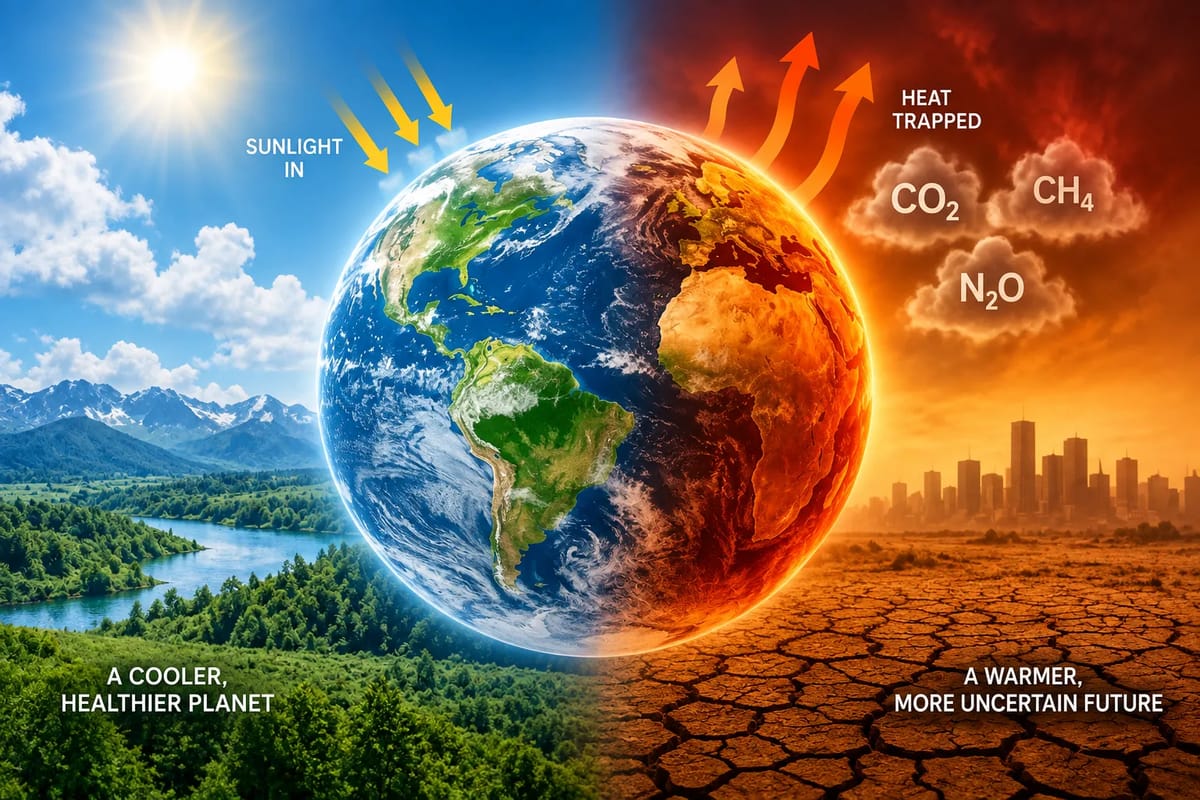
Sunlight enters → Earth’s surface absorbs energy → Earth releases heat → some heat escapes into space.
If the amount of energy entering the Earth system and the amount leaving it remain broadly balanced, Earth’s average temperature remains relatively stable.
But if the planet temporarily retains more energy than it sends back into space, the climate system warms.
That is the basic physical problem at the heart of global warming.
What Is the Greenhouse Effect?
The greenhouse effect is a natural process that keeps Earth warm enough to support life.
Certain gases in the atmosphere can absorb some of the infrared radiation released by Earth’s surface. They then emit energy in different directions, including back toward the surface.
This slows the rate at which heat escapes into space.
Without the natural greenhouse effect, Earth’s average surface temperature would be dramatically colder. NASA estimates that the natural greenhouse effect keeps Earth’s average surface temperature around 15°C rather than roughly 33°C colder.
So the greenhouse effect itself is not a problem.
It is essential to life.
The problem is that human activities have increased the concentration of several greenhouse gases, strengthening the natural greenhouse effect and changing Earth’s energy balance.
For a deeper look at the mechanism itself, Understanding How Climate Change Works explores the broader physical processes involved.
Which Gases Cause the Greenhouse Effect?
Several gases contribute to Earth’s greenhouse effect.
The most important include:
- Carbon dioxide (CO₂)
- Methane (CH₄)
- Nitrous oxide (N₂O)
- Water vapor
- Ozone
- Certain industrial gases
These gases do not all behave in exactly the same way. They differ in how strongly they absorb infrared radiation, how long they remain in the atmosphere, and where they come from.
Carbon dioxide receives particular attention because human activities release enormous quantities of it, especially through the burning of coal, oil, and natural gas.
Methane is released through sources including fossil fuel production, agriculture, livestock, wetlands, and landfills.
Nitrous oxide is associated with processes including agricultural activities and fertilizer use.
Water vapor is also an important greenhouse gas, but it behaves differently from gases such as carbon dioxide. As the atmosphere warms, it can hold more water vapor, creating a feedback that can amplify warming rather than acting as the original long-term forcing.
The relationship between these gases and temperature is explained in more detail in How Greenhouse Gases Affect Climate.
How Human Activity Increases Global Warming
The modern increase in greenhouse gases is closely connected to human economic activity.
For more than a century, societies have burned fossil fuels to generate electricity, heat buildings, manufacture products, operate machinery, and transport people and goods.
When fossil fuels are burned, carbon that was stored underground for millions of years is released into the atmosphere primarily as carbon dioxide.
Human activities also affect greenhouse gas concentrations through land-use changes, agriculture, industrial processes, and other activities.
Deforestation is particularly important because forests and other ecosystems can absorb carbon dioxide. Removing or degrading those ecosystems can reduce the amount of carbon that is removed from the atmosphere while sometimes releasing additional stored carbon.
NASA reports that atmospheric carbon dioxide has increased substantially since the Industrial Revolution, with human activities identified as the primary cause of the increase.
Why More Carbon Dioxide Causes Warming
Carbon dioxide is invisible and makes up only a small fraction of Earth’s atmosphere, but its effect on the climate is significant.
The key is not simply how much of a gas exists in the atmosphere. It is how that gas interacts with infrared radiation.
Earth’s surface absorbs sunlight and releases energy as infrared radiation. Greenhouse gases absorb some of this outgoing infrared energy and subsequently emit radiation.
When greenhouse gas concentrations increase, the atmosphere becomes more effective at slowing the loss of heat to space.
The climate system then adjusts.
As more energy remains within the Earth system, surface and atmospheric temperatures rise until the planet reaches a new energy balance.
This is why global warming is fundamentally an energy-balance problem rather than simply a matter of the atmosphere becoming “hotter.”
Is the Sun Causing Global Warming?
The Sun is Earth’s primary source of energy, so it is reasonable to ask whether changes in solar activity could explain modern warming.
Solar activity does vary over time, and changes in solar energy have contributed to some climate changes in Earth’s past.
However, measurements show that changes in the Sun cannot explain the long-term warming observed during the modern era.
NASA notes that the amount of solar energy reaching Earth has not shown the sustained increase that would be required to explain the observed warming trend. Scientists have also observed different temperature patterns within the atmosphere than would be expected if increased solar energy were the main cause.
The evidence instead points strongly toward the increase in human-produced greenhouse gases as the principal driver of modern global warming.
What Is the Difference Between Global Warming and Climate Change?
The two terms are closely connected but do not mean exactly the same thing.
Global warming refers specifically to the long-term increase in Earth’s average temperature.
Climate change describes the wider set of long-term changes occurring throughout the climate system.
These changes can include:
- Rising average temperatures
- Melting glaciers and ice sheets
- Declining sea ice
- Rising sea levels
- Changes in precipitation
- Shifting growing seasons
- Changes in ecosystems
- More frequent or intense heat extremes in many regions
- Changes in some patterns of drought and heavy rainfall
Global warming is therefore one major component of climate change.
Think of global warming as one central part of a much larger system of environmental changes.
Why the Atmosphere Matters So Much
Earth’s atmosphere is not simply a layer of air surrounding the planet. It is an active part of the climate system.
The atmosphere contains gases, water vapor, aerosols, and clouds that interact with sunlight and infrared radiation.
It also moves heat and moisture around the planet.
That is why understanding the atmosphere is essential to understanding climate.
For readers who want to explore the broader system, Complete Guide to Earth’s Atmosphere, Weather and Air provides additional context about the atmosphere and the processes that shape weather and climate.
What Are Climate Feedbacks?
Global warming does not simply produce a one-for-one increase in temperature.
Once the climate begins changing, other processes can amplify or reduce the original change. These processes are called climate feedbacks.
One important example is water vapor.
Warmer air can hold more water vapor. Because water vapor is itself a greenhouse gas, increased atmospheric moisture can contribute to additional warming.
Ice and snow provide another important example.
Bright surfaces such as snow and ice reflect a significant portion of incoming sunlight. When warming causes some of that ice or snow to disappear, darker land or ocean surfaces can absorb more solar energy.
That can contribute to additional warming.
Clouds can have both warming and cooling effects, depending on their characteristics, altitude, location, and other factors. Their overall influence is an important part of climate research.
Why Oceans Matter
The oceans play a major role in Earth’s climate because water can absorb and store enormous amounts of heat.
When the atmosphere warms, the ocean takes up a substantial portion of the additional energy entering the climate system.
Oceans also interact with carbon dioxide.
They absorb carbon dioxide from the atmosphere, making them an important part of the global carbon cycle. But absorbing additional carbon dioxide also changes ocean chemistry and contributes to ocean acidification.
This means global warming is not simply an atmospheric phenomenon.
It involves the atmosphere, oceans, land, ice, ecosystems, and living organisms interacting as one connected Earth system.
Why Global Warming Does Not Mean Every Place Gets Warmer
The phrase “global warming” can sometimes create the mistaken impression that every location on Earth should experience identical temperature increases.
The climate system is much more complicated.
Different regions warm at different rates. Some areas experience stronger changes in precipitation, while others may experience significant changes in drought, snow, or extreme heat.
Ocean currents, atmospheric circulation, land characteristics, elevation, ice cover, and many other factors influence how warming is expressed locally.
As a result, global warming describes a planetary trend rather than a uniform temperature increase everywhere.
How Scientists Know Global Warming Is Happening
Scientists do not rely on a single thermometer or a single measurement.
Evidence comes from many independent sources.
Researchers monitor:
- Surface temperatures
- Ocean temperatures
- Satellite observations
- Glacier and ice-sheet changes
- Sea levels
- Arctic sea ice
- Atmospheric greenhouse gas concentrations
- Ocean chemistry
- Long-term weather records
- Paleoclimate evidence
When these different measurements are considered together, they reveal consistent evidence of a warming planet and associated changes throughout the climate system.
The strength of the evidence comes partly from the fact that different measurement systems tell a consistent story.
Why Global Warming Matters
A warmer planet can affect natural systems and human societies in many ways.
Rising temperatures can influence agriculture, water availability, ecosystems, infrastructure, energy demand, public health, and coastal communities.
Sea-level rise creates particular challenges for low-lying coastal areas.
Changing temperatures can also shift the geographic ranges of plants and animals, alter growing conditions, and influence the timing of seasonal biological events.
The consequences are not identical everywhere. Geography, economic resources, infrastructure, adaptation measures, and local environmental conditions all influence how communities experience climate change.
That makes global warming both a scientific issue and a practical challenge for societies around the world.
Can Global Warming Be Reversed?
The answer depends on what “reversed” means.
Some climate changes can eventually stabilize or improve if greenhouse gas concentrations stop increasing and, in some circumstances, decline.
However, the climate system has considerable inertia.
Carbon dioxide can remain in the atmosphere for a long time, and oceans and ice respond to warming over different timescales.
That means reducing greenhouse gas emissions can slow the rate of warming, but it does not instantly return the planet to an earlier climate.
The distinction is important.
Reducing emissions primarily addresses the cause of additional warming. Removing carbon dioxide from the atmosphere can potentially address part of the accumulated greenhouse gas burden, but large-scale carbon removal also presents technological, economic, environmental, and logistical challenges.
What Happens Next Depends on the Energy Balance
Global warming becomes easier to understand when it is viewed as a chain of physical processes:
Human activities increase greenhouse gas concentrations → greenhouse gases absorb more outgoing infrared radiation → less heat escapes to space initially → Earth’s energy balance changes → the climate system warms → other feedbacks and environmental responses occur.
That chain connects everyday activities such as energy production and transportation with changes occurring throughout the global climate system.
It also explains why climate change cannot be understood simply by looking at daily temperatures or individual weather events.
The important signal is the long-term change in the planet’s energy balance.
Understanding the Bigger Climate Picture
Global warming is not a mysterious process and it is not separate from the rest of Earth’s climate system.
It begins with energy from the Sun, continues through interactions between Earth’s surface and atmosphere, and is strongly influenced by the concentration of greenhouse gases in the atmosphere.
The natural greenhouse effect makes Earth habitable. Human activities have strengthened that effect by adding substantial quantities of heat-trapping gases to the atmosphere.
The result is a long-term warming trend that is affecting oceans, ice, ecosystems, weather patterns, and human communities.
Understanding that basic mechanism provides the foundation for making sense of the much broader subject of climate change—and why changes in the atmosphere today can influence Earth’s environment for generations.




2 Comments
Micle harison
June 7, 2019Lorem ipsum dolor sit amet, usu ut perfecto postulant deterruisset, libris causae volutpat at est, ius id modus laoreet urbanitas. Mel ei delenit dolores.
John Doe
June 7, 2019Some consultants are employed indirectly by the client via a consultancy staffing company.