
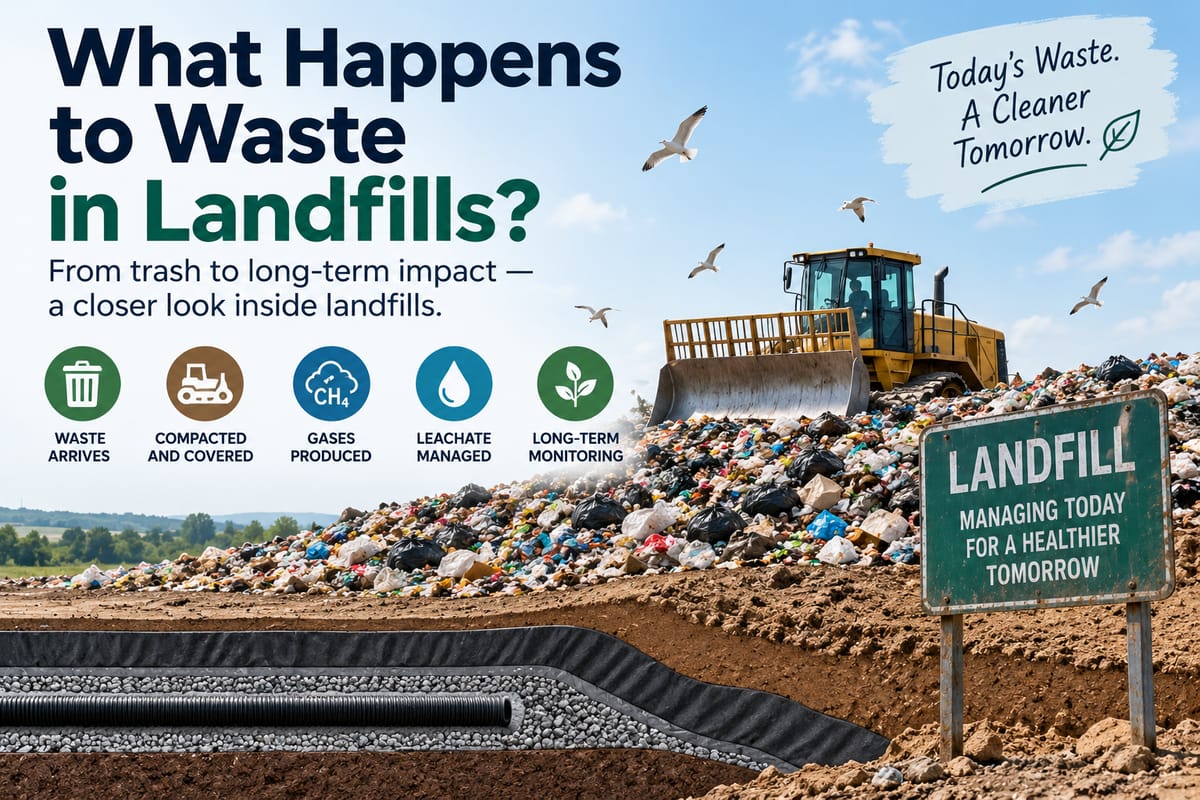
**What Happens to Waste in Landfills?
Every day, households, businesses, schools, restaurants, and other organizations throw away enormous amounts of material. Once a garbage truck collects that waste, most people rarely think about what happens next.
For waste that cannot be reused, recycled, composted, or otherwise recovered, a landfill may be its final destination.
But a landfill is more than simply a large hole filled with garbage. Modern landfills are engineered facilities designed to contain waste, manage liquids and gases, control odors, and reduce the risk of pollution reaching surrounding soil and water.
Inside a landfill, however, waste does not simply disappear. Organic materials break down, liquids move through the waste, gases are produced, and some materials can remain largely unchanged for decades or longer.
Understanding what happens after garbage is buried helps explain why waste reduction, recycling, and responsible disposal matter.
What Is a Landfill?
A landfill is a specially designed site where waste is placed, compacted, and covered.
Modern sanitary landfills are engineered differently from uncontrolled dumping sites. They typically incorporate systems intended to isolate waste from the surrounding environment and manage materials produced as waste decomposes.
Depending on local regulations and facility design, a landfill can include:
- Protective liners
- Leachate collection systems
- Gas collection systems
- Daily cover materials
- Drainage systems
- Monitoring wells
- Environmental monitoring equipment
- Final covers and vegetation after closure
The basic objective is to contain waste while reducing potential risks to people and the environment.
What Happens When Garbage Arrives?
The landfill process begins when waste collection vehicles arrive at the facility.
The incoming loads may be weighed and inspected before being directed to an active disposal area.
At the disposal area, heavy equipment spreads and compacts the waste.
Compaction is important because it reduces the volume occupied by garbage and allows the landfill to use its available space more efficiently.
Waste may then be covered with soil or another approved material.
This process is repeated as new waste arrives.
Over time, layers of compacted and covered waste build up within the landfill.
Waste Is Not All the Same
Different types of waste behave differently once buried.
Organic materials such as food scraps, paper, and yard waste can decompose. Plastics generally break down much more slowly, while glass and many metals can remain for extremely long periods.
Other materials may undergo chemical or physical changes without completely disappearing.
A landfill therefore contains a mixture of materials at different stages of decomposition.
Some waste may be relatively new, while material buried deeper in the landfill may have been there for years or decades.
What Happens to Organic Waste?
Organic waste can be broken down by microorganisms.
Food scraps, paper, cardboard, and other biodegradable materials contain organic compounds that microorganisms can use as sources of energy.
The decomposition process depends on factors such as:
- Moisture
- Temperature
- Oxygen availability
- Waste composition
- Compaction
- Microbial activity
- Landfill design
Landfills are often oxygen-limited environments, particularly deeper within buried waste. As a result, decomposition can shift toward anaerobic processes, meaning processes that occur without oxygen.
These conditions influence the gases and liquids produced during decomposition.
Landfill Gas
One of the most important products of anaerobic decomposition is landfill gas.
Landfill gas commonly contains significant amounts of methane and carbon dioxide, along with smaller quantities of other gases.
Methane is particularly important because it is a potent greenhouse gas.
Modern landfills can use gas collection systems to capture landfill gas. The collected gas may be flared or, at some facilities, used as an energy source.
Capturing landfill gas can reduce the uncontrolled release of methane and help manage another important environmental challenge associated with buried organic waste.
Why Landfills Produce Methane
Methane production is closely connected to the decomposition of organic material in oxygen-poor conditions.
Microorganisms break down organic compounds through a series of processes. Eventually, specialized microorganisms known as methanogens produce methane as part of their metabolism.
The amount of methane produced depends on factors such as the quantity and composition of biodegradable waste, moisture, temperature, and the age of the landfill.
Landfill gas production can continue for many years after waste is deposited.
What Is Leachate?
Another important product of landfills is leachate.
Leachate is liquid that has passed through waste and picked up dissolved or suspended substances along the way.
Rainwater entering a landfill can contribute to leachate, as can moisture already present in waste and water generated during decomposition.
Because leachate can contain contaminants, modern landfills are designed to collect and manage it.
This is one reason engineered landfills use liners and drainage systems.
How Landfill Liners Protect the Ground
A landfill liner creates a barrier between the waste and the surrounding environment.
Modern facilities may use carefully engineered combinations of compacted clay and synthetic materials.
The purpose is to reduce the movement of contaminants from the landfill into surrounding soil and groundwater.
A liner does not make waste environmentally harmless. Instead, it is part of a larger containment system designed to reduce the risk of contamination.
Landfills can also have monitoring wells around the facility to help detect potential changes in groundwater quality.
What Happens to Rainwater?
Rainwater is an important consideration at landfill sites.
Some rain may run off the surface and be directed into drainage systems. Other water can enter exposed waste and contribute to leachate.
Landfill operators therefore use covers and drainage structures to control how much water comes into contact with buried waste.
As disposal areas are completed, they can receive more permanent covers designed to limit water infiltration.
Controlling water movement is important because less infiltration can mean less leachate requiring collection and treatment.
Does Garbage Decompose Completely?
Not necessarily.
Some materials can break down relatively quickly under suitable conditions, while others are extremely resistant to decomposition.
Paper and food waste may undergo substantial biological breakdown, although the process inside a landfill can be slower or different from decomposition in an actively managed composting system.
Materials such as glass and many forms of plastic can remain for very long periods.
Even when an item appears to disappear, it may simply have broken down into smaller pieces or been chemically transformed rather than completely vanishing.
Why Plastics Can Remain for Long Periods
Many conventional plastics are designed to be durable.
Their chemical structures can make them resistant to biological decomposition.
Inside a landfill, where oxygen, sunlight, and biological activity may be limited, degradation can be particularly slow.
Some plastics may gradually fragment into smaller pieces rather than rapidly biodegrading.
This is one reason reducing unnecessary plastic consumption, reusing products, and improving material recovery can be important parts of waste management.
What Happens to Paper and Cardboard?
Paper and cardboard are generally biodegradable because they contain cellulose and other organic materials.
However, conditions inside a landfill can affect how quickly they decompose.
A tightly compacted landfill may contain limited oxygen and moisture distribution, which can slow biological processes.
This means that materials that would decompose relatively readily under controlled composting conditions can behave differently when buried among layers of compacted waste.
What Happens to Metals?
Metals generally do not biodegrade.
Some metals can corrode or undergo chemical changes, particularly when exposed to moisture and other substances.
However, many metal objects can remain in recognizable form for long periods.
This is particularly significant because metals can often be recovered and recycled instead of being buried.
Recycling metals can reduce the need to extract and process additional raw materials.
What Happens to Glass?
Glass is highly resistant to biological decomposition.
A glass bottle buried in a landfill can remain physically recognizable for an extremely long time.
Unlike organic waste, microorganisms do not simply consume glass and convert it into gases and other biological products.
Glass can often be collected, processed, and manufactured into new products, making recycling an important alternative to disposal.
For a broader look at how materials can be recovered and reused, see The Complete Guide to Recycling.
Why Landfills Are Covered
Landfill operators commonly cover waste as part of routine operations.
Daily cover can help:
- Reduce odors
- Discourage pests
- Reduce litter
- Limit exposure to waste
- Control rainwater infiltration
- Improve site management
Cover materials may include soil or approved alternative materials.
Once a landfill section reaches its designed capacity, a more substantial final cover can be installed.
What Happens When a Landfill Is Full?
A landfill does not necessarily become an abandoned pile of garbage when it reaches capacity.
Closure generally involves installing a final cover and carrying out environmental controls.
The final cover can help reduce rainwater infiltration and control erosion.
The site may then be landscaped or otherwise managed according to local requirements.
However, the waste beneath the surface continues to undergo physical, chemical, and biological changes.
This means landfill management can continue long after the facility stops accepting new waste.
Landfill Aftercare Can Continue for Years
A closed landfill may still require monitoring and maintenance.
Operators or responsible authorities may monitor:
- Groundwater
- Landfill gas
- Leachate
- Surface water
- Settlement
- Cover integrity
- Vegetation
- Erosion
The exact requirements depend on the landfill, local regulations, and environmental conditions.
Waste buried underground can continue generating gas and producing leachate, so closure does not necessarily mean the environmental management process has ended.
Landfill Settlement
Waste can settle after it is buried.
Several processes contribute to settlement, including compaction caused by the weight of material above and the breakdown of organic components.
Settlement can continue for years.
Landfill operators account for this when designing and maintaining the site because excessive or uneven settlement can affect the final surface and infrastructure placed above it.
This is one reason closed landfill sites require ongoing management.
Can Landfills Be Used Again?
In some circumstances, closed landfill sites can eventually be used for other purposes.
Depending on the site’s design, regulations, stability, and environmental conditions, former landfill areas may become parks, open spaces, solar-energy sites, or other carefully planned uses.
However, development over former landfill areas requires consideration of issues such as settlement, methane, groundwater, and the stability of the underlying waste.
A former landfill is therefore not simply treated like ordinary undeveloped land.
How Landfills Affect the Environment
Landfills provide an important waste-disposal function, but they can also create environmental challenges.
Potential concerns include:
- Methane emissions
- Leachate management
- Land use
- Odors
- Traffic
- Litter
- Air pollution
- Groundwater contamination if containment fails
- Long-term monitoring requirements
The environmental consequences of waste disposal are discussed more broadly in How Waste Management Affects the Environment.
The design and operation of a landfill can significantly influence how effectively these risks are controlled.
Landfills and Environmental Pollution
Waste management is closely connected to the broader issue of environmental pollution.
When waste is poorly managed, contaminants can enter air, water, or soil.
Airborne pollutants can affect atmospheric quality, while improperly managed liquids can threaten water resources. Waste can also create physical pollution when materials accumulate in places where they do not belong.
For a wider explanation of these processes, Environmental Pollution Explained: The Complete Guide explores how different forms of pollution affect natural systems and human environments.
Engineered landfills are designed in part to prevent uncontrolled waste disposal from producing these types of impacts.
Why Waste Reduction Matters
Even a well-designed landfill has limited capacity.
Every truckload of garbage occupies physical space, requires transportation, and creates a long-term management responsibility.
Reducing the amount of waste generated in the first place can therefore reduce pressure on disposal facilities.
Waste reduction can involve:
- Buying only what is needed
- Reusing products
- Repairing items
- Avoiding unnecessary packaging
- Composting organic materials where appropriate
- Recycling suitable materials
- Donating usable goods
These approaches address waste before it reaches the landfill.
Recycling Can Keep Materials Out of Landfills
Recycling allows certain discarded materials to become inputs for new products.
Paper, cardboard, metals, glass, and some plastics can be recovered through appropriate recycling systems.
Recycling does not mean that every item can be recycled indefinitely or in every community. Collection systems, contamination, material quality, processing capacity, and economics all affect what can actually be recovered.
Nevertheless, recycling can reduce the volume of some materials sent to disposal facilities.
Composting Provides Another Alternative
Organic waste can sometimes be diverted from landfills through composting.
Composting uses controlled biological decomposition to transform suitable organic materials into a stable material that can be used as a soil amendment.
Common compostable materials can include:
- Fruit and vegetable scraps
- Yard waste
- Leaves
- Grass clippings
- Certain paper products
Composting can reduce the amount of organic material entering landfills while producing a useful end product.
Household Waste Management Starts Before the Trash Bin
Waste management is not something that begins at the landfill.
It starts when people purchase products, use them, reuse them, sort them, recycle them, compost them, or place them in the trash.
The choices made at home can determine which materials are recovered and which eventually require disposal.
A useful overview of this process can be found in How Household Waste Management Works.
Understanding the complete journey of household waste can make disposal decisions more deliberate.
What Happens Inside a Landfill Over Time?
A landfill changes continuously.
In the early stages, newly deposited waste may contain relatively accessible oxygen. As that oxygen is consumed, biological activity changes.
Moisture moves through the waste. Organic materials decompose. Methane and carbon dioxide can be produced. Waste settles under its own weight and the weight of material placed above it.
Eventually, biological activity may decline as easily degradable materials become less available.
However, the landfill remains a complex environment rather than becoming completely inactive.
The Hidden Life of Buried Waste
A landfill can look still and inactive from the surface, but significant processes can occur underground.
Microorganisms continue breaking down organic materials. Chemical reactions alter some substances. Water moves through the waste and is collected as leachate. Gases accumulate and can be captured through collection systems.
Meanwhile, durable materials such as glass and many plastics can remain in the waste mass for extremely long periods.
What appears to be a simple mound of garbage is therefore a complicated engineered and biological system.
Why Proper Landfill Management Matters
Landfills play a role in modern waste-management systems because some waste will continue to require disposal even after recycling, reuse, composting, and other recovery methods are used.
The challenge is managing that waste responsibly.
Modern landfill design attempts to control the movement of water, collect landfill gas, contain waste, monitor surrounding environmental conditions, and manage the site after closure.
At the same time, reducing the amount of material that needs burial can reduce the demands placed on these facilities.
The Journey Doesn’t End at the Landfill
When a piece of garbage disappears into a trash truck, it has not necessarily disappeared from the environment. It has simply moved into another stage of its lifecycle.
Inside a landfill, some waste decomposes, some produces gases, some contributes to leachate, and some materials remain largely unchanged for very long periods. Modern engineering can reduce many of the associated environmental risks, but landfill capacity and long-term management remain important considerations.
That makes the decisions made before disposal especially significant. Reducing consumption, reusing products, recycling appropriate materials, composting organic waste, and disposing of remaining waste responsibly can all influence how much material ultimately ends up buried.
A landfill may be the final destination for waste that cannot be recovered, but responsible waste management begins long before the garbage reaches the landfill gate.




2 Comments
Micle harison
June 7, 2019Lorem ipsum dolor sit amet, usu ut perfecto postulant deterruisset, libris causae volutpat at est, ius id modus laoreet urbanitas. Mel ei delenit dolores.
John Doe
June 7, 2019Some consultants are employed indirectly by the client via a consultancy staffing company.