
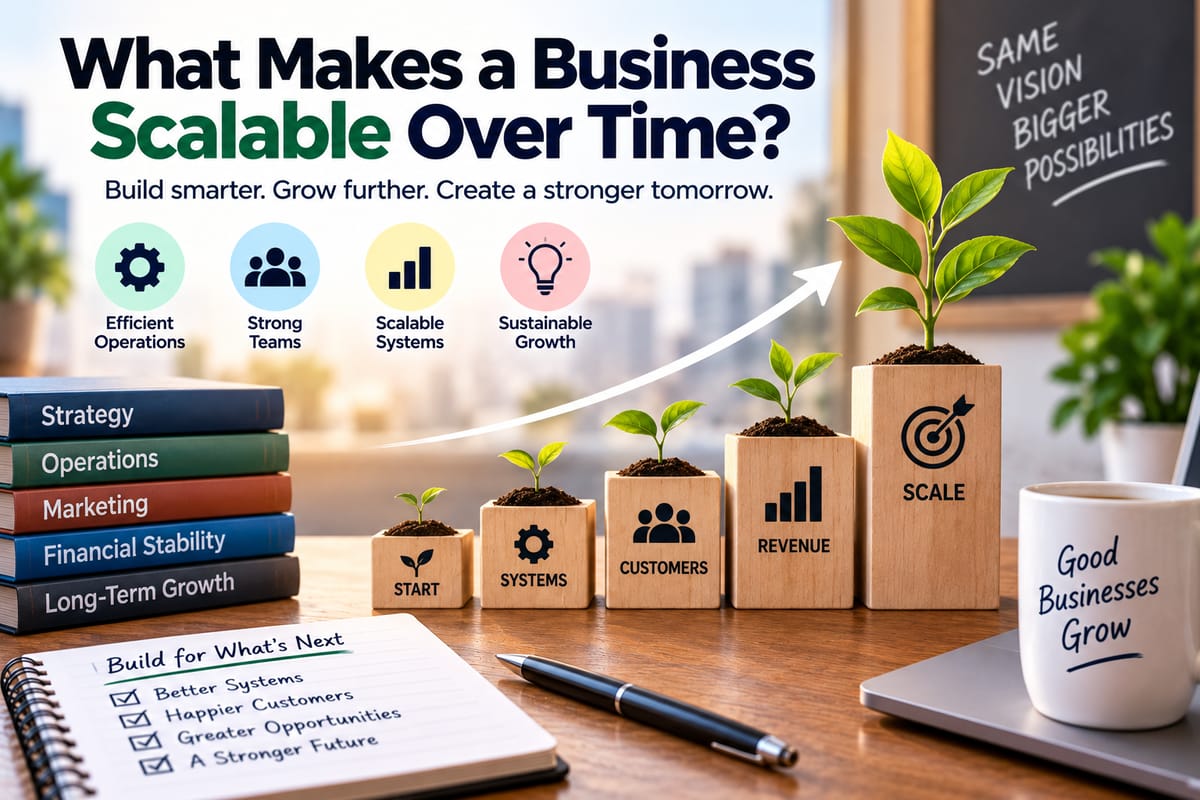
What Makes a Business Scalable Over Time
A business can grow without necessarily being scalable.
Growth may mean adding more customers, employees, locations, products, or revenue. Scalability is different. A scalable business is designed so that it can increase output and revenue without costs, complexity, and operational demands increasing at the same rate.
This distinction becomes increasingly important as a company moves beyond its early stages. A business that works well with 10 customers may struggle with 1,000 customers if every new customer requires the same amount of manual work. Likewise, a company may generate strong sales but still find growth difficult if its systems, employees, technology, or suppliers cannot keep up.
Scalability is therefore less about simply becoming larger and more about building a business that can handle greater demand efficiently.
What Does Business Scalability Mean?
Business scalability is the ability of a company to increase its revenue, customers, or output while maintaining manageable costs and operational complexity.
A scalable company does not necessarily avoid additional costs as it grows. Hiring employees, purchasing equipment, expanding infrastructure, and increasing marketing spending can all require additional investment.
The important question is whether those costs increase proportionally with revenue.
For example, imagine two businesses:
- Business A earns $100,000 with 10 employees and needs 20 additional employees to double its revenue.
- Business B earns $100,000 with 10 employees and can double its revenue with only a few additional employees because much of its operation is automated.
Both businesses are growing, but Business B has characteristics that make scaling easier.
Scalability can appear in many different forms, including:
- Operational scalability
- Financial scalability
- Technological scalability
- Workforce scalability
- Marketing scalability
- Production scalability
- Customer-service scalability
The strongest businesses often develop several of these capabilities at the same time.
A Scalable Business Has a Repeatable Model
One of the most important characteristics of scalability is repeatability.
If a company has to reinvent its process every time it acquires a customer, expanding can become expensive and difficult.
A repeatable business model allows the company to perform important activities consistently.
Examples include:
- A standardized sales process
- A repeatable onboarding system
- Consistent production procedures
- Documented customer-service processes
- Automated billing
- Standardized marketing campaigns
- Reusable software infrastructure
- Clearly defined employee responsibilities
Repeatability does not mean that every customer must receive exactly the same experience. Instead, it means that the underlying system can reliably support similar transactions without requiring the company to start from scratch every time.
Strong Business Strategy Creates a Foundation for Scale
Scalability begins with deciding what the business is actually trying to accomplish.
A company that expands into unrelated products, markets, or customer segments without a clear strategy can quickly accumulate unnecessary complexity.
Strategic planning helps businesses determine where to compete, how to allocate resources, and which opportunities deserve attention.
The Complete Guide to Business Strategy and Strategic Planning provides a broader framework for understanding how companies establish priorities and make long-term decisions.
A scalable strategy generally considers questions such as:
- Who is the target customer?
- What problem does the business solve?
- How does the company make money?
- Which activities create the most value?
- Which processes can be standardized?
- Which markets can be served efficiently?
- What resources will growth require?
- What could prevent expansion?
Without clear answers, rapid growth can create more problems than opportunities.
A Clear Value Proposition Supports Scalability
A business is easier to scale when customers understand why they should choose it.
A clear value proposition can simplify marketing, sales, product development, and customer communication.
When the core offering is easy to explain and deliver, the company can often create repeatable systems around it.
By contrast, a business with an unclear or constantly changing value proposition may require extensive customization for each customer.
Customization is not inherently bad. In some industries, it is an important competitive advantage. However, highly customized offerings can require more employees, more management, more training, and more time as the customer base expands.
A scalable company therefore needs to understand where customization creates meaningful value and where standardization is more efficient.
Technology Can Make Scaling Easier
Technology is one of the most powerful tools available to businesses seeking to scale.
Software can automate or streamline activities such as:
- Customer relationship management
- Payments
- Invoicing
- Scheduling
- Inventory management
- Marketing
- Data analysis
- Customer support
- Employee communication
- Reporting
Automation allows businesses to handle greater volumes without necessarily increasing headcount at the same rate.
However, adding technology does not automatically make a business scalable.
Poorly designed systems can create additional complexity. A company may end up managing multiple disconnected applications, duplicate data, manual workarounds, and expensive software subscriptions.
The objective should be to use technology to simplify important processes rather than simply adding more tools.
Efficient Operations Are Essential
A business cannot scale effectively if its internal operations become increasingly inefficient as it grows.
Small inefficiencies may be manageable when a company has a handful of customers. At a larger scale, the same inefficiencies can become expensive.
For example, a five-minute manual task performed once a day may seem insignificant. If the same task must be performed thousands of times each month, it can consume substantial amounts of employee time.
Businesses should therefore regularly examine:
- How work moves through the organization
- Where bottlenecks occur
- Which tasks are repetitive
- Where errors frequently happen
- Which processes depend on one person
- Which activities can be automated
- Where resources are being wasted
The How Businesses Manage Operations, Processes, Resources and Efficiency guide explores how organizations can structure their operations to improve efficiency and support performance.
Standardized Processes Reduce Complexity
Documentation becomes increasingly valuable as a business grows.
When important processes exist only in employees’ memories, expansion becomes dependent on individual knowledge.
A scalable organization documents important procedures so that employees can understand how work should be performed.
Documentation might cover:
- Sales procedures
- Customer onboarding
- Product fulfillment
- Quality control
- Hiring
- Employee training
- Financial procedures
- Customer support
- Security practices
- Internal approvals
Standardization also makes it easier to identify weaknesses.
If a process is written down, managers can examine it and ask whether each step is still necessary.
Employees Should Be Able to Work Independently
A business can struggle to scale when every important decision must pass through the owner or a small group of managers.
This creates a bottleneck.
As organizations grow, leaders need to delegate responsibility while maintaining appropriate oversight.
Employees should understand:
- What they are responsible for
- Which decisions they can make independently
- When approval is required
- What performance standards apply
- How their work contributes to broader objectives
Delegation does not mean abandoning control. It means designing the organization so that routine decisions can be handled at the appropriate level.
Scalable Businesses Build Strong Teams
Hiring more employees is not the same as building a scalable workforce.
A business may need additional employees as it grows, but its ability to recruit, train, manage, and retain those employees can determine how efficiently it expands.
Scalable companies often invest in:
- Clear job descriptions
- Repeatable hiring processes
- Structured onboarding
- Training materials
- Management systems
- Performance expectations
- Internal communication
- Leadership development
A well-designed team can absorb additional work without requiring constant intervention from the company’s founders.
Customer Acquisition Must Be Repeatable
A business cannot scale if acquiring every new customer becomes increasingly expensive or complicated.
Companies therefore need to understand which customer-acquisition channels produce sustainable results.
Potential channels include:
- Search marketing
- Content marketing
- Advertising
- Referrals
- Partnerships
- Social media
- Sales teams
- Email marketing
- Existing-customer expansion
A scalable acquisition system can consistently bring qualified prospects into the business without requiring an entirely new strategy for every customer.
This does not mean that marketing costs remain fixed. It means the company has a process for increasing customer acquisition without creating disproportionate operational problems.
Revenue Should Be Able to Grow Efficiently
Revenue growth is one of the clearest signs of business expansion, but revenue alone does not demonstrate scalability.
A company might double sales while also doubling or tripling its operating costs.
Scalable growth focuses on improving the relationship between revenue and the resources required to generate that revenue.
Important considerations include:
- Revenue per employee
- Customer acquisition costs
- Customer retention
- Gross margins
- Operating costs
- Average transaction value
- Recurring revenue
- Customer lifetime value
The How Businesses Grow Revenue, Customers, Operations and Market Share guide provides a broader look at the different components involved in sustainable business expansion.
The Business Model Matters
Some business models naturally have more scalable characteristics than others.
For example, digital products can often be distributed to additional customers without manufacturing a new physical product for every transaction.
A traditional service business may require additional employees whenever customer demand increases.
That does not make one model universally better. Different models have different economics and operational requirements.
The key is understanding how revenue is generated and what resources are required to support each additional customer.
The Complete Guide to Business Models and Revenue Strategies explores how different approaches to generating revenue can shape the structure and growth potential of a company.
Recurring Revenue Can Improve Predictability
Recurring revenue can make financial planning easier because customers generate revenue repeatedly rather than through isolated transactions.
Examples can include:
- Subscriptions
- Memberships
- Retainers
- Maintenance agreements
- Licensing arrangements
- Recurring service contracts
Predictable revenue can make it easier for businesses to plan staffing, technology investments, inventory, and other expenses.
However, recurring revenue is only useful when customers continue receiving enough value to remain with the business.
Retention therefore becomes just as important as acquisition.
Customer Retention Supports Efficient Growth
Acquiring customers repeatedly can become expensive if customers leave quickly.
A company with strong retention may be able to grow its customer base more efficiently because existing customers continue generating revenue.
Retention can be influenced by:
- Product quality
- Customer support
- Reliability
- Pricing
- Convenience
- Communication
- Customer experience
- Ability to solve the customer’s problem
A scalable business does not simply focus on acquiring more customers. It also creates systems that allow existing customers to remain satisfied as the company expands.
Supply Chains Need Room to Grow
For product-based businesses, scalability depends heavily on supply-chain capacity.
A company may have strong demand but still struggle to grow if it cannot obtain enough:
- Raw materials
- Inventory
- Packaging
- Manufacturing capacity
- Transportation
- Warehouse space
Supplier relationships can become especially important during rapid growth.
Businesses may need multiple suppliers, better inventory forecasting, stronger purchasing systems, or additional distribution capacity.
Growth should therefore be considered across the entire supply chain rather than only at the point where customers place orders.
Financial Management Becomes More Important With Scale
Growth often requires investment before additional revenue arrives.
A company may need to spend money on:
- Employees
- Equipment
- Inventory
- Technology
- Marketing
- Facilities
- Professional services
This creates a cash-flow challenge.
A business can be profitable on paper and still experience financial pressure if too much cash is tied up in inventory, unpaid invoices, or expansion costs.
Strong financial management helps leaders understand how much growth the business can realistically support.
Scalable Businesses Measure the Right Things
What gets measured tends to receive management attention.
Businesses seeking to scale should monitor metrics that reveal whether growth is becoming more or less efficient.
Depending on the company, these may include:
| Area | Example measurements |
|---|---|
| Revenue | Total sales, recurring revenue, revenue growth |
| Customers | New customers, retention, churn |
| Marketing | Leads, conversion rates, acquisition cost |
| Operations | Output, processing time, error rates |
| Finance | Gross margin, operating costs, cash flow |
| Workforce | Revenue per employee, productivity, turnover |
| Customer experience | Satisfaction, support volume, resolution time |
The appropriate metrics depend on the business model.
The purpose is not to measure everything. It is to identify the numbers that help leaders understand whether the organization can continue growing efficiently.
Automation Should Remove Bottlenecks
Automation works best when it addresses a genuine constraint.
For example, automating invoice generation can reduce repetitive administrative work. Automated customer onboarding can reduce manual setup. Inventory alerts can help prevent stock shortages.
But automation can also create problems if a company automates a poorly designed process.
A useful sequence is:
- Understand the existing process.
- Remove unnecessary steps.
- Standardize what remains.
- Identify repetitive work.
- Automate appropriate tasks.
- Monitor the results.
This approach prevents businesses from simply making inefficient processes happen faster.
Scalable Businesses Design for Change
A company that works well today may face very different demands in the future.
Customer expectations can change. Technology can evolve. Competitors can introduce new products. Regulations can change. Suppliers can become unreliable.
Scalability therefore requires flexibility as well as efficiency.
Businesses should avoid building systems that work only under one narrow set of circumstances.
Instead, they can create processes and technology that allow reasonable changes in:
- Customer volume
- Product offerings
- Geographic markets
- Employee numbers
- Sales channels
- Supplier relationships
Flexibility can make future expansion less disruptive.
Growth Should Not Destroy Quality
Rapid expansion can create pressure to prioritize volume over quality.
That can be dangerous.
If customer service deteriorates, product defects increase, or delivery times become unreliable, growth may damage the reputation that helped create demand in the first place.
Scalable businesses therefore need quality-control systems that can operate at greater volumes.
These may include:
- Standard operating procedures
- Automated quality checks
- Employee training
- Customer feedback systems
- Performance monitoring
- Regular process reviews
The objective is to ensure that increased volume does not automatically mean lower standards.
Scalability Is Not the Same as Rapid Growth
A scalable business does not necessarily need to expand as quickly as possible.
Scaling is about the ability to grow efficiently when the opportunity exists.
A company may deliberately grow slowly while strengthening its systems, improving its product, or developing its team.
In some cases, controlled growth can help the organization identify problems before they become expensive.
The best time to think about scalability is often before growth makes existing weaknesses difficult to fix.
Common Obstacles to Business Scalability
Several problems can make scaling more difficult.
Too Much Dependence on the Founder
If every important decision requires the founder, the founder can become the company’s biggest bottleneck.
Poor Documentation
When processes are undocumented, training new employees becomes slower and inconsistent.
Excessive Customization
Creating a unique solution for every customer can make expansion expensive.
Weak Technology Infrastructure
Systems that cannot handle higher transaction volumes can limit growth.
Poor Cash-Flow Planning
Growing sales can increase the need for working capital before the business receives payment.
Weak Management Systems
More employees require clearer structures, communication, and accountability.
Lack of Quality Controls
Increasing output without maintaining quality can damage customer trust.
How Businesses Can Prepare for Scale
A company does not need to be large before it begins building scalable systems.
Even a small business can:
- Document important processes
- Track key financial metrics
- Standardize repetitive tasks
- Automate appropriate administrative work
- Build customer-retention systems
- Develop clear employee responsibilities
- Review operating costs
- Strengthen cash-flow management
- Build reliable supplier relationships
- Regularly test operational capacity
These steps can make future growth less disruptive.
Building a Business That Can Carry More Weight
Business scalability ultimately comes from designing an organization that can handle increasing demand without becoming proportionally more expensive, complicated, or fragile.
A scalable company combines a clear business model with repeatable processes, capable employees, efficient operations, appropriate technology, reliable financial management, and a customer proposition that can be delivered consistently.
The objective is not simply to make a business bigger. It is to make the underlying system stronger so that growth becomes manageable.
When strategy, operations, technology, people, and finances work together, a company has a much stronger foundation for expanding over time while protecting the quality and efficiency that made its original success possible.



2 Comments
Micle harison
June 7, 2019Lorem ipsum dolor sit amet, usu ut perfecto postulant deterruisset, libris causae volutpat at est, ius id modus laoreet urbanitas. Mel ei delenit dolores.
John Doe
June 7, 2019Some consultants are employed indirectly by the client via a consultancy staffing company.