
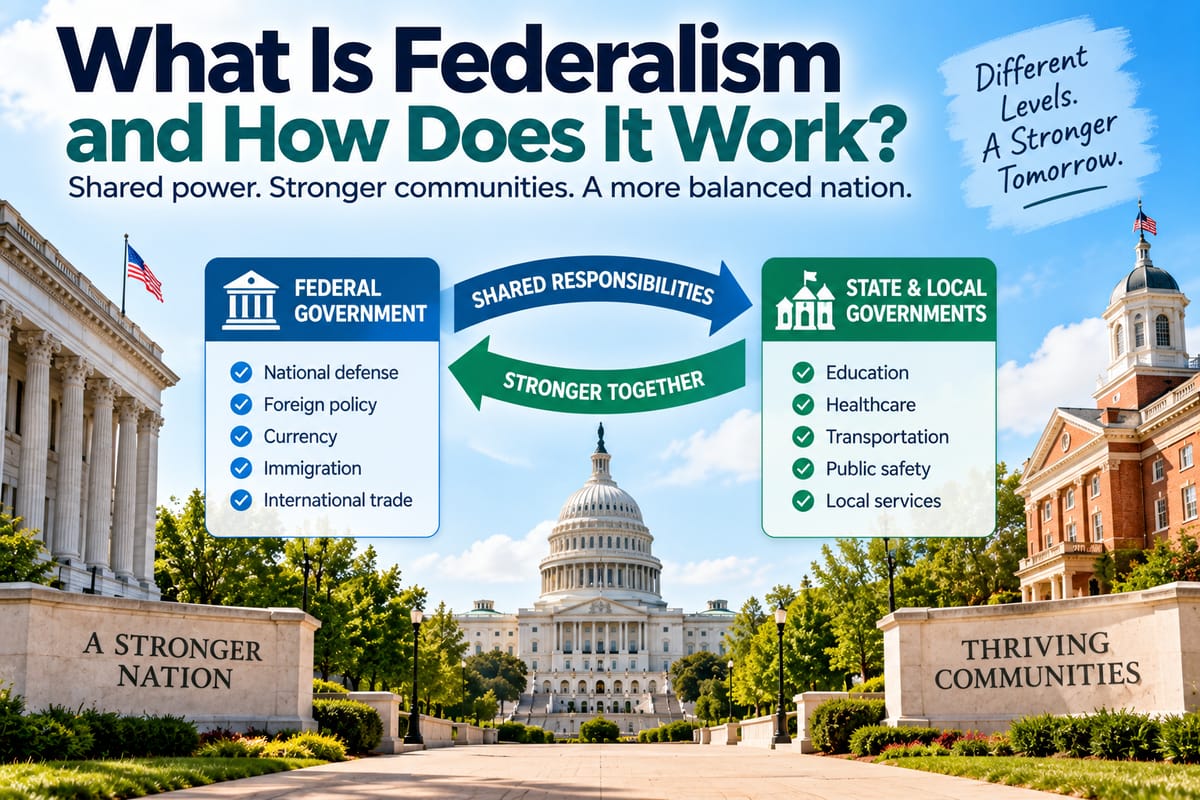
What Is Federalism and How Does It Work?
Federalism is a system of government in which political authority is divided between a national government and regional governments, with each level having areas of responsibility protected by constitutional or legal arrangements.
Instead of concentrating most governing authority in one central institution, federal systems distribute power across multiple levels. The national government may handle matters such as foreign affairs, national defense, currency, or immigration, while regional governments can have substantial authority over areas such as education, health services, transportation, policing, or local economic policy.
The precise division varies considerably from one country to another. Federalism is therefore not a single model that every federation follows in exactly the same way. Constitutions, political institutions, fiscal arrangements, courts, and historical circumstances all influence how federal systems operate.
What Is Federalism?
Federalism is a form of government in which authority is constitutionally or legally distributed between different levels of government.
In a typical federation, there is a national or federal government and a number of constituent regional governments. These regional units may be called states, provinces, cantons, Länder, or other names depending on the country.
The important feature is that regional governments are not simply administrative branches of the national government. They possess their own areas of governmental authority.
In many federations, the division of responsibilities is protected by the constitution, meaning the national government generally cannot change the basic distribution of powers through ordinary legislation alone.
For a broader introduction to different forms of government, The Complete Guide to Political Systems provides useful context on how governments organize and exercise political authority.
Why Do Countries Use Federal Systems?
Countries can adopt federal arrangements for different historical and political reasons.
In some cases, previously separate territories join together to create a larger political union while retaining substantial regional autonomy. This is sometimes described as a “coming together” federation.
In other cases, an existing country distributes authority among regions to accommodate geographic size, cultural diversity, regional identities, or political demands for autonomy. This can be described as a “holding together” federation.
Federal systems can therefore emerge from different circumstances.
The reasons for federalism in one country may be very different from those in another.
How Is Power Divided in a Federation?
The central principle of federalism is the division of governmental responsibilities.
A constitution may identify:
- Powers belonging exclusively to the federal government
- Powers belonging exclusively to regional governments
- Responsibilities shared by both levels
- Areas requiring cooperation between levels
- Rules governing taxation and public finances
- Procedures for resolving disputes between governments
For example, the federal government may have authority over national defense and foreign relations, while regional governments may control important domestic policy areas.
Some responsibilities may overlap, requiring both levels to coordinate their activities.
The exact arrangement depends on the country’s constitution and political institutions.
Federal Government and Regional Governments
A federation normally has at least two constitutionally significant levels of government.
The Federal Government
The federal government handles matters that require national coordination.
Depending on the country, these can include:
- National defense
- Foreign affairs
- Currency
- Immigration
- National taxation
- International trade
- National infrastructure
- Federal criminal law
Not every federal country assigns all of these responsibilities exclusively to the national government.
Regional Governments
Regional governments exercise authority within their territories.
Their responsibilities may include:
- Education
- Health services
- Transportation
- Local economic development
- Environmental regulation
- Public safety
- Regional infrastructure
- Cultural programs
Again, these responsibilities differ among federations.
The important point is that regional governments possess genuine governing authority rather than simply implementing instructions from the national government.
Federalism Depends on the Constitution
Constitutions play a central role in federal systems because they establish or protect the basic distribution of authority.
A constitution may specify which level of government has responsibility for particular policy areas and establish institutions for resolving disagreements.
The OECD notes that federal constitutions commonly identify exclusive or shared responsibilities for different levels of government, although the precise arrangements vary substantially between countries.
The Complete Guide to Constitutions provides a broader explanation of how constitutions establish governmental structures, powers, rights, and legal frameworks.
What Happens When Governments Disagree?
Federal systems inevitably create situations in which different governments interpret their responsibilities differently.
A regional government might argue that a particular policy falls within its authority, while the federal government might take a different view.
Disagreements can involve:
- Legislation
- Taxation
- Public spending
- Environmental rules
- Education
- Health policy
- Infrastructure
- Natural resources
- Regulatory authority
Courts can play an important role in resolving constitutional or legal disputes between levels of government.
Federal systems therefore often require institutions capable of interpreting constitutional provisions and determining which level of government has authority over a disputed issue.
The Role of Courts in Federalism
Courts can become important referees in federal systems.
When governments disagree over constitutional authority, courts may be asked to determine whether a particular action falls within the powers assigned to one level of government or another.
The exact role of courts differs by country.
Some constitutions give constitutional courts or supreme courts significant authority over disputes involving federalism. Other systems use different judicial structures.
The underlying principle is that the division of powers needs an established method for resolving disagreements.
Federalism and Shared Powers
Federalism does not mean that every government responsibility can be placed neatly into one category.
Many policy areas require cooperation.
For example, a national government might establish broad standards while regional governments administer programs.
Health care, education, infrastructure, environmental policy, and taxation can all involve multiple levels of government.
The OECD’s comparative research emphasizes that responsibilities and resources are often shared between government levels, making coordination an important part of multi-level governance.
This means federalism is often less about completely separating governments and more about establishing rules for how different governments exercise authority together.
What Is Fiscal Federalism?
Federalism also involves money.
Governments need revenue to perform their responsibilities, so federal systems must determine how public money is collected and distributed.
This area is commonly called fiscal federalism.
It involves questions such as:
- Which government can impose particular taxes?
- Which level collects revenue?
- Which government pays for specific services?
- How are funds transferred between levels?
- How are differences in regional revenue capacity addressed?
- What borrowing powers do regional governments have?
The OECD describes intergovernmental fiscal arrangements as an important part of how responsibilities and resources are divided between levels of government.
Why Money Matters in Federalism
A regional government can have legal responsibility for a service but still depend partly on funding arrangements involving the national government.
This can create complex relationships.
For example, a federal government might collect certain major taxes while regional governments are responsible for delivering particular public services.
Transfers, shared taxes, grants, and other fiscal mechanisms can help connect these responsibilities.
The design of these arrangements varies significantly across countries.
Federalism Is Different From Decentralization
Federalism and decentralization are related but not identical concepts.
Decentralization generally refers to transferring authority or responsibilities from a central government to lower levels.
Federalism establishes constitutionally or legally protected governmental authority at multiple levels.
A decentralized unitary country can give substantial responsibilities to regional or local governments while remaining constitutionally unitary.
In a federal country, constituent regional governments generally have a constitutionally protected position that cannot simply be removed by the unilateral decision of the national government.
This distinction is important because a country can be highly decentralized without being a federation.
Federalism Compared With a Unitary System
The difference becomes clearer when comparing federal and unitary systems.
In a unitary system, ultimate constitutional authority generally rests with the national government, even when significant responsibilities are delegated or decentralized to regional and local institutions.
In a federal system, regional governments have constitutionally protected areas of authority.
This does not mean that every federation is more decentralized than every unitary state. Comparative research shows that some federal countries can be relatively centralized, while some unitary countries can provide substantial autonomy to subnational governments.
The distinction is therefore primarily about the constitutional structure of authority rather than simply how much work regional governments perform.
Federalism Compared With a Confederation
A confederation is another form of political organization, but it differs from a federation.
In a federation, the federal government exercises authority directly within areas assigned to it by the constitutional system.
A confederation generally gives greater emphasis to the sovereignty of its member units, with the common institutions having more limited authority.
The terms can sometimes be used differently in historical contexts, so the exact meaning depends on the political arrangement being discussed.
Modern federations are generally understood as systems in which national and constituent governments both possess recognized governing authority.
How Federalism Can Accommodate Regional Differences
Large countries can contain regions with different economic conditions, geographic characteristics, languages, cultures, political traditions, and policy priorities.
Federal arrangements can provide mechanisms through which regional governments exercise authority over matters that have strong local or regional dimensions.
This can allow different regions to develop policies within the boundaries established by their national constitutions and laws.
Some countries also use asymmetric arrangements in which different regions have different levels or types of autonomy. The OECD identifies asymmetric regional governance as an approach used in both federal and unitary countries.
Federalism and Democratic Government
Federalism can interact closely with democratic institutions.
Citizens may participate in elections at more than one level, choosing national representatives as well as regional or local officials.
This creates multiple political institutions through which citizens can influence public policy.
However, federalism does not automatically determine whether a country is democratic. Federalism describes the territorial distribution of governmental authority, while democracy concerns how political power is constituted, exercised, and held accountable.
For more background, How Democratic Governments Work and Why They Matter examines the institutions and principles associated with democratic government.
Federalism and Local Government
Federal systems can contain another level of government below the federal and regional levels.
These may include:
- Municipalities
- Counties
- Districts
- Cities
- Towns
- Villages
The constitutional position of local governments varies considerably.
In some federations, local governments operate primarily under regional or state governments. In others, the national constitution gives municipalities a more direct constitutional position.
This is one reason federalism can involve several layers of government rather than simply two.
How Federalism Affects Public Services
The division of responsibilities between governments can influence how public services are designed and delivered.
For example, one government level may establish national standards while another manages day-to-day administration.
The quality and effectiveness of such arrangements can depend on:
- Clear responsibilities
- Adequate funding
- Administrative capacity
- Coordination
- Accountability
- Information sharing
- Legal clarity
Research on multi-level governance emphasizes that assigning responsibilities across government levels is a significant institutional challenge.
A formal division of power alone does not determine how effectively governments work together.
Federalism and Natural Resources
Natural resources can become particularly important in federal systems.
A country’s constitution or laws may determine whether the federal government, regional governments, or both have authority over resources such as:
- Minerals
- Oil and gas
- Forests
- Water
- Fisheries
- Land
- Energy resources
Resource governance can therefore create questions about taxation, ownership, environmental regulation, and revenue sharing.
The division of authority can vary substantially between countries.
Federalism and National Policy
Federal systems can create situations in which national policy interacts with different regional policies.
A federal government might establish national rules while regional governments adopt additional regulations within their constitutional authority.
This can produce differences between regions.
Such differences can arise in areas such as:
- Education
- Healthcare
- Transportation
- Environmental protection
- Business regulation
- Taxation
- Public safety
Whether a particular policy can be controlled nationally or regionally depends on the country’s constitutional arrangements.
Federalism and Political Representation
Federal systems often contain institutions designed to represent regional interests at the national level.
A common example is a two-chamber legislature in which one chamber represents the population while another represents constituent regions.
The exact structure varies among countries.
Such institutions can give regional governments or territories a role in national lawmaking, although the strength and nature of that role differs from one federation to another.
What Makes Federal Systems Complex?
Federalism can involve several overlapping relationships:
- Federal government and regional governments
- Regional governments and local governments
- Courts and legislatures
- Tax collection and public spending
- National standards and regional implementation
- Shared responsibilities and separate responsibilities
As a result, federal systems can be institutionally complex.
The OECD notes that constitutional arrangements for multi-level governance vary significantly in areas such as territorial organization, division of responsibilities, finance, and coordination mechanisms.
Common Challenges in Federal Systems
Federal systems can face several recurring challenges.
Disputes Over Authority
Governments may disagree about who has jurisdiction over a particular issue.
Unequal Resources
Regions can differ substantially in their ability to raise revenue.
Policy Coordination
Different governments may need to coordinate policies that cross administrative boundaries.
Administrative Complexity
Citizens and businesses may need to interact with multiple government institutions.
Conflicting Regulations
Different jurisdictions can adopt different rules, creating additional compliance requirements.
Intergovernmental Conflict
Political disagreements between levels of government can affect policymaking and public administration.
These challenges are not necessarily unique to federal systems, but the division of constitutional authority can make them particularly significant.
How Federal Governments Coordinate With Regions
Federalism requires mechanisms for cooperation.
Governments may coordinate through:
- Intergovernmental councils
- Formal agreements
- Joint programs
- Revenue-sharing arrangements
- Legislative processes
- Administrative committees
- Courts
- Regular meetings between government officials
Some constitutions establish formal coordination mechanisms, while other arrangements develop through legislation, political practice, or agreements between governments.
The precise balance between cooperation and independence varies from federation to federation.
Is Federalism the Same Everywhere?
No.
There is considerable variation among federal countries.
The constitutional arrangements of countries such as the United States, Canada, Germany, Australia, India, Switzerland, and other federations differ in important ways.
They can differ in:
- Legislative powers
- Tax authority
- Court structures
- Regional constitutions
- Local government arrangements
- Revenue-sharing systems
- Administrative responsibilities
- Representation in national institutions
Comparative research therefore treats federalism as a family of systems rather than a single standardized model.
Understanding Federalism Through Three Questions
A useful way to understand any federal system is to ask three basic questions.
Who Has the Power?
Identify which level of government is responsible for the issue.
Where Does That Power Come From?
Determine whether the authority comes from the constitution, legislation, judicial interpretation, or another legal arrangement.
How Is the Power Coordinated?
Look at how different governments cooperate when their responsibilities overlap.
These questions can reveal much of the structure behind a country’s federal system.
Federalism in Everyday Life
Although federalism is a constitutional concept, it can affect ordinary activities.
A person may encounter different levels of government when dealing with:
- Schools
- Healthcare
- Taxes
- Driver licensing
- Transportation
- Land use
- Business permits
- Environmental regulations
- Public safety
- Infrastructure
Which government handles a particular matter depends on the country’s constitutional and administrative arrangements.
This means federalism is not simply an abstract political theory. It can shape how public institutions interact with citizens.
The Basic Idea Behind Federalism
At its core, federalism is about sharing governmental authority across territorial levels.
The national government has responsibilities that require national coordination, while regional governments retain authority over matters assigned to them.
The constitution or broader legal framework establishes the rules governing this relationship, while courts, legislatures, executives, and intergovernmental institutions help interpret and operate the system.
Federalism can therefore be understood as a continuing institutional relationship rather than merely a list of powers.
The central question is not only which government has authority, but also how different governments exercise their authority within the same country.
That combination of shared national institutions, constitutionally recognized regional authority, financial relationships, judicial interpretation, and intergovernmental cooperation is what makes federalism one of the major ways modern states organize political power.





2 Comments
Micle harison
June 7, 2019Lorem ipsum dolor sit amet, usu ut perfecto postulant deterruisset, libris causae volutpat at est, ius id modus laoreet urbanitas. Mel ei delenit dolores.
John Doe
June 7, 2019Some consultants are employed indirectly by the client via a consultancy staffing company.