
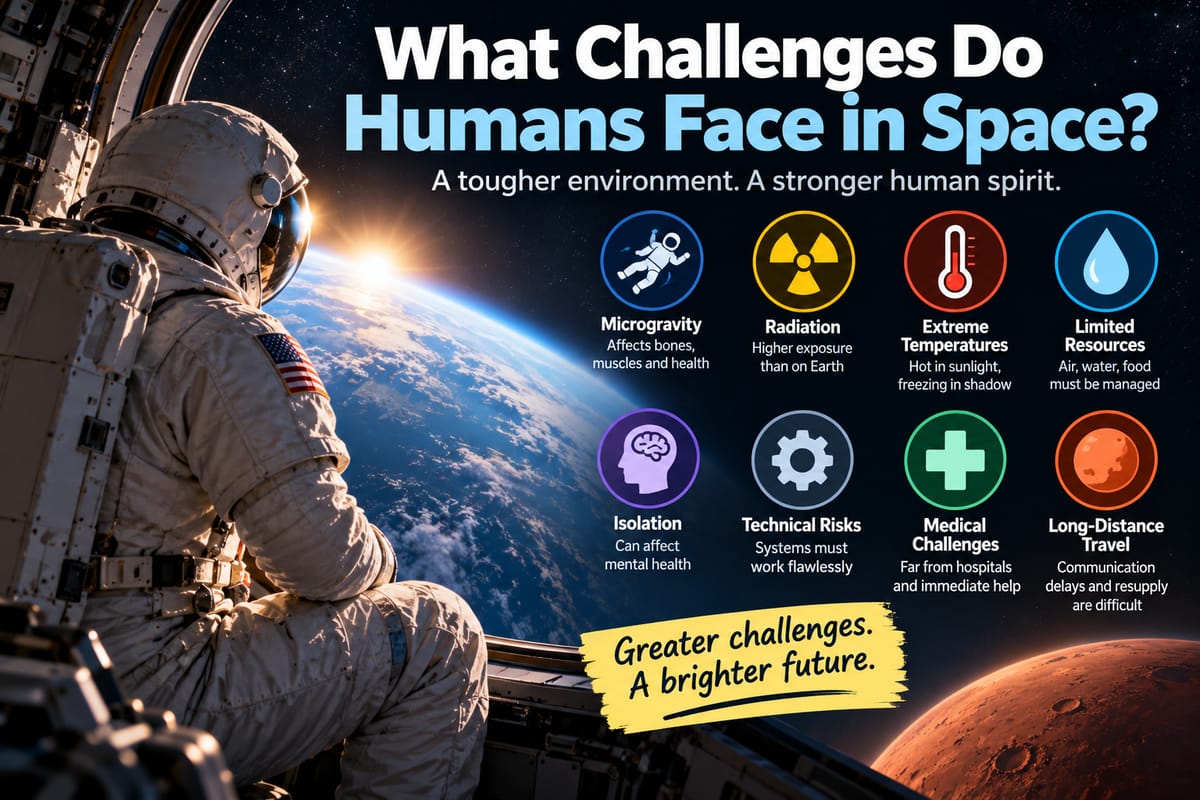
What Challenges Do Humans Face in Space?
Space exploration has allowed humans to travel beyond Earth, live aboard orbiting spacecraft, and conduct scientific research in an environment unlike anything found on the surface of our planet. Yet every human mission into space comes with significant challenges.
The human body evolved under Earth’s gravity, atmosphere, pressure, and protective magnetic environment. Once astronauts leave Earth, they encounter radiation, microgravity, isolation, extreme temperatures, limited resources, and the constant need to maintain complex life-support systems.
Understanding these challenges is essential to understanding why human spaceflight remains technically demanding and why future missions to the Moon, Mars, and beyond require increasingly sophisticated technology and careful preparation.
Why Is Space So Difficult for Humans?
Earth provides humans with a remarkably stable environment. The atmosphere supplies breathable oxygen, atmospheric pressure keeps bodily fluids stable, temperatures generally remain within survivable ranges, and Earth’s magnetic field and atmosphere provide substantial protection from space radiation.
Space removes or dramatically changes many of these protections.
Astronauts must therefore take an artificial environment with them. A spacecraft needs to provide:
- Oxygen for breathing
- Appropriate atmospheric pressure
- Carbon dioxide removal
- Temperature regulation
- Water
- Food
- Waste management
- Radiation protection
- Communication systems
- Power
- Emergency equipment
The complexity of maintaining these systems increases as missions become longer and travel farther from Earth.
The broader subject of human missions beyond our planet is explored in Space Exploration Explained, including why spaceflight requires specialized vehicles, equipment, and operating procedures.
Microgravity Changes the Human Body
One of the most important challenges astronauts face is microgravity.
In orbit, astronauts experience an environment in which they appear to be weightless. Although gravity is still present, the spacecraft and its occupants are continuously falling around Earth, producing the sensation of weightlessness.
The human body responds to this environment in several ways.
Muscle Loss
On Earth, muscles constantly work against gravity. In microgravity, many muscles no longer need to support the body in the same way.
Without regular exercise, astronauts can lose muscle strength during extended missions.
Spacecraft therefore include exercise equipment that allows crew members to perform activities designed to place mechanical loads on their muscles.
Bone Loss
Bones also respond to mechanical stress.
When the skeleton does not regularly experience Earth’s gravitational loading, bone density can decrease. This can create health concerns during long-duration missions and after astronauts return to Earth.
Exercise and nutritional strategies are therefore important components of life in space.
Changes in Balance and Movement
The human nervous system is accustomed to interpreting movement using signals from the inner ear, eyes, muscles, and joints.
Microgravity changes these signals.
Astronauts may initially experience motion sickness, disorientation, and difficulties with coordination. Their bodies gradually adapt, but returning to Earth’s gravity can produce another period of adjustment.
Space Radiation Is a Major Hazard
Earth’s atmosphere and magnetic field protect people from much of the radiation originating from space.
Astronauts outside this protective environment can be exposed to higher levels of ionizing radiation.
Sources include particles from the Sun and high-energy cosmic rays originating beyond the solar system.
Radiation exposure is particularly important for long-duration missions because the cumulative exposure increases with time.
Potential risks can include damage to cells and tissues and an increased long-term risk of certain health problems.
This makes radiation shielding an important consideration in spacecraft design, mission planning, and habitat construction.
For missions beyond low Earth orbit, radiation becomes an even more significant engineering and health challenge because astronauts may spend much longer periods outside Earth’s protective environment.
Spacecraft Must Maintain a Habitable Environment
A spacecraft is essentially an artificial ecosystem.
Astronauts cannot simply open a window to obtain fresh air or release waste into the surrounding environment. Every essential resource has to be supplied, recycled, stored, or carefully managed.
Life-support systems must regulate:
- Oxygen levels
- Carbon dioxide
- Humidity
- Temperature
- Air circulation
- Water
- Waste products
- Contaminants
A failure in one of these systems can become an emergency.
This is why spacecraft are designed with redundancy whenever practical. Critical systems may have backup components so that a single failure does not immediately threaten the crew.
Limited Water and Food Create Logistical Problems
Water is heavy, and transporting anything from Earth into space requires substantial energy.
For long-duration missions, carrying all the water astronauts will need becomes increasingly impractical. Spacecraft therefore use technologies that recover and recycle water whenever possible.
Food creates another challenge.
Astronauts need nutritious meals that can remain stable for long periods, fit within limited storage space, and be prepared without creating excessive crumbs or debris.
Future missions lasting months or years may require more advanced approaches to food production and resource recycling.
Growing some food in space could potentially supplement stored supplies, although producing food away from Earth introduces its own technical challenges involving lighting, water, nutrients, space, and energy.
Extreme Temperatures Make Spacecraft Thermal Control Essential
Space does not have an atmosphere that can conveniently distribute heat.
A spacecraft can become extremely hot when exposed to sunlight and lose heat through radiation when operating in darkness.
This creates a difficult thermal-control problem.
Spacecraft use insulation, radiators, reflective surfaces, heaters, and other systems to keep equipment and crew areas within appropriate temperature ranges.
Temperature control is particularly important because electronic systems, batteries, scientific instruments, and life-support equipment can operate only within certain limits.
Spacecraft Face Mechanical and Engineering Risks
A spacecraft must operate reliably in an environment where repairs can be difficult or impossible.
Launch subjects vehicles to powerful forces and vibration. Once in space, spacecraft must withstand temperature changes, radiation, vacuum, and the possibility of impacts from small objects.
The Complete Guide to Rockets and Spacecraft provides broader context for understanding the vehicles and technologies that make space missions possible.
Engineers must consider not only how spacecraft operate under normal conditions but also what happens when components fail.
A seemingly minor malfunction can become serious when replacement parts, specialized tools, or additional personnel are hundreds of thousands or millions of kilometers away.
Tiny Pieces of Space Debris Can Be Dangerous
Spacecraft travel at extremely high speeds.
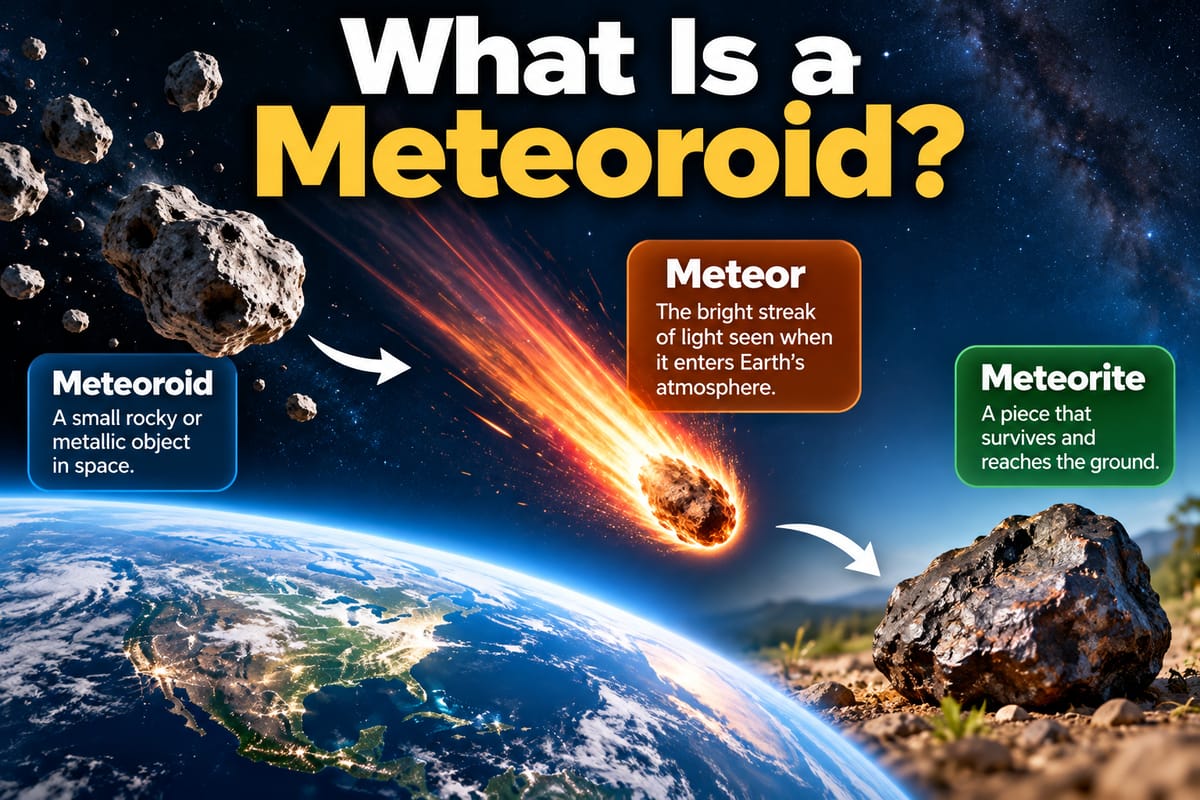
That means even relatively small pieces of debris can carry significant kinetic energy when they collide with a spacecraft.
Objects in orbit can include fragments from old spacecraft, rocket stages, and other human-made material.
Space agencies and operators track many larger objects so spacecraft can sometimes perform avoidance maneuvers.
However, very small particles may be difficult to detect or track individually.
Spacecraft therefore use protective materials and shielding in areas where impacts are considered possible.
Isolation Can Affect Astronauts
Human spaceflight is not only an engineering challenge. It is also a social and psychological challenge.
Astronauts on long missions may spend months in a confined environment with a small group of people. They are separated from family, friends, familiar surroundings, and many ordinary aspects of life on Earth.
Potential difficulties include:
- Loneliness
- Stress
- Sleep disruption
- Conflicts between crew members
- Limited privacy
- Monotony
- Communication delays
- Emotional strain
Crew selection and training therefore consider teamwork, communication, problem-solving, and the ability to operate effectively under stressful conditions.
Sleep Can Be Difficult in Space
Astronauts do not experience ordinary day-and-night conditions in orbit.
A spacecraft orbiting Earth can pass from sunlight into darkness many times during a single day. Artificial lighting and carefully designed schedules help establish regular sleep routines.
Noise can also be an issue because spacecraft contain fans, pumps, computers, ventilation systems, and other equipment that may operate continuously.
Poor sleep can affect concentration, mood, reaction time, and decision-making, making sleep management an important part of crew health and mission safety.
Communication Delays Become More Important Farther From Earth
Communication with astronauts in low Earth orbit can be relatively fast because signals travel comparatively short distances.
That changes as spacecraft travel farther away.
Signals between Earth and distant spacecraft can take increasingly long periods to travel in both directions. A conversation that works naturally on Earth becomes impossible when significant communication delays are present.
For missions to Mars, communication delays can be long enough that astronauts cannot rely on real-time conversations with mission controllers.
Future crews may therefore need greater independence and the ability to make decisions without waiting for immediate instructions from Earth.
Emergency Response Is Extremely Difficult
On Earth, medical emergencies can often be addressed by emergency services, hospitals, specialists, and large teams of professionals.
In space, those resources are limited.
An astronaut facing a serious injury or illness may have access only to the medical supplies and equipment carried aboard the spacecraft.
Crew members receive medical training, and missions are designed with emergency procedures, but the ability to provide advanced treatment can be limited.
The challenge becomes even greater when astronauts are far from Earth.
A medical emergency during a deep-space mission could require the crew to stabilize the patient without immediate evacuation or direct assistance from specialists.
Spacewalks Are Particularly Risky
Extravehicular activity, commonly known as a spacewalk, exposes astronauts directly to the space environment while they wear specialized spacesuits.
A spacesuit functions as a personal spacecraft. It provides oxygen, pressure, temperature control, communications, and protection from the environment.
During a spacewalk, astronauts must carefully manage their movements and equipment while remaining attached to the spacecraft or using appropriate safety systems.
Potential hazards include equipment failure, loss of pressure, extreme temperatures, radiation exposure, and collision with objects.
Because astronauts cannot simply return to a nearby hospital or safe room during an emergency, spacewalks require extensive preparation and procedures.
Fire and Atmospheric Contamination Are Serious Concerns
Fire behaves differently in microgravity, and a spacecraft contains many electrical systems and materials that could potentially contribute to an emergency.
A fire aboard a spacecraft would be particularly dangerous because the crew is enclosed within a limited environment.
Smoke and toxic gases could spread through the cabin, while damage to ventilation or life-support systems could threaten the entire crew.
Spacecraft therefore incorporate fire detection, suppression equipment, emergency procedures, and material-selection requirements intended to reduce these risks.
Psychological Distance From Earth May Increase on Deep-Space Missions
The farther humans travel, the less immediate their connection with Earth becomes.
A mission to the Moon is fundamentally different from a mission to Mars in terms of travel time, communication, logistics, and emergency response.
A Mars crew could potentially spend years away from Earth when travel, surface operations, and return are considered.
That means future astronauts may need to operate with a greater degree of independence.
They will have to solve problems, manage limited resources, maintain equipment, and make decisions in circumstances where Earth-based assistance is delayed or unavailable.
Spacecraft Reliability Becomes More Important on Long Missions
A short mission can sometimes tolerate a different level of risk than a multiyear expedition.
For a long-duration mission, systems must operate for extended periods without major failures.
This includes:
- Power generation
- Propulsion
- Navigation
- Communications
- Life support
- Thermal control
- Computing
- Water recycling
- Food storage
- Scientific equipment
Maintenance becomes an important part of the mission.
Astronauts may need to inspect equipment, replace components, repair damaged systems, and improvise solutions when the exact replacement part is unavailable.
Robotic Systems Can Reduce Some Human Risks
Not every space mission requires people.
Robotic spacecraft can explore environments that are dangerous, distant, or difficult for humans to reach.
The technologies involved are described in How Robotic Spacecraft Travel Through and Explore Space.
Robotic missions can gather information without exposing astronauts to the risks of radiation, isolation, life-support failure, or long-duration travel.
However, robots also have limitations. They may operate with communication delays, limited energy, restricted mobility, and less flexibility than a human scientist working directly with an environment.
Distance Makes Resupply Difficult
Astronauts aboard the International Space Station can receive supplies from Earth through cargo spacecraft.
Deep-space missions would make resupply far more complicated.
A crew traveling to Mars, for example, could not simply request a replacement component and expect it to arrive quickly.
Long-distance missions therefore require careful planning of:
- Food
- Water
- Spare parts
- Fuel
- Medical supplies
- Tools
- Scientific equipment
- Clothing
- Maintenance materials
The farther the destination, the more important it becomes to anticipate problems before the mission begins.
Landing and Returning to Earth Create Additional Challenges
Spaceflight does not end when a spacecraft reaches its destination.
Returning safely can be just as demanding.
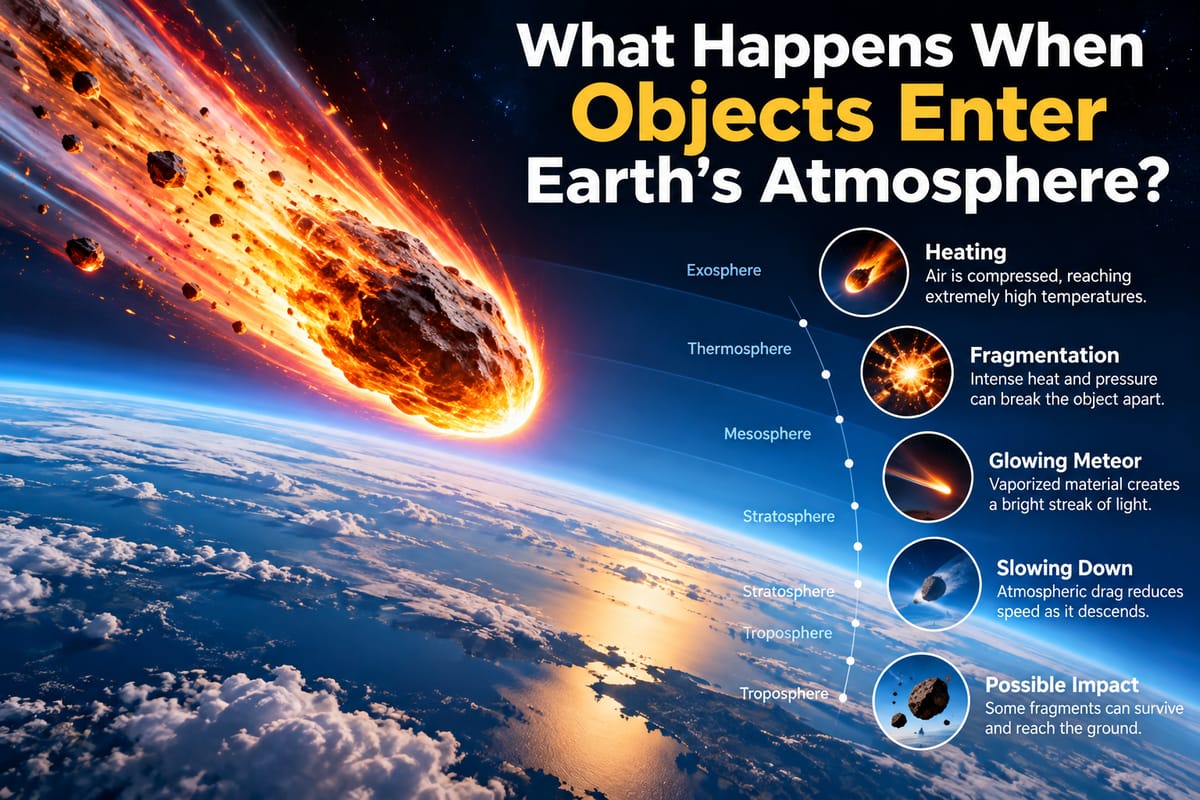
A spacecraft returning to Earth must manage high speeds, atmospheric heating, navigation, and landing or splashdown procedures.
Astronauts also have to readapt to Earth’s gravity after spending extended periods in microgravity.
They may initially experience weakness, balance problems, and difficulty standing or walking normally.
Recovery can therefore continue well after the spacecraft has returned to Earth.
Future Missions Will Require New Solutions
As human missions move farther from Earth, many existing technologies will need to become more capable and reliable.
Future exploration may involve improved radiation shielding, advanced life-support systems, better spacesuits, autonomous medical technologies, more efficient propulsion, expanded recycling systems, and habitats designed for long-term use.
The goal is not simply to make space travel possible. It is to make long-duration human operations increasingly sustainable.
That requires solving interconnected problems rather than treating each challenge separately.
The Human Challenge of Going Beyond Earth
Humans face an unusual combination of physical, technological, environmental, and psychological challenges in space.
Microgravity affects the body. Radiation creates long-term risks. Limited resources require careful management. Isolation can affect crew wellbeing. Spacecraft must remain functional despite operating far from repair facilities, while emergencies can be much harder to handle than they would be on Earth.
Yet each challenge has also driven advances in engineering, medicine, robotics, materials science, communications, and life-support technology.
Human space exploration is therefore not simply about building a rocket and launching people into orbit. It is about creating an environment in which people can survive, work, make decisions, maintain complex systems, and eventually explore places far beyond Earth.



2 Comments
Micle harison
June 7, 2019Lorem ipsum dolor sit amet, usu ut perfecto postulant deterruisset, libris causae volutpat at est, ius id modus laoreet urbanitas. Mel ei delenit dolores.
John Doe
June 7, 2019Some consultants are employed indirectly by the client via a consultancy staffing company.