
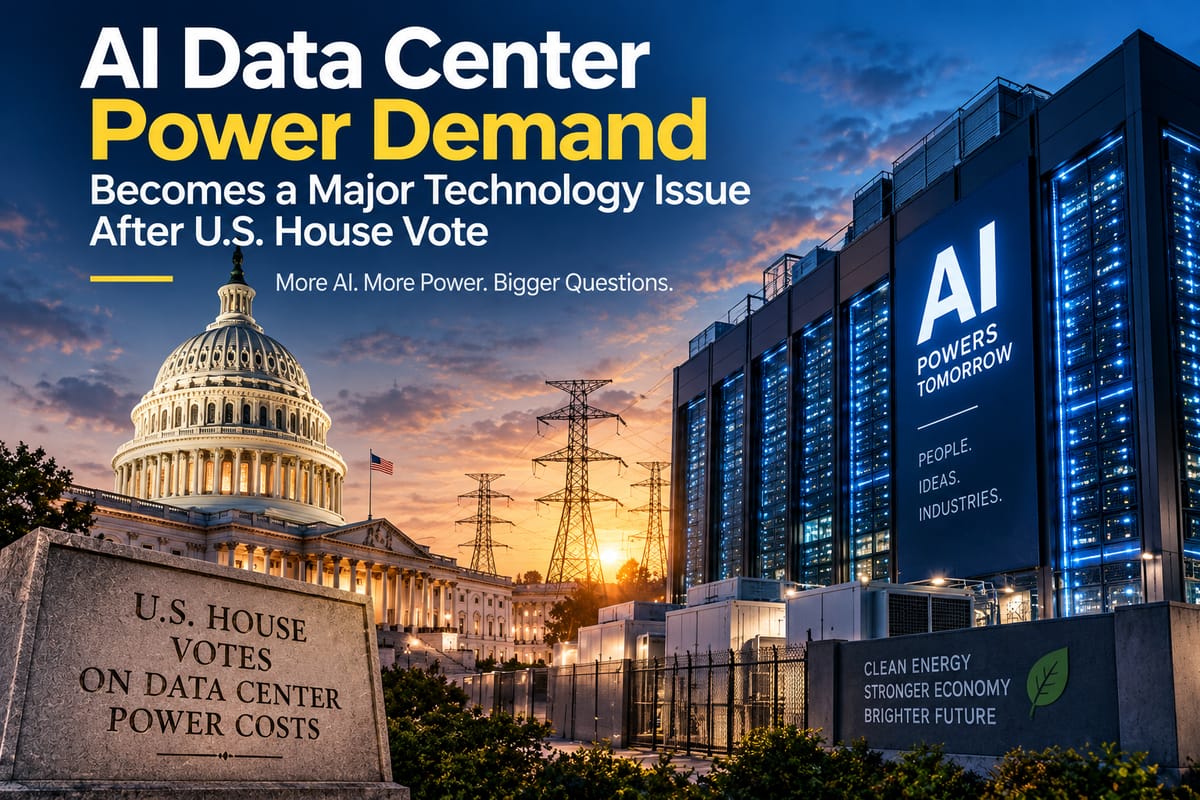
**AI Data Center Power Demand Becomes a Major Technology Issue After U.S. House Vote
Artificial intelligence has become synonymous with faster chips, larger models and increasingly powerful software. But as the AI industry expands, another part of the technology stack is becoming impossible to ignore: electricity.
The issue moved further into the national spotlight on September 16, when the U.S. House of Representatives overwhelmingly passed the Ratepayer Protection Act, legislation focused on the electricity infrastructure costs associated with large data centers. The bill passed by a 417-3 vote and would require state utility regulators to consider whether major electricity users such as data centers should cover the additional costs of infrastructure built to serve them.
The vote highlights a fundamental challenge for the AI industry. Building increasingly capable AI systems requires enormous computing capacity, and that computing capacity requires enormous amounts of power.
As companies race to expand AI infrastructure, electricity availability, grid capacity and the cost of new generation are becoming strategic technology issues rather than concerns limited to the energy sector.
Why AI Data Centers Need So Much Power
Modern AI systems depend on specialized computing hardware capable of performing huge numbers of calculations. Training advanced models can require large clusters of processors operating continuously, while serving AI applications to millions of users creates another significant source of electricity demand.
Data centers also need power for much more than the processors themselves.
Cooling systems, networking equipment, storage infrastructure, backup systems and other facility operations all consume electricity. As computing density increases, cooling and power management become increasingly important parts of data-center design.
This is one reason the AI boom is closely connected to the broader transformation of technology infrastructure. The expansion of AI is not simply about developing new software. It requires physical facilities, semiconductor manufacturing, electricity generation, transmission networks and increasingly sophisticated cooling systems.
For readers looking at the broader relationship between AI and physical infrastructure, How AI Infrastructure Spending Is Reshaping the Technology Industry provides useful context.
The House Vote Puts Electricity Costs Into the AI Conversation
The Ratepayer Protection Act does not simply attempt to restrict data-center construction. Instead, it focuses on who should bear the cost of the additional electricity infrastructure required by large facilities.
Under the legislation, state utility regulators would consider approaches that require large data centers to pay for the incremental infrastructure needed to serve their electricity demand. The goal is to reduce the possibility that households and small businesses could be left paying for upgrades primarily associated with major industrial electricity users.
That distinction matters because building a large data center can require more than connecting one facility to an existing power line.
Utilities may need to expand transmission and distribution systems, develop additional generation capacity or make other grid investments. Where those costs ultimately fall can become a major question for regulators and consumers.
The House vote therefore represents a shift in the political and economic conversation surrounding AI infrastructure. The question is increasingly not only how quickly the United States can build AI capacity, but also how the infrastructure required to support that growth should be financed.
AI’s Infrastructure Race Is Becoming an Electricity Race
The technology industry has already committed enormous resources to AI infrastructure.
Major technology companies and AI developers are investing in data centers, processors, networking systems and energy infrastructure in an effort to support increasingly demanding workloads. The scale of those investments has created what can broadly be described as an AI infrastructure race.
The expansion is closely connected to the industry’s ambition to develop increasingly capable systems. For background on that longer-term technological trajectory, What Is Artificial General Intelligence? explores the concept of highly capable AI systems and the technological direction behind much of today’s research.
The more computationally demanding AI becomes, the more important physical infrastructure becomes.
That creates a feedback loop. More powerful models can increase demand for computing. More computing requires more data-center capacity. More capacity requires more electricity. Additional electricity demand can then require new infrastructure, creating higher costs and longer development timelines.
The Scale of Big Tech Spending Matters
The electricity issue is also inseparable from the amount of money technology companies are directing toward AI.
The Big Tech AI $1 Trillion Spending Race illustrates the extraordinary scale of investment surrounding the sector.
Those investments are helping finance new servers, chips, data centers and supporting infrastructure. But capital spending alone does not guarantee that new computing capacity can be brought online quickly.
Power availability can become a limiting factor.
A company can have access to advanced processors and sufficient financial resources while still facing delays if a proposed data center cannot obtain enough electricity or if the surrounding grid requires substantial upgrades.
This makes electricity access an increasingly important consideration when technology companies decide where to build.
The Grid Has Become Part of the AI Supply Chain
Traditional technology supply chains have focused heavily on semiconductors, manufacturing capacity, networking equipment and software.
AI is expanding that definition.
Electricity generation and transmission are becoming critical parts of the supply chain because advanced computing cannot operate without reliable power.
A shortage of electricity capacity in a particular region can therefore have consequences for AI development. Companies may need to consider access to generation, transmission infrastructure, cooling resources and utility connections alongside factors such as land, fiber connectivity and semiconductor availability.
This is changing the geography of the technology industry.
Data centers have historically been attracted to locations with favorable connectivity, land availability, tax conditions and operating costs. Increasing AI workloads add another consideration: access to large quantities of reliable electricity.
Why Utilities Are Paying Attention
Electric utilities are facing a complicated situation.
On one hand, data centers can represent major new customers and create demand for additional infrastructure. On the other hand, rapidly increasing electricity consumption can require utilities to make large investments.
Those investments ultimately have to be financed.
The policy debate is therefore centered partly on whether the companies creating substantial new demand should cover the associated infrastructure costs or whether some of those costs should be distributed among a broader group of electricity customers.
The House legislation specifically targets this question by encouraging state regulators to consider rules addressing the costs created by large electricity users.
The Numbers Behind the Power Challenge
The potential scale of AI-related electricity demand is significant.
The U.S. Department of Energy estimated that data centers accounted for about 4.4% of U.S. electricity consumption in 2023 and projected that their share could reach roughly 12% by 2028.
Those figures help explain why AI infrastructure has moved into discussions about national energy policy.
Even if individual data centers become more energy efficient, overall electricity consumption can continue rising if the number of facilities and the amount of computing performed inside them grow rapidly.
Efficiency improvements therefore do not necessarily eliminate the infrastructure challenge. They can make individual workloads less energy intensive while overall demand continues increasing because the technology is being used on a much larger scale.
Data Centers Could Reshape Local Energy Markets
The effects of AI infrastructure are not necessarily distributed evenly across the country.
A region that attracts several large data centers may experience a sharp increase in electricity demand. That can influence utility investment decisions, transmission planning and local infrastructure requirements.
Communities can also face questions about water use, land development, tax incentives and the broader economic effects of large technology facilities.
The House debate has so far focused heavily on electricity costs, but some environmental organizations and other critics argue that the wider effects of data-center development deserve attention as well, including water consumption and pollution.
That means the future of AI infrastructure could involve increasingly complex negotiations among technology companies, utilities, regulators, local governments and communities.
AI Infrastructure Events Reflect the Same Shift
The growing importance of physical infrastructure is also visible in the technology industry’s event calendar.
An AI Infrastructure Summit Could Bring New Chip, Data Center and Agentic AI Announcements reflects how closely developments in chips, data centers and AI applications are becoming connected.
The distinction between AI software and AI infrastructure is becoming less meaningful.
New AI models depend on hardware. Hardware depends on semiconductor manufacturing. Data centers depend on electricity and cooling. Electricity demand depends on generation and transmission capacity.
Each part of the system affects the others.
What the House Vote Could Mean for Technology Companies
The House vote does not immediately change the economics of every data center project in the United States. The bill still has to move through the Senate, and the legislation focuses on state utility regulation rather than imposing a single nationwide electricity pricing system.
Nevertheless, the vote sends a clear signal that the infrastructure costs of AI expansion are receiving greater attention in Washington.
For technology companies, that could make power planning an even more important component of future expansion strategies.
Companies may increasingly evaluate potential data-center locations based on the availability and cost of electricity, the capacity of local grids and the investments required to connect new facilities.
It could also encourage greater interest in long-term energy contracts, on-site generation, renewable power, nuclear energy and other approaches designed to provide dependable electricity for large computing facilities.
The Next Phase of the AI Boom
The AI industry entered its current expansion phase primarily through advances in chips, models and software. The next phase is increasingly about whether the physical infrastructure can keep pace.
Electricity is now part of that equation.
The House’s passage of the Ratepayer Protection Act demonstrates how quickly an issue that once seemed largely technical has become a national policy question. The bill passed with overwhelming bipartisan support, but its practical effects will depend on what happens in the Senate and how state regulators respond if it becomes law.
For the technology industry, the larger lesson is that AI growth cannot be separated from the infrastructure required to support it.
The competition to build more capable AI systems will continue, but so will the competition for chips, data-center capacity and reliable electricity. As computing demand rises, access to power could become one of the most important constraints—and strategic advantages—in the next stage of the AI industry.





2 Comments
Micle harison
June 7, 2019Lorem ipsum dolor sit amet, usu ut perfecto postulant deterruisset, libris causae volutpat at est, ius id modus laoreet urbanitas. Mel ei delenit dolores.
John Doe
June 7, 2019Some consultants are employed indirectly by the client via a consultancy staffing company.