
How DNA, Genes and Heredity Work in Living Organisms
Every living organism carries biological information that helps determine how its cells function, develop, and respond to their surroundings. Much of that information is stored in DNA, a remarkably complex molecule found in cells.
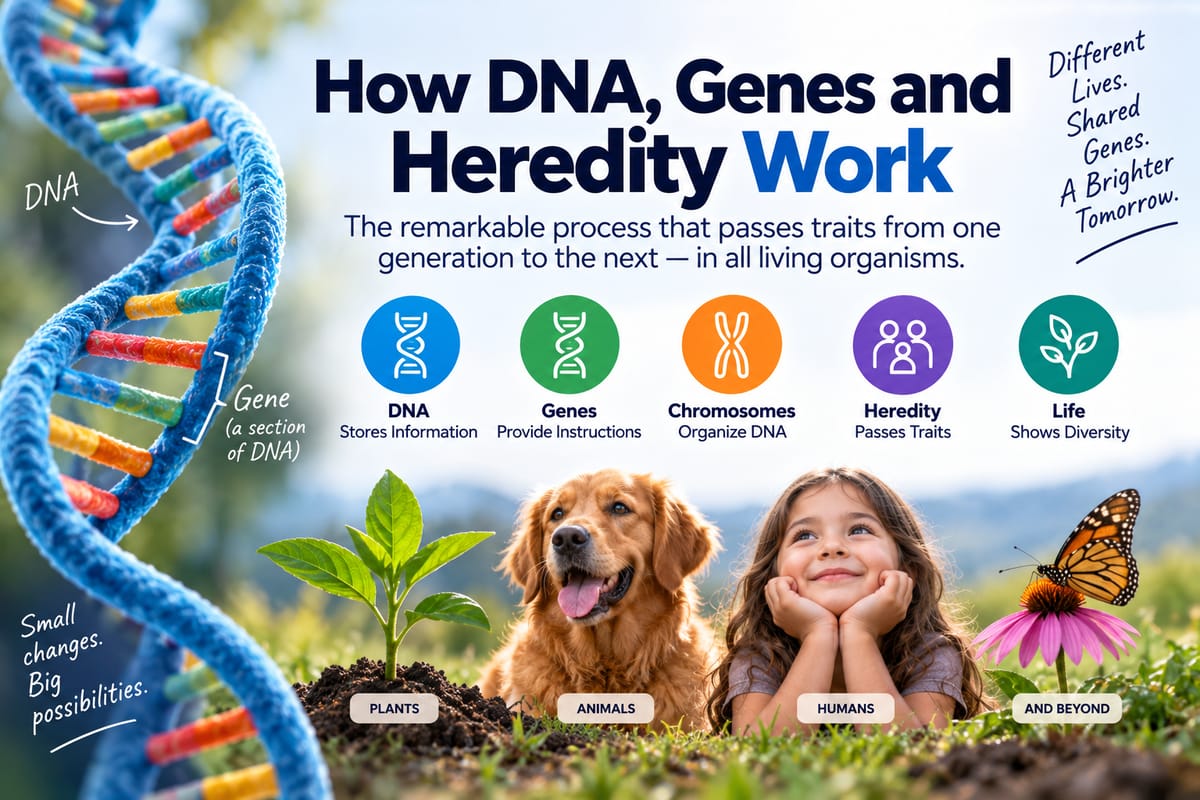
DNA provides instructions used to build and maintain living organisms. Sections of DNA called genes contain specific biological instructions, while chromosomes organize large amounts of DNA inside cells. Through reproduction, genetic information can be passed from parents to offspring, creating heredity.
At the same time, heredity does not mean that offspring are exact copies of their parents. Genetic variation, environmental influences, and interactions between many genes all contribute to the characteristics of living organisms.
Understanding DNA, genes, and heredity provides a foundation for understanding biology, evolution, development, and many aspects of life.
What Is DNA?
DNA stands for deoxyribonucleic acid. It is the molecule that stores hereditary information in almost all living organisms.
DNA can be thought of as a biological information-storage system. Its sequence contains instructions that cells use to produce functional molecules and regulate many cellular processes.
DNA is built from smaller chemical units called nucleotides. Each nucleotide contains a sugar, a phosphate group, and one of four nitrogen-containing bases:
- Adenine, usually represented by A
- Thymine, represented by T
- Cytosine, represented by C
- Guanine, represented by G
The order of these bases forms a genetic sequence.
The sequence is important because cells use it as information. Different sequences can contain instructions for producing different RNA molecules and proteins or for regulating when and where particular genes are active.
Why Does DNA Have a Double-Helix Structure?
DNA is commonly described as a double helix because it consists of two complementary strands that twist around each other.
The bases on the two strands pair in predictable ways:
- Adenine pairs with thymine.
- Cytosine pairs with guanine.
These pairing rules are important because they allow DNA to be copied accurately.
If one strand contains a particular sequence, its complementary strand provides information that can help reconstruct the original sequence during DNA replication.
The double-stranded structure therefore contributes to the stability and copying of genetic information.
What Is a Gene?
A gene is a region of DNA that contributes to a specific biological function.
Many genes contain instructions for making proteins. Other genes produce functional RNA molecules, while some genetic regions help regulate when other genes are active.
Genes are therefore not simply isolated instructions for visible characteristics such as eye color or height.
A characteristic may be influenced by many genes, environmental conditions, and interactions between biological systems.
The relationship between genes and observable traits can be complex.
What Are Chromosomes?
Chromosomes are structures that organize DNA inside cells.
In many organisms, DNA is packaged around proteins and arranged into chromosomes. This organization allows extremely long DNA molecules to fit within the relatively small space of a cell nucleus.
Humans typically have 23 pairs of chromosomes in most body cells, for a total of 46 chromosomes.
One chromosome in each pair generally comes from the biological mother and the other from the biological father.
Different organisms have different chromosome numbers. Having more chromosomes does not necessarily mean that an organism is biologically more complex.
How DNA Is Passed From Parents to Offspring
Heredity occurs when genetic information is transmitted from parents to offspring.
In organisms that reproduce sexually, specialized reproductive cells called gametes carry genetic information to the next generation.
In humans, eggs and sperm normally contain one copy of each chromosome rather than two.
During fertilization, an egg and sperm combine their genetic material. The resulting cell receives genetic information from both biological parents.
This creates a new combination of inherited genetic material.
That combination helps explain why children can resemble their parents while still being genetically distinct individuals.
What Is Heredity?
Heredity is the transmission of biological characteristics from parents to offspring through genetic information.
Heredity helps explain why certain characteristics can run through families.
Examples can include inherited variations associated with:
- Certain physical characteristics
- Blood groups
- Some inherited disorders
- Aspects of metabolism
- Certain biological traits
- Susceptibility to particular conditions
However, not every characteristic that appears in a family is necessarily determined entirely by genes.
Environment, lifestyle, nutrition, development, and other factors can also influence how characteristics appear.
How Genes Influence Characteristics
Genes influence characteristics through biological processes involving DNA, RNA, proteins, cells, and larger biological systems.
A simplified pathway is:
DNA → RNA → Protein → Cellular function → Biological characteristics
This is not a complete description of every genetic process, but it provides a useful starting point.
A gene can contain information used to produce a particular protein. That protein may perform a specific function within a cell, such as transporting substances, controlling chemical reactions, sending signals, or contributing to cell structure.
Changes in genes can therefore sometimes affect how cells function.
What Is Gene Expression?
Having a gene does not necessarily mean that it is active at all times.
Gene expression refers to the process through which information contained in genes is used by cells.
Different cells can activate different sets of genes even though most cells within an organism contain essentially the same DNA.
For example, a muscle cell and a nerve cell contain the same genome but have very different structures and functions.
Part of the reason is that different genes are active at different levels in different cell types.
Gene expression can also change in response to developmental signals and environmental conditions.
The Role of RNA
RNA, or ribonucleic acid, plays several important roles in how genetic information is used.
One well-known type is messenger RNA, or mRNA.
When a protein-coding gene is expressed, the DNA sequence can be copied into an RNA molecule through a process called transcription.
The mRNA can then be used by cellular machinery to help assemble a protein through a process called translation.
Other types of RNA perform additional functions in gene expression and cellular activity.
This system allows DNA to store information while RNA helps carry out and regulate many of the processes through which that information is used.
How Proteins Connect Genes to Biology
Proteins perform a huge variety of functions in living organisms.
They can act as:
- Enzymes
- Structural components
- Transport molecules
- Receptors
- Signals
- Antibodies
- Regulators
- Molecular machines
Because proteins influence so many cellular processes, changes in the instructions used to make them can sometimes affect an organism’s characteristics.
However, the relationship is rarely as simple as one gene producing one visible trait.
Many characteristics depend on networks of genes and interactions between genes and the environment.
What Are Genetic Variants?
Individuals of the same species do not necessarily have identical DNA sequences.
Differences in DNA sequences are called genetic variants.
Some variants have little or no noticeable effect. Others can influence biological characteristics, while some can affect how an organism responds to particular environmental conditions or diseases.
Genetic variation is a fundamental feature of populations.
It also provides the raw material on which evolutionary processes can act.
What Is a Mutation?
A mutation is a change in DNA sequence.
Mutations can arise through different processes, including errors during DNA replication or exposure to certain environmental factors.
Mutations can have different consequences.
A mutation may:
- Have no noticeable effect
- Change a protein
- Alter gene regulation
- Affect how a cell functions
- Be harmful under particular circumstances
- Occasionally provide an advantage in a particular environment
The word mutation is sometimes associated only with harmful changes, but mutations can have many different effects.
How DNA Replication Works
Before many cells divide, their DNA needs to be copied.
DNA replication uses the complementary relationship between DNA strands.
The two strands separate, and each existing strand can serve as a template for building a new complementary strand.
The result is two DNA molecules that contain essentially the same genetic information as the original molecule, subject to the possibility of copying errors.
Accurate replication is essential because cells need to pass genetic information to their descendants.
Why Genetic Information Must Be Copied Accurately
Multicellular organisms contain enormous numbers of cells.
As cells divide, they generally need to preserve the genetic instructions required for their functions.
If DNA copying were consistently inaccurate, genetic information would become increasingly disrupted from one cell generation to the next.
Cells therefore have mechanisms that help identify and repair certain types of DNA damage and copying errors.
These mechanisms are not perfect, which is one reason genetic changes can arise.
How Meiosis Creates Genetic Diversity
Sexual reproduction involves a specialized type of cell division called meiosis.
Meiosis produces reproductive cells with half the usual number of chromosomes.
It also contributes to genetic diversity through processes such as chromosome assortment and the exchange of genetic material between paired chromosomes.
As a result, the reproductive cells produced by an individual can carry different combinations of genetic information.
When reproductive cells from two parents combine, the offspring receives a new genetic combination.
Why Siblings Can Look Different
Brothers and sisters can share many genetic characteristics while still having different combinations of inherited variants.
This happens because each parent contributes a particular combination of genetic material to each reproductive cell.
The genetic combinations that come together during fertilization therefore differ between pregnancies.
Environmental factors can also contribute to differences between siblings.
This is why children from the same parents can have different heights, appearances, temperaments, abilities, and susceptibility to particular conditions.
Genes and the Environment Work Together
Genes are important, but they do not operate independently of the environment.
Characteristics can emerge from interactions between inherited genetic information and environmental conditions.
Examples of environmental influences can include:
- Nutrition
- Physical activity
- Temperature
- Sunlight
- Exposure to certain substances
- Social conditions
- Learning opportunities
- Stress
- Sleep
- Access to healthcare
The relative importance of genetic and environmental factors varies from one characteristic to another.
This is why inherited DNA should not always be interpreted as a fixed prediction of how a person will develop.
Genes and Human Development
Genetic information plays an important role throughout development.
From the earliest stages of embryonic development through childhood, adolescence, adulthood, and aging, cells use genetic instructions to build structures, regulate biological processes, and respond to changing conditions.
Development is not simply a matter of following a predetermined genetic blueprint. It involves continuous interactions among genes, cells, tissues, hormones, environmental conditions, and other biological systems.
The broader relationship between biology and development can be explored through How the Human Body Changes Across Different Ages.
Heredity and Childhood Development
Children inherit genetic information from their biological parents, but development involves much more than inherited DNA.
Growth and development are influenced by factors such as nutrition, physical surroundings, healthcare, relationships, learning, sleep, and many other conditions.
Genetic differences can contribute to variations in growth and biological development, while environmental conditions can influence how those inherited characteristics are expressed.
For a broader discussion of development, How Child and Adolescent Health Develops Across Childhood provides additional context.
How Genes Are Related to Evolution
Genetic variation is central to evolution.
When genetic differences are passed between generations, populations can gradually change over time. If particular inherited characteristics affect survival or reproduction in a specific environment, those characteristics may become more common across generations.
This process is known as natural selection.
Other evolutionary mechanisms also influence populations, including genetic drift, mutation, and gene flow.
The relationship between inherited variation and natural selection is explored in greater detail in How Evolution Works Through Natural Selection.
Why Natural Selection Acts on Variation
Natural selection requires variation within a population.
If individuals have different inherited characteristics and those differences affect reproductive success in a particular environment, the frequencies of those characteristics can change over generations.
For example, imagine a population containing individuals with slightly different inherited traits that affect their ability to survive in a particular environment. If one trait consistently provides an advantage under those conditions, individuals carrying variants associated with that trait may leave more offspring.
Over many generations, the associated genetic variants can become more common.
This does not mean that organisms consciously adapt because they need to. Instead, populations change as inherited variation is filtered through environmental conditions and reproductive differences.
What Is Genetic Inheritance?
Genetic inheritance describes how genetic information passes from parents to offspring.
Different inheritance patterns can occur.
Some characteristics are influenced strongly by variants in a single gene, while others involve multiple genes.
Common concepts include:
- Dominant inheritance
- Recessive inheritance
- Sex-linked inheritance
- Polygenic inheritance
- Mitochondrial inheritance
Real biological inheritance can be more complicated than these basic categories suggest.
Genes can interact with each other, and environmental factors can influence how inherited variants affect an organism.
Dominant and Recessive Variants
In basic genetics, a dominant variant can influence a characteristic when a person has one copy, while a recessive variant generally produces its associated effect when particular copies are present in the relevant genetic context.
Dominant does not mean stronger, better, or more common.
Likewise, recessive does not mean weaker.
These terms describe particular patterns of genetic expression and inheritance.
A person can carry a recessive variant without showing the associated characteristic if another copy or biological mechanism prevents it from being expressed in the expected way.
What Are Genetic Disorders?
Some health conditions are caused partly or primarily by changes in genetic material.
These can arise from variants affecting a single gene, multiple genes, chromosomes, or combinations of genetic and environmental factors.
Genetic conditions can be inherited from parents, arise through new genetic changes, or result from complex interactions among multiple factors.
Not every genetic condition follows a straightforward family pattern.
Understanding the underlying inheritance pattern can sometimes help explain why a condition appears in some family members but not others.
DNA Is More Than a Simple Instruction Manual
It can be tempting to describe DNA as a blueprint that completely determines an organism.
That analogy is useful for introducing the concept of biological information, but it has limits.
DNA operates within living cells containing complex networks of proteins, RNA molecules, chemical signals, membranes, and regulatory systems.
Genes interact with one another, and gene activity can change in response to developmental and environmental signals.
An organism therefore emerges from the interaction of genetic information with many other biological processes.
How Scientists Study Genes and Heredity
Scientists study genetics using observations, experiments, DNA sequencing, laboratory techniques, statistical analysis, computational tools, and studies of organisms and populations.
Researchers may compare genetic sequences, investigate how genes are expressed, observe inherited characteristics, or study how genetic variants affect biological processes.
Scientific conclusions are built from evidence rather than from a single observation.
The broader process of testing ideas, evaluating evidence, and refining explanations is described in Scientific Method and How Science Works.
Why Genetic Research Continues to Develop
Genetics is a rapidly expanding area of biology.
Researchers continue to investigate how genes influence health, development, aging, evolution, disease, and biological diversity.
Advances in DNA sequencing and other technologies have made it possible to study genetic information at increasingly detailed levels.
At the same time, the growing amount of genetic information has created important questions about privacy, data use, medical interpretation, and how genetic findings should be communicated.
Scientific knowledge therefore continues to develop as researchers gather new evidence and improve their methods.
DNA, Genes, and Heredity Are Connected
DNA provides the molecular foundation for storing biological information. Genes are functional regions of that DNA, and chromosomes organize DNA within cells. Through reproduction, genetic information can pass from one generation to the next, creating heredity.
Yet inheritance is not simply a process of copying identical characteristics from parents to children. Genetic recombination creates new combinations of inherited variants, mutations introduce changes, and environmental conditions influence how biological systems develop and function.
Together, these processes help explain why living organisms resemble their ancestors while also displaying enormous biological diversity.
Understanding DNA, genes, and heredity therefore provides a window into some of the fundamental processes that make life possible, allow organisms to develop, and enable populations to change across generations.




2 Comments
Micle harison
June 7, 2019Lorem ipsum dolor sit amet, usu ut perfecto postulant deterruisset, libris causae volutpat at est, ius id modus laoreet urbanitas. Mel ei delenit dolores.
John Doe
June 7, 2019Some consultants are employed indirectly by the client via a consultancy staffing company.