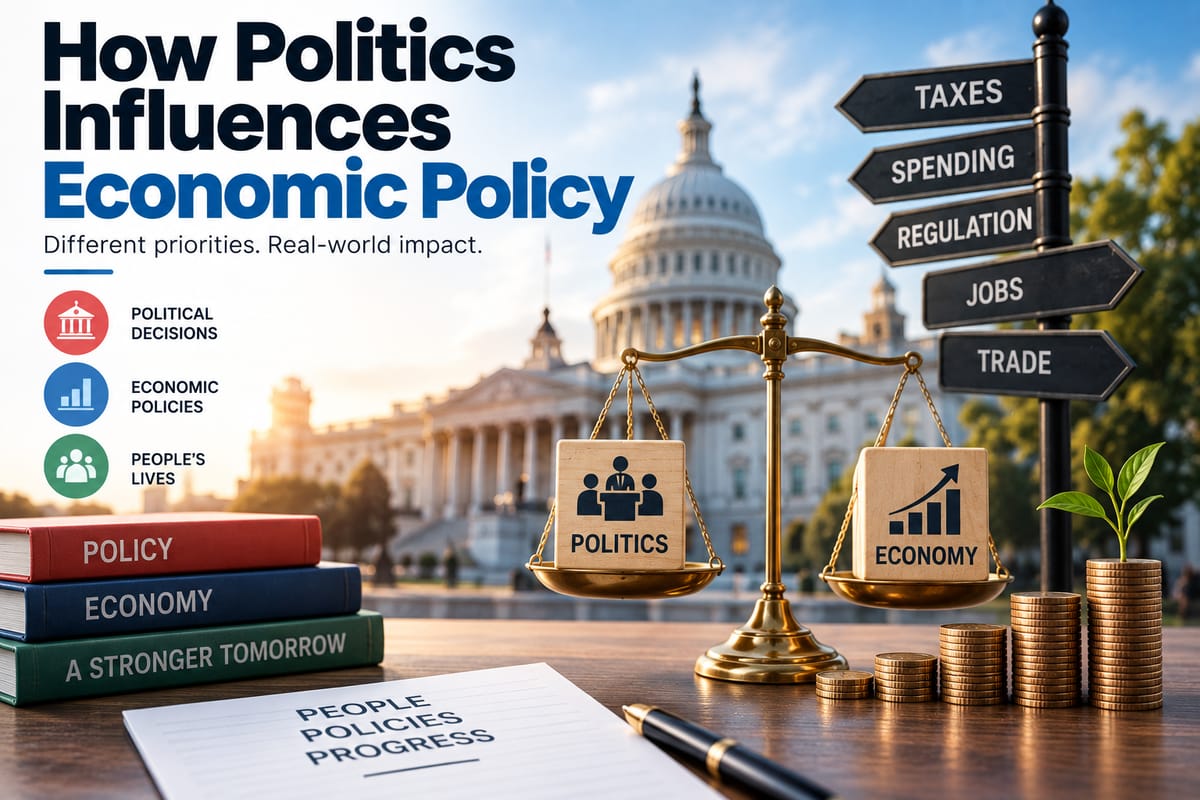
How Politics Influences Economic Policy
Economic policy is often discussed in terms of numbers: interest rates, taxes, government spending, inflation, employment and economic growth. But behind those numbers are political decisions about what a government considers important, who should benefit from public resources and how economic problems should be addressed.
Politics influences virtually every major area of economic policy. Elected officials decide which taxes to raise or reduce, how public money should be spent, what industries should be regulated and which economic priorities deserve government attention.
Central banks may have varying degrees of independence, but political institutions still shape the legal frameworks within which monetary and financial systems operate. Legislatures also determine budgets, taxation rules and many of the laws that influence businesses and households.
Understanding this relationship helps explain why governments can respond very differently to similar economic challenges.
What Is Economic Policy?
Economic policy refers to the decisions and actions governments and public institutions take to influence economic activity.
It can cover areas such as:
- Taxation
- Government spending
- Public debt
- Employment
- Inflation
- Trade
- Business regulation
- Investment
- Social welfare
- Infrastructure
- Financial markets
- Industrial development
- Economic inequality
Economic policy is not one single policy. It is a collection of decisions that affect how an economy operates.
Politics enters the process because different political parties, leaders and interest groups often have different ideas about what the economy should prioritize.
One government may emphasize lower taxes and private investment. Another may place greater emphasis on public services, social protection and redistribution.
Both may agree that economic growth is desirable while disagreeing substantially about how to achieve it.
Why Political Systems Matter
The way a country is governed affects how economic decisions are made.
Presidential systems, parliamentary systems, coalition governments and other political arrangements distribute decision-making power differently.
In some systems, the executive branch has considerable influence over economic policy. In others, legislatures, coalition partners, regional governments or independent institutions can exert significant influence.
For a broader understanding of these differences, see The Complete Guide to Political Systems.
Political institutions matter because economic policy rarely comes from a single individual.
A proposed tax change, for example, may require approval from a legislature. A government spending program may depend on a budget vote. Major regulatory changes may require legislation or formal administrative procedures.
The structure of government therefore influences how quickly and how easily economic policies can change.
Elections Can Shape Economic Priorities
Elections are one of the clearest connections between politics and economic policy.
Political parties generally campaign on economic promises designed to appeal to voters.
These promises might include:
- Reducing taxes
- Increasing wages
- Expanding healthcare
- Improving infrastructure
- Supporting small businesses
- Increasing pensions or social benefits
- Reducing government debt
- Creating jobs
- Protecting domestic industries
- Attracting foreign investment
Once elected, governments face the challenge of turning campaign promises into practical policies.
That process can be complicated by budget constraints, economic conditions, opposition parties and unexpected events.
A government may promise tax reductions, for example, but later decide that reducing the deficit is more important.
Political priorities can therefore change as economic circumstances change.
Tax Policy Is a Political Decision
Taxes are among the most politically significant economic policies because they directly affect households, businesses and government revenue.
Governments must decide how much revenue to collect and how that burden should be distributed.
Questions can include:
- Should income taxes be higher or lower?
- Should corporations pay more or less?
- Should consumption be taxed?
- Should wealth or property be taxed?
- Should certain industries receive tax incentives?
- Should low-income households receive tax relief?
- Should taxes be used to discourage certain behaviors?
Different political philosophies produce different answers.
A government focused on expanding public services may support higher taxation to generate additional revenue.
A government focused on reducing the role of the state may favor lower taxes and greater reliance on private-sector activity.
Tax policy therefore reflects both economic reasoning and political priorities.
Government Spending Reflects Political Choices
Government budgets provide another clear example of politics influencing the economy.
Governments have limited resources and must decide how to allocate them.
A national budget might dedicate significant funding to:
- Education
- Healthcare
- Roads
- Energy
- Defense
- Public transportation
- Social protection
- Agriculture
- Technology
- Housing
- Environmental programs
Increasing spending in one area can require reducing spending elsewhere, raising taxes or increasing borrowing.
That makes budget decisions inherently political.
Political parties may disagree about which programs should receive priority even when they agree that government spending can influence economic activity.
How Legislatures Influence Economic Policy
In many political systems, legislatures play a central role in approving laws and budgets.
Members of parliament or congress can debate proposed economic measures, introduce amendments and vote on legislation.
The legislative process can slow down economic policy changes, but this can also provide opportunities for scrutiny and public debate.
Our guide on How Legislatures Make Laws and Pass Legislation explains how this process works and why legislative institutions are important to government decision-making.
Economic policies therefore often emerge from negotiation rather than from a single political decision.
Political Representation and Economic Policy
The people making economic decisions are ultimately representatives of different communities and constituencies.
Their decisions can reflect the interests and concerns of the voters they represent.
For example, lawmakers representing agricultural regions may place greater emphasis on farming subsidies, rural infrastructure or agricultural trade.
Representatives from industrial areas may prioritize manufacturing, energy prices or employment.
Urban representatives may focus more heavily on transportation, housing and public services.
This does not mean politicians always act only in the interests of their constituencies. National political parties, ideological beliefs and broader economic considerations also influence their decisions.
Still, representation creates an important connection between citizens and economic policy.
The relationship is explored further in How Political Representation Works in Legislatures and Governments.
Political Ideology Shapes Economic Decisions
Political ideology can strongly influence economic policy.
Different political traditions may place different levels of emphasis on markets, government intervention, taxation, public ownership and social protection.
A market-oriented government might prioritize:
- Lower business taxes
- Deregulation
- Private investment
- Free trade
- Entrepreneurship
- Reduced government intervention
A government with a stronger emphasis on social welfare might prioritize:
- Public services
- Social safety nets
- Worker protections
- Progressive taxation
- Public investment
- Income redistribution
In practice, governments rarely follow a political philosophy perfectly.
Economic policies are often compromises between ideological goals and practical constraints.
Interest Groups Can Influence Policy
Political decisions are also influenced by organized groups representing particular economic interests.
These can include:
- Business associations
- Labor unions
- Professional organizations
- Agricultural groups
- Consumer organizations
- Environmental organizations
- Financial institutions
- Industry associations
These groups may lobby policymakers, provide research, participate in public consultations or campaign for specific legislation.
Their influence can be significant, particularly when proposed economic policies have major consequences for a particular industry.
The challenge for policymakers is balancing competing interests while considering the broader public interest.
Political Stability Affects Economic Confidence
Politics can influence the economy even before a new policy is implemented.
Businesses and investors pay attention to political stability because economic decisions often involve long-term commitments.
A company considering a major investment may want to know:
- Will tax rules remain stable?
- Could regulations change?
- Is the government likely to honor existing contracts?
- Are property rights protected?
- Is political instability a significant risk?
- Could trade policies change after the next election?
When political conditions are highly uncertain, businesses may delay investment decisions.
Political stability can therefore influence economic confidence, investment and financial markets.
Political Uncertainty Can Affect Markets
Financial markets react to expectations about future economic policy.
If investors believe a government may introduce policies that affect taxes, interest rates, regulation, trade or government borrowing, asset prices can respond before those policies are actually implemented.
For example, an unexpected election result could cause investors to reconsider their expectations about:
- Government spending
- Public debt
- Corporate taxation
- Trade policy
- Regulation
- Currency policy
Markets do not necessarily respond to whether a policy is politically popular.
They respond to expectations about how policies could affect future economic conditions and financial returns.
Monetary Policy and Political Institutions
Monetary policy is another area where politics and economics intersect.
Central banks often have operational independence, allowing them to make interest-rate decisions without direct political instructions.
This independence is designed to reduce short-term political pressure.
Politicians may prefer lower interest rates because cheaper borrowing can support economic activity and make government debt less expensive to service.
However, excessively loose monetary policy can contribute to inflationary pressures under certain circumstances.
Central-bank independence therefore represents an attempt to separate certain economic decisions from short-term political incentives.
Even when independent, central banks operate within legal frameworks established by political institutions.
Trade Policy Is Closely Connected to Politics
International trade provides another powerful example.
Governments decide whether to impose tariffs, negotiate trade agreements, restrict certain imports or provide support to domestic industries.
These decisions can be motivated by economic considerations, but politics often plays an important role.
A government may introduce tariffs to protect domestic producers even if economists disagree about their long-term economic effects.
Trade policies can also become politically important because industries and workers experience globalization differently.
Consumers may benefit from cheaper imported goods, while domestic producers may face increased competition.
Policymakers must therefore balance different economic interests.
Industrial Policy Can Pick Economic Winners
Governments sometimes deliberately support particular industries because they believe those sectors are strategically or economically important.
Support can take the form of:
- Tax incentives
- Subsidies
- Government contracts
- Research funding
- Infrastructure investment
- Import protections
- Training programs
- Loans or financing support
Modern industrial policy can focus on areas such as technology, energy, manufacturing, agriculture or strategic infrastructure.
The political debate often centers on whether governments should actively shape economic development or allow market forces to determine which industries succeed.
Supporters argue that governments can help develop strategically important industries and create long-term economic opportunities.
Critics warn that political decisions can lead to inefficient spending or favoritism.
Public Policy Connects Politics and the Economy
Economic policy is ultimately part of the larger public policymaking process.
Political leaders identify problems, develop proposals, negotiate with stakeholders and seek to implement solutions.
The process can involve government agencies, legislatures, courts, businesses, civil society and citizens.
Our Complete Guide to Public Policy and Policymaking provides a broader look at how governments develop and implement policies.
Understanding this process makes it easier to see why economic policy can take time to change.
A policy proposal may be economically attractive but politically difficult to pass.
Another proposal may be politically popular but financially challenging to sustain.
Economic Conditions Can Also Change Politics
The relationship works in both directions.
Politics influences the economy, but economic conditions also influence politics.
High inflation can become a major political issue because households notice rising prices in everyday purchases.
High unemployment can increase pressure on governments to create jobs.
A recession can change voters’ attitudes toward the government.
Rapid economic growth, meanwhile, can strengthen political leaders’ claims that their policies are working.
This creates a feedback loop:
Economic conditions → Public opinion → Elections → Political priorities → Economic policy → Economic conditions
The process is rarely this simple in practice, but the connection is important.
Inflation Can Become a Political Issue
Inflation demonstrates how economic policy can become politically sensitive.
When prices rise rapidly, households may experience declining purchasing power.
Even if inflation is caused by factors outside a government’s direct control, voters may still hold political leaders responsible.
Governments can respond through various policies, including measures involving taxation, spending, energy costs, supply chains or competition.
Central banks may also increase interest rates to reduce inflationary pressure.
Each response can create political consequences.
Higher interest rates can help reduce inflation but may increase borrowing costs for households and businesses.
Reducing government spending may improve fiscal sustainability but can be politically unpopular.
Economic policymaking therefore involves difficult trade-offs.
Public Debt Creates Political Choices
Government borrowing can help finance infrastructure, emergency programs and public services.
However, rising debt also creates future obligations.
Political parties can disagree about how much borrowing is appropriate.
One side may argue that borrowing is justified when the money finances productive investment.
Another may emphasize the importance of reducing deficits and limiting future debt-service costs.
These disagreements are not purely technical.
They reflect different views about the responsibilities of governments today versus future generations.
Short-Term Politics Versus Long-Term Economics
One of the biggest challenges in economic policymaking is the difference between political and economic time horizons.
Politicians often operate around election cycles.
Economic investments may take decades to produce their full benefits.
Infrastructure projects, education reforms and scientific research can require years of spending before their effects become visible.
A policy that creates short-term economic pain but produces long-term benefits can therefore be politically difficult to implement.
Conversely, policies that produce immediate benefits may create longer-term costs.
Effective economic policymaking requires policymakers to balance both horizons.
Why Policy Consistency Matters
Businesses and households make plans based partly on expectations about the future.
Frequent and unpredictable policy changes can make planning more difficult.
For businesses, uncertainty can affect decisions about hiring, investment and expansion.
For households, uncertainty can affect decisions about housing, saving and major purchases.
This does not mean economic policy should never change.
Economic conditions evolve, and governments sometimes need to respond.
But predictable institutions and transparent policymaking can make economic adjustments easier for businesses and households to navigate.
The Role of Compromise
Economic policy rarely reflects the preferences of one political group completely.
Governments often need to negotiate with opposition parties, coalition partners, regional authorities, businesses and other stakeholders.
Compromise can produce policies that are less ambitious than the original proposal but more politically durable.
This can be especially important for major economic reforms.
A policy that survives changes in government may provide greater certainty than a policy that is repeatedly reversed after elections.
Why Citizens Should Understand the Connection
Economic policy affects everyday life.
Taxes influence disposable income.
Government spending affects public services and infrastructure.
Interest rates affect borrowing and saving.
Trade policies can influence prices and employment.
Regulation affects how businesses operate.
Social programs can provide financial support during difficult periods.
Understanding the political forces behind these decisions makes economic news easier to interpret.
Instead of viewing economic announcements as isolated numbers, citizens can ask deeper questions:
- Who benefits from this policy?
- Who pays for it?
- What problem is the government trying to solve?
- What are the short-term effects?
- What could happen over the long term?
- Which political interests support or oppose it?
- How might the policy change after an election?
These questions help reveal the connection between political choices and economic outcomes.
Politics and Economics Are Closely Connected
Economic policy is not created in a political vacuum.
Governments make choices about taxation, spending, regulation, trade, investment and social protection based on economic conditions, political priorities and public demands.
Political institutions determine how those choices are debated and implemented, while elections give citizens an opportunity to influence the direction of government.
At the same time, economic outcomes can reshape political priorities. Inflation, unemployment, inequality, growth and living standards can influence public opinion and determine which issues dominate political debate.
Why Economic Policy Is Ultimately About Choices
The relationship between politics and economic policy becomes clearer when economic decisions are viewed as choices rather than simply numbers.
Every government faces limited resources and competing demands. Deciding where money goes, who pays taxes, which industries receive support and how economic risks are managed requires choices about priorities.
Those choices are political as well as economic.
Understanding that connection helps explain why economic policy can be controversial even when people agree on the underlying economic facts. Different groups may simply have different ideas about which outcomes matter most and how the costs and benefits should be distributed.
That tension between competing priorities is unlikely to disappear. It is a fundamental part of how democratic governments shape their economies.


2 Comments
Micle harison
June 7, 2019Lorem ipsum dolor sit amet, usu ut perfecto postulant deterruisset, libris causae volutpat at est, ius id modus laoreet urbanitas. Mel ei delenit dolores.
John Doe
June 7, 2019Some consultants are employed indirectly by the client via a consultancy staffing company.