
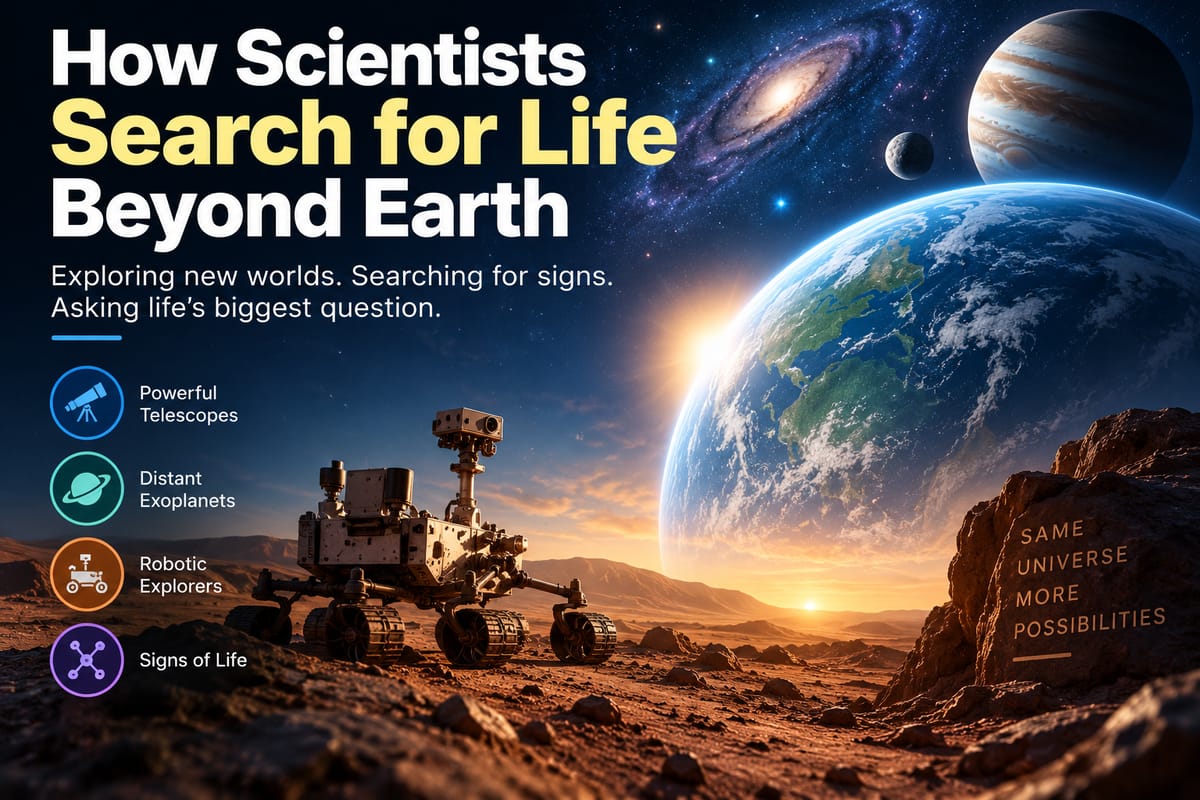
How Scientists Search for Life Beyond Earth
For centuries, humans have looked into the night sky and wondered whether Earth is the only place where life exists. Today, that question has moved beyond philosophy and into the laboratories, observatories and spacecraft of modern science.
Scientists are searching for life beyond Earth in several different ways. They study planets orbiting distant stars, investigate potentially habitable environments within our own solar system, examine the atmospheres of distant worlds and search for chemical or physical evidence that could be associated with biological activity.
The search is not necessarily about finding little green organisms. Scientists are more likely to begin with much smaller clues: water, organic molecules, unusual atmospheric gases, chemical imbalances or geological features that could potentially be connected to life.
The challenge is determining which signals are genuinely biological and which can be explained by ordinary chemistry or geology.
What Does It Mean to Search for Life?
The scientific search for extraterrestrial life is closely connected to astrobiology, an interdisciplinary field that combines astronomy, biology, chemistry, geology, planetary science and other areas of research.
Scientists generally look for environments where life could potentially exist and for evidence that life may already have existed.
That creates two broad objectives.
The first is to identify potentially habitable environments. These are places where conditions such as liquid water, suitable temperatures and useful chemical ingredients could exist.
The second is to search for biosignatures — measurable features that could provide evidence of biological activity.
Our Complete Guide to Astrobiology and Life in Space explores this broader scientific field and the questions researchers are trying to answer.
Scientists Start With the Conditions Life Needs
Earth provides scientists with their primary example of a living world.
Life on our planet depends on a remarkable variety of conditions, but researchers often focus on several fundamental ingredients when evaluating other worlds.
These include:
- A source of energy
- Appropriate chemical elements
- A suitable environment
- A solvent such as liquid water for Earth-like life
- Sufficiently stable conditions for biological processes
However, scientists do not assume that extraterrestrial life must look exactly like life on Earth.
That distinction is important.
If researchers searched only for organisms identical to those found on our planet, they could potentially overlook forms of life that evolved under very different conditions.
Instead, scientists look for physical and chemical processes that could indicate biology.
Looking for Habitable Worlds
One of the biggest developments in the search for extraterrestrial life has been the discovery of exoplanets.
Exoplanets are planets that orbit stars beyond our Sun. Thousands have now been confirmed, revealing an enormous diversity of planetary systems.
Some are giant gas planets.
Others are rocky worlds.
Some orbit extremely close to their stars, while others travel much farther away.
Scientists are particularly interested in planets that could potentially have conditions suitable for liquid water.
The location where this might be possible is commonly called the habitable zone.
The habitable zone is not a guarantee that a planet supports life. It simply describes a region around a star where temperatures could potentially allow liquid water to exist on the surface under appropriate atmospheric conditions.
For a deeper explanation of the techniques researchers use, see How Exoplanets Are Discovered and Studied.
Studying the Atmospheres of Distant Planets
Finding a potentially habitable planet is only the beginning.
Scientists want to know what the planet is actually like.
One of the most promising approaches is studying its atmosphere.
When a planet passes in front of its star from Earth’s perspective, some of the starlight can pass through the planet’s atmosphere. Different gases absorb different wavelengths of light.
By analyzing these changes, astronomers can determine which chemicals may be present in the atmosphere.
This technique is known as transmission spectroscopy.
It can potentially reveal gases such as:
- Water vapor
- Carbon dioxide
- Methane
- Oxygen
- Ozone
- Other atmospheric molecules
The presence of a single gas does not automatically mean that life exists.
Many chemicals associated with life can also be produced through non-biological processes.
Scientists therefore pay particular attention to combinations of gases or atmospheric conditions that would be difficult to explain without biological activity.
What Are Biosignatures?
A biosignature is a feature or signal that could provide evidence of past or present life.
Scientists can look for several different types.
Atmospheric Biosignatures
Certain gases can potentially be associated with biological processes.
On Earth, for example, organisms play a major role in maintaining atmospheric concentrations of gases such as oxygen and methane.
Researchers therefore investigate whether unusual combinations of gases might indicate biological activity on another planet.
But the interpretation must be extremely careful.
A planet could potentially produce oxygen through chemical or geological processes without having life.
Chemical Biosignatures
Organic molecules are another important target.
Organic chemistry involves carbon-containing compounds, many of which are essential to life on Earth.
Finding organic molecules elsewhere would therefore be interesting, but it would not by itself prove that life exists.
Organic compounds can form naturally through non-biological processes.
Scientists must determine how the molecules formed and whether they occur alongside other evidence.
Physical Biosignatures
Scientists can also look for physical characteristics that might be difficult to explain through geology alone.
Examples could include unusual surface structures, patterns or changes in planetary environments.
These signals are particularly difficult to interpret at great distances, which is why researchers typically seek multiple independent lines of evidence.
Searching Close to Home
The search for life is not limited to distant planets.
Our own solar system contains several environments that scientists consider potentially interesting.
Mars is an obvious example.
Although Mars is cold and dry on its surface today, evidence indicates that ancient Mars once had rivers, lakes and other environments involving liquid water.
Scientists therefore investigate whether microbial life could have existed there in the distant past.
The search also extends to the icy moons of the outer solar system.
Europa, one of Jupiter’s largest moons, is believed to contain a subsurface ocean beneath its icy exterior. Saturn’s moon Enceladus also has strong evidence for a subsurface ocean and releases material into space through plumes.
These environments are scientifically fascinating because liquid water, chemical ingredients and sources of energy may exist beneath their icy surfaces.
How Robotic Spacecraft Help
Humans cannot simply travel to most potentially habitable worlds and investigate them directly.
Robotic spacecraft provide an alternative.
Mars rovers, orbiters, landers and other robotic missions allow scientists to examine planetary environments remotely or collect measurements directly from another world.
Robotic spacecraft can:
- Photograph planetary surfaces
- Analyze rocks and soil
- Measure atmospheric conditions
- Search for organic molecules
- Study radiation
- Investigate geological structures
- Collect environmental data
- Examine evidence of ancient water
Our guide to How Robotic Spacecraft Travel Through and Explore Space explains the technology behind these missions and how robotic explorers operate across enormous distances.
Mars and the Search for Ancient Life
Mars remains one of the most important destinations in astrobiology.
The planet’s ancient environment appears to have been significantly different from the cold, dry world observed today.
Evidence of ancient river channels, lake environments and water-altered minerals suggests that liquid water was present on the Martian surface billions of years ago.
That raises an important question: Could microbial life have existed when Mars was warmer and wetter?
Scientists are investigating this question by studying Martian rocks and geological formations.
Some rocks can preserve chemical or physical evidence of ancient environments, potentially providing clues about whether conditions were favorable for life.
The challenge is that finding evidence of habitability is not the same as finding evidence of life.
A planet can have water and the necessary ingredients for life without actually producing living organisms.
Why Organic Molecules Matter
Organic molecules are particularly interesting because carbon forms the molecular backbone of life as we know it.
Space missions have detected organic compounds on Mars and elsewhere in the solar system.
But this discovery needs to be placed in context.
Organic molecules can form without life.
They can be produced through chemical reactions involving rocks, water, sunlight and other environmental processes.
Scientists therefore ask more detailed questions:
- What molecules are present?
- How complex are they?
- How are they distributed?
- What geological environment contains them?
- Could non-biological chemistry explain them?
- Are there multiple independent signs pointing toward biology?
The goal is not simply to detect an interesting chemical.
It is to determine whether the complete collection of evidence supports a biological explanation.
Searching for Life in Icy Moons
Some of the most intriguing targets in the solar system may be hidden beneath layers of ice.
Europa is believed to contain a large ocean beneath its icy crust. Enceladus also appears to have a subsurface ocean, and material from that environment is ejected into space.
These worlds are particularly interesting because scientists suspect that liquid water may interact with rock beneath the ice.
On Earth, environments where water interacts with minerals can provide chemical energy that supports life.
Deep oceans, hydrothermal environments and other extreme habitats demonstrate that life does not necessarily require sunlight.
This expands the possibilities for where extraterrestrial life could potentially exist.
Instead of looking only at planets with Earth-like surfaces, scientists can investigate hidden oceans and other environments where microorganisms might survive.
Scientists Also Study Extreme Life on Earth
Earth itself serves as a natural laboratory.
Scientists study organisms known as extremophiles, which can survive conditions that would be hostile to many other forms of life.
Some microorganisms tolerate extreme heat.
Others survive in highly acidic environments, intense pressure, salty conditions or places with very little available energy.
Studying these organisms helps researchers understand the limits of life.
It also changes assumptions about what kinds of environments might be considered habitable elsewhere.
If life on Earth can survive in environments once thought to be impossible, similar environments on other worlds may deserve closer attention.
The Search for Technological Life
Not every search for extraterrestrial intelligence focuses on biological organisms.
Some researchers are interested in detecting evidence of advanced technological civilizations.
This area is often associated with the search for extraterrestrial intelligence, or SETI.
Instead of looking for microbes, researchers may search for signals or technological signatures that could indicate the presence of an advanced civilization.
Radio signals have historically been an important target.
Scientists can also consider other potential technosignatures, such as unusual electromagnetic emissions or other observations that could be difficult to explain through natural processes.
The challenge is enormous.
The universe contains an extraordinary number of stars and planets, while signals from distant civilizations could be extremely weak or difficult to distinguish from natural astronomical phenomena.
Why Finding Life Is So Difficult
The universe is vast.
Even the closest stars beyond our solar system are separated from Earth by distances that make direct exploration extremely difficult with current technology.
That means many searches must rely on remote observations.
Remote observation creates another problem: ambiguity.
A telescope might detect a chemical that could potentially be produced by life.
But scientists must determine whether geology, atmospheric chemistry or another non-biological process could produce the same signal.
This is why extraordinary claims require multiple lines of evidence.
Researchers generally want observations that can be independently confirmed and explanations that survive attempts to rule out alternative possibilities.
Astronomy Provides the Foundation
The search for life is built on many of the same observational techniques used throughout astronomy.
Scientists first need to understand stars, planets, galaxies, planetary systems and the physical processes that shape them.
Astronomy also provides the tools needed to measure the light, motion, temperature and composition of distant objects.
Readers who want to understand the broader scientific discipline can explore The Complete Guide to Astronomy.
Understanding ordinary planetary and stellar processes is especially important because scientists need to distinguish unusual observations from normal natural phenomena.
The Role of Powerful Space Telescopes
Modern space telescopes have significantly expanded scientists’ ability to study distant worlds.
Large observatories can collect faint light from objects billions of light-years away and separate that light into different wavelengths.
For exoplanet research, this can provide information about planetary atmospheres, temperatures and chemical composition.
The process is technically challenging.
A planet is typically much fainter than the star it orbits, meaning scientists must extract an extremely small signal from a much brighter source.
Even when an atmospheric molecule is detected, researchers must carefully model the planet’s atmosphere and consider alternative explanations.
That combination of observation, laboratory science and computer modeling is central to modern astrobiology.
What Would Count as Strong Evidence?
Scientists are unlikely to declare that extraterrestrial life has been discovered based on one ambiguous observation.
Instead, researchers would look for a pattern of evidence.
A particularly compelling discovery might involve several independent observations showing:
- A potentially habitable environment exists.
- Relevant chemical ingredients are present.
- A possible biological signature has been detected.
- Non-biological explanations have been investigated.
- The observation can be independently reproduced or confirmed.
- Multiple scientific teams reach compatible conclusions.
The more independent evidence that points toward the same explanation, the stronger the case becomes.
This cautious approach may seem slow, but it is essential.
A false discovery would be scientifically significant, but so would a genuine detection of life beyond Earth.
Could Life Look Completely Different?
One of the biggest unanswered questions is whether extraterrestrial life would resemble life on Earth.
All known organisms share fundamental characteristics because they evolved from common biological ancestry.
But life elsewhere may have followed a completely different evolutionary path.
Scientists therefore distinguish between searching for life as we know it and searching for life as it could potentially be.
This is one reason astrobiology is not simply a search for Earth-like planets.
Researchers are increasingly interested in environments that challenge traditional assumptions about habitability.
The search could ultimately reveal that life is widespread, extraordinarily rare or fundamentally different from what scientists currently expect.
Artificial Intelligence Is Becoming Part of the Search
The enormous amount of astronomical data produced by modern telescopes creates another challenge.
Researchers cannot manually examine every signal, image or spectrum.
Machine-learning systems can help identify patterns, classify astronomical objects and prioritize observations for further investigation.
AI can potentially help scientists search large datasets for unusual signals that might otherwise be difficult to identify.
However, AI does not eliminate the need for human scientific judgment.
An algorithm can identify something unusual without explaining what caused it.
Researchers still need to determine whether an observation represents a genuine biological signal, an instrumental artifact, a natural astronomical phenomenon or something else entirely.
What Happens If Scientists Find Life?
The discovery of extraterrestrial life would be one of the most significant scientific developments in human history.
But the response would depend heavily on what was discovered.
Finding evidence of ancient microbial life on Mars would answer one set of questions.
Detecting microbial life beneath the ice of an ocean moon would raise another.
Discovering independent life elsewhere in the universe would have an even broader implication: life would not be unique to Earth.
And detecting evidence of an advanced technological civilization would represent an entirely different scientific and societal event.
In every case, scientists would need to verify the evidence carefully before making definitive claims.
The Search Is Just Beginning
Humanity has only recently developed the technology capable of seriously investigating whether life exists beyond Earth.
Scientists are searching in multiple directions at once: examining Mars, studying icy moons, discovering and characterizing exoplanets, analyzing planetary atmospheres and listening for potential technological signals.
No confirmed evidence of extraterrestrial life has yet established that life exists beyond Earth.
But the search itself is becoming increasingly sophisticated.
Every new planet discovered, every unusual molecule detected and every spacecraft sent to a distant world adds another piece to the puzzle.
The most important breakthrough may eventually come not from a single spectacular signal, but from several independent observations that together become difficult to explain without biology.
The Biggest Question in the Night Sky
The search for life beyond Earth is ultimately a search for our place in the universe.
Scientists are no longer limited to asking whether another world looks like Earth. They can examine distant atmospheres, analyze planetary chemistry, study ancient environments and send robotic explorers into some of the most promising locations in our solar system.
The evidence may take decades to assemble, and some questions may remain unanswered for generations.
But with every new telescope observation and every robotic mission, humanity is getting better at asking the right question: where could life exist, what evidence would it leave behind, and how can we distinguish that evidence from the ordinary workings of nature?
Those questions are turning the ancient mystery of whether we are alone into one of the most ambitious scientific investigations ever undertaken.


2 Comments
Micle harison
June 7, 2019Lorem ipsum dolor sit amet, usu ut perfecto postulant deterruisset, libris causae volutpat at est, ius id modus laoreet urbanitas. Mel ei delenit dolores.
John Doe
June 7, 2019Some consultants are employed indirectly by the client via a consultancy staffing company.