
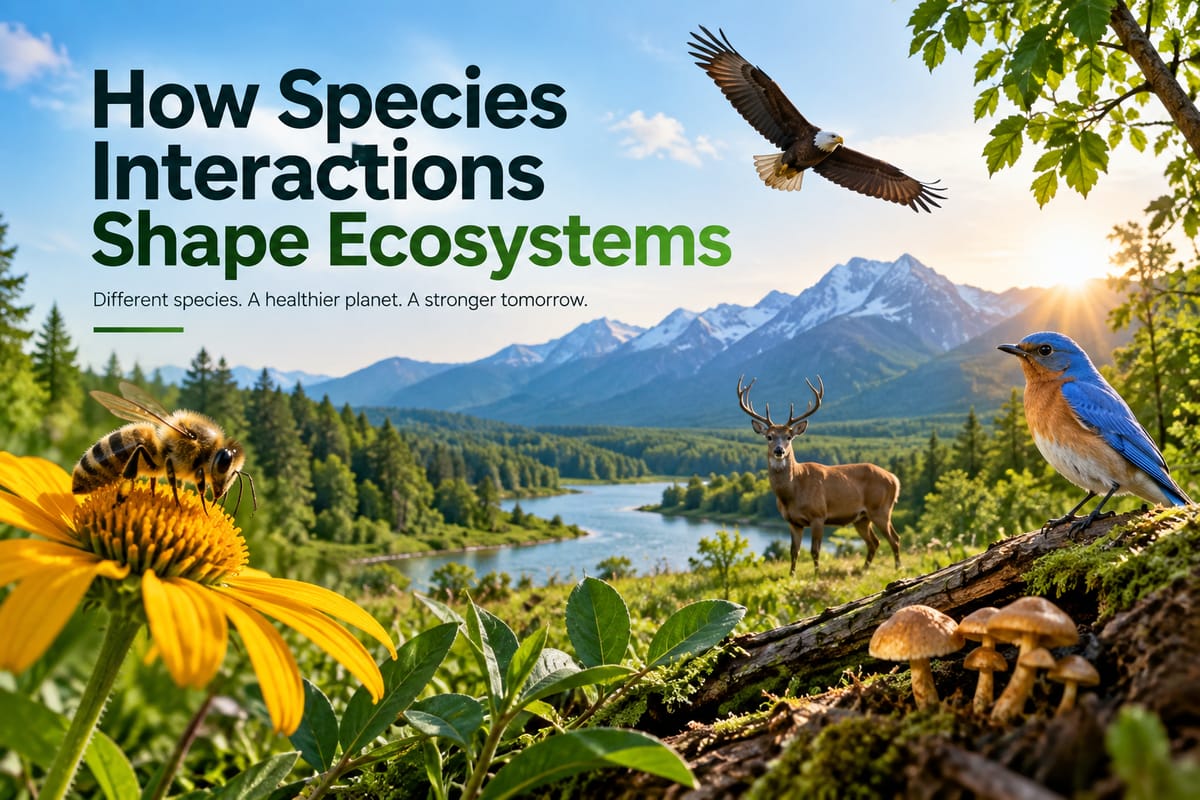
How Species Interactions Shape Ecosystems
Ecosystems are often described as networks of living organisms and their physical surroundings, but the connections between species are what truly make those systems function. Plants, animals, fungi, bacteria and other organisms constantly interact with one another, competing for resources, cooperating for mutual benefit, consuming other organisms and sometimes simply sharing space.
These relationships can influence everything from population sizes and nutrient cycling to plant reproduction and the stability of entire habitats. A change involving one species can sometimes spread through an ecosystem, producing effects far beyond the organisms directly involved.
Understanding these interactions helps explain why ecosystems can remain relatively stable for long periods—and why they can also change rapidly when environmental conditions or species populations shift.
Why Species Interactions Matter
No species exists completely independently of its surroundings. Every organism needs resources such as food, water, nutrients or shelter, and many depend on other species for survival or reproduction.
For example, flowering plants may rely on insects to transfer pollen, while those insects depend on plants for nectar and other food resources. Predators influence the abundance of prey, while decomposers break down dead organisms and return nutrients to the environment.
This interconnectedness is central to how ecosystems work and stay balanced. Ecosystem balance does not mean that populations remain fixed. Instead, it reflects a constantly changing system in which different organisms and environmental processes influence one another.
Competition Shapes Who Survives
Competition occurs when organisms need the same limited resource. Species may compete for food, water, sunlight, territory, nesting sites or other necessities.
Plants growing close together, for instance, may compete for sunlight and soil nutrients. Two predators may compete for the same prey. Even members of the same species can compete when resources become scarce.
Competition can affect where species live and how abundant they become. Some organisms evolve specialized ways of obtaining resources, allowing them to occupy ecological niches that reduce direct competition.
This process contributes to the diversity of life found within many ecosystems. A habitat with numerous species can contain organisms that use different resources or occupy different ecological roles, creating a complex network of interactions.
Predators Can Reshape Entire Communities
Predation is one of the most visible species interactions. A predator consumes another organism, but its influence can extend beyond the individual prey it catches.
If predators reduce the population of a particular herbivore, for example, plants eaten by that herbivore may become more abundant. More vegetation can then provide additional food or shelter for other organisms.
These cascading effects are sometimes called trophic cascades. They demonstrate how changes at one level of a food web can influence organisms several steps away.
The relationships become easier to understand when viewed as interconnected networks rather than simple chains. Our guide to how Earth’s food webs work explores how energy and nutrients move between organisms and why these connections matter for ecosystem stability.
Mutualism Creates Benefits for Both Species
Not every interaction involves competition or consumption. In mutualism, two species interact in ways that benefit both.
Pollination provides a familiar example. Bees and other pollinators obtain food from flowers, while flowering plants benefit when pollen is transferred between flowers.
Another important relationship occurs between plants and certain fungi in the soil. Mycorrhizal fungi can help plants obtain water and nutrients, while the fungi receive carbohydrates produced by the plants.
Mutualistic relationships can become essential parts of ecosystem functioning. If one partner declines dramatically, organisms that depend on the relationship may also face difficulties.
Parasitism Has a Different Balance
Parasites benefit from relationships in which their hosts are harmed. Ticks feeding on mammals, for example, obtain resources from their hosts while potentially affecting host health.
Parasites are not necessarily ecosystem destroyers. They are part of natural ecological networks and can influence population sizes, behavior and competition among species.
Because parasites often interact with particular hosts, changes in host populations can affect parasite populations as well. This creates another layer of interconnectedness within ecosystems.
Herbivores Influence Plant Communities
Herbivory—the consumption of plants by animals—is another major force shaping ecosystems.
Large grazing animals can influence vegetation structure by feeding on particular plants. In some environments, grazing can prevent certain species from becoming dominant and create opportunities for other plants to grow.
At the same time, excessive herbivory can damage vegetation and prevent plants from regenerating. The outcome depends on factors such as herbivore abundance, plant growth rates, climate and the availability of alternative food sources.
These relationships show why simply counting individual species is not enough to understand an ecosystem. The strength and nature of interactions between species can be just as important as the number of species present.
Decomposers Keep Nutrients Moving
Some of the most important ecological interactions happen out of sight.
Fungi, bacteria and other decomposers break down dead plants and animals. In doing so, they help release nutrients that can become available to plants and other organisms.
Without decomposition, organic material would accumulate and essential nutrients would become increasingly difficult to recycle.
Decomposers therefore connect different stages of an ecosystem’s biological processes. Nutrients absorbed by plants can eventually move through herbivores and predators before returning to soil or water through waste and decomposition.
Biodiversity Adds More Connections
The greater the variety of organisms in an ecosystem, the more potential relationships exist among them. This is one reason biodiversity explained is such an important part of understanding ecosystem health.
Biodiversity includes more than simply the number of species. It also encompasses genetic diversity within species and the variety of ecosystems and ecological communities.
A diverse ecosystem may contain numerous predators, prey, pollinators, decomposers, competitors and mutualistic partners. If one population declines, other organisms may sometimes partially compensate for the lost ecological function.
However, biodiversity does not guarantee that an ecosystem will withstand every disturbance. Severe habitat destruction, invasive species, pollution, climate shifts and other pressures can disrupt many interactions simultaneously.
When One Species Changes, Others Can Follow
Species interactions help explain why ecological changes can spread through a community.
Imagine that a predator population falls sharply because of habitat loss. Its prey may increase. That increase could place greater pressure on plants or smaller animals. Reduced vegetation could then affect insects, birds and other organisms that depend on those plants.
The reverse can also happen. A decline in a major food source can reduce the population of animals that depend on it, potentially affecting predators farther up the food web.
This interconnected response is one reason ecologists pay close attention to keystone species. A keystone species can have an influence on its ecosystem that is disproportionately large compared with its abundance.
Invasive Species Can Disrupt Established Relationships
When a species enters an ecosystem where it did not previously occur, it can encounter a very different network of competitors, predators and prey.
Some introduced species become invasive because they reproduce rapidly, exploit resources effectively or face relatively few natural predators in their new environment.
An invasive plant, for example, may compete with native vegetation for sunlight, water and nutrients. As native plants decline, insects and other animals that depend on them may also be affected.
The resulting changes can extend through multiple levels of the ecosystem, particularly when the introduced species occupies an important ecological role.
Climate Change Is Altering Species Relationships
Environmental changes can modify species interactions even when individual species remain present.
Changing temperatures can alter the timing of flowering, migration, breeding and insect emergence. If interacting species respond at different rates, relationships that evolved over long periods may become less synchronized.
Changes in rainfall can affect plant growth and water availability. Warmer conditions can alter where species can survive, potentially bringing organisms into contact with new competitors or separating them from important partners.
Climate change therefore affects ecosystems not only by changing physical conditions but also by reshaping the relationships among organisms.
Ecosystem Stability Depends on Relationships
The stability of an ecosystem is influenced by the number, strength and flexibility of interactions among its organisms.
Some ecosystems may be able to absorb relatively small disturbances because multiple species perform similar ecological functions. Others may be more vulnerable because a particular species plays a unique and essential role.
Scientists often study interaction networks to understand these differences. Rather than looking at species in isolation, researchers examine who eats whom, who competes, who cooperates and which organisms depend on particular resources.
This network perspective can reveal vulnerabilities that would otherwise be difficult to see.
Protecting Species Interactions Matters
Conservation is not simply about keeping individual species alive. Protecting the relationships between species is also critical.
Preserving habitats can maintain feeding relationships, breeding grounds, pollination networks and predator-prey dynamics. Protecting a forest, wetland, grassland or coral reef can therefore preserve hundreds or thousands of ecological connections at once.
This broader approach is central to conservation explained: protecting nature for future generations. Effective conservation increasingly considers entire ecosystems and ecological processes rather than focusing exclusively on individual endangered species.
The Bigger Picture
Species interactions are the threads that connect an ecosystem together. Competition determines how organisms share limited resources, predators regulate populations, mutualistic relationships provide shared benefits, herbivores shape vegetation and decomposers keep nutrients circulating.
These interactions also mean that ecological change rarely stays isolated. A disturbance affecting one species can influence many others, sometimes creating a chain of consequences that changes the structure of an entire community.
The health of an ecosystem, ultimately, depends not just on which species are present but on whether the relationships among them continue to function. Protecting those connections may be one of the most important ways to preserve the resilience and diversity of Earth’s natural systems.



2 Comments
Micle harison
June 7, 2019Lorem ipsum dolor sit amet, usu ut perfecto postulant deterruisset, libris causae volutpat at est, ius id modus laoreet urbanitas. Mel ei delenit dolores.
John Doe
June 7, 2019Some consultants are employed indirectly by the client via a consultancy staffing company.