
**How Spacecraft Generate Power in Space
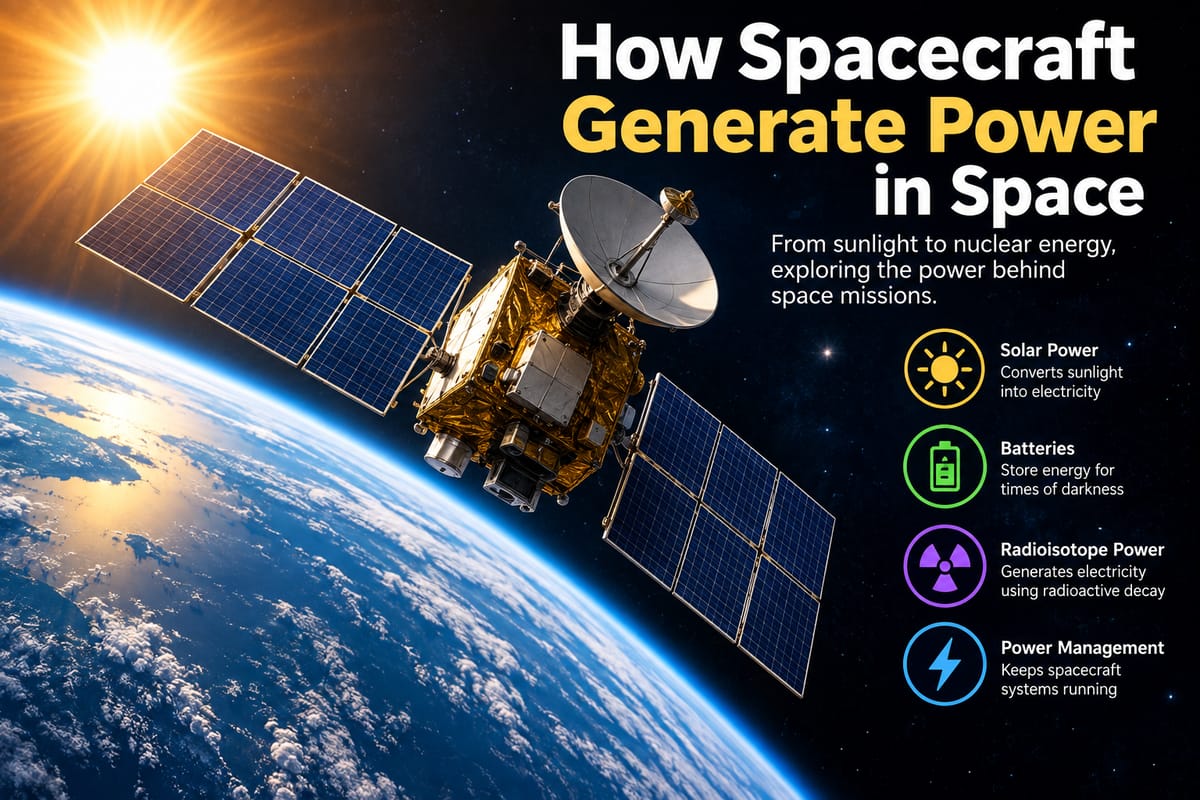
Spacecraft need electricity for almost everything they do. Computers, communication equipment, scientific instruments, heaters, propulsion systems, navigation equipment, cameras, and life-support systems all depend on a reliable supply of power.
On Earth, electrical systems can draw energy from large power grids or refuel generators. In space, spacecraft generally have to carry their own energy systems or collect energy from their surroundings. Once a spacecraft is launched, repairing or replacing its primary power source can be extremely difficult, making power generation one of the most important parts of spacecraft design.
The way a spacecraft generates electricity depends on where it travels, how long the mission lasts, how much power it needs, and what environmental conditions it will encounter.
Why Spacecraft Need Their Own Power
A spacecraft cannot simply plug into an electrical outlet after leaving Earth.
During a mission, it may need to power computers, sensors, transmitters, motors, thermal-control systems, and scientific instruments continuously or at specific times.
A spacecraft may also need electricity while it is far from Earth, where sunlight is weaker, or while it is operating in darkness.
This means mission planners must consider both how energy is generated and how it is stored and distributed.
Power systems are therefore integrated into the overall spacecraft architecture alongside communications, propulsion, navigation, thermal control, and scientific equipment.
The Complete Guide to Rockets and Spacecraft provides a broader look at the systems that allow spacecraft to launch, travel, and operate beyond Earth.
Solar Power Is the Most Common Source
For many spacecraft, the Sun is the primary source of energy.
Solar panels, technically called photovoltaic arrays, convert sunlight into electricity. When sunlight reaches photovoltaic cells, it causes the cells to generate an electrical current.
Large solar arrays can produce substantial amounts of electricity while a spacecraft is exposed to sunlight.
This makes solar power particularly useful for missions operating near Earth and throughout much of the inner Solar System.
Solar arrays can be designed in different shapes and configurations depending on the spacecraft’s size and power requirements.
How Solar Panels Produce Electricity
Solar cells use semiconductor materials to convert light energy into electrical energy.
When photons from sunlight strike the semiconductor, they can transfer energy to electrons. The movement of those electrons creates an electrical current that can be collected and used by the spacecraft.
Individual solar cells produce relatively small amounts of power, so spacecraft combine many cells into panels and larger arrays.
The electricity generated by the arrays then passes through power-management equipment that regulates voltage and distributes electricity to the spacecraft’s various systems.
Why Solar Arrays Can Become Very Large
Some spacecraft require considerably more electricity than others.
A small scientific probe may need relatively little power, while a large orbital platform can require substantial amounts of electricity to operate instruments, computers, communications systems, and other equipment.
Large solar arrays provide additional surface area for collecting sunlight.
Spacecraft designers must balance this advantage against the mass, structural complexity, and mechanical requirements of deploying and controlling large panels.
Solar arrays can also create aerodynamic and structural considerations during launch, which is why many are folded or stowed until the spacecraft reaches its operational environment.
Spacecraft Must Manage Power Carefully
Generating electricity is only part of the problem.
A spacecraft must ensure that enough power is available to its most important systems at the right time.
Power-management systems can monitor electricity production and consumption, regulate voltage, distribute energy, and protect equipment from abnormal conditions.
Mission controllers may also schedule instruments and other systems according to available power.
If a spacecraft is temporarily receiving less energy than expected, nonessential equipment may be switched off or placed into a lower-power mode.
This type of power budgeting is especially important for missions with limited energy reserves.
Batteries Store Energy for Darkness
Solar-powered spacecraft cannot rely on sunlight continuously.
A spacecraft orbiting Earth, for example, can periodically pass through Earth’s shadow. During that period, its solar arrays cannot generate electricity from direct sunlight.
Rechargeable batteries provide energy during these periods.
While the spacecraft is illuminated, its solar arrays can generate electricity for the spacecraft’s systems and recharge the batteries. When sunlight disappears, the batteries can supply the required power.
This creates a cycle of generation, storage, and consumption.
Battery capacity and durability are important because batteries may need to undergo thousands of charge and discharge cycles during a long mission.
Power Requirements Change During a Mission
A spacecraft does not necessarily use the same amount of electricity at every moment.
Power consumption can increase when:
- Scientific instruments are operating
- High-power communications are underway
- Motors are moving spacecraft components
- Heaters are activated
- Propulsion systems are operating
- Data is being processed
- Solar arrays are being repositioned
During quieter periods, power consumption may be substantially lower.
Mission planners therefore develop detailed power budgets that estimate how much energy different systems require under different operating conditions.
Distance From the Sun Matters
Solar power becomes less effective as spacecraft travel farther from the Sun.
Sunlight spreads out as it travels through space, so the amount of solar energy available decreases with increasing distance from the Sun.
A spacecraft operating near Earth receives considerably more sunlight than one operating in the outer Solar System.
This creates a major design challenge for missions traveling to distant planets.
Spacecraft can compensate by using larger solar arrays, improving the efficiency of their solar cells, reducing their power requirements, or using another energy source.
Solar Power Beyond Earth Orbit
Solar power can still be used far from Earth, but the spacecraft must be designed around the weaker sunlight.
Modern solar-powered spacecraft can operate in regions where solar energy is significantly lower than near Earth.
However, eventually there is a point where solar arrays become impractical for the required mission.
At very large distances from the Sun, another type of power system can become more useful.
Radioisotope Power Systems
Some spacecraft use radioisotope power systems, which generate electricity from the heat produced by the natural radioactive decay of certain materials.
These systems do not depend on sunlight.
A radioisotope thermoelectric generator, or RTG, uses the heat produced by radioactive decay and converts some of that heat into electrical power.
This approach can be particularly useful for missions traveling far from the Sun or operating in environments where sunlight is limited.
Radioisotope systems can also provide power for long periods, making them valuable for certain deep-space missions.
Why Radioisotope Power Is Useful in Deep Space
The biggest advantage of a radioisotope power system is that it can operate regardless of whether the spacecraft is receiving significant sunlight.
A spacecraft traveling through the outer Solar System may receive too little solar energy for conventional solar arrays to be practical.
A radioisotope system can continue producing electricity in darkness and at great distances from the Sun.
It can also provide heat that may help protect spacecraft components from extremely cold environments.
This combination of electrical power and heat makes radioisotope systems particularly useful for some deep-space missions.
Power Systems Can Produce Heat as Well as Electricity
Space is often associated with extreme cold, but spacecraft thermal management is more complicated than simply keeping everything warm.
Electronics and other equipment generate heat when they operate. Radioisotope systems also produce heat as part of their operation.
Spacecraft must control this heat because excessive temperatures can damage equipment.
At the same time, some components may become too cold if they are exposed to the space environment without sufficient heating.
Power generation and thermal control are therefore closely connected.
Electricity Must Be Distributed Throughout the Spacecraft
Once electricity has been generated or stored, it needs to reach the systems that use it.
Spacecraft contain electrical distribution networks that deliver power to computers, instruments, communications equipment, heaters, motors, and other components.
These systems can include switches, regulators, converters, protection devices, cables, and control electronics.
The power-distribution system must be reliable because a failure in the wrong location could affect multiple spacecraft functions.
Spacecraft Need Protection From Power Problems
Electrical systems can experience problems such as short circuits, voltage fluctuations, excessive current, or component failures.
Spacecraft therefore include protection mechanisms designed to isolate faults and prevent damage from spreading.
Redundancy is another important strategy.
Critical systems may have backup components so that the spacecraft can continue operating if one component fails.
The level of redundancy depends on the mission’s objectives, cost, mass limitations, and risk tolerance.
Power and Communications Are Closely Connected
A spacecraft needs electricity to communicate with Earth.
Radio transmitters and other communication equipment consume power, particularly when a spacecraft sends large quantities of scientific data across enormous distances.
Communication sessions therefore have to be considered when developing a spacecraft’s power budget.
A spacecraft may collect scientific observations for hours or days and then transmit the accumulated data during scheduled communication windows.
This requires coordination between scientific operations, onboard storage, power availability, and communications.
Robotic Spacecraft Have Different Power Needs
Robotic spacecraft can have very different energy requirements depending on their mission.
An orbiter may operate cameras, radar systems, spectrometers, communication equipment, and propulsion systems.
A lander may need heaters, scientific instruments, drills, cameras, and communications equipment while operating on a planetary surface.
A rover may additionally need electricity for motors and mechanisms that allow it to move across the surface.
The How Robotic Spacecraft Travel Through and Explore Space explains more about the technologies that allow robotic spacecraft to conduct missions across the Solar System.
Human Spaceflight Requires Much More Power Management
Crewed spacecraft have additional energy requirements because humans need a controlled environment.
Life-support equipment can require electricity for air circulation, temperature control, water processing, environmental monitoring, communications, lighting, and other functions.
A failure in the power system can therefore become much more serious when people are aboard.
Crewed missions generally require carefully designed backup systems and power reserves.
The broader challenges of keeping astronauts alive and productive in space are explored in How Humans Live and Work Safely in the Space Environment.
Solar Panels Can Degrade Over Time
Spacecraft power systems must also account for aging.
Solar cells can gradually lose performance because of radiation exposure, contamination, temperature effects, and other environmental factors.
For long-duration missions, engineers have to estimate how much electricity the solar arrays will produce not only when they are new but also years into the mission.
The spacecraft’s power requirements must remain compatible with the expected decline in generation capacity.
Spacecraft Orientation Can Affect Power Generation
Solar arrays generally produce the most electricity when they are positioned appropriately relative to the Sun.
Some spacecraft can rotate their solar arrays to maintain a favorable orientation.
Others may have fixed panels and must carefully manage their attitude to balance power generation with other requirements.
Spacecraft orientation can also affect communications, scientific observations, thermal conditions, and propulsion operations.
This means attitude control and power generation often have to be coordinated.
What Happens When a Spacecraft Enters Darkness?
When a solar-powered spacecraft enters darkness, its batteries can take over the electrical load.
The spacecraft’s control system must ensure that enough stored energy remains to operate essential systems until sunlight returns.
If the spacecraft spends an unusually long time without sunlight, energy conservation becomes particularly important.
Mission controllers may reduce the operation of nonessential instruments or place parts of the spacecraft into low-power modes.
This is one reason mission planners carefully model orbital conditions and expected periods of sunlight and darkness.
Power Systems Help Determine Mission Possibilities
The available energy can influence what a spacecraft is capable of doing.
More electrical power can allow a mission to operate more instruments, transmit more information, perform more complex computations, or conduct more demanding operations.
However, increasing power generation can also increase spacecraft mass, size, complexity, and cost.
Engineers therefore have to find a balance between power capability and the rest of the spacecraft’s design.
The Future of Spacecraft Power
Future spacecraft could use increasingly efficient solar cells, improved batteries, advanced nuclear power systems, and other energy technologies.
More efficient electronics can also reduce the amount of electricity required to perform certain tasks.
As missions venture farther from Earth and remain operational for longer periods, dependable power generation will become even more important.
This is especially true for missions operating in permanently shadowed regions, on distant worlds, or in environments where solar energy is severely limited.
Power Is the Foundation of Space Operations
Every spacecraft mission depends on energy.
Solar arrays allow many spacecraft to convert sunlight into electricity. Batteries provide energy when sunlight is unavailable. Radioisotope systems can supply power far from the Sun. Electrical distribution and control systems then deliver that energy to the computers, instruments, communications equipment, heaters, motors, and other components that keep the spacecraft functioning.
These systems may not receive as much attention as rockets or spectacular scientific instruments, but they are fundamental to space exploration.
As humanity sends spacecraft farther, operates them longer, and attempts increasingly complex missions, reliable power generation will remain one of the essential technologies determining what spacecraft can accomplish.


2 Comments
Micle harison
June 7, 2019Lorem ipsum dolor sit amet, usu ut perfecto postulant deterruisset, libris causae volutpat at est, ius id modus laoreet urbanitas. Mel ei delenit dolores.
John Doe
June 7, 2019Some consultants are employed indirectly by the client via a consultancy staffing company.