
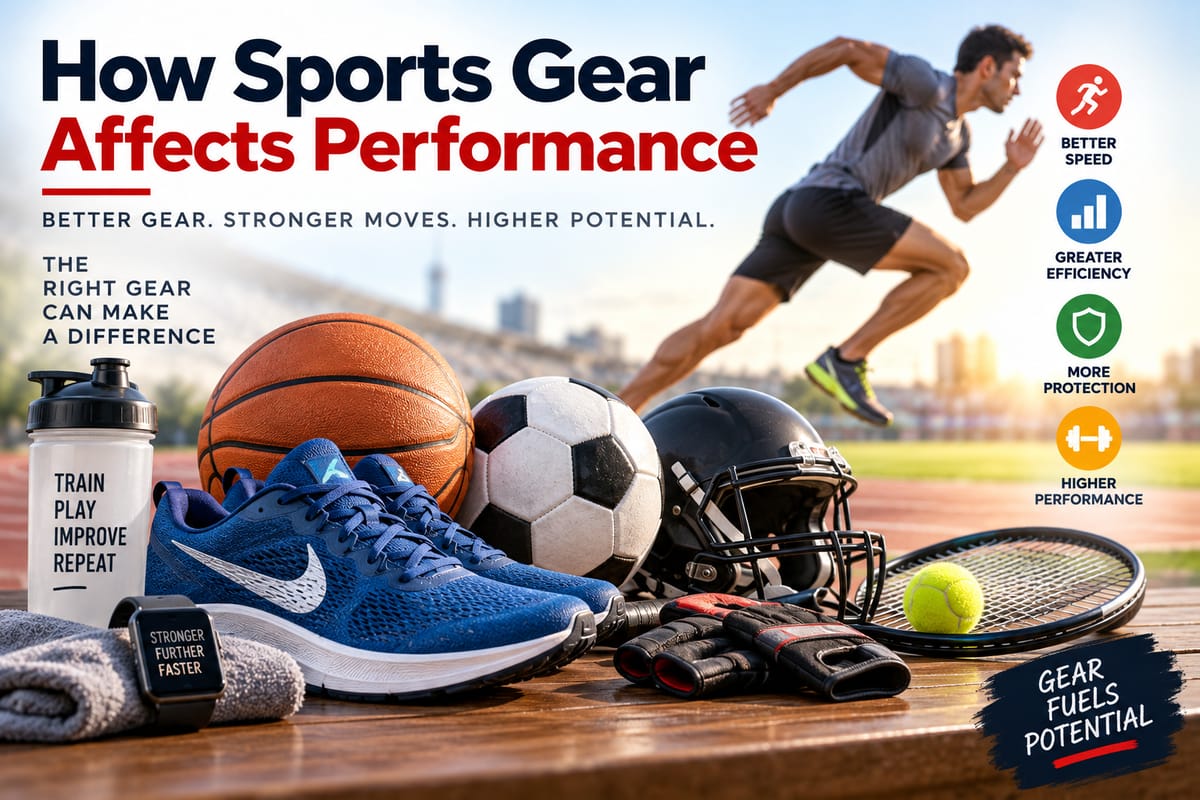
How Sports Gear Affects Performance
Sports gear is often treated as a supporting part of athletic performance, but the equipment an athlete uses can influence movement, comfort, safety, efficiency and confidence.
From running shoes and football boots to helmets, protective padding, rackets and specialized clothing, sports equipment is designed to help athletes perform specific movements under particular conditions. The right gear does not replace training or physical ability, but it can help an athlete use those abilities more effectively.
The effect can be especially noticeable in sports where small differences in traction, weight, balance, protection or aerodynamics influence how efficiently an athlete moves.
Understanding the relationship between equipment and performance also requires looking beyond the product itself. Fit, technique, physical preparation, playing conditions and the athlete’s individual needs all determine whether a particular piece of gear actually provides an advantage.
What Makes Sports Gear Important?
Sports gear serves several basic purposes.
It can help athletes:
- Perform movements more efficiently
- Protect vulnerable parts of the body
- Improve traction and stability
- Manage heat and moisture
- Reduce unnecessary discomfort
- Support specific sporting techniques
- Track training and performance
- Adapt to different playing conditions
The importance of each factor depends heavily on the sport.
A basketball player’s shoes need to provide appropriate traction and stability for repeated changes of direction. A cyclist’s helmet is primarily designed to provide protection, while the bicycle itself has a much more direct relationship with speed and movement efficiency.
For a swimmer, the properties of a swimsuit can influence drag, while a runner’s shoes affect how the athlete interacts with the ground.
The equipment therefore needs to match the demands of the activity.
Footwear Can Change Movement Efficiency
Footwear is among the most influential pieces of equipment for many athletes because the feet provide the connection between the body and the playing surface.
Running shoes, football boots, basketball shoes and court shoes are designed for different movement patterns.
A running shoe may emphasize cushioning, stability and efficient forward movement. A basketball shoe needs to accommodate jumping, landing and rapid lateral movement. Football boots need to provide traction while allowing players to accelerate, stop and change direction on grass or artificial surfaces.
The wrong footwear can interfere with movement by providing inadequate traction, excessive weight or an unsuitable fit.
Proper footwear can also make movement feel more predictable. When an athlete trusts the interaction between the shoe and the surface, they can focus more completely on executing the movement.
Traction Affects Acceleration and Direction Changes
Traction determines how effectively an athlete can apply force against the ground without slipping.
This becomes particularly important in sports involving acceleration, deceleration and rapid changes of direction.
An athlete needs enough grip to transfer force into the ground. However, extremely high traction is not automatically beneficial in every situation. The interaction between the shoe and surface needs to be appropriate for the movement and environment.
For example, footwear designed for natural grass may perform differently on artificial turf, indoor courts or wet surfaces.
The design of the sole, tread pattern and materials all influence this interaction.
Equipment and Sports Biomechanics
Sports performance is closely connected to biomechanics, which examines how the body produces and controls movement.
How Sports Biomechanics Explains Human Movement provides a useful foundation for understanding why equipment design matters.
Every athletic movement involves forces, joint positions, balance and coordination. Equipment interacts with those factors.
A shoe changes how force is transferred between the foot and the ground. A racket affects how force is transferred from the athlete’s arm into the ball. Protective equipment can change the distribution of forces during collisions.
Even seemingly small design changes can therefore influence how an athlete moves.
Weight Can Influence Energy Use
The weight of sports equipment can affect how much effort an athlete needs to move it.
In endurance sports, carrying unnecessary weight can increase the physical demand of repeated movement. Lightweight equipment may therefore be valuable when it maintains the necessary strength, durability and protection.
However, lighter does not automatically mean better.
An athlete may need equipment with additional structure, cushioning or protection even if that equipment weighs slightly more.
The ideal balance depends on the sport and the athlete’s priorities.
A marathon runner, for example, may place considerable emphasis on minimizing unnecessary weight. A hockey player needs equipment that provides meaningful protection even though protective gear adds weight.
Protective Equipment Can Support Confident Movement
Protective equipment has an obvious role in reducing injury risk, but its influence on performance can extend further.
Helmets, mouthguards, shin guards, padding and other protective equipment allow athletes to participate in activities involving physical contact or high-speed movement while providing a degree of protection.
When properly fitted, protective equipment can also allow athletes to move with greater confidence.
That does not mean protective equipment eliminates injury risk. No piece of equipment can guarantee complete protection.
Instead, equipment forms one part of a broader approach that includes proper technique, conditioning, rules, recovery and appropriate coaching.
Fit Matters as Much as Design
A technically advanced piece of equipment may provide little benefit if it does not fit the athlete properly.
Shoes that are too tight can create discomfort and affect movement. Protective equipment that shifts during activity can become distracting. Clothing that restricts movement can interfere with technique.
Fit is particularly important because athletes have different body shapes, movement patterns and preferences.
Equipment should therefore be evaluated based not only on specifications but also on how it performs when the athlete actually moves.
An item that looks impressive in a product description may not necessarily be suitable for a particular athlete.
Clothing Can Affect Temperature and Comfort
Sports clothing plays an important role in managing the athlete’s environment.
During exercise, the body produces heat and sweat. Clothing can influence how effectively heat and moisture are managed.
Lightweight and breathable fabrics can help athletes remain more comfortable in warm conditions, while insulating layers can help retain heat in cold environments.
Clothing also needs to permit unrestricted movement.
A runner, swimmer, cyclist and football player may have completely different requirements because their movements and environmental conditions differ.
Comfort matters because distractions can interfere with concentration. An athlete who is constantly adjusting clothing or dealing with uncomfortable equipment may have difficulty focusing on technique and competition.
Equipment Can Influence Technique
Sports gear does not simply respond to an athlete’s movement. In some cases, it can influence how the movement is performed.
A tennis racket has characteristics such as weight, balance, head size and string configuration that influence how the player generates and controls shots.
A golf club’s length, loft and shaft characteristics affect how the golfer interacts with the ball.
A bicycle’s geometry and setup influence the rider’s position and control.
This does not mean equipment automatically creates better technique.
Instead, equipment interacts with the technique an athlete already possesses.
A well-matched piece of equipment can complement an athlete’s movement pattern, while poorly matched equipment may make certain movements more difficult.
Training Still Comes First
Equipment can support performance, but it cannot substitute for physical preparation.
Strength, endurance, mobility, coordination, technique and recovery remain fundamental components of athletic development.
How Strength and Conditioning Improves Athletic Performance explains why physical preparation provides the foundation that allows athletes to use their equipment effectively.
Consider a pair of high-performance running shoes. They cannot compensate for inadequate running mechanics, insufficient conditioning or poor recovery.
Likewise, an advanced racket cannot replace the practice required to develop accurate strokes.
The relationship works in the opposite direction: training develops the athlete’s physical and technical abilities, while suitable equipment can help that athlete apply those abilities effectively.
Gear Should Match the Sport
One of the most common mistakes is assuming that equipment can be judged independently of the activity.
Sports place different demands on the body.
Running
Running equipment generally emphasizes comfort, weight, traction and the interaction between the foot and running surface.
Basketball
Basketball footwear and protective equipment need to support jumping, landing, lateral movement and repeated acceleration and deceleration.
Football
Football equipment must accommodate running, ball control, changes of direction and physical contact. Footwear also needs to match the playing surface.
Cycling
The bicycle itself becomes a major component of performance. Position, frame geometry, gearing, wheel characteristics and rider fit can all influence efficiency.
Swimming
Swimsuits, goggles and caps are designed around movement through water, where drag and body position are particularly important.
Racket Sports
Racket weight, balance, grip size and string characteristics can affect control and the way force is transferred into the ball or shuttlecock.
These examples show why there is no universal definition of the “best” sports equipment.
Technology Is Changing Sports Gear
Modern sports equipment increasingly incorporates technology.
Wearable devices can track heart rate, distance, speed, acceleration and other measurements. Smart equipment can provide athletes and coaches with information that was previously difficult to collect.
GPS trackers, motion sensors and connected devices can help athletes analyze training sessions and identify patterns.
The growing role of data has also changed the relationship between equipment and performance analysis.
A Complete Guide to Sports Performance Analysis explains how performance information can be used to examine athletic actions, identify patterns and support training decisions.
Technology can therefore make equipment more than a physical tool. In some cases, it becomes a source of performance information.
Data Can Help Athletes Evaluate Equipment
Athletes can use performance data to assess whether a change in equipment is actually making a meaningful difference.
For example, a runner might compare pace, heart rate and perceived effort across similar training sessions. A cyclist can examine power output, speed and cadence. A golfer can use launch-monitor data to examine ball speed, launch angle and distance.
The purpose is not necessarily to chase the most expensive equipment.
Instead, data can help separate measurable changes from assumptions.
An athlete may discover that a new piece of equipment provides a meaningful benefit, while another expensive upgrade produces little noticeable difference.
Comfort Can Affect Concentration
Performance is not entirely physical.
Athletes need to maintain concentration, make decisions and respond quickly to changing situations.
Equipment that causes discomfort can become a distraction.
A loose shoe, poorly fitting helmet, uncomfortable mouthguard or restrictive garment can repeatedly draw an athlete’s attention away from the activity.
Comfort does not guarantee better performance, but reducing unnecessary distractions can help athletes focus on execution.
This is particularly important during long competitions or training sessions where small sources of discomfort can become increasingly noticeable.
Confidence and Familiarity Matter
Athletes also develop familiarity with their equipment.
A player who has trained extensively with a particular racket, pair of shoes or set of clubs understands how that equipment responds.
Changing equipment immediately before competition can therefore introduce uncertainty even if the replacement is technically advanced.
Athletes often benefit from testing new equipment during training before relying on it in important competition settings.
Familiarity allows the athlete to understand how the equipment behaves during different movements and conditions.
Expensive Gear Is Not Always Necessary
The sports-equipment market includes products at a wide range of prices.
Higher-priced equipment may incorporate advanced materials, specialized construction or additional features. But those features are not necessarily useful for every athlete.
Equipment should be selected according to the athlete’s needs, experience, sport and budget.
A beginner may gain more from learning proper technique and developing physical conditioning than from purchasing professional-level equipment.
Similarly, an experienced athlete should consider whether a new product addresses a specific performance need rather than assuming a higher price automatically means better results.
Maintenance Can Preserve Equipment Performance
Sports gear also needs proper maintenance.
Shoes eventually lose cushioning or traction. Protective equipment can deteriorate. Rackets may require restringing. Bicycles require regular mechanical attention.
Ignoring maintenance can reduce the performance and safety characteristics of equipment.
Athletes should follow manufacturer care instructions and regularly inspect gear for damage or excessive wear.
Replacing equipment when it is no longer performing its intended function can be more important than constantly upgrading to the newest model.
Individual Needs Should Guide Equipment Choices
Athletic performance depends on a combination of factors rather than a single piece of equipment.
Understanding Athletic Performance Principles helps put equipment into that broader context.
Training, nutrition, sleep, recovery, technique, psychology and physical characteristics all interact with equipment.
The same product may work extremely well for one athlete and poorly for another.
Body structure, experience, playing style and previous injuries can all influence equipment requirements.
That is why athletes should think about equipment as part of an overall performance system rather than as an independent shortcut to improvement.
How Athletes Can Choose Gear More Effectively
A practical equipment-selection process can begin with a few simple questions:
- What demands does the sport place on the body?
- What movements are most important?
- What type of surface or environment will the equipment be used in?
- Does the equipment fit properly?
- Does it provide the required protection?
- Is it comfortable during extended use?
- Does it complement the athlete’s technique?
- Is the technology actually useful for the athlete’s goals?
- Can the equipment be maintained easily?
- Does the cost make sense relative to the expected benefit?
Answering these questions can help athletes avoid choosing equipment simply because it is marketed as high-performance.
The Right Gear Supports the Athlete, Rather Than Replacing Them
Sports gear can affect performance in many ways, from traction and movement efficiency to protection, comfort and data collection.
Its influence is particularly important when equipment interacts directly with athletic movement. Footwear affects how athletes transfer force into the ground. Rackets and clubs influence how force is transferred to sporting objects. Protective equipment can allow athletes to participate more safely, while clothing can help manage environmental conditions.
But equipment works best when it is matched to the athlete and supported by proper preparation.
Training develops the physical and technical qualities needed for performance. Biomechanics helps explain how equipment interacts with movement. Performance analysis can reveal whether equipment changes produce measurable differences. Technology can provide additional information, while proper fit and maintenance help ensure that equipment continues to perform as intended.
Ultimately, effective sports gear is not simply about buying the newest or most expensive product. It is about choosing equipment that fits the demands of the sport, complements the athlete’s abilities and helps them perform their movements with greater efficiency, comfort and confidence.



2 Comments
Micle harison
June 7, 2019Lorem ipsum dolor sit amet, usu ut perfecto postulant deterruisset, libris causae volutpat at est, ius id modus laoreet urbanitas. Mel ei delenit dolores.
John Doe
June 7, 2019Some consultants are employed indirectly by the client via a consultancy staffing company.